

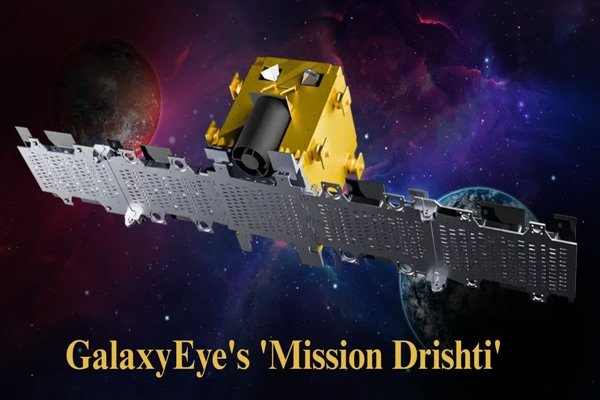
In May 2026, India marked a major milestone in its space journey with the launch of Mission Drishti, a groundbreaking Earth observation satellite developed by Bengaluru-based startup GalaxEye. Launched aboard a SpaceX Falcon 9 rocket from California, the mission represents a leap forward not only for India’s private space sector but also for global satellite imaging technology.
What is Mission Drishti?
Mission Drishti is the world’s first “OptoSAR” satellite—a unique Earth observation system that combines optical imaging and Synthetic Aperture Radar (SAR) on a single platform.
Traditionally, satellites use either optical cameras (which need daylight and clear skies) or radar systems (which work in all weather but offer different types of data). Drishti merges both technologies, enabling it to capture high-resolution images of the same location simultaneously, regardless of weather or time of day.
Key Features and Technology
●OptoSAR Payload: Integrates a high-resolution SAR sensor with a multi-spectral optical imager on one satellite.
●All-weather, 24/7 Imaging: Unlike traditional satellites, it can “see” through clouds, rain, and darkness.
●High Resolution (~1.8 m): Provides detailed, analysis-ready data for multiple applications.
●AI-enabled Processing: Data processing is enhanced with onboard artificial intelligence for faster insights.
Weighing around 190 kg, Drishti is also India’s largest privately built Earth observation satellite to date.
Why is it Important?
Mission Drishti addresses a long-standing limitation in satellite imaging—reliance on weather and daylight. By combining optical clarity with radar reliability, it creates a continuous, dependable stream of Earth data.
Its applications are vast and impactful:
●Disaster management: Monitoring floods, cyclones, and earthquakes in real time
●Agriculture: Crop health analysis and yield prediction
●Urban planning: Mapping infrastructure and land use
●Defence & surveillance: Strategic monitoring and national security
●Environmental monitoring: Tracking deforestation, climate change, and pollution
A Boost for India’s Private Space Sector
Mission Drishti is more than just a satellite—it symbolizes the rise of private players in India’s space ecosystem. Supported by institutions like IN-SPACe, startups like GalaxEye are now contributing cutting-edge innovations alongside traditional agencies.
Prime Minister Narendra Modi hailed the mission as a “major achievement” and a testament to India’s growing technological prowess and youth-driven innovation.
Conclusion
Mission Drishti sets a new benchmark in Earth observation by introducing a powerful, hybrid imaging system that works anytime, anywhere. As the world increasingly depends on accurate geospatial intelligence, this pioneering OptoSAR satellite places India at the forefront of next-generation space technology—signaling a future where private innovation plays a central role in exploring and understanding our planet.