

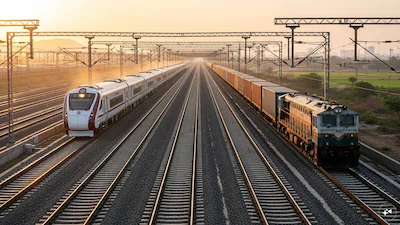
In a significant boost to India’s transport infrastructure, the Union Cabinet has approved three major railway multi-tracking projects worth ₹23,437 crore. The decision, taken by the Cabinet Committee on Economic Affairs (CCEA) chaired by Prime Minister Narendra Modi, aims to enhance capacity, reduce congestion, and strengthen connectivity across key regions of the country.
Key Highlights of the Projects
The approved projects span six states—Madhya Pradesh, Rajasthan, Uttar Pradesh, Karnataka, Andhra Pradesh, and Telangana—covering 19 districts.
Together, they will expand the Indian Railways network by approximately 901 kilometres, making a substantial addition to the existing infrastructure.
The three major corridors included in the approval are:
●Nagda–Mathura (3rd & 4th lines)
●Guntakal–Wadi (3rd & 4th lines)
●Burhwal–Sitapur (3rd & 4th lines)
These projects focus on adding additional railway lines (multi-tracking) along heavily used routes, which currently face congestion due to high passenger and freight traffic.
Objectives and Importance
The primary goal of these projects is to decongest busy rail corridors and improve operational efficiency. Multi-tracking allows more trains to run simultaneously, reducing delays and enhancing service reliability.
The initiative is aligned with the government’s PM Gati Shakti National Master Plan, which aims to create integrated, seamless, and efficient infrastructure across sectors.
Benefits for People and Economy
The impact of these projects is expected to be wide-ranging:
●Improved Connectivity: Around 4,161 villages, with a population of nearly 83 lakh people, will benefit from better rail access.
●Boost to Freight Movement: Enhanced capacity will facilitate faster and more efficient transportation of goods, lowering logistics costs.
●Regional Development: Improved rail links will support economic growth, tourism, and access to markets and services.
●Access to Key Destinations: The corridors connect important cultural and tourist hubs such as Mathura, Vrindavan, and major national parks.
Timeline and Implementation
The projects are slated for completion by 2030–31, indicating a long-term infrastructure development strategy aimed at meeting future transport demands.
Strategic Significance
Indian Railways is one of the largest rail networks in the world, and increasing capacity is essential to keep pace with growing passenger demand and freight requirements. These projects will not only enhance efficiency but also contribute to environmental sustainability by encouraging rail-based transport over roadways.
Conclusion
The approval of ₹23,437 crore railway projects marks another major step in modernising India’s rail infrastructure. By focusing on multi-tracking and connectivity, the government aims to build a faster, more efficient, and future-ready railway network—one that supports economic growth while improving everyday travel for millions of citizens.