

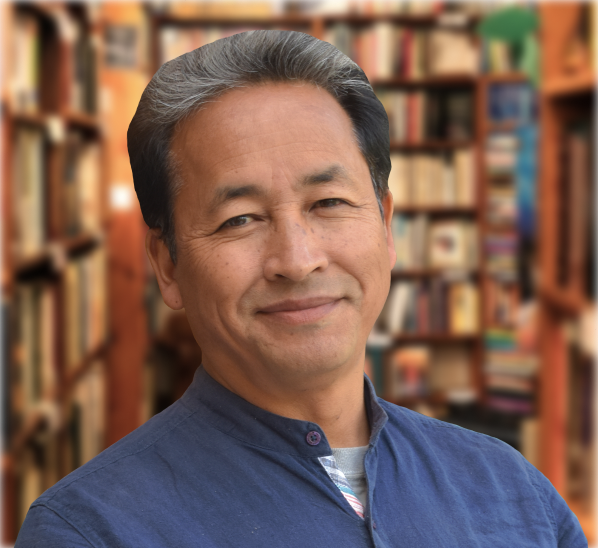
From designing sustainable buildings in the Himalayas to promoting education in local languages, Sonam Wangchuk has emerged as one of India’s most inspiring innovators. His work proves that science, technology, and environmental conservation can go hand in hand.
In the high-altitude region of Ladakh, where winters are harsh and resources are limited, one man has spent decades finding practical solutions to everyday challenges. Engineer, education reformer, environmentalist, and innovator Sonam Wangchuk is widely known for transforming local problems into globally admired innovations.
Recently, Wangchuk has once again been in the spotlight. Following allegations surrounding the NEET examination, he launched a prolonged hunger strike demanding accountability from the government. Even while making headlines for his activism, his remarkable contributions to education, sustainability, and climate action continue to inspire millions.
Who is Sonam Wangchuk?
Born on 1 September 1966 in Uleytokpo village of Leh, Ladakh, Sonam Wangchuk studied Mechanical Engineering at the National Institute of Technology (formerly Regional Engineering College), Srinagar. Growing up in a remote Himalayan region exposed him to the challenges faced by mountain communities, shaping his lifelong mission of creating locally relevant and sustainable solutions.
He is the founder of the Students’ Educational and Cultural Movement of Ladakh (SECMOL), an alternative educational institution that focuses on experiential learning, practical skills, sustainability, and innovation.
Wangchuk gained international recognition after the character Phunsukh Wangdu in the Bollywood film 3 Idiots was inspired in part by his life and educational philosophy.
A Polyglot with a Passion for Local Languages
Sonam Wangchuk is fluent in nine languages, reflecting both his multicultural upbringing and commitment to education.
The languages he is known to speak include:
Ladakhi
Hindi
English
Urdu
Tibetan
French
Swedish
Spanish
Italian
Beyond speaking multiple languages, Wangchuk has advocated for teaching subjects such as science and mathematics in Ladakhi, arguing that children learn concepts more effectively when educated in their mother tongue.
Innovation Rooted in Nature
Unlike many innovators who focus on advanced laboratories, Wangchuk believes the best solutions often come from understanding nature.
Ice Stupa Project
His most celebrated innovation is the Ice Stupa, an artificial glacier that stores winter water in the form of towering ice cones. As temperatures rise in spring, the slowly melting ice provides water for irrigation when farmers need it the most. The project has become a global model for climate adaptation in mountain regions.
Passive Solar Buildings
Another pioneering contribution is the development of passive solar-heated buildings. Using local materials such as mud, stone, and wood, these structures remain warm during freezing Himalayan winters without relying heavily on electricity or conventional heating systems. Some of these buildings maintain indoor temperatures around 15°C even when outside temperatures fall to -15°C or lower, significantly reducing energy consumption.
Sustainable Architecture
Wangchuk strongly promotes eco-friendly construction using traditional materials and indigenous knowledge. His designs demonstrate that modern engineering and traditional wisdom can complement each other while reducing environmental impact.
Transforming Education
Through SECMOL, Wangchuk has reimagined education for rural students. Instead of rote learning, the institution emphasizes problem-solving, creativity, entrepreneurship, renewable energy, and self-reliance. Students actively participate in running the campus, making it a living laboratory for sustainable development.
His educational philosophy encourages young people to become job creators rather than job seekers.
Awards and Recognition
Sonam Wangchuk’s work has received global acclaim. He has been featured by TIME Magazine among influential climate leaders and has received several prestigious international honours, including the Rolex Award for Enterprise (2016) and the Ramon Magsaysay Award (2018), often regarded as Asia’s Nobel Prize.
Beyond Innovation: A Voice for Ladakh
In recent years, Wangchuk has also emerged as a prominent public advocate for environmental protection and constitutional safeguards for Ladakh. Through peaceful protests, awareness campaigns, and public engagement, he has consistently highlighted issues such as ecological conservation, sustainable development, and responsible governance in the fragile Himalayan ecosystem.
A Visionary for the Future
Sonam Wangchuk’s journey illustrates that meaningful innovation does not always require expensive technology, it requires empathy, creativity, and a deep understanding of local challenges. Whether designing artificial glaciers, building energy-efficient schools, reforming education, or promoting learning in native languages, he has shown how simple ideas can create extraordinary impact.
At a time when climate change, sustainable development, and educational reform dominate global conversations, Sonam Wangchuk stands as a powerful reminder that the most effective solutions are often those rooted in local knowledge, scientific thinking, and a commitment to improving lives.