

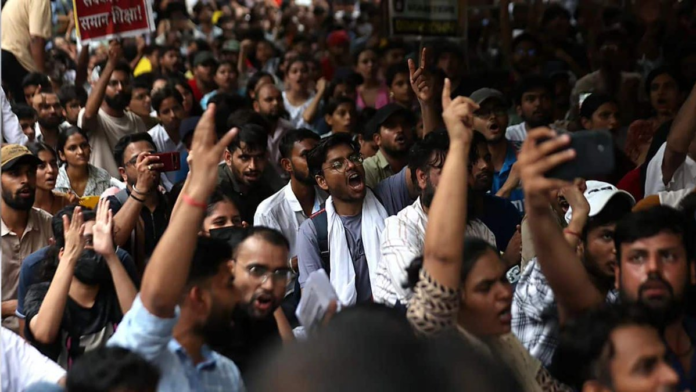
The protest by the Cockroach Janata Party (CJP) achieved its objective as the union government decided to take decisive actions against paper leak in public examinations. Meanwhile, the resignation of Dharmendra Pradhan, the minister for Education, has been celebrated by the opposition as a rare win against the Modi government since 2014.
Much is being written about the 36-day long saga as it is being termed as a turning point for the youth and the young India. In regional context, it is being compared with so-called GenZ agitation in Nepal, Bangladesh and Sri Lanka and few over enthusiastic commentators are even comparing it with the Arab Spring. Eloquent, as the claim may sound, but reality is that agitation had a specific agenda, an issue – which affected the vast middle class and upwardly mobile neo-middle class of the country. This social strata sees education to their children, as the only way to emancipation from daily miseries and also is the core vote bank of BJP including the one much coveted specific layer termed as, ‘floating votes’.
Accountability, integrity, justice, transparency, constitutional morality, tolerance, dialogue, empathy, inclusiveness, public trust, democratic ethics, rule of law, respect for dissent, peaceful participation, ethical leadership, citizen responsibility, social harmony, consensus building etc., are being talked about but in reality, this protest got traction as it was essentially non-political in its aim and affected almost every family.
Student agitation in Nepal and Bangladesh were for political transition and in Sri Lanka, youth took to streets due to severe economic crisis which led to demand for political change. The Jantar Mantar protest definitely lacked the ferocity of protests in Thailand. Usual ‘andolanjeevi’ troops were visible beating their ‘dhapli’, while ‘friends of India’ from Shaheen bagh to Qatar tried to contribute actively. ‘FOMO’ – fear of missing out, from GenZ vocabulary, was being feverishly talked about in a very smart way to attract a crowd on the weekend, before the government decided to act.
But, there is definitely a consensus of opinion that youth of India should get a fair chance to prove their abilities to achieve academic excellence and equal opportunity in employment opportunities. The middle class, which pays lakhs of rupees to coaching institutes to enable their young kids to prepare for an exam like NEET, were directly affected. Re-NEET took a toll on these families, both emotionally and financially.
Entry of word ‘cockroach’ in public discourse, use of social media to launch a platform for voicing dissent by a U.S. based indian student and his hurried arrival in India leading to Jantar Mantar protest, is a different line of investigation, in what led to culmination of this agitation. Another fact is that not many, who prepared for Re-NEET or their parents, were part of this agitation.
But the use of abusive language by the youth at the agitation shocked everyone. Is Indian youth this brash? Gyatt!!
They are ‘Skibidi’, ‘Delulu’, ‘Simp’ and ‘looksmaxxing’ but not the version which country had seen at the Jantar Mantar. GenZ is a ‘glow-up’ crowd and definitely ‘NPC’ with their ‘main character energy’ and are mostly ‘sigma’. They have ‘rizz’ with ‘no-cap’ attitude, use occasional cuss words but not an abuse-frothing version of reel paglus from Jantar Mantar.
So, what went wrong?
There is definitely a huge gap in aspirations and expectations of youth with their own parents and the way government functions. Indian youth – GenZ sees India as a promising nation, which competes to rise to the European or American standards of life and Chinese tech. They get their inspiration from Korean pop-bands but have bandwidth to enjoy Bob Marley and Susheela Raman also. What they definitely do not think about is anything related to Pakistan and may rarely focus on AISA-SFI slogan chanting.
Moreover, as the aim of this agitation was to highlight paper-leak in India’s one of the most elite exams, they could not have been treated like the usual baton charge. Authorities may have their own logic to use force but bruises caused by police-baton raised the emotional quotient of the event, across the country. ‘Baccho ko mara’, worked as a connector of emotions, which could have been avoided.
As the parliament discusses the stringent measures with the Public Examinations (prevention of unfair means) amendment bill 2026 and union government has constituted a high-powered committee led by top technocrat Nandan Nilekani to recommend reforms for conducting competitive examinations in India, it is high time to focus on need, aspirations and life-goals of the GenZ as youth is now a majority in the country’s demography. Globally, India as a young, educated, disciplined, tech-savvy country ticks all the right boxes to become a developed nation. But failure of governance is simply ‘opp’, for such high aspirations.
India can not become a country where a lot of around 100 youth from a single village gets selected in competitive exams, eating the pie of the honest and hardworking ones, as happened during the last congress regime in Rajasthan. The viral pictures of mass copying in the board or university exams are complete no-no.
More than that, this agitation should serve as a wake-up call for the leaders to inculcate aspirations and ideas of these budding talents rather than getting them drowned in the usual political din.
GenZ has not come from mars. In their own vocabulary, they are young people who neither suffer from ‘brain-rot’ nor do they ‘lives in trenches’. ‘Doom Scrolling’ and ‘Phantom vibrations’ are part of what they are but these ignited minds are not prone to ‘rage-baiting’, ‘gas lighting’, algorithmic echo chamber effects or ‘dopamine loops’.
Bottom line is that they can be cajoled but not convinced, like a previous generation. So, get ready to deal with a clientele that keeps you on toe, on the go.
(The writer of this article is Dr Arvind Singh, a former journalist based in Jaipur.)