

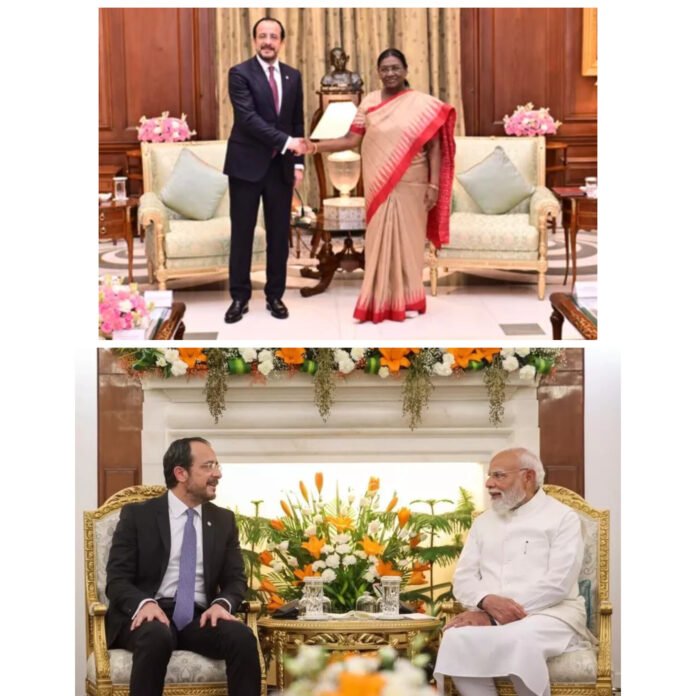
India and Cyprus have significantly upgraded their bilateral relationship by elevating their Comprehensive Partnership to a “Strategic Partnership” during the state visit of Cypriot President Nikos Christodoulides to India from May 20 to 23. The visit, held at the invitation of Prime Minister Narendra Modi, marks a major step in strengthening cooperation between the two nations across defence, trade, technology, connectivity and counter-terrorism.
The visit assumes added significance as Cyprus currently holds the Presidency of the Council of the European Union, positioning the country as an important bridge between India and Europe. The discussions built upon the momentum generated during PM Modi’s historic visit to Cyprus in June 2025, when both countries launched a Joint Action Plan for 2025–2029.
During bilateral talks in New Delhi, the two leaders reaffirmed their commitment to democratic values, rule of law and a rules-based international order. Cyprus reiterated its strong support for India’s permanent membership in a reformed United Nations Security Council, while both countries agreed to deepen coordination at the United Nations and other multilateral platforms.
One of the key highlights of the visit was enhanced cooperation in security and counter-terrorism. Both nations strongly condemned terrorism in all forms, including cross-border terrorism, and denounced the terrorist attacks in Pahalgam and near Red Fort in 2025. India and Cyprus signed an MoU to establish a Joint Working Group on Counter Terrorism, aimed at boosting intelligence-sharing, capacity-building and cooperation against terror financing, radicalisation and cyber threats.
Defence and maritime cooperation also emerged as major pillars of the partnership. The two sides welcomed the India-Cyprus Bilateral Defence Cooperation Programme signed earlier this year and agreed to strengthen collaboration in defence industries, cybersecurity, emerging technologies and maritime security. A roadmap for defence cooperation between 2026 and 2031 was also finalized.
Economic and technological collaboration featured prominently in the discussions. Both countries explored opportunities in financial services, shipping, clean energy, logistics, innovation, artificial intelligence and startups. Cyprus welcomed the growing use of India’s digital payment infrastructure, with both sides supporting interoperability between India’s Unified Payments Interface (UPI) and Europe’s payment systems to facilitate smoother cross-border transactions.
The leaders also highlighted the strategic importance of the India–Middle East–Europe Economic Corridor (IMEEC), describing it as a transformative initiative for trade and connectivity linking India with Europe through the Mediterranean region.
In education and culture, the two countries signed agreements on higher education, diplomatic training and cultural cooperation, while also promoting student exchanges, tourism and people-to-people ties.
The visit is being viewed as a major diplomatic milestone that transforms India-Cyprus ties into a modern, future-oriented strategic partnership, while also strengthening India’s broader engagement with the European Union and the Mediterranean region.