

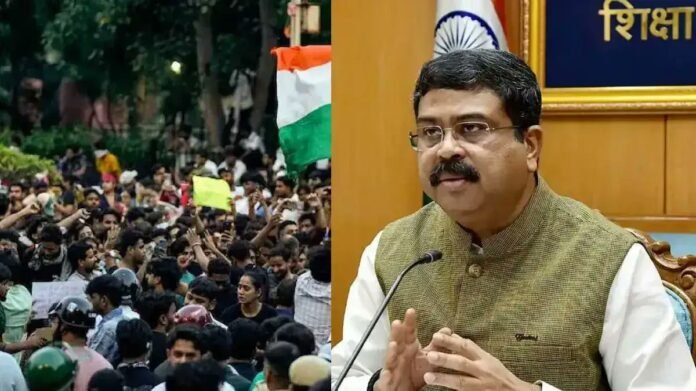
Politics often comes full circle. Few careers illustrate this better than that of Dharmendra Pradhan, who began his public life as a student activist protesting examination irregularities and, nearly three decades later, stepped down as India’s Union Education Minister following nationwide protests over alleged exam paper leaks.
The two episodes, separated by 29 years, have become one of the most striking parallels in contemporary Indian politics.
The 1997 Student Protest in Odisha
Long before entering national politics, Dharmendra Pradhan was an activist with the Akhil Bharatiya Vidyarthi Parishad (ABVP), one of India’s largest student organisations.
In 1997, Odisha witnessed widespread allegations of examination paper leaks. As a young student leader, Pradhan led a protest of nearly 1,500 students outside the Odisha State Secretariat, demanding accountability and action against those responsible for compromising the examination system.
The demonstration was met with a police lathi-charge. Pradhan was among those injured during the crackdown, becoming one of the prominent faces of the movement. The protest reflected growing frustration among students who believed that paper leaks undermined merit and the credibility of public examinations.
For Pradhan, the agitation became an important chapter in his early political life, reinforcing his image as a grassroots leader willing to stand with students against administrative failures.
Rise to National Leadership
Over the next three decades, Pradhan rose steadily through the Bharatiya Janata Party (BJP). He served in several key ministerial positions, including Petroleum and Natural Gas, before becoming the Union Minister for Education.
His tenure saw the implementation of significant reforms under the National Education Policy (NEP) 2020, expansion of digital learning initiatives, and efforts to improve higher education and skill development.
Yet, by 2026, his ministry found itself at the centre of a crisis remarkably similar to the issue he had once protested against.
The 2026 Student Uprising
The trigger was the alleged NEET-UG examination paper leak and wider concerns over recurring examination irregularities. Public anger quickly spread beyond NEET, evolving into a nationwide movement demanding greater transparency, accountability, and reform in India’s examination system.
The protests, led by students and youth groups, including the Cockroach Janta Party (CJP), featured demonstrations, sit-ins, hunger strikes and marches across several cities. Protesters argued that repeated exam leaks had damaged the futures of millions of aspirants and demanded institutional reforms. One of their central demands was Dharmendra Pradhan’s resignation.
After weeks of sustained protests and mounting political pressure, Dharmendra Pradhan resigned as Union Education Minister on 25 July 2026. In his resignation statement, he said the decision was “not a matter of personal prestige” and that he wanted to prevent further disruption to students’ futures and maintain national unity.
Following his resignation, protest organisers announced the withdrawal of their agitation after the government also agreed to several other assurances, including examination reforms and measures concerning protesters.
A Political Full Circle
The contrast between 1997 and 2026 is difficult to ignore.
As a student leader, Dharmendra Pradhan stood on the streets demanding accountability for examination failures and endured police action during a protest against paper leaks.
Nearly three decades later, he occupied the highest office responsible for India’s education system and became the focus of another student-led movement over examination irregularities. This time, instead of leading the protest, he was the minister being asked to take responsibility.
Whether viewed as political irony or as a reminder of democratic accountability, Pradhan’s journey underscores an enduring reality of public life: leaders who once challenged governments can themselves become answerable to the same standards when they hold office.
His story serves as a rare example of how history can come full circle, linking a young student activist on the streets of Bhubaneswar in 1997 with a Union Minister whose resignation, in 2026, marked the culmination of one of India’s largest youth-led protests in recent years.