

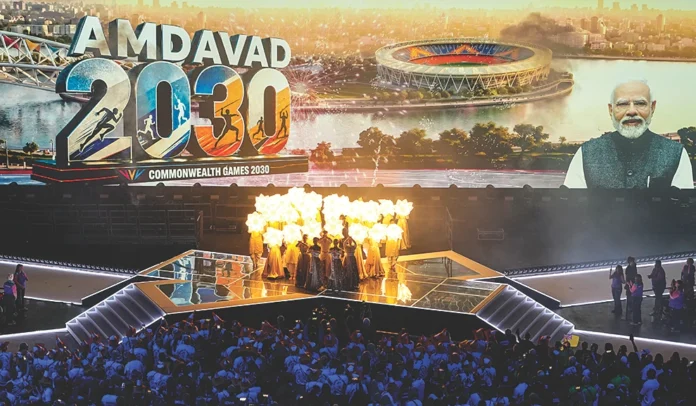
Just days after the curtain fell on the 2026 Commonwealth Games in Glasgow, India officially began its journey towards hosting the next edition of the Games. In a symbolic moment at the closing ceremony, the Commonwealth Games Flag was handed over to India, marking the start of the countdown to the 2030 Commonwealth Games, which will be hosted in Ahmedabad, Gujarat. The flag has now reached Gujarat, where preparations are gathering momentum for what will be the centenary edition of the Commonwealth Games.
The 2030 Games will hold special significance as they commemorate 100 years of the Commonwealth Games, first held in 1930. It will also be India’s second time hosting the event, after New Delhi successfully organised the 2010 Commonwealth Games, and only the third time the Games will be held in Asia.
The formal handover of the Commonwealth Games Flag to Gujarat Chief Minister Bhupendra Patel symbolised the transition from Glasgow to Ahmedabad. The ceremony also marked the beginning of a four-year preparation phase, with state and central authorities aiming to deliver a world-class sporting spectacle.
Ahmedabad’s selection is the result of years of investment in sports infrastructure and the city’s growing reputation as a host for major international events. The Games are expected to be centred around the Sardar Vallabhbhai Patel Sports Enclave in Motera, anchored by the Narendra Modi Stadium, the world’s largest cricket stadium. New venues, including indoor arenas, aquatics facilities and athletics infrastructure, are also being developed, while existing sports complexes across Ahmedabad and neighbouring Gandhinagar will be upgraded.
Preparations extend beyond sports venues. The Gujarat government is accelerating improvements in roads, public transport, metro connectivity, airport infrastructure, accommodation and urban amenities to ensure the city is ready to welcome athletes and visitors from across the Commonwealth. These projects are expected to leave behind a lasting legacy, benefiting residents long after the Games conclude.
The 2030 edition will also introduce a more flexible sporting programme under Commonwealth Sport’s new model. Athletics and swimming will remain compulsory, while host cities have greater freedom to choose additional sports that reflect regional interests. This opens the possibility of showcasing disciplines in which India has traditionally excelled, including cricket, hockey, shooting and indigenous sports such as kabaddi or kho kho, subject to final approval.
For India, however, Ahmedabad 2030 represents much more than hosting a multi-sport event. It is widely viewed as a crucial stepping stone in the country’s ambition to host the 2036 Olympic Games. Successfully organising the Commonwealth Games would demonstrate India’s capability to manage an event of global scale, strengthen sporting infrastructure and reinforce its credentials before the International Olympic Committee.
The Games are also expected to provide a significant boost to Gujarat’s economy through investments in infrastructure, tourism, hospitality and employment. Thousands of athletes, officials, media personnel and spectators from the Commonwealth’s 74 member associations are expected to visit India, generating opportunities for local businesses and showcasing the country’s culture, heritage and hospitality on the global stage.
As the Commonwealth Games Flag now flies in Gujarat, it carries with it not only the responsibility of hosting one of the world’s premier sporting events but also the aspirations of a nation eager to establish itself as a global sporting powerhouse.
With four years remaining, Ahmedabad’s preparations have officially begun. If executed successfully, the 2030 Commonwealth Games could become far more than a celebration of sport, they could mark a defining chapter in India’s sporting journey and strengthen its bid to host the Olympic Games in the years ahead.