

Imagine trying to unite millions of people against the world’s most powerful empire without the internet, smartphones, television or social media. No WhatsApp groups. No Instagram reels. No X (formerly Twitter). No YouTube videos.
It sounds almost unimaginable today.
Yet, this was the reality of India’s freedom movement. Decades before the digital age, newspapers became the nation’s most powerful communication network. They spread revolutionary ideas, challenged colonial rule, inspired ordinary citizens and transformed local protests into a nationwide struggle for independence.
The freedom movement had no social media influencers, but it had fearless editors, visionary writers and courageous printers who understood the power of words. Their printing presses became the engines of India’s first truly “viral” movement.
India’s First Content Creators
Today’s creators build audiences through videos, podcasts and social media posts. During the freedom struggle, India’s leaders built a nation through newspapers.
Freedom fighters were not just politicians or activists, they were editors, journalists and publishers who believed that changing minds was the first step towards changing the country.
Among the most influential was Bal Gangadhar Tilak, whose newspapers Kesari (Marathi) and The Mahratta (English) became powerful voices of nationalism. Through bold editorials, Tilak urged Indians to reject fear and demand self-rule. His famous declaration, “Swaraj is my birthright, and I shall have it,” echoed across the country through the pages of his newspapers.
Mahatma Gandhi understood that communication was as important as protest. Through publications such as Young India, Harijan, Navjivan and Indian Opinion in South Africa, he explained the philosophy of satyagraha, promoted non-violence and encouraged people to participate in movements such as Non-Cooperation, Civil Disobedience and Quit India. Every issue educated readers, answered criticism and inspired action.
Other nationalist newspapers also played remarkable roles. Amrita Bazar Patrika, The Hindu, The Tribune, Bombay Chronicle, Bande Mataram, The Bengalee, Hindustan Times and several regional publications fearlessly questioned British policies and gave voice to India’s growing nationalist movement.
When Publishing the Truth Meant Going to Jail
Today, publishing an opinion online takes only a few seconds. During British rule, publishing the truth could cost someone their freedom.
The colonial government recognised the influence of newspapers and introduced strict censorship laws to silence the Indian press. Among the most infamous was the Vernacular Press Act of 1878, which specifically targeted newspapers published in Indian languages. Authorities could seize printing presses, confiscate publications, impose heavy penalties and arrest editors without giving them a fair opportunity to defend themselves.
Many journalists faced imprisonment, financial ruin and constant surveillance. Printing presses were raided, newspapers were banned and editors were prosecuted for sedition.
Yet, the nationalist press refused to surrender.
When one publication was shut down, another emerged. When editors were jailed, others continued the mission. The determination to keep the flow of information alive became an act of resistance in itself.
The Internet Before the Internet
Long before instant messaging and social media, newspapers served as India’s largest information network.
Copies of newspapers travelled by train, post and hand delivery from cities to villages. Public readings became common because many Indians could not read or afford to buy newspapers. In marketplaces, schools, libraries and village squares, one person would read aloud while dozens gathered to listen.
In this way, news travelled far beyond the printed page.
Reports of British repression, stories of peaceful protests, speeches by national leaders and calls for boycotting foreign goods spread rapidly across regions and languages. Newspapers connected Bengal with Punjab, Maharashtra with Tamil Nadu, and villages with major cities.
The Swadeshi Movement, Non-Cooperation Movement, Civil Disobedience Movement and Quit India Movement all relied heavily on newspapers to communicate their message, mobilise volunteers and strengthen public participation.
Building a National Identity
The nationalist press did much more than report daily events.
It challenged colonial propaganda, encouraged social reform, promoted Indian languages and literature, and nurtured a shared sense of belonging among people from diverse regions and communities.
For the first time, millions of Indians began to see themselves as part of one nation with a common destiny. Newspapers created conversations that crossed provincial, linguistic and cultural boundaries.
The freedom movement was fought not only in courts, prisons and streets but also in editorial offices, printing presses and newspaper columns.
Every printed article became an argument for freedom.
Every editorial became an act of courage.
Every edition strengthened the belief that independence was possible.
The Legacy That Lives On
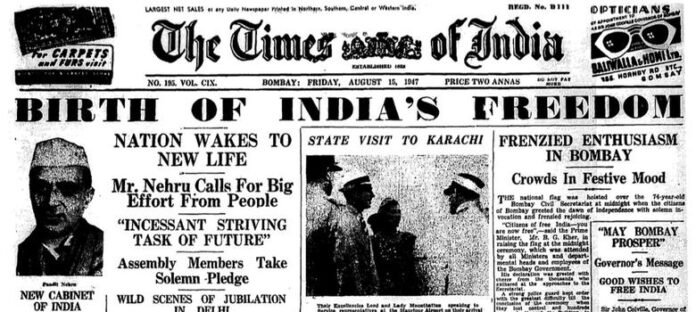
When India finally achieved independence on 15 August 1947, the press had already established itself as one of the strongest pillars of the freedom movement. It had informed citizens, exposed injustice, united diverse communities and kept hope alive during some of the nation’s darkest years.
Today, journalism has entered a completely different era. Artificial intelligence, smartphones, digital newsrooms, podcasts, livestreams and social media have transformed how information is created and consumed. News now reaches millions within seconds rather than days.
But while technology has changed dramatically, the core responsibility of journalism remains unchanged, to inform the public, question those in power, verify facts, amplify unheard voices and safeguard democracy.
As India celebrates its independence each year, it is worth remembering that before likes, shares, reels and trending hashtags, there were determined journalists working under immense pressure, risking imprisonment and persecution simply to print the truth.
The next time you scroll through your news feed or share a story online, pause for a moment and remember those early editors, printers and reporters whose ink, courage and conviction helped ignite one of the greatest freedom movements in history.
Long before the digital revolution, India’s battle for freedom was fought not only on the streets, but also on the printed page.