

July 22 marks a defining moment in India’s history. On this day in 1947, just weeks before the country attained Independence, the Constituent Assembly adopted the National Flag of India in its present form. More than a ceremonial decision, it gave a soon-to-be independent nation a symbol that would embody its ideals, sacrifices and aspirations. Every year, Flag Adoption Day offers an opportunity to look beyond the colours of the Tiranga and revisit the extraordinary journey that shaped India’s most cherished national symbol.
The Indian National Flag did not emerge overnight. It evolved over decades alongside the freedom movement, with each design reflecting the changing aspirations of a nation determined to define its own identity.
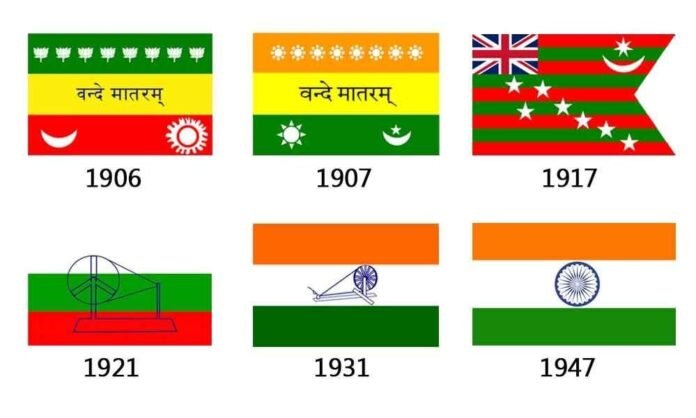
The journey began on August 7, 1906, when one of the earliest unofficial Indian flags was unfurled at Parsi Bagan Square in Calcutta (now Kolkata). Designed by Sachindra Prasad Bose and Sukumar Mitra, it featured three horizontal bands of green, yellow and red, eight blooming lotuses representing India’s provinces, a crescent with a star, and the words “Vande Mataram.” It was among the first attempts to create a unifying symbol for a nation yearning for freedom.
A year later, in 1907, revolutionary Madam Bhikaji Cama, along with nationalist leaders associated with the Indian independence movement abroad, unfurled a similar tricolour at the International Socialist Congress in Stuttgart, Germany. It became the first Indian flag to be hoisted on foreign soil, bringing India’s demand for freedom before the international community.
The next significant milestone came during the Home Rule Movement in 1917, when Dr. Annie Besant and Bal Gangadhar Tilak introduced a new flag. It featured five red and four green stripes, the Union Jack, a crescent and star, and the Saptarishi (Seven Stars) constellation. While it reflected India’s demand for self-governance, it also acknowledged the political realities of the time.
The turning point came in 1921, when Pingali Venkayya, a freedom fighter, educationist and noted flag researcher, presented a two-colour flag to Mahatma Gandhi. Gandhi suggested adding a white band to represent all communities and placing the charkha at the centre as a symbol of self-reliance, dignity of labour and the Swadeshi movement. The design soon became closely associated with India’s freedom struggle.
Recognising the need for a universally acceptable national emblem, the Indian National Congress adopted a new tricolour in 1931, featuring saffron, white and green with the charkha at its centre. Though it was not yet the national flag, it became the principal banner of the independence movement and laid the foundation for the flag India proudly flies today.
Finally, on July 22, 1947, the Constituent Assembly adopted the present National Flag. While retaining the tricolour, it replaced the charkha with the navy-blue Ashoka Chakra, inspired by the Lion Capital of Ashoka at Sarnath. The 24-spoked wheel represents dharma (righteousness), justice, progress and the constant movement of life, reminding citizens that a nation must always move forward.
Today, the Tiranga carries profound symbolism. Saffron stands for courage and sacrifice, white represents truth and peace, and green signifies faith, prosperity and harmony with nature. Together with the Ashoka Chakra, these elements express the values upon which modern India was built.
As India observes Flag Adoption Day, the Tiranga remains far more than a national emblem. It is a living chronicle of the country’s freedom struggle, a tribute to the visionaries who imagined an independent India, and a timeless reminder that unity in diversity remains the nation’s greatest strength. Every time the Tricolour soars against the sky, it carries with it not just the pride of a free nation, but the story of a century-long journey towards India’s identity.