

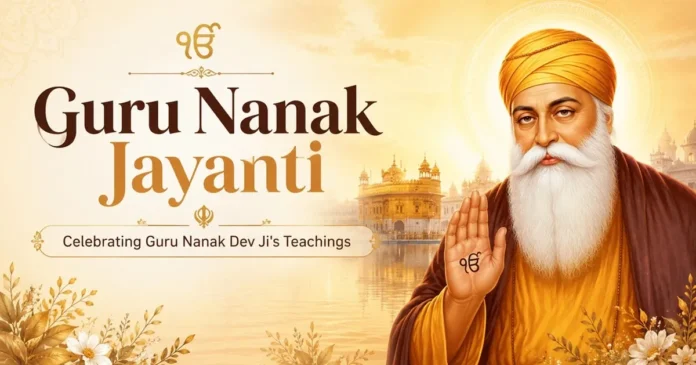
Guru Nanak Jayanti, also known as Gurpurab or Prakash Parv, will be celebrated on Tuesday, November 24, 2026, marking the 557th birth anniversary of Guru Nanak Dev Ji, the founder of Sikhism and the first of the ten Sikh Gurus. Observed on the occasion of Kartik Purnima, the full moon day of the Hindu month of Kartik, the festival holds immense religious and spiritual significance for the Sikh community across the world. Gurdwaras are decorated with flowers and lights, devotional hymns fill the air, and community kitchens prepare meals for devotees and visitors.
Beyond the celebrations, the occasion is a reminder of Guru Nanak Dev Ji’s timeless message of equality, compassion, honest living and service to humanity.
Who Was Guru Nanak Dev Ji?
Guru Nanak Dev Ji was born in 1469 at Rai-Bhoi-di Talwandi, a village in present-day Pakistan, now known as Nankana Sahib. From an early age, he showed a deep interest in spirituality and questioned social practices that promoted discrimination, inequality and religious divisions. His teachings challenged caste-based distinctions and emphasised that all human beings are equal before the Almighty.
As he grew older, Guru Nanak Dev Ji travelled extensively across different regions to spread his message of truth, devotion and humanity. These journeys, traditionally known as Udasis, took him to several parts of the Indian subcontinent and beyond. Through his interactions with people from different religious and social backgrounds, he advocated a life guided by humility, compassion, righteous conduct and faith in one universal God.
He established the foundations of Sikhism and spent the later years of his life at Kartarpur, where he encouraged a community based on prayer, honest work and collective service. Before his passing in 1539, he appointed Bhai Lehna Ji as his successor, who became Guru Angad Dev Ji, the second Sikh Guru.
The Three Core Teachings of Guru Nanak Dev Ji
Guru Nanak Dev Ji’s philosophy is rooted in the belief that spirituality should reflect in everyday actions and not remain limited to religious practices. Three central principles form an important part of his teachings.
Naam Japna refers to remembering and meditating on God’s name, encouraging individuals to remain connected with the Divine. Kirat Karni emphasises earning an honest livelihood through hard work and integrity. Vand Chakna teaches people to share their earnings, food and resources with others, particularly those in need.
Another central teaching is Ik Onkar, which expresses the belief in one universal God. His message of equality, regardless of caste, religion, gender or social position, continues to form the foundation of Sikh values.
Why Is Gurpurab Celebrated?
The word Gurpurab refers to a sacred occasion associated with the lives of Sikh Gurus. Guru Nanak Jayanti is one of the most important Gurpurabs as it commemorates the birth of the first Sikh Guru. It is also called Prakash Parv, symbolising the arrival of spiritual light and wisdom in the world.
The festival is not merely a celebration of a historical figure’s birth but an opportunity for devotees to reflect on his teachings and incorporate them into their lives. His message of universal brotherhood, equality, selfless service and devotion remains relevant across generations and communities.
How Is Guru Nanak Jayanti Celebrated?
The celebrations usually begin several days before the main festival with Prabhat Pheris, early morning religious processions in which devotees visit neighbourhoods while singing devotional hymns and spreading the Guru’s message.
One of the important observances is the Akhand Path, a continuous, uninterrupted recitation of the Guru Granth Sahib, the central religious scripture of Sikhism, traditionally completed over 48 hours. On the day of Gurpurab, devotees visit gurdwaras to offer prayers, listen to Kirtan (devotional singing of hymns) and attend Katha (religious discourses explaining the teachings of Sikh scriptures).
Another prominent tradition is the Nagar Kirtan, a devotional procession organised a day before the festival in many places. Led by the Panj Pyare, or the Five Beloved Ones, the procession features the Guru Granth Sahib carried in a decorated palanquin, devotional singing and participation by members of the Sikh community. Traditional Gatka performances, showcasing the Sikh martial art, are also organised during these processions.
On the main day, special morning prayers, including Asa Di Vaar, are held at gurdwaras. Devotees also participate in Ardas, the Sikh congregational prayer, followed by the distribution of Karah Prasad, a sacred sweet offering.
Langar: The Spirit of Equality and Seva
Perhaps one of the most meaningful traditions associated with Gurpurab is Langar, the community kitchen organised at gurdwaras. Free meals are prepared and served to everyone, irrespective of religion, caste, gender or financial background. Devotees voluntarily participate in preparing food, serving meals and cleaning the premises as an expression of Seva, or selfless service.
The tradition reflects Guru Nanak Dev Ji’s belief that no individual is superior to another and that sharing food and resources is an essential part of living a meaningful life. People sit together and share meals, reinforcing the values of equality, dignity and togetherness.
As gurdwaras across India and the world illuminate their premises and welcome devotees, Guru Nanak Jayanti offers a reminder that the true essence of faith lies in compassion, honesty, humility and service.
Centuries after Guru Nanak Dev Ji shared his teachings, his message continues to inspire people to look beyond differences and build a society rooted in peace, equality and humanity.