

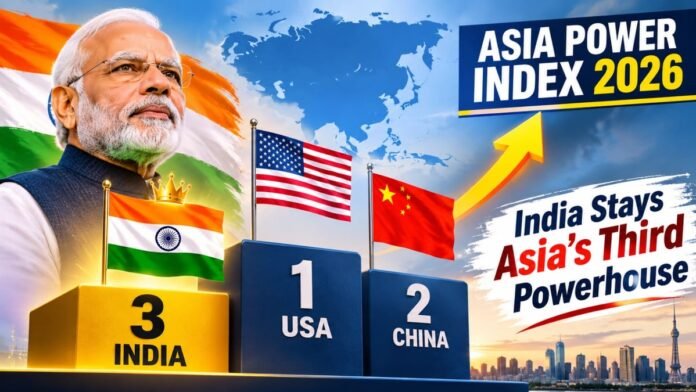
India has retained its position as the third most powerful country in Asia in the 2026 Asia Power Index released by the Australia-based Lowy Institute, recording a score of 40.5 out of 100. The country’s score marks a slight improvement from 40.0 in 2025, reflecting its growing diplomatic influence, cultural reach and regional engagement despite a relatively weak economic performance.
The United States continues to lead the rankings with a score of 78.9, followed by China at 73.6. India remains third, ahead of Japan (38.6), Russia (32.2), Australia (31.7) and South Korea (31.0). Singapore, Indonesia and Malaysia complete the top ten with scores of 26.9, 21.7 and 20.5, respectively.
One of the significant findings of the 2026 index is that the gap between India and China has narrowed to its smallest level since the index was introduced in 2018. However, China’s overall power remains approximately 80 per cent higher than India’s, highlighting the considerable difference in their comprehensive national capabilities.
Diplomatic influence remains India’s strongest area
India’s strongest performance came in diplomatic influence, where it secured a score of 70.3, reflecting its expanding engagement with regional and international partners. Prime Minister Narendra Modi also moved up three positions to become the second-most effective leader in the region, behind Chinese President Xi Jinping.
India also recorded improvements in its defence networks, with a score of 18.6, placing it ninth in the category. Its growing defence engagement with Southeast Asian countries, including the sale of BrahMos missiles, contributed to its regional strategic presence. The country’s cultural influence also remained significant, scoring 43.8, while its economic relationships improved by two positions to rank seventh.
Economic challenges remain a concern
Despite gains in several strategic areas, India’s economic performance presented a mixed picture. Its economic capability score declined slightly to 26.4, influenced by factors including a weaker rupee, changes in the International Monetary Fund’s measurement methodology and a decline of nearly $20 billion in outbound investment.
However, India’s future resources score stood at 56.2, indicating its considerable long-term potential. The country also narrowed its power yield gap for the first time since 2023, suggesting improvements in its ability to translate available resources into broader regional influence.
India’s growing position in the Asian power landscape
The 2026 rankings underline India’s growing importance in the Asian geopolitical landscape. While the United States and China continue to dominate the region’s overall power structure, India’s performance reflects its increasing diplomatic engagement, defence partnerships and cultural influence.
The findings also highlight that national power is not determined by economic strength alone. Diplomatic relationships, military capabilities, strategic partnerships, cultural influence and future resources collectively shape a country’s standing.
India’s continued presence among Asia’s top three powers, alongside its narrowing gap with China, signals its expanding regional role. However, sustaining this momentum will depend on strengthening economic capabilities and translating its growing international influence into long-term strategic and economic advantages.