

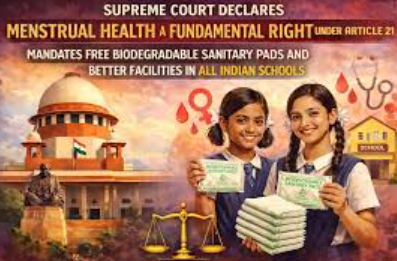
In a landmark judgement, the Supreme Court of India has recognised menstrual health as part of the fundamental right to dignity, bringing it under constitutional protection. The ruling marks a major step in addressing period poverty and reframes menstrual health as an issue of equality, public policy, and human rights, rather than merely a welfare concern.
The Court observed that despite progress in toilet construction and household tap water connections, menstrual deprivation persists due to uneven access and poorly maintained facilities. This highlights the gap between policy intent and on-ground implementation.
Gaps in Implementation and Governance
The judgement flagged serious governance failures in menstrual hygiene management. The Court noted that 10 states and 8 Union Territories failed to respond to directions issued three years ago regarding menstrual health policies across key ministries, including drinking water and sanitation, women and child development, and education.
The Court clarified that although menstruation affects only a segment of the population, the right to dignified menstrual health warrants constitutional safeguards under the principles of equality and dignity.
Health Implications and Underdiagnosed Conditions
Poor menstrual management affects health, education, mobility, and livelihoods. The Court highlighted that conditions such as premenstrual syndrome (PMS), premenstrual dysphoric disorder (PMDD), and endometriosis remain widely underdiagnosed, impacting quality of life and fertility.
A health-systems approach must normalise menstrual awareness so individuals can distinguish between healthy cycles and symptoms requiring medical attention.
Education, Environment and Gender Perspective
The ruling emphasised gender-inclusive menstrual education for all students to dismantle stigma and enable informed choices. Education should cover both disposable and reusable menstrual products, their benefits, and limitations.
Environmental sustainability was identified as a key pillar. Reusable products such as cloth pads, menstrual cups, and period underwear can reduce waste and costs when supported by adequate water, sanitation, and privacy infrastructure. The Bureau of Indian Standards (BIS) quality benchmarks for reusable products were noted as an important regulatory safeguard.
Important Facts
- Article 21 of the Indian Constitution guarantees the right to life and dignity.
- Rashtriya Kishor Swasthya Karyakram (RKSK) focuses on adolescent health.
- Menstrual hygiene management is linked to Sustainable Development Goals (SDGs) on health, gender equality, and sanitation.
- Bureau of Indian Standards (BIS) sets quality norms for consumer products.
Need for Civil Society Collaboration
The Supreme Court acknowledged the role of civil society organisations in advancing menstrual health awareness and services. The ruling stressed that constitutional recognition must be supported by government–NGO collaboration, accountability mechanisms, and sustained policy implementation to translate legal rights into everyday dignity.