

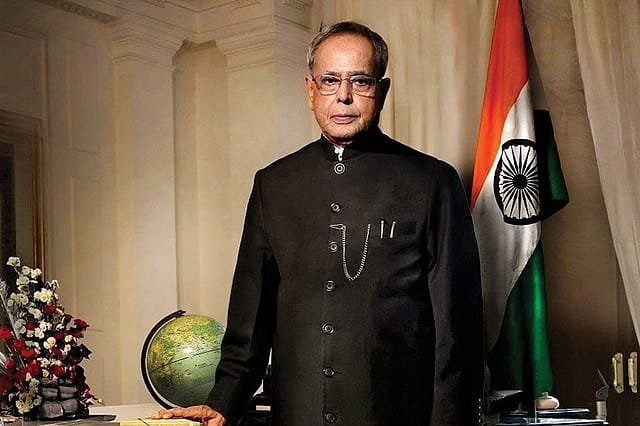
August 31 marks the death anniversary of Pranab Mukherjee, one of India’s most experienced parliamentarians and statesmen. Mukherjee, who served as the 13th President of India from 2012 to 2017, passed away on August 31, 2020, at the age of 84. His political career spanned more than five decades and included some of the most important offices in the Union government.
Born on December 11, 1935, in Mirati village in Birbhum district of West Bengal, Mukherjee came from a family connected with India’s freedom movement. His father, Kamada Kinkar Mukherjee, was a Congress leader who had participated in the freedom struggle and was imprisoned several times. Pranab Mukherjee studied history and political science and later obtained a law degree from the University of Calcutta. Before entering full-time politics, he worked as a college teacher and journalist.
Mukherjee entered Parliament in 1969 as a member of the Rajya Sabha. His political rise was closely associated with former Prime Minister Indira Gandhi, under whose leadership he became a minister in the Union government. Over the following decades, he built a reputation as a knowledgeable parliamentarian with a deep understanding of government, economics, foreign affairs and parliamentary procedures.
His ministerial career was remarkably diverse. He served as Finance Minister, Defence Minister, External Affairs Minister and Commerce Minister at different stages. He was Finance Minister for the first time in 1982 and later held the portfolio again from 2009 to 2012. He also served as Leader of the House in the Lok Sabha from 2004 to 2012. His long experience made him an important figure in the functioning and decision-making of successive governments.
Mukherjee was also known for his ability to work across political differences. During his years in Parliament, he participated in and chaired numerous groups dealing with major policy matters. His experience extended to issues including administrative reforms, economic policy, food and energy security, information technology and telecommunications. He also represented India at major international forums and served on the boards of institutions including the International Monetary Fund, World Bank and Asian Development Bank.
In 2012, Pranab Mukherjee was elected President of India and assumed office on July 25 that year. As President, he emphasised the importance of constitutional values, parliamentary democracy, education and inclusive development. In his farewell address in 2017, he described his principal responsibility as President as being the guardian of the Constitution and said he had sought to preserve, protect and defend it in both word and spirit.
His contributions were recognised with several honours. He received the Padma Vibhushan in 2008 and the Best Parliamentarian Award in 1997. In 2019, the Government of India conferred upon him the Bharat Ratna, the country’s highest civilian award, in recognition of his exceptional contribution to public affairs. His intellectual interests also extended beyond politics. A prolific reader and writer, he authored books on the Indian economy, political affairs and nation-building and was known for his interest in music, literature and culture.
Pranab Mukherjee passed away on August 31, 2020, bringing an end to a public career that had closely followed India’s political journey for half a century. His legacy rests not only on the offices he held but also on his extensive knowledge of parliamentary institutions, governance and public policy. On his death anniversary, he is remembered as a politician who evolved into a statesman and as one of the most experienced figures to occupy the highest constitutional office in India.