

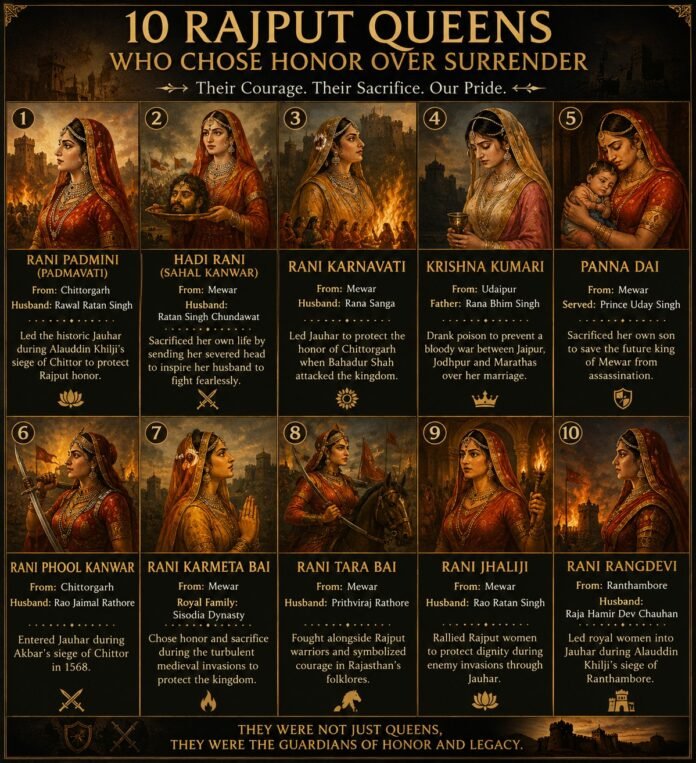
The history of Rajasthan is filled with stories of extraordinary courage, sacrifice, and unwavering pride. Across centuries, Rajput women became powerful symbols of resilience during some of the most turbulent periods in Indian history. Whether through acts of battlefield bravery, political wisdom, or ultimate sacrifice, these queens and royal women left behind legacies that continue to live in Rajasthan’s forts, folklore, and collective memory.
Many of these stories are deeply rooted in oral traditions and regional legends, while others are documented in historical chronicles. Together, they reflect the Rajput ideals of honor, duty, and sacrifice that shaped the history of Rajputana.
Rani Padmini (Padmavati)
Among the most well-known figures in Rajput history, Rani Padmini of Chittorgarh is remembered for the legendary Jauhar performed during Alauddin Khilji’s siege of Chittor in 1303. According to medieval literary traditions, especially Malik Muhammad Jayasi’s epic Padmavat, she chose death over capture after the fall of the fort.While historians continue to debate the historical accuracy of some aspects of her story, Rani Padmini remains a lasting cultural symbol of Rajput pride and resistance.
Hadi Rani (Sahal Kanwar)
Hadi Rani is remembered in Rajasthan’s folklore as the embodiment of sacrifice and courage. Married to Ratan Singh Chundawat, a Rajput commander, she is believed to have sacrificed her life so that her husband could leave personal attachments behind and fight fearlessly in battle for Mewar.Her story survives primarily through oral traditions and folk narratives, where she is revered as a symbol of supreme devotion and bravery.
Rani Karnavati
Rani Karnavati, the widow of Rana Sanga and regent of Mewar, played a crucial role during Bahadur Shah of Gujarat’s attack on Chittorgarh in 1535. Facing inevitable defeat, she is remembered for leading the women of the fort into Jauhar while Rajput warriors prepared for their final battle.
She also remains associated with the famous story of sending a rakhi to Mughal emperor Humayun seeking assistance, though historians differ on certain details surrounding the event.
Krishna Kumari
Princess Krishna Kumari of Udaipur is remembered for a tragic sacrifice made to prevent bloodshed among Rajput kingdoms. In the early 19th century, rival states entered into conflict over her proposed marriage alliance. To stop a devastating war and protect her kingdom, she consumed poison at a young age.
Her sacrifice is regarded as one of the most heartbreaking episodes in Rajput history and symbolizes duty towards the larger good above personal life.
Panna Dai
Though not a queen, Panna Dai occupies a revered place in the history of Mewar. Serving as the nurse and guardian of Prince Uday Singh, she made one of the greatest sacrifices recorded in Rajput history.
When Banbir attempted to kill the young prince to seize the throne, Panna Dai secretly replaced Uday Singh with her own son in the royal bedchamber. Her son was killed, while the future ruler of Mewar survived. Her loyalty ultimately helped preserve the Sisodia dynasty.
Rani Phool Kanwar
Rani Phool Kanwar, associated with Rao Jaimal Rathore during Akbar’s siege of Chittorgarh in 1568, is remembered in local traditions for participating in Jauhar along with the women of the fort before Chittor fell to the Mughal forces.
The siege itself remains one of the most defining moments in Rajput resistance against the Mughal Empire.
Rani Karmavati Bai
Stories associated with Rajput resistance often mention women from the Sisodia dynasty who chose sacrifice and honor during periods of invasion and warfare. While detailed historical records about Rani Karmeta Bai are limited, regional traditions continue to remember such figures as representations of Rajput valor and dignity.
Tara Bai and Other Rajput Heroines
Several Rajput women, including figures remembered in folklore such as Tara Bai and Jhali Rani, symbolize the courage of women who stood beside Rajput warriors during difficult times. Some stories describe them inspiring soldiers, protecting royal families, or participating in resistance during invasions.
Though certain accounts belong more to oral history than documented political records, these narratives continue to form an important part of Rajasthan’s cultural heritage.
Rani Rangdevi
Rani Rangdevi, associated with Ranthambore and Raja Hammir Dev Chauhan, is remembered in historical traditions linked to Alauddin Khilji’s siege of Ranthambore in 1301. As defeat became inevitable, she is believed to have led the royal women into Jauhar, following the Rajput tradition of choosing death over capture.
Legacy of Rajputana
The stories of these women continue to occupy a unique place in Indian history and cultural memory. Across Rajasthan, their names survive in folk songs, literature, oral traditions, and the walls of ancient forts that witnessed both glory and tragedy.
They came to symbolize ideals that were deeply valued in Rajput society:
●Honor before surrender
●Duty before personal desire
●Courage in the face of impossible odds
Today, whether viewed through the lens of history, legend, or cultural identity, these queens and heroines remain enduring symbols of sacrifice and resilience in the story of Rajputana.