

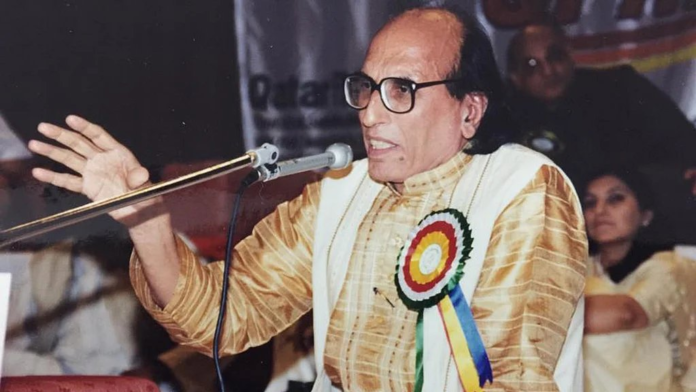
The world of Urdu poetry lost one of its most beloved voices on May 28, 2026, as celebrated poet Bashir Badr passed away in Bhopal at the age of 91 following a prolonged illness.
Born as Syed Muhammad Bashir on February 15, 1935, in Faizabad, Uttar Pradesh, Bashir Badr carved a unique place in Indian literature through his soulful ghazals that blended romance, longing, pain, and quiet wisdom. His poetry transcended generations, finding admirers not only among literary scholars but also among ordinary readers who found their own emotions reflected in his words.
For decades, Bashir Badr remained one of the most recognisable faces of the Urdu ghazal tradition. His verses, marked by simplicity and emotional depth, became staples of mushairas across the country. Unlike classical poetry that often remained confined to literary circles, Badr’s poetry travelled effortlessly into homes, hearts, and popular culture.
Beyond poetry, Bashir Badr was also an academic deeply committed to the Urdu language. He taught Urdu at Aligarh Muslim University before serving as the Head of the Urdu Department at Meerut College for nearly seventeen years. His contribution as a teacher shaped countless students and strengthened the academic study of Urdu literature.
Life, however, was not untouched by tragedy.
The communal riots that shook Meerut in 1987 proved to be a devastating turning point. Much of Bashir Badr’s unpublished literary work was reportedly lost during the violence, a personal and creative loss that deeply affected him. In the years that followed, he moved to Bhopal, where he continued to write and remain connected to literature.
Despite personal setbacks and declining health in later years, including a prolonged battle with dementia, Bashir Badr’s poetic legacy remained undiminished.
Many of his lines became timeless expressions of love, separation, and human vulnerability, quoted widely across generations and languages.
He is survived by his wife, Rahat Badr, and their two children.
With Bashir Badr’s passing, Urdu literature bids farewell not merely to a poet but to an era—a gentle craftsman of words whose ghazals carried both fragility and strength, and whose voice will continue to echo wherever poetry is cherished.