

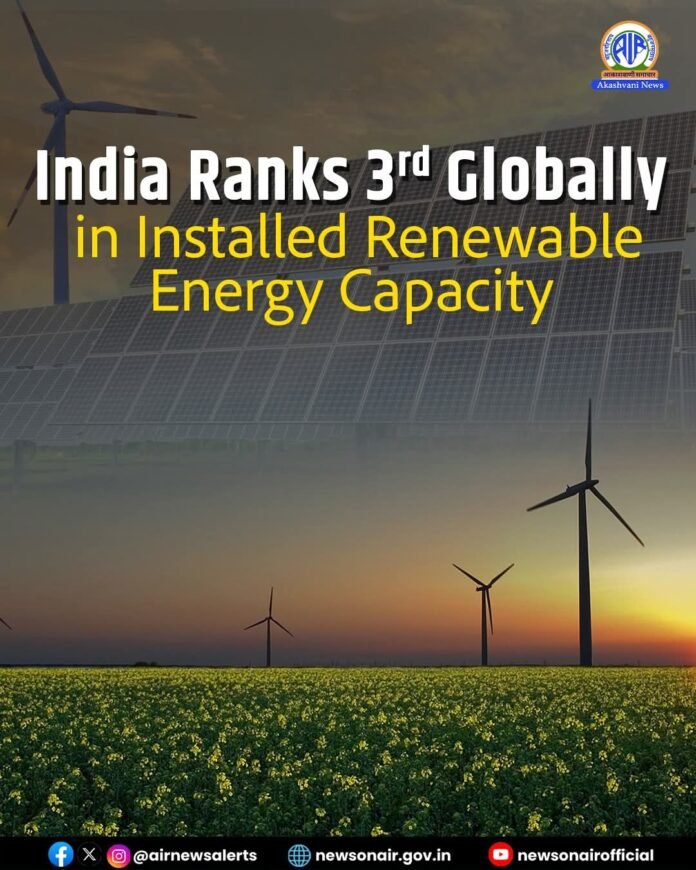
India has achieved a major milestone in its clean energy journey by becoming the world’s third-largest country in installed renewable energy capacity, overtaking Brazil. The announcement was made by Union Minister for New and Renewable Energy Pralhad Joshi, citing the Renewable Energy Statistics 2026 released by the International Renewable Energy Agency (IRENA). India now trails only China and the United States in global renewable energy capacity rankings.
The achievement reflects India’s rapid transition toward sustainable energy and its growing global role in climate action. As of March 31, 2026, India’s total non-fossil fuel-based installed capacity reached 283.46 gigawatts (GW), of which renewable energy alone accounts for 274.68 GW.
A major driver of this growth has been solar energy. India’s solar power capacity has expanded dramatically over the past decade, rising from just 2.82 GW in 2014 to over 150 GW in 2026. Wind energy has also witnessed strong growth, crossing 56 GW. The country additionally generates renewable energy through bioenergy, hydropower and emerging green technologies.
The government says India added a record 55.3 GW of non-fossil fuel capacity during the financial year 2025–26 — the highest annual increase so far. Another significant milestone was achieved in June 2025 when India crossed 50% cumulative installed power capacity from non-fossil fuel sources, five years ahead of its Paris Agreement target for 2030.
Renewable energy is also contributing increasingly to India’s electricity needs. In July 2025, clean energy sources met a record 51.5% of the country’s electricity demand, indicating the growing reliability and integration of renewables into the national power grid.
India’s renewable energy push is being driven by multiple factors. Rising energy demand, concerns over climate change, dependence on imported fossil fuels and the need for long-term energy security have all accelerated investment in green energy. Government schemes such as the National Solar Mission, PM Surya Ghar Yojana and incentives for domestic solar manufacturing have further boosted the sector.
Experts say the shift toward renewable energy is crucial not only environmentally but also economically. Expanding solar and wind energy can reduce pollution, lower fuel import bills, create jobs and improve energy access in rural areas. At the same time, India still faces major challenges including energy storage, transmission infrastructure and balancing renewable power with rising electricity demand.
India has set an ambitious target of achieving 500 GW of non-fossil fuel capacity by 2030. With rapid expansion in solar parks, rooftop solar projects, green hydrogen initiatives and wind energy corridors, the country is positioning itself as one of the leading players in the global clean energy transition.