

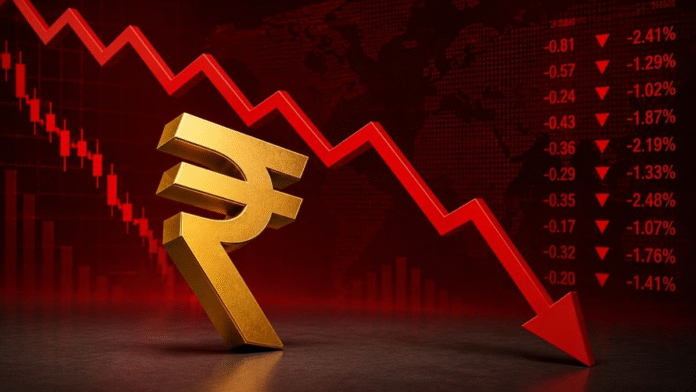
The Indian rupee has been under constant pressure in recent years, reaching historic lows against the US dollar. While many people see this only as a financial issue, the falling rupee affects the daily lives of ordinary Indians through rising fuel prices, inflation, expensive imports, and costly foreign education. The weakening rupee has now become one of the biggest economic concerns in the country.
Why Is the Rupee Falling?
India imports large amounts of crude oil, electronics, machinery, and gold. Since these imports are paid for in US dollars, demand for dollars remains high. India also imports nearly 85% of its crude oil, making the economy highly vulnerable to global oil price increases.
Another major reason is the strengthening of the US dollar. Whenever US interest rates rise, investors move money into American markets, causing currencies like the rupee to weaken.
Jayant Mundhra’s Perspective
Finance educator Jayant Mundhra explains that a falling rupee should not always be viewed emotionally. According to him, the rupee weakens mainly because of economic fundamentals such as trade deficits, oil dependence, and global dollar dominance.
He also points out that foreign investors play a huge role in short-term currency movements. When foreign investors pull money out of India, they convert rupees into dollars, increasing pressure on the Indian currency.
Jayant Mundhra believes that the Reserve Bank of India can control panic temporarily, but long-term currency strength depends on stronger manufacturing, exports, and productivity.
Impact on Common People
A weak rupee increases the prices of petrol, diesel, electronics, medicines, and imported goods. Students planning to study abroad face higher expenses, while foreign travel also becomes costlier.
However, some sectors such as IT and export industries benefit because they earn in dollars while spending in rupees.
Conclusion
The decline of the Indian rupee reflects deeper structural challenges in the Indian economy. While India continues to grow globally, dependence on imports and foreign capital keeps pressure on the currency. The real solution lies in building stronger exports, reducing import dependence, and improving economic productivity in the long run.
(The writer of this article is Akhilesh Saproo, a student of Class 10th E, APS Jaipur)