

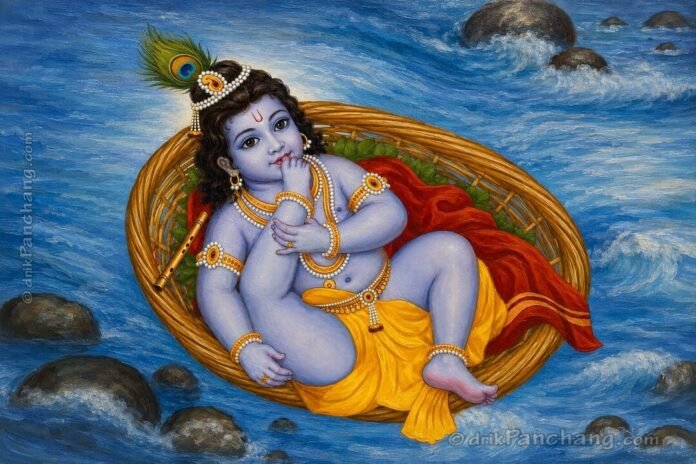
Janmashtami, one of the most revered festivals in Hindu tradition, celebrates the birth of Lord Krishna, the eighth incarnation of Lord Vishnu. Observed on the Ashtami Tithi of Krishna Paksha in the month of Bhadrapada, the festival carries deep spiritual, cultural and philosophical significance. Devotees across India and around the world observe the occasion with fasting, prayers, devotional music, temple celebrations and midnight rituals marking the birth of Krishna.
According to Hindu scriptures, Krishna was born in Mathura at a time when the kingdom was ruled by his maternal uncle, the tyrannical King Kansa. A prophecy had foretold that Kansa would be killed by the eighth child of his sister Devaki. Fearing the prophecy, Kansa imprisoned Devaki and her husband Vasudeva and killed their children one after another. When Krishna was born at midnight, divine intervention enabled Vasudeva to carry the newborn across the Yamuna River to Gokul, where he was placed under the care of Nanda and Yashoda.
Krishna’s childhood in Gokul and Vrindavan forms one of the most beloved parts of his story. His playful nature, affection for his mother Yashoda, love for butter, friendship with the cowherd boys and his bond with Radha and the Gopis have become an enduring part of Indian culture. Stories of Makhan Chor, Govardhan and Krishna’s flute continue to be retold through generations, literature, music, dance, paintings and theatre.
Yet Krishna’s significance goes far beyond the stories of his childhood. As he grew older, he became a central figure in the Mahabharata and one of the most important philosophical voices in Indian thought. On the battlefield of Kurukshetra, Krishna served as Arjuna’s charioteer and delivered the teachings of the Bhagavad Gita. His message emphasised performing one’s duty without attachment to the fruits of action, maintaining balance in times of difficulty and following the path of righteousness.
This philosophical dimension gives Janmashtami a meaning beyond the celebration of a divine birth. Krishna’s life represents the idea that dharma must ultimately prevail over adharma. His birth is traditionally understood as the arrival of hope at a time when oppression and injustice had become dominant. The festival therefore carries the enduring message that darkness cannot last forever and that righteousness eventually finds a way to restore balance.
The midnight celebration is one of the defining features of Janmashtami. Devotees often observe a fast throughout the day and gather in temples before midnight. At the appointed time, prayers and chants mark Krishna’s birth, and an idol or image of the infant Krishna is ceremonially bathed, dressed and placed in a cradle. Temples are decorated with flowers, lights and colourful displays depicting scenes from Krishna’s life.
Different regions celebrate Janmashtami through their own distinctive traditions. In Maharashtra, the festival is famously associated with Dahi Handi, in which groups form human pyramids to break a pot filled with curd or other treats suspended high above the ground. The tradition is inspired by stories of Krishna and his friends playfully stealing butter and curd. In Mathura and Vrindavan, where Krishna’s life is deeply woven into local culture, elaborate religious programmes, processions, devotional performances and temple rituals attract devotees from across the country.
Music and dance are equally central to the festival. Bhajans, kirtans, Ras Leela performances and devotional songs bring Krishna’s stories to life. Children are often dressed as Krishna and Radha, while homes and temples create tableaux depicting scenes from Krishna’s childhood. These traditions transform the festival into both a religious observance and a vibrant expression of Indian cultural heritage.
Janmashtami also carries a deeply personal message. Krishna’s teachings encourage people to face life’s challenges with courage, perform their responsibilities sincerely and remain spiritually grounded amid success and failure. His life combines seemingly contrasting qualities: the playful child, the compassionate friend, the strategist, the statesman and the philosopher. Together, these dimensions have made Krishna one of the most enduring figures in India’s spiritual and cultural imagination.
The celebration of Janmashtami ultimately reminds devotees that divinity can be found not only in temples and rituals but also in love, duty, compassion and righteousness. From the midnight prayers of Mathura to the colourful Dahi Handi celebrations of Maharashtra, the festival brings together millions of people in a shared celebration of faith.
Janmashtami is therefore not merely the commemoration of the birth of Lord Krishna. It is a celebration of hope over despair, righteousness over injustice and wisdom over confusion. Every year, as temples echo with the chant of “Hare Krishna” and devotees welcome the arrival of the divine child at midnight, the timeless message of Krishna’s life continues to find relevance in the modern world.