

Some chapters of history cannot be understood merely by looking at them through the values of the present. They must first be understood through the circumstances in which people actually lived.
Jauhar, Kesariya and Saka belong to one such chapter of Indian history. They emerged from the brutal realities of medieval warfare, particularly when a fort was surrounded, supplies were exhausted, defeat had become almost certain and the women, children and warriors inside faced the possibility of capture.
For the Rajputs of that age, surrender was not always considered an acceptable alternative. When an enemy army was about to breach a fort, the consequences of defeat could extend far beyond the loss of territory. Captivity, enslavement, forced concubinage and sexual violence were among the dangers faced by women in the aftermath of conquest. Historical scholarship on medieval India records the existence of female slavery, harems and the taking of women as captives during warfare.
It was against this grim background that the tradition of Jauhar-Shaka acquired its meaning.
What Was Jauhar?
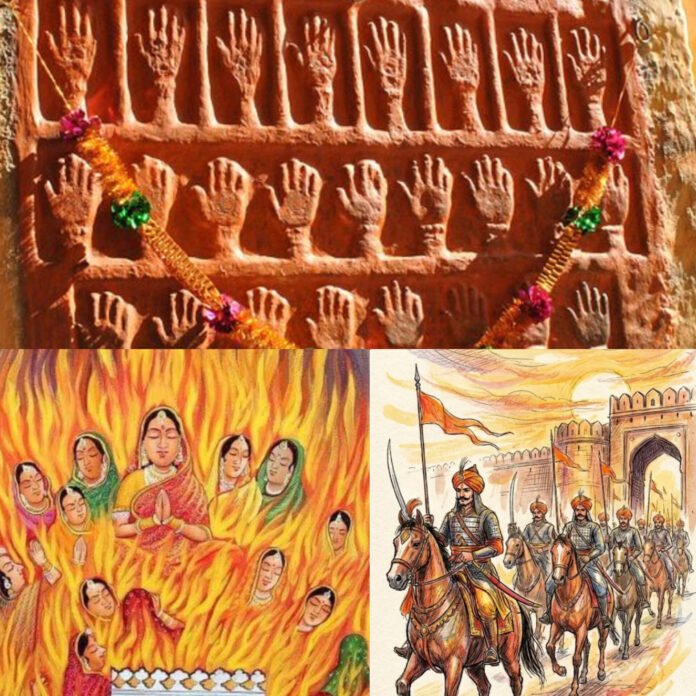
Jauhar was the collective self-immolation of women in a besieged fort when defeat and capture were considered unavoidable. Women, often accompanied by children, would enter a large fire before the enemy could take the fort.
It is important to distinguish Jauhar from Sati. Sati belonged to a different social and ritual context, whereas Jauhar was specifically associated with the extraordinary circumstances of war and imminent capture.
To understand Jauhar, one must ask a simple question: why would anyone voluntarily choose fire, one of the most painful forms of death, when survival was possible?
The answer lies in the circumstances surrounding that choice.
The Rajput woman standing inside a besieged fort was not choosing between a peaceful life and death. She was, according to the tradition and historical context of these sieges, choosing between death at her own hands and the possibility of being captured by a victorious army, enslaved, separated from her family or subjected to sexual violence.
That makes it impossible to simply dismiss Jauhar as an act of cowardice.
Cowardice is the refusal to face danger. Jauhar required facing the most terrifying danger imaginable.
A person can instinctively recoil from a flame. Even an accidental burn causes intense pain. Yet these women knowingly walked towards fire, fully aware of what it meant. They did not flee from death. They confronted it because they believed that preserving their maryada, dignity and control over their own bodies was worth the ultimate sacrifice.
From the Rajput perspective, therefore, Jauhar represented not surrender but defiance.
It was a declaration that an enemy might conquer a fort, but would not necessarily gain possession of the women within it.
What Was Kesariya?
While the women performed Jauhar, the surviving Rajput warriors prepared for their final battle.
This was known as Kesariya, associated with the saffron clothing or turbans worn by warriors before entering what was expected to be their last battle. Saffron carried deep associations with sacrifice and renunciation in Indian tradition.
The warriors knew that the military situation had reached its final stage. There was little expectation of returning alive. The fort gates would be opened and the men would ride or march out to confront the enemy.
They fought not because victory was assured, but because surrender was no longer an option.
Their objective was to fight until their final breath.
Thus, the two acts represented two different forms of sacrifice:
The women entered the fire rather than face capture.
The men entered the battlefield rather than surrender.
Then What Was Saka?
This brings us to Saka or Shaka.
In the Rajput tradition, the term is associated with the final stage of a doomed siege, encompassing the Jauhar of the women and the final battle of the warriors. Some historical descriptions specifically use shaka for the warriors’ last sortie, which is why terminology can vary between sources.
In simple terms:
Jauhar was the women’s final sacrifice.
Kesariya was the warriors’ final battle.
Saka was the larger final stand associated with both.
The significance of the tradition lies in this connection. Inside the fort, women prepared for Jauhar. Outside its gates, the warriors prepared for Kesariya. One was a confrontation with fire; the other was a confrontation with the enemy.
Both demanded the acceptance of death.
Why Did Such Extreme Acts Become Necessary?
The answer cannot be separated from the history of medieval invasions and warfare in India.
The armies of various Islamic dynasties that invaded and ruled parts of India, including the Delhi Sultanate and later the Mughal Empire, fought numerous campaigns in which defeated populations could face killing, plunder and enslavement. Historical records document the taking of women and children as captives and the existence of female slavery and concubinage in medieval Muslim-ruled societies.
The conquest of Indian kingdoms was therefore not always a simple transfer of political authority from one ruler to another. In some campaigns, the defeated population itself became part of the spoils of war.
For Rajput women, this created a terrifying possibility: what would happen when the fort fell?
Jauhar was the answer that emerged from their particular social, religious and martial worldview.
It was an extreme answer to an extreme situation.
The Jauhars Remembered in History
Several Jauhars are remembered in the historical traditions of the Indian subcontinent. Among the best-known are the Ranthambore Jauhar of 1301, associated with Alauddin Khalji’s siege of Hammiradeva’s kingdom; the Chittorgarh Jauhars of 1303, 1535 and 1568, associated respectively with Alauddin Khalji, Bahadur Shah of Gujarat and Mughal Emperor Akbar; and the Jauhar associated with Chanderi in 1528, during Babur’s campaign. The Rajasthan Tourism Department also records the Jauhar associated with the 1303 siege of Ranthambore.
These episodes are remembered because they represent the same fundamental pattern: a fort facing overwhelming military force, the possibility of defeat and capture becoming imminent, women choosing Jauhar and warriors making their final stand.
Not Cowardice, But Courage in Its Most Extreme Form
Today, Jauhar is difficult to comprehend, and rightly so. No woman should ever have to choose between death and violation.
But that is precisely why the women who made that choice should not be casually called cowards.
They lived in a world radically different from ours. They faced enemies at the gates, knew what defeat could mean and made an extraordinarily painful choice according to the values they held sacred.
One does not have to advocate Jauhar in the modern world to recognise the courage of those who performed it.
Jauhar was not an act of surrender. It was the refusal to be surrendered.
Kesariya was not an escape from battle. It was the decision to enter battle knowing that death was almost certain.
And Saka was the final expression of that Rajput ideal: when the fort could no longer be saved, honour would still be defended.
The flames of Jauhar and the saffron of Kesariya therefore remain two powerful symbols of Rajputana’s memory of sacrifice.
The fort could fall.
The kingdom could be conquered.
But, in the eyes of those who chose Jauhar and Kesariya, their dignity was not something an enemy could claim as the spoils of victory.