

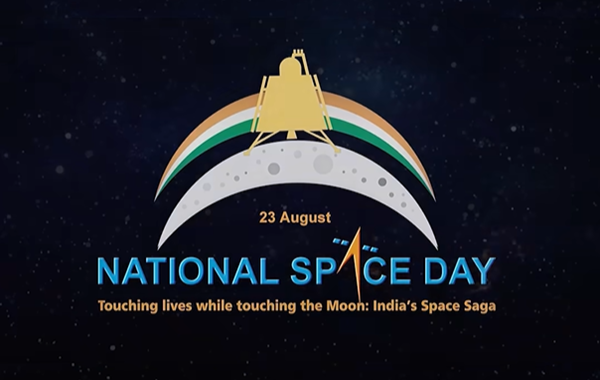
Every year on August 23, India celebrates National Space Day to commemorate one of the most remarkable milestones in the country’s space journey, the successful landing of Chandrayaan-3 on the Moon in 2023. The day celebrates India’s achievements in space science while looking ahead to the country’s growing ambitions in lunar exploration, human spaceflight, satellite technology and the wider space economy.
National Space Day was officially announced following the historic achievement of Chandrayaan-3. On August 23, 2023, the mission’s Vikram lander successfully soft-landed on the lunar surface, with the Pragyan rover subsequently deployed to carry out scientific experiments. The landing took place at a high-latitude region near the Moon’s south polar area, making India the first country to achieve a soft landing in that region and only the fourth country to achieve a soft landing on the Moon.
The achievement was significant not simply because India reached the Moon, but because Chandrayaan-3 demonstrated the country’s ability to design, build and operate a complex lunar mission. The Vikram lander and Pragyan rover carried scientific instruments that studied the lunar surface and environment, generating valuable data for scientists and adding to global understanding of the Moon.
The success also gave a new identity to the landing site. The location where Vikram touched down was named Shiv Shakti Point, while the site of Chandrayaan-2’s lander crash was named Tiranga Point. These names symbolise India’s growing connection with lunar exploration and its national aspirations in space.
From Aryabhatta to Chandrayaan
India’s space journey began decades before Chandrayaan-3. The country’s first satellite, Aryabhata, was launched in 1975, marking the beginning of an ambitious national space programme. Under the vision of scientists such as Vikram Sarabhai, India’s space programme focused not only on exploration but also on using space technology to address practical challenges on Earth.
Over the decades, Indian satellites have transformed communication, weather forecasting, agriculture, navigation, disaster management, remote sensing and broadcasting. Missions such as Mangalyaan, India’s Mars Orbiter Mission, demonstrated the country’s ability to undertake interplanetary exploration, while the Chandrayaan series progressively expanded India’s scientific understanding of the Moon.
National Space Day therefore represents much more than a single successful landing. It celebrates a journey that has developed over generations.
Inspiring the Next Generation
One of the central purposes of National Space Day is to inspire young Indians to take an interest in science and technology.
ISRO’s National Space Day programmes include exhibitions, lectures, competitions, interactions with scientists, robotics challenges and other educational activities designed to bring space science closer to students. The 2025 celebrations, for example, involved 125 events across seven zones, reaching around 1.5 lakh students and 15,000 teachers from approximately 750 schools and institutions.
The focus continues in 2026 through initiatives such as the ISRO Robotics Challenge, which encourages students to develop technologies inspired by future planetary exploration. The winners of the 2026 challenge are scheduled to be announced during the National Space Day celebrations on August 23.
Such initiatives underline an important idea: India’s future in space will depend not only on rockets and satellites, but also on the young scientists, engineers, researchers and innovators who will build the next generation of missions.
India’s Space Ambitions Are Growing
Chandrayaan-3 was a milestone, but it is not the destination.
India’s space programme is moving towards increasingly ambitious goals, including Gaganyaan, the country’s human spaceflight programme. The broader vision also includes greater participation in the global space economy, stronger collaboration between ISRO, startups and industry, and the development of technologies for future exploration.
The 2025 National Space Day theme, “Aryabhatta to Gaganyaan: Ancient Wisdom to Infinite Possibilities,” reflected this transition from India’s early satellite experiments to its ambitions for human spaceflight and beyond.
India is also expanding opportunities for private companies and startups in the space sector. The growing ecosystem is changing the character of India’s space programme, creating opportunities for innovation in launch vehicles, satellites, space applications, robotics and other technologies.
Space Technology for Life on Earth
While lunar missions capture the imagination, much of India’s space programme has always been closely connected to life on Earth.
Satellite technology supports weather forecasting and cyclone warnings, helps monitor crops and water resources, assists disaster management and enables communication and navigation services. Remote-sensing satellites provide information that can help governments and researchers understand changes in forests, agriculture, coastlines, glaciers and urban areas.
This practical dimension is an important part of India’s space story. The country’s space programme has never been only about reaching distant worlds. It has also been about using the vantage point of space to understand and improve life on Earth.
Looking Beyond the Moon
National Space Day is ultimately a celebration of both achievement and possibility.
The success of Chandrayaan-3 demonstrated that ambitious scientific goals can be achieved through persistence, innovation and careful engineering. The mission also showed students across the country that careers in science and technology can lead to extraordinary destinations, even the Moon.
As India looks towards human spaceflight and future lunar and planetary missions, the meaning of August 23 continues to evolve. It is a day to remember the moment when Vikram touched the lunar surface, but also to think about what comes next.
From Aryabhata to Chandrayaan, from Mangalyaan to Gaganyaan, India’s space journey has moved steadily from observing the skies to reaching beyond them.
National Space Day is therefore not just a celebration of where India has been. It is a reminder of how much farther it can go.