

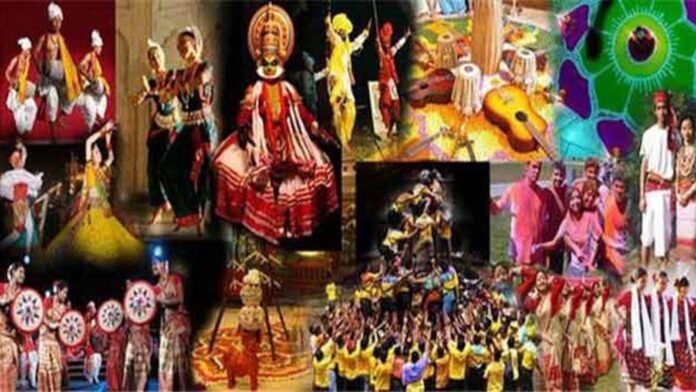
Long before stories found their way into books, films and digital screens, they travelled from one generation to another through voices. Grandparents told them to children, travellers carried them from one village to another, and communities preserved them through songs, performances, festivals and rituals. In India, this tradition created an extraordinary world of folklore, filled with animals that could speak, kings who faced impossible questions, clever ministers who outsmarted their opponents, wandering spirits and mythical creatures.
Indian folklore is not one single collection of stories. It is a vast and constantly evolving tapestry shaped by the country’s languages, landscapes, religions, communities and regional traditions. From the wisdom of the Panchatantra to the ghostly legends of India’s villages, these stories entertain, teach, warn and preserve memories of the societies that created them.
Stories That Taught Wisdom
Among India’s most celebrated collections are the Panchatantra, a group of interconnected animal fables traditionally attributed to Vishnu Sharma. Written around the idea of teaching practical wisdom, diplomacy and leadership, the stories use animals such as lions, jackals, crows, mice and turtles to explore very human qualities, friendship, greed, intelligence, loyalty and betrayal.
The appeal of the Panchatantra lies partly in its simplicity. A small animal can outwit a powerful king, while an apparently harmless decision can have unexpected consequences. Behind the humour and adventure are lessons about understanding people, thinking carefully and recognising the consequences of one’s actions.
Another beloved tradition is the world of Akbar and Birbal. Set in the court of Mughal emperor Akbar, these popular tales portray Birbal as a remarkably clever minister who uses wit and logic to resolve difficult situations. Whether or not every episode attributed to the pair is historically documented, the stories have become an enduring part of India’s popular storytelling tradition.
In South India, similar affection surrounds Tenali Rama, the witty poet and courtier associated with the Vijayanagara ruler Krishnadevaraya. His stories celebrate intelligence over arrogance and often show how humour and quick thinking can overcome seemingly impossible situations.
When Stories Become Moral Questions
Indian folklore also has a fascination with stories within stories. Few examples are as famous as Vikram and Betal.
The traditional tale follows King Vikramaditya, who must carry the spirit Betal on his back. During the journey, Betal narrates a story and ends it with a difficult question. If the king knows the answer but remains silent, his head will supposedly burst; if he answers, Betal escapes and returns to the tree.
The stories are entertaining, but their real strength lies in the moral dilemmas they present. Questions of justice, duty, truth, loyalty and responsibility repeatedly challenge the king.
The Jataka Tales, meanwhile, belong to the Buddhist storytelling tradition and narrate stories of the Buddha’s previous births. Animals, kings, merchants and ordinary people become characters in stories about compassion, generosity, wisdom and the consequences of one’s actions.
Together, these traditions show one of the most enduring qualities of Indian folklore: stories were rarely told only for entertainment. They were also a way of teaching people how to understand the world.
Every Region Has Its Own Stories
India’s folklore changes dramatically as the landscape changes.
The mountains, forests, rivers, deserts and coastal regions of the country have all produced their own legends and supernatural beings. Many of these stories are deeply connected with local geography and community beliefs.
In Assamese folklore, for example, the Baak is described in traditional stories as a supernatural water-associated being, often portrayed as mischievous and fond of fish. Such stories reflect the importance of rivers and waterways in Assamese life while adding a supernatural dimension to the landscape.
In Karnataka, the famous Nale Ba legend tells of a mysterious spirit said to roam at night. The warning associated with the legend became part of popular culture, with people traditionally writing “Nale Ba” , meaning “come tomorrow”, outside homes as a way of keeping the spirit away.
The Khasi folklore of Meghalaya has its own darker legends, including the Thlen, a serpent-like supernatural being associated with greed and malevolence. The story has been interpreted as a warning about human greed and the destructive consequences of unchecked desire.
In Kerala, stories surrounding the Odiyan describe mysterious shape-shifters believed in traditional rural folklore to possess the ability to assume different forms and move through the night. Over time, the legend has become deeply embedded in Kerala’s popular imagination.
These stories may be frightening, mysterious or fantastical, but they often reveal something real about the communities that created them, their relationship with nature, their fears, their social values and their understanding of the unknown.
Folklore Is More Than Ghost Stories
When people hear the word folklore, they often think of myths, ghosts and legendary creatures. But India’s folklore extends far beyond the supernatural.
Folk songs, proverbs, riddles, children’s rhymes, ballads, puppetry, dances, oral histories, traditional games and festival traditions are all part of this cultural world.
In Rajasthan, for instance, the tradition of Kathputli combines puppetry, music and storytelling. Heroic ballads such as those associated with Pabuji have been preserved through performance traditions such as the Phad, where painted scrolls become visual backdrops for oral storytelling.
In Bengal, the Baul tradition carries philosophical ideas through music. In Chhattisgarh, Pandavani transforms episodes from the Mahabharata into powerful musical storytelling. Karnataka’s Yakshagana combines theatre, music, dance and elaborate costumes to bring mythological narratives to life.
Every region has its own vocabulary of stories, and every community has its own way of keeping them alive.
Stories That Travel Across Generations
One of the most remarkable things about folklore is that it changes as it travels.
A story told in one village may appear with a different ending in another. A character may change names. A supernatural creature may become more frightening or more humorous. A folk song may acquire new verses as new generations sing it.
Unlike a fixed written text, oral folklore is constantly being recreated.
That is also why it is difficult to speak of a single “original” version of many Indian folk stories. Their strength lies precisely in their ability to adapt while retaining their central ideas.
From Oral Tradition to Digital Screens
Today, India’s folk stories are entering a new phase.
Stories that were once shared around courtyards, village gatherings and family homes are now being recorded in books, podcasts, films, television programmes, social media videos and digital archives. Characters such as Birbal, Tenali Rama and Vikram-Betal have found new audiences through contemporary adaptations.
This transition offers both an opportunity and a challenge. Digital platforms can help preserve stories that might otherwise disappear, but taking folklore out of its original cultural setting can sometimes simplify or change its meaning.
Preserving folklore, therefore, is not only about recording the words of a story. It also means understanding the communities, languages, performances and traditions through which those stories have survived.
A Living Archive of India
Indian folklore is ultimately a record of how ordinary people have understood extraordinary things.
It tells us what communities feared and admired, how they explained nature, how they taught children about right and wrong, how they remembered heroes and how they imagined the supernatural. It preserves the voices of people whose experiences may never have entered formal history books.
A clever jackal in the Panchatantra, Birbal solving a royal puzzle, Tenali Rama laughing at arrogance, Vikram answering Betal’s questions or a mysterious spirit waiting beside a river may seem like characters from completely different worlds. Yet they share a common purpose: they turn experience into story.
And that is perhaps the greatest strength of Indian folklore. It does not live only in the past. Every time a grandmother tells a story, a folk singer performs an old ballad, a child repeats a familiar rhyme or a community celebrates a traditional ritual, the story begins again.
The characters may be ancient, but the telling is always new.