

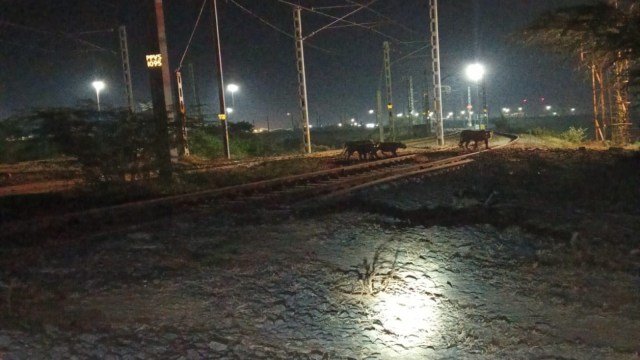
Gujarat is turning to artificial intelligence and advanced surveillance technology to protect one of India’s most iconic wild animals, the Asiatic lion, from railway accidents in the Saurashtra region. As lions increasingly move beyond the traditional boundaries of the Gir landscape, railway tracks passing through their habitat have emerged as a serious conservation challenge. A new technology-driven safety system is now being developed to detect lions near tracks and alert railway authorities before a collision can occur.
The need for such measures is significant. According to a compliance report submitted before the Gujarat High Court, 19 lions were killed in train accidents between 2014 and 2024. In response, the Gujarat government and Indian Railways have introduced a combination of traditional wildlife safeguards and new technology. These measures have included railway trackers, watchtowers, vegetation clearance, underpasses, speed restrictions and warning systems for trains.
The latest initiative is an Artificial Intelligence-based Intrusion Detection System (IDS) designed to identify lion movement close to railway tracks. The Centre has sanctioned the system for a 115-km stretch between Damnagar and Pipavav in the Bhavnagar division of Western Railway, an area located within the wider Gir lion landscape. Once operational, the system is intended to send alerts to loco pilots, station masters and railway control rooms, allowing preventive action to be taken when lions approach the tracks.
The technology is being combined with optical-fibre sensing and CCTV surveillance. Fibre-optic cables have already been laid along the Liliya-Savarkundla section in Amreli district, where lion movement near the railway line has been identified as a concern. The system is designed to detect movement signatures and provide an early warning. AI-powered cameras are also being planned at identified hotspots to detect lions approaching the tracks and alert train operators.
However, the system is still being developed and tested. The Gujarat government’s submission to the High Court noted that the current software accuracy needs improvement, while further deployment of fibre-optic cables in forest areas will require assessment. The Intrusion Detection System is therefore being introduced in phases, following proof-of-concept trials and the necessary railway approvals.
Technology is only one part of the larger conservation effort. The state has deployed 70 railway trackers, identified around 100 wildlife-movement hotspots, installed watchtowers and cleared vegetation along vulnerable sections so that train drivers and wildlife personnel have better visibility. Railway underpasses are also being upgraded, with additional underpasses proposed in areas where wildlife movement is frequent.
Between April and July 2026 alone, authorities carried out 1,104 lion-diversion operations and issued 1,356 caution orders to help prevent encounters between lions and trains. Across the broader safety programme, more than 6,600 lions have been diverted from railway tracks, along with more than 1,100 other animals. The state has also conducted training programmes for railway personnel and loco pilots operating in the lion landscape.
The measures appear to have made a significant difference. The Indian Express reported that no lion was killed by a train between August 2024 and May 2026. There was, however, an incident in November 2025 when a train hit a one-year-old lion cub between Vadiya-Haveli and Vavdi stations. The injured cub survived after being taken to Sakkarbaug Zoo for treatment.
The Railways is also improving visibility for locomotive drivers. Locomotives operating in vulnerable areas are being equipped with twin-beam LED headlights, with Western Railway reporting that 559 of 917 locomotives had been converted to LED headlights, while the remaining 358 were under conversion. Better visibility, speed restrictions, trackers and AI-based detection are intended to work together rather than replace human intervention.
The effort reflects a larger challenge facing Gujarat’s conservation programme. The Asiatic lion population has expanded beyond its traditional stronghold in Gir, increasing the number of encounters between wildlife and human infrastructure. Railway lines, roads and expanding settlements can become dangerous barriers for animals moving through the wider landscape.
The Gujarat High Court is monitoring the implementation of safety measures through a suo motu public interest litigation concerning lion deaths caused by railway accidents. The court has sought updates on underpass retrofitting, railway safety measures, LED headlights, trials of the Intrusion Detection System and progress on AI-based monitoring. The matter is scheduled to be reviewed again on September 11, 2026.
Gujarat’s approach represents a growing intersection between wildlife conservation and technology. Instead of waiting for a lion to reach the tracks and relying solely on human trackers to respond, the emerging system aims to detect movement earlier and give railway authorities precious time to act.
For the Asiatic lion, that few extra seconds could make the difference between life and death. As technology becomes another tool in the conservation toolbox, Gujarat is attempting to ensure that its railway network and its most celebrated wild residents can share the same landscape more safely.