

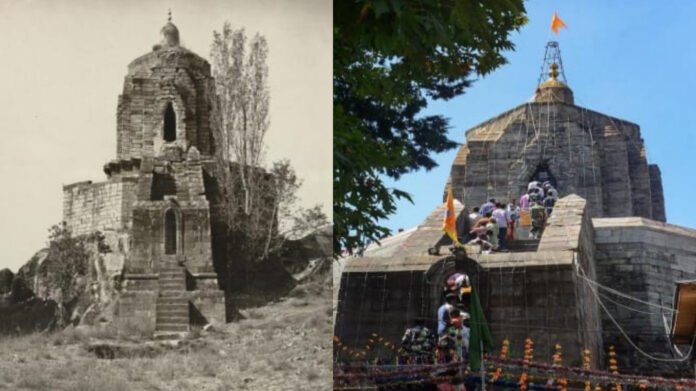
High above Srinagar, on a forested hill overlooking the city, stands a small stone temple that seems to watch over the entire valley. This is the Shankaracharya Temple, one of Kashmir’s most recognisable landmarks and one of its most revered Hindu shrines.
From a distance, the grey stone structure looks almost like a crown resting on the hill. From its terrace, Srinagar unfolds below, Dal Lake glitters in the distance, houseboats appear like tiny shapes on the water and the surrounding mountains frame the valley.
But the view is only part of the experience. To reach the temple, visitors climb a flight of 243 stone steps. By the time you reach the top, the climb itself feels like a small pilgrimage.
A Temple Older Than Its Name
The history of the shrine reaches far beyond the name by which it is known today.
The hill has been associated with several names and traditions over the centuries, including Gopadari and Takht-e-Sulaiman. Different historical accounts and local traditions offer varying dates for the origins of the shrine, with some placing its beginnings in antiquity and others associating the present temple with later periods.
The important point is that the site has undergone several phases of repair and reconstruction over centuries. Kings and rulers from different periods contributed to its preservation, while the temple and hill continued to acquire new layers of history.
According to the Government of India’s Incredible India portal, rulers including Gopaditya, Lalitaditya and Gulab Singh were among those associated with additions, repairs or reconstruction at the site.
This makes the Shankaracharya Temple less a monument belonging to one particular era and more a structure shaped by centuries of Kashmir’s changing history.
When Adi Shankaracharya Came to Kashmir
The temple’s present identity is closely connected with Adi Shankaracharya, the great philosopher and teacher associated with Advaita Vedanta.
Born in Kaladi in present-day Kerala, Adi Shankaracharya is traditionally believed to have travelled extensively across India during his life. His journeys took him to different centres of learning, where he debated scholars and taught the philosophy of Advaita Vedanta, the idea that the ultimate reality is non-dual and that the apparent separation between the individual self and the supreme reality is ultimately an illusion.
Kashmiri tradition holds that Shankaracharya visited the valley and climbed the hill where the temple stands today. He is believed to have meditated here and engaged in philosophical contemplation.
The temple was not built by him. Its association with the philosopher developed over time, and the hill and shrine eventually became known by his name.
Historical sources place the emergence of the name Shankaracharya in connection with 19th-century repairs and restoration, rather than suggesting that the temple had carried this name since his visit.
That distinction makes the story even more fascinating: the shrine itself is older than the name that eventually became inseparable from it.
A Structure Built to Endure
The temple’s architecture is striking in its simplicity.
It stands on a 20-foot-high octagonal base, with a square structure above it and a circular sanctum within. The shrine is built primarily of massive stone blocks and rests directly on the rocky hilltop. The interior houses a Shiva Lingam in the sanctum.
The temple is also an example of the distinctive architectural traditions that developed in Kashmir. Its solid stone construction and elevated position give it a remarkably enduring presence against the landscape.
The Archaeological Survey of India describes the temple as standing on a solid rock, with an octagonal stone basement supporting the square temple structure.
Over the centuries, however, the building did not survive untouched. Repairs were carried out at different points in its history. The Dogra ruler Maharaja Gulab Singh is credited with constructing the steps from the Durga Naag side, while later additions and repairs further shaped the monument visitors see today.
The shrine is now a nationally protected monument maintained by the Archaeological Survey of India, while its religious affairs are managed by the Dharmarth Trust.
A Sacred Place for Kashmiri Hindus
For Kashmiri Hindus, the temple is much more than a historic monument.
Dedicated to Lord Shiva, it remains an important place of worship, particularly during Maha Shivaratri, known among Kashmiri Pandits as Herath.
Devotees climb the hill, enter the stone sanctum and offer prayers before the Shiva Lingam. The atmosphere is markedly different from the bustle of Srinagar below. Once inside the temple complex, the noise of the city seems to fall away.
The spiritual significance of the place is also closely connected with the memory of Adi Shankaracharya and the philosophical traditions associated with his visit to Kashmir.
In 1961, the Shankaracharya of Dwarkapeeth installed a statue of Adi Shankaracharya at the temple, adding another layer to the shrine’s long association with the philosopher.
The 243-Step Climb
The climb is an essential part of the experience.
There are 243 steps leading towards the temple complex, followed by additional steps leading into the sanctum. The climb is manageable for many visitors, but it is still worth taking slowly, particularly if you are not accustomed to walking uphill.
There is something symbolic about approaching a hilltop Shiva shrine this way. With every step, the city gradually disappears behind you. The sounds become quieter, the trees become more prominent and the view of the valley keeps widening.
By the time you reach the top, the journey has become as memorable as the destination.
What to Know Before You Visit
The Shankaracharya Temple lies within a high-security area, so visitors should be prepared for security checks.
Mobile phones and cameras are not permitted at the temple because of security restrictions. JKTDC specifically advises visitors not to carry these devices to the top.
The temple is generally listed as open from 7 am to 8 pm, although access arrangements can change and visitors should follow the instructions of security personnel at the time of their visit.
There is no entry fee for darshan. Comfortable footwear is advisable because of the long flight of steps, and visitors should dress respectfully as they are entering an active place of worship.
Because security rules can be updated, it is best to check locally before visiting rather than relying entirely on older travel information.
What to See Nearby
A visit to Shankaracharya Temple can easily be combined with some of Srinagar’s most famous attractions.
The Mughal gardens, Nishat Bagh, Shalimar Bagh and Chashme Shahi, lie around Dal Lake and are known for their terraces, fountains, lawns and old chinar trees.
Nearby, Pari Mahal, or the Palace of Fairies, sits dramatically on another hill and offers sweeping views of the city and Dal Lake.
The Hazratbal Shrine, located on the northern shore of Dal Lake, is another important landmark of Srinagar and an important part of the city’s religious and architectural landscape.
And, of course, no visit to Srinagar feels complete without spending time on Dal Lake. A shikara ride in the softer light of late afternoon offers a completely different perspective of the city and its surrounding hills.
Where History, Faith and Landscape Meet
People climb Shankaracharya Hill for different reasons.
Some come to pray before Shiva. Some come because of the connection with Adi Shankaracharya. Others come for the sweeping view of Srinagar and Dal Lake.
And some simply want to experience the famous 243-step climb.
Yet the temple leaves an impression that goes beyond any one of these reasons.
Its story contains ancient traditions, the memory of a wandering philosopher, centuries of repair and restoration, changing rulers and generations of devotees who continued to return to the same hilltop.
That is perhaps what makes Shankaracharya Temple so compelling. It is not a monument frozen in one moment of history. It is a place where different layers of Kashmir’s past continue to exist together.
And when you finally stand at the top, with the stone temple behind you and Srinagar spread out below, the 243 steps begin to feel like more than a climb.
They feel like a journey through time, one step, one story and one prayer at a time.
(The writer of this article is Akhilesh Saproo, a student of APS Jaipur)