

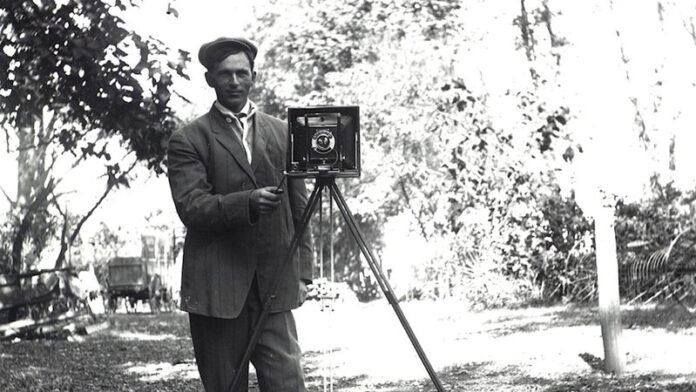
Photography may seem like a modern invention, but its foundations go back thousands of years. Long before cameras could capture and preserve an image, philosophers and scientists were fascinated by the behaviour of light. Ancient thinkers in China and Greece observed that when light passed through a small opening into a darkened space, it projected an inverted image of the scene outside. This principle eventually became known as the camera obscura and provided the foundation for modern photography.
The major breakthrough came in the early 19th century. French inventor Nicéphore Niépce experimented with light-sensitive substances and, around 1826, created what is widely regarded as the world’s first permanent photograph. Known as View from the Window at Le Gras, the image was made using bitumen of Judea spread over a pewter plate. The process required an exposure lasting several hours, but it demonstrated for the first time that an image produced by light could be permanently recorded.
Niépce later collaborated with French artist and inventor Louis Daguerre. After Niépce’s death, Daguerre continued developing their work and introduced the daguerreotype in 1839. The process produced highly detailed photographs on polished metal plates. Unlike later photographic techniques, each daguerreotype was a unique image that could not simply be reproduced from a negative. The process nevertheless represented a major step forward and helped bring photography into public life.
Another important development came from English scientist William Henry Fox Talbot, who developed the calotype process. Unlike the daguerreotype, Talbot’s method used a paper negative from which multiple positive prints could be produced. This negative-positive system became an important foundation for the photographic processes that followed and eventually made reproduction of photographs much easier.
During the middle of the 19th century, photography continued to become sharper, faster and more practical. The wet plate collodion process, introduced in 1851, produced detailed images and became widely used. However, photographers still had to prepare and process photographic plates while they were wet, meaning that photography often required considerable equipment, chemicals and technical skill.
Photography began moving towards mass accessibility in the late 19th century. In 1888, George Eastman introduced Kodak’s handheld camera using flexible roll film, dramatically simplifying the process for ordinary users. Kodak’s famous slogan, “You press the button, we do the rest,” reflected a new idea: photography no longer had to be limited to professional photographers and specialists. People could now take photographs more easily and send the film for processing.
The 20th century brought further changes, particularly with the arrival of colour photography and instant photography. Kodachrome colour film was introduced in 1935, making colour photographs increasingly practical and popular. In 1947, Polaroid introduced instant photography, allowing people to see a developed photograph almost immediately after taking it. Photography was becoming not only a tool for documentation but also an important part of everyday social and family life.
The next revolution began with digital technology. In 1975, Kodak engineer Steven Sasson built an early prototype of a digital camera. Instead of recording an image on film, the camera used an electronic sensor and stored the captured information digitally. Although the technology was primitive compared with today’s devices, it marked the beginning of a transformation that would eventually change photography forever.
By the late 20th and early 21st centuries, digital cameras began replacing film for professional and everyday photography. Images could be viewed instantly, stored electronically, edited on computers and shared without the need for chemical processing. As digital sensors became smaller and more powerful, cameras were increasingly incorporated into mobile phones.
The arrival of the smartphone camera transformed photography on an unprecedented scale. Today, almost anyone can capture, edit and share a photograph within seconds. Modern smartphones combine multiple lenses, powerful sensors, artificial intelligence and computational photography to produce images that would have required sophisticated equipment only a few decades ago.
Photography has therefore travelled a remarkable path, from a simple projection of light inside a camera obscura to sophisticated computational images created by pocket-sized devices. Yet its fundamental purpose remains unchanged: to capture a moment and preserve it beyond the passage of time.
Whether it is an early photograph that provides a glimpse into the 19th century, a historic image that documents social change, a family picture that preserves a personal memory or a smartphone photograph shared across the world, photography continues to shape how people understand and remember their lives. Its technology has changed dramatically, but its power to tell stories remains timeless.