

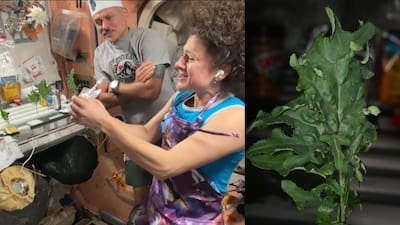
Indian-origin NASA astronaut Anil Menon and fellow astronaut Jessica Meir recently harvested kale and wasabi mustard greens grown aboard the International Space Station, offering a glimpse of what farming could look like on future missions to the Moon and Mars.
Growing vegetables in space may sound like something from a science-fiction film, but astronauts aboard the International Space Station (ISS) are turning the idea into reality. In a recent experiment, Indian-origin NASA astronaut Anil Menon and astronaut Jessica Meir harvested fresh kale and wasabi mustard greens grown aboard the orbiting laboratory and used them to prepare a meal.
The experiment is part of NASA’s continuing efforts to understand how plants can be cultivated in the challenging environment of space. The vegetables were grown aboard the ISS for about a month using NASA’s Veggie plant-growth system, which is designed to study plant growth in microgravity and explore the possibilities of producing fresh food away from Earth.
Menon recently shared a glimpse of the unusual farm-to-table experience in orbit, showing the astronauts harvesting the greens before preparing and eating them. The simple meal represented a significant step in space-food research: rather than receiving all their food from Earth, astronauts could eventually grow at least part of what they eat during long-duration missions.
Why Grow Food in Space?
Astronauts aboard the ISS currently depend largely on packaged and preserved food, with fresh produce periodically delivered through resupply missions. While this system works for missions in low Earth orbit, it becomes far more difficult when humans travel farther from Earth.
A future journey to Mars could take months each way, making regular resupply impossible. NASA has therefore been studying whether astronauts could produce fresh fruits and vegetables during long missions. Freshly grown food could provide important nutrients, while also adding variety to an otherwise highly processed diet. NASA notes that plants could also offer psychological benefits by bringing a small element of nature into an otherwise artificial environment.
Farming Without Earth’s Gravity
Growing a plant in space is considerably more complicated than growing one in a garden on Earth. In microgravity, roots do not respond to gravity in the same way, and water and nutrients behave differently. Researchers must therefore carefully control factors such as lighting, moisture, nutrients and the plant’s growing environment.
NASA’s Veggie system uses specialised growing arrangements and artificial lighting to create suitable conditions for plants aboard the ISS. Earlier experiments have successfully grown several types of crops, including lettuce, Chinese cabbage, mustard greens and kale.
The latest harvest of Red Russian kale and wasabi mustard greens adds to this growing body of research. The ISS has previously experimented with similar crops, demonstrating that plants can not only grow in orbit but, under controlled conditions, provide food for astronauts.
A Taste of the Future
For Menon and Meir, the experiment offered something more than scientific data, it offered the novelty of eating food that had been grown where there is no soil, no traditional farm and no natural sunlight.
The idea has wider implications. Future lunar bases or Mars habitats may need some form of controlled agriculture to reduce dependence on supplies sent from Earth. Researchers are therefore exploring which crops can grow efficiently in space and how plants respond to microgravity and artificial growing conditions.
NASA has already tested a variety of plants in space, and research continues into crops that could provide nutrition while requiring relatively little space, water and energy.
From the ISS to the Moon and Mars
The significance of the experiment lies not in the quantity of vegetables harvested but in what it represents for the future of human exploration. Space agencies are preparing for missions that could keep humans away from Earth for much longer periods than today’s typical orbital missions.
For astronauts heading to the Moon, Mars or beyond, the ability to grow at least some food locally could become an important part of building sustainable habitats. Plants could potentially contribute not only food but also psychological benefits and, in carefully designed life-support systems, help with aspects of air and environmental management.
The small greens growing inside the ISS may therefore be early signs of a much larger possibility: farms beyond Earth.
What looks like a simple harvest of kale and mustard today could eventually become a crucial part of how humans survive far from home. For now, astronauts are taking small steps, one plant, one harvest and one meal at a time, to discover whether farming can truly follow humanity into space.