

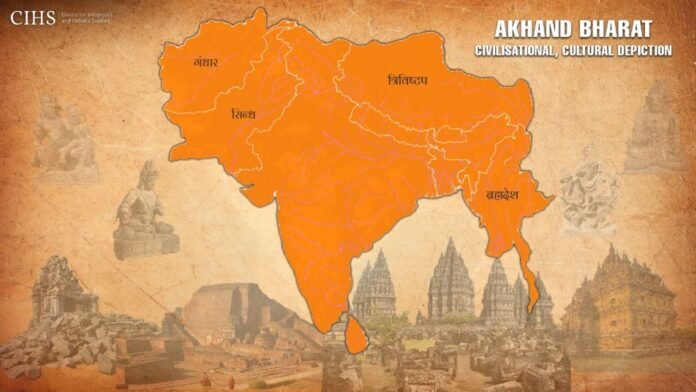
Before there was a Republic of India, before the borders of India and Pakistan were drawn in 1947, there existed an older idea of Bharatavarsha, a geographical and civilisational imagination that connected diverse regions through stories, sacred places, philosophical traditions, trade and pilgrimage.
This is the historical foundation from which the modern idea of Akhand Bharat, or Undivided Bharat, draws its meaning. But to understand it accurately, one distinction is essential: Akhand Bharat was not an ancient nation-state with permanently fixed borders. It represents a civilisational idea that, at different moments, was also reflected in large political empires.
A Bharat before modern borders
Ancient Indian texts refer to geographical concepts such as Bharatavarsha and Aryavarta. The Mahabharata, for instance, contains a remarkably wide geographical world: Gandhari is associated with Gandhara, corresponding broadly to the region around present-day Kandahar; Krishna’s story connects Mathura and Dwarka; and Arjuna’s journeys extend to regions in the east. The Ramayana similarly creates a north-south geographical imagination stretching from Ayodhya to Rameswaram and Lanka.
These epics should not be read as modern geographical atlases. But their importance lies elsewhere. Their stories travelled across linguistic and regional boundaries, creating a shared sacred and cultural geography.
A pilgrim did not need a single emperor to travel from one end of the subcontinent to another.
When political unity did exist
There were also periods when substantial parts of the subcontinent came under common political authority.
The Mauryan Empire, beginning with Chandragupta Maurya in the fourth century BCE and reaching its greatest extent under Ashoka, brought much of the subcontinent under one imperial administration. The empire extended into areas of present-day Pakistan and Afghanistan, while southern kingdoms remained outside direct Mauryan rule.
Centuries later, the Mughal Empire also governed enormous portions of the subcontinent, although its territorial extent changed considerably over time.
These empires demonstrate that political unification on a large scale was possible. They do not, however, prove that the entire territory shown on some modern Akhand Bharat maps was ever governed continuously by one state.
That distinction is crucial to historical accuracy.
A unity carried by culture
Perhaps the strongest evidence for the older idea of a connected Bharat lies not in imperial borders but in movement.
The Bhakti traditions that developed in different regions created links across languages and kingdoms. The Alvars and Nayanars in the south, followed centuries later by figures such as Chaitanya Mahaprabhu, Mirabai, Tulsidas, Surdas, Guru Nanak and Tukaram, expressed devotion in different languages and traditions while drawing upon a wider shared religious and cultural vocabulary.
The stories of Ram, Krishna, Shiva and Shakti were repeatedly retold in Tamil, Kannada, Bengali, Marathi, Braj, Awadhi, Rajasthani and other languages.
The result was not uniformity. It was unity within diversity.
The same can be seen in pilgrimage. Sacred centres across the subcontinent created networks that connected regions long before the age of modern transport.
Tradition also associates Adi Shankaracharya with establishing major monastic centres at Sringeri in the south, Dwarka in the west, Puri in the east and Badrinath in the north. While details of these traditions are debated by historians, they reflect the long-standing importance of pan-Indian pilgrimage and intellectual networks.
From civilisation to political idea
The explicitly political formulation of Akhand Bharat is much more recent.
During the nationalist period, thinkers such as V. D. Savarkar and K. M. Munshi articulated visions of an undivided Indian homeland. In October 1944, intellectual Radha Kumud Mukherjee presided over an Akhand Hindustan Leaders’ Conference in Delhi. Later, Deendayal Upadhyaya described Akhand Bharat in terms of nationalism and an integral cultural unity.
Partition in 1947 gave the idea an even sharper political meaning. For its proponents, the division of British India represented a rupture of a historically connected civilisation. For others, the post-1947 states represented legitimate national and political identities that had emerged from a complex history.
Thus, the modern political idea of Akhand Bharat belongs to the debates of modern nationalism; it should not simply be projected backwards as though ancient people used the term with exactly the same meaning.
So, was Akhand Bharat real?
As a civilisational geography with deep connections across much of the subcontinent, yes. Ancient texts, pilgrimage traditions, philosophical exchanges, religious movements, languages, trade and shared epics reveal connections that long predate the British Empire.
And at certain points in history, vast portions of this geographical world were politically unified under powerful empires such as the Mauryas.
Akhand Bharat, therefore, is best understood not as a claim that one ancient empire possessed today’s entire map of South Asia, but as a modern expression rooted in the older civilisational idea of Bharatavarsha.
The map may have changed many times. Kingdoms rose and fell. Languages and political boundaries shifted. Yet the journeys of stories, pilgrims, poets and ideas continued across them.
The historical story of Akhand Bharat is, ultimately, less about one map and more about a civilisation that existed across many maps.