

What does independence mean to an ordinary person? For a child, it is the freedom to dream without fear. For a student, it is the opportunity to learn and build a future. For every citizen, it is the right to speak freely, choose a profession, practise one’s faith, and live with dignity under the protection of the Constitution.
These freedoms, however, were hard-earned. Before 15 August 1947, India was under colonial rule. The voices of Indians were suppressed, opportunities were limited, and those who challenged British authority often faced imprisonment or worse. Yet, countless freedom fighters refused to surrender.
From Mahatma Gandhi’s path of truth and non-violence to the revolutionary courage of Bhagat Singh, Chandrashekhar Azad, Subhas Chandra Bose, Rani Lakshmibai, Usha Mehta, and thousands of unsung heroes, every sacrifice had one common goal, an independent India. Their dream was not merely political freedom but a nation where future generations could live with dignity, equality, and hope.
Nearly eight decades later, India has made remarkable progress. We have strengthened our democracy, advanced in science and technology, and emerged as one of the world’s fastest-growing economies. Yet, challenges such as corruption, misinformation, discrimination, and injustice continue to test our society.
Every generation has its own responsibility. While our freedom fighters liberated India from colonial rule, our duty is to strengthen the nation by upholding honesty, compassion, unity, and respect for democratic values. True independence is not only about celebrating the past but also about shaping a better future.
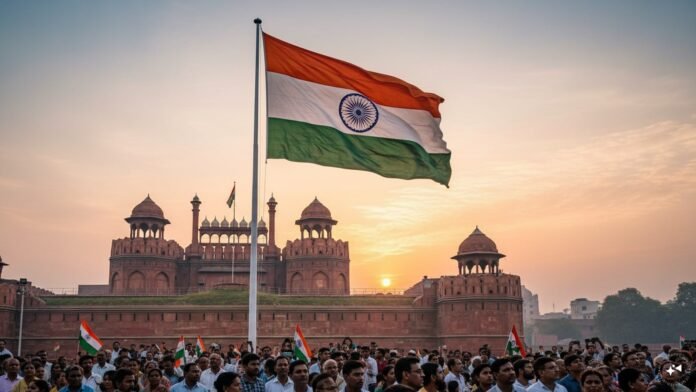
As the Tricolour flies high this Independence Day, let us remember that freedom was earned through immense sacrifice. The greatest tribute we can pay to those who fought for our nation is to build an India that is stronger, fairer, and more united for generations to come.
Jai Hind!
(The writer of this article is Lakshya Govani, a student of APS Jaipur)