

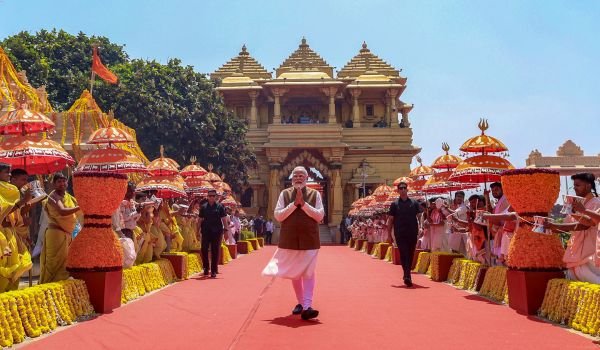
The historic Somnath Temple once again became the centre of national attention as Prime Minister Narendra Modi visited Gujarat to participate in the Somnath Amrut Mahotsav celebrations marking 75 years of the temple’s post-Independence reconstruction. The occasion commemorates not only the rebuilding of one of India’s holiest temples, but also what many describe as a symbol of India’s cultural resurgence and civilisational resilience.
Located on the western coast of Gujarat at Prabhas Patan, Somnath is revered as the first among the twelve Jyotirlingas of Lord Shiva. Over centuries, the temple became a symbol of repeated destruction and reconstruction. It was attacked and rebuilt multiple times through history, most famously after the invasion by Mahmud of Ghazni in 1026 CE. Yet despite repeated devastation, the temple continued to rise again, becoming deeply associated with India’s enduring spiritual and cultural identity.
After Independence, the reconstruction of Somnath became one of the earliest cultural restoration efforts of newly free India. The initiative was led by Sardar Vallabhbhai Patel and strongly supported by writer and statesman K. M. Munshi. The rebuilt temple was inaugurated in 1951 by India’s first President, Rajendra Prasad.
During the recent celebrations, Prime Minister Modi described Somnath as a “timeless symbol of Bharat’s resilience, unity and civilisational strength.” He shared articles highlighting how the temple’s reconstruction represented “one of the earliest expressions of national self-confidence” in independent India. According to the Prime Minister, despite opposition from sections of the political establishment at the time, the reconstruction sowed the seeds of India’s cultural renaissance and renewed civilisational pride.
Addressing devotees and visitors during the event, the Prime Minister said Somnath was not merely a temple but a symbol of the spirit of India that could never be erased despite repeated attacks across centuries. He noted that the temple’s journey reflected the ability of Indian civilisation to survive adversity while preserving faith and heritage.
The Amrut Mahotsav celebrations included spiritual ceremonies, cultural programmes and events honouring the temple’s thousand-year history. The occasion also highlighted the broader significance of preserving India’s cultural and spiritual heritage in modern times.
Today, Somnath stands not only as a major pilgrimage centre but also as a powerful reminder of historical continuity and national identity. Its story — of destruction, rebuilding and revival — continues to resonate across generations as a symbol of faith, endurance and cultural self-confidence in modern India.