

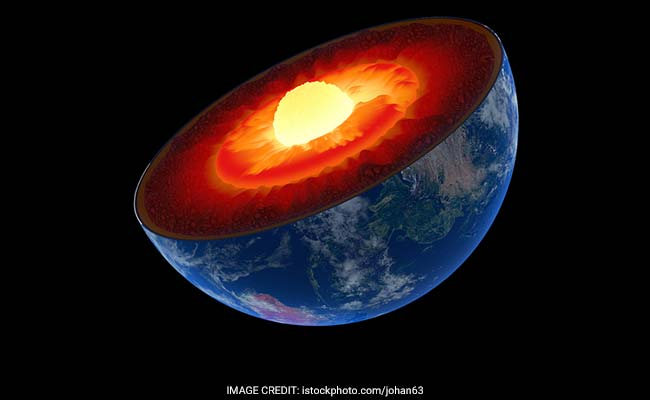
Scientists have uncovered evidence of a vast water reservoir located nearly 700 kilometres beneath the Earth’s surface, potentially containing more water than all oceans combined. This “hidden ocean” is not a liquid body but water trapped within minerals deep inside the mantle. The discovery is reshaping scientific understanding of Earth’s internal structure and the origin of its water.
Location and Nature of the Hidden Reservoir
The water is found in the Earth’s mantle, far below the crust, in a region known as the transition zone. Unlike surface oceans, this water is not free-flowing. Instead, it is chemically bound within a high-pressure mineral called ringwoodite. Formed under extreme heat and pressure, ringwoodite can store significant amounts of water within its crystal structure, making it a crucial component of Earth’s deep water cycle.
Scientific Evidence and Research Methods
Direct exploration at such depths is not possible with current technology. Scientists rely on indirect methods such as seismic wave analysis. Earthquake waves slow down when passing through water-rich regions, providing clues about subsurface composition. Laboratory experiments and the study of ringwoodite samples, brought to the surface through volcanic activity, have confirmed the presence of water within these minerals.
Implications for Earth’s Water Origin
This discovery challenges the long-held theory that Earth’s water was delivered by comets. Instead, it supports the idea that water has been present within the planet since its formation. Over geological time, this internal water may have gradually reached the surface through volcanic processes, contributing to the formation of oceans while maintaining a stable global water volume.
Important Facts
- Ringwoodite is a high-pressure mineral capable of storing water in the mantle.
- Earth’s transition zone lies between 410 km and 660 km depth.
- Seismic waves slow down in water-bearing regions inside Earth.
- The mantle holds a significant portion of Earth’s internal water reserves.
Significance for Earth Sciences
The presence of such a massive internal water reserve has major implications for geology and planetary science. It enhances understanding of the deep water cycle, tectonic activity, and long-term climate stability. This finding also opens new avenues for studying how Earth’s interior influences surface conditions, reinforcing the complexity of planetary evolution.