

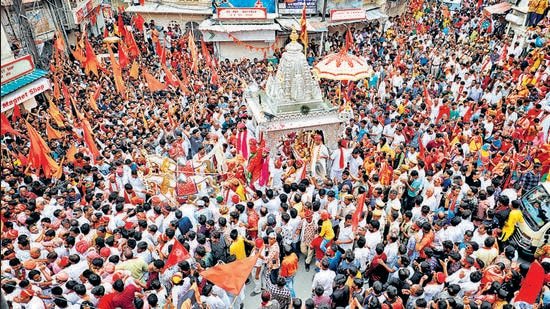
While the grand Rath Yatra of Puri in Odisha is celebrated as one of the world’s largest religious festivals, few know that Udaipur, the historic capital of Mewar, has its own centuries-old Jagannath Rath Yatra rooted in royal tradition. Every year, the streets around the iconic Jagdish Temple come alive with devotional chants, colourful processions, and thousands of devotees as Lord Jagannath, accompanied by Lord Balabhadra and Devi Subhadra, embarks on a ceremonial journey.
More than a religious procession, the Rath Yatra of Jagdish Mandir is a living symbol of Udaipur’s royal legacy, cultural continuity, and deep Vaishnavite traditions that have been preserved for nearly four centuries.
Maharana Jagat Singh and the Foundation of Jagdish Temple
The story of Udaipur’s Rath Yatra begins with Maharana Jagat Singh I, one of the prominent rulers of the Mewar kingdom.
A devout follower of Lord Vishnu, Maharana Jagat Singh commissioned the construction of the magnificent Jagdish Temple in 1651 CE. Built at a reported cost of around 15 lakh rupees, an enormous sum for its time, the temple became one of the largest and most important Vaishnavite shrines in Rajasthan.
Situated in the heart of Udaipur, just north of the City Palace, the temple is dedicated to Lord Jagannath, worshipped locally as Lord Jagdish, a form of Lord Vishnu. Its towering Indo-Aryan shikhara, richly carved pillars, sculpted elephants, musicians, dancers, celestial beings, and scenes from Hindu mythology make it one of the finest examples of Mewar’s temple architecture.
Since its establishment, the temple has remained not only a centre of worship but also a focal point of Udaipur’s religious and cultural life.
Inspired by the Sacred Tradition of Puri
The Jagdish Mandir Rath Yatra draws its inspiration from the renowned Rath Yatra of Puri, Odisha, where Lord Jagannath undertakes His annual journey to the Gundicha Temple.
Following this sacred tradition, beautifully decorated wooden chariots carrying Lord Jagdish (Jagannath), Lord Balabhadra, and Devi Subhadra are taken out in a ceremonial procession through the old city. Devotional hymns, traditional music, and chants of “Jai Jagannath” accompany the procession as devotees gather in large numbers to seek blessings.
While the scale is naturally smaller than Puri’s world-famous festival, the spiritual essence remains the same—the Lord leaves the sanctum of the temple to bless devotees outside its walls, symbolising accessibility, compassion, and equality.
A Royal Tradition That Lives On
One of the most distinctive features of Udaipur’s Rath Yatra is its enduring connection with the House of Mewar.
Historically, the Maharanas of Mewar regarded Lord Jagdish as the divine protector of the kingdom. Members of the erstwhile royal family traditionally participated in important temple ceremonies, offering prayers and paying homage before the procession commenced.
Even today, representatives of the Mewar royal family continue to be associated with the festival, preserving customs that have been handed down through generations. Their participation reflects the centuries-old relationship between the rulers of Mewar and the temple established by Maharana Jagat Singh I.
The festival thus serves as a bridge between Rajasthan’s royal heritage and its living religious traditions.
The Procession Through the Heart of Udaipur
On the day of the Rath Yatra, the surroundings of Jagdish Chowk are transformed into a vibrant centre of devotion.
The decorated chariot carrying the deities moves through traditional routes in the old city, accompanied by priests, temple devotees, musicians, bhajan mandalis, and local residents. Flowers are showered upon the procession, devotional songs fill the air, and families line the streets to witness the sacred journey.
Many devotees consider pulling or accompanying the chariot a deeply auspicious act, symbolising humility and devotion. The festival brings together people from different communities, reflecting the inclusive spirit that has long characterised the Jagannath tradition.
Faith Beyond Ritual
For the people of Udaipur, the Rath Yatra is much more than an annual religious event. It is a celebration of the city’s history, identity, and collective faith.
Generations of families have participated in the procession, making it an integral part of Udaipur’s cultural calendar. Visitors and tourists also gather to witness the unique blend of royal grandeur, temple rituals, and community participation that distinguishes the festival from many others in Rajasthan.
The event highlights how centuries-old traditions continue to thrive in a rapidly changing world, connecting the past with the present.
A Living Legacy of Mewar
Nearly 400 years after Maharana Jagat Singh I established the Jagdish Temple, the Rath Yatra continues to uphold the values of devotion, service, and cultural continuity.
As Lord Jagdish’s chariot rolls through the historic lanes of Udaipur each year, it carries more than sacred idols. It carries the memory of a visionary ruler, the artistic brilliance of Mewar’s temple architecture, and a tradition that has united royalty and common citizens in shared devotion for generations.
In an age of constant change, Udaipur’s Jagdish Mandir Rath Yatra remains a powerful reminder that some journeys are timeless, where faith, history, and heritage move together, one chariot at a time.