

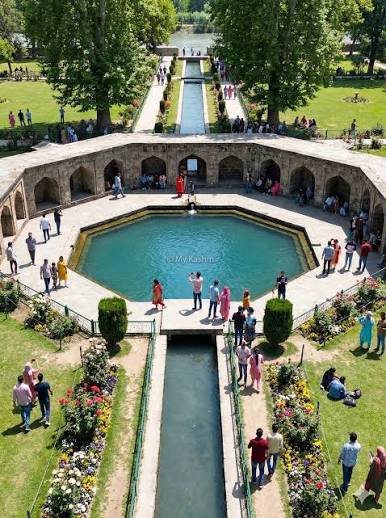
There is a particular kind of silence at Verinag before the crowds arrive. Pine-covered slopes surround an octagonal pool of remarkably clear water, while stone arcades and Mughal-era gardens preserve memories of emperors, legends and centuries of history. Many travellers pass through South Kashmir on their way to Pahalgam or Gulmarg without stopping here. Yet Verinag holds an extraordinary story of its own, where mythology, Mughal history and the origins of the Jhelum come together.
Located in the Pir Panjal range, Verinag is traditionally regarded as the source of the Jhelum, one of the major rivers of the Kashmir Valley. The spring’s importance, however, goes far beyond geography. For centuries, it has been associated with the Hindu goddess Vitasta, Mughal emperors Jahangir and Shah Jahan, and a shared local tradition that protects the fish living in its waters.
A Spring Rooted in Ancient Legend
The history of Verinag reaches far beyond the Mughal period. The spring is associated with the ancient Sanskrit name Nila Naga, while Kashmir’s traditional literature connects the origin of the Vitasta, the ancient name for the Jhelum, with the sacred landscape of Kashmir.
According to the Nilamata Purana, Kashmir was once a vast lake known as Satisar. Sage Kashyapa is said to have drained the lake to rid the region of a powerful demon. In the mythology surrounding the Vitasta, Lord Shiva struck the earth with his trident, creating the source from which the sacred river was to emerge.
One legend says that when the goddess attempted to appear at the spring, she found Shiva already present there. Out of reverence, she withdrew and emerged at another location. The story is traditionally connected with the name Virahnag, which over time evolved into Vernag and eventually Verinag.
Whether understood as mythology or sacred tradition, these stories demonstrate how deeply the spring is embedded in Kashmir’s cultural memory.
When the Mughals Discovered Verinag
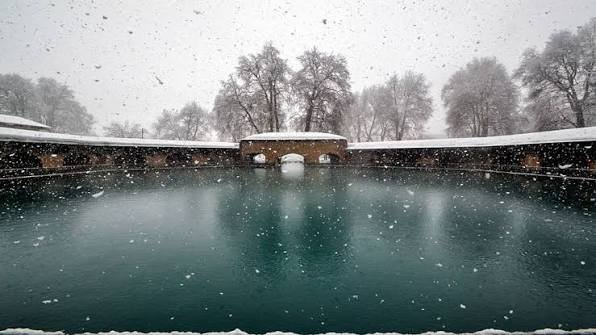
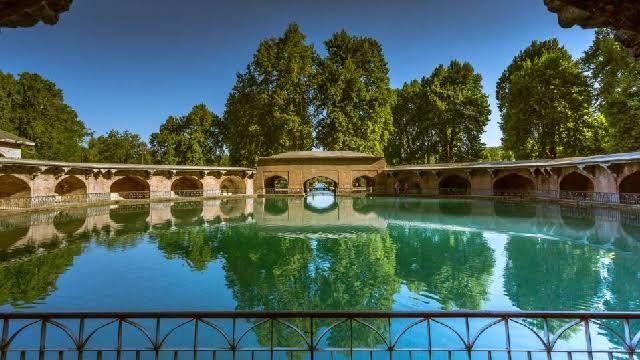
The spring acquired a new chapter in its history under the Mughals. Emperor Jahangir was captivated by Verinag and ordered the construction of the distinctive octagonal stone basin around the spring in 1620. His son, Shah Jahan, later contributed to the development of the surrounding garden.
Jahangir was particularly fascinated by the stories surrounding the depth of the spring. Local tradition described it as seemingly bottomless. According to accounts associated with his visit, an attempt was made to measure its depth, revealing that the spring was far shallower than the legend suggested.
The Mughal rulers nevertheless transformed Verinag into a carefully designed retreat. Persian inscriptions were added to the stone structures, while a long water channel carried the spring’s water through the garden. Unlike the perfectly symmetrical charbagh gardens commonly associated with Mughal architecture, Verinag’s steep terrain required the builders to adapt the design to the mountain landscape.
The result is a rare meeting of Mughal garden aesthetics and Himalayan geography.
Another colourful story associated with the Mughal court concerns the spring’s fish. According to local accounts, some fish were fitted with gold ornaments associated with Empress Nur Jahan before being released back into the water. Whether every detail of the story can be independently established is difficult to determine, but it remains part of the folklore surrounding Verinag.
The Emperor Who Wanted to Return
Perhaps the most poignant story connected with Verinag belongs to Jahangir himself.
The emperor was deeply attached to the spring. During his final journey in 1627, as he was travelling through the Pir Panjal region in failing health, tradition holds that he expressed a wish to be taken back to Verinag and buried there.
His wish was not fulfilled. With winter approaching and the mountain passes becoming increasingly difficult to cross, his remains were taken towards Lahore, where he was eventually buried.
The emperor who had transformed Verinag into one of Kashmir’s celebrated Mughal landscapes never returned to the spring.
A Place of Shared Reverence
Verinag’s significance continued beyond the Mughal period. Nearby religious traditions also connect the surrounding landscape with Hindu worship, while the spring itself has long been respected by local Muslim and Hindu communities.
One of the most distinctive traditions concerns the fish inhabiting its waters. Fishing in the spring is traditionally forbidden, and this practice has helped preserve its aquatic life. The custom is notable because reverence for the spring and its fish has been shared across communities, becoming part of the area’s local cultural identity.
The Archaeological Survey of India recognises the Verinag spring and its Mughal structures as a Monument of National Importance, adding formal heritage status to a site whose cultural importance is centuries older.
Verinag Through the Seasons
The character of Verinag changes dramatically with the seasons. From spring through autumn, the surrounding gardens become lush and colourful, with flowers, lawns and pine-covered mountains creating a striking backdrop to the clear waters.
Autumn brings warmer shades to the landscape, while winter transforms the site into a quieter world of snow-covered slopes and stone architecture. The spring itself continues to flow even as the surrounding landscape changes, making it the constant presence at the heart of Verinag.
Where the Jhelum Begins
Perhaps the greatest geographical significance of Verinag is that its waters form the beginning of the Jhelum, known in ancient tradition as the Vitasta. The river flows through the Kashmir Valley before continuing into Pakistan, where it eventually becomes part of the wider Indus river system.
This gives Verinag an importance that extends far beyond its gardens and monuments. The spring is not simply a historic site; it is the beginning of a river that has shaped the geography, agriculture, settlements and cultural history of Kashmir for centuries.
A Spring Worth Stopping For
Verinag is remarkable because its appeal does not depend on a single story. It is at once a sacred spring, an important geographical landmark, a Mughal heritage site and a repository of local folklore.
Its stone architecture recalls the grandeur of the Mughal period, while its legends reach back into Kashmir’s ancient traditions. The spring itself remains the quiet centre of everything, continuing to feed the river whose waters travel far beyond the mountains.
For travellers heading through Kashmir, Verinag offers something different from the region’s better-known destinations. It is not merely a place to photograph and leave behind. It is a place where mythology meets history, where architecture follows the contours of the mountains, and where a small spring becomes the starting point of one of the region’s most important rivers.
Perhaps that is Verinag’s greatest secret: while emperors tried to shape it, legends tried to explain it and generations tried to preserve it, the spring itself simply continued to flow.
(The writer of this article is Akhilesh Saproo, a student of APS Jaipur)