

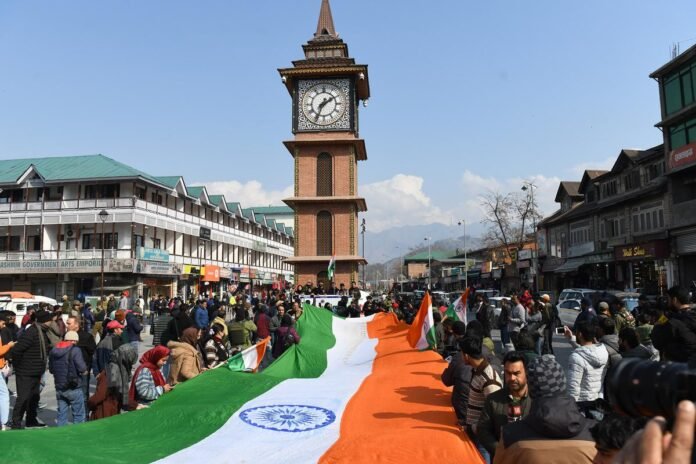
August 5, 2026, marks seven years since one of the most consequential constitutional decisions in independent India’s history, the abrogation of Article 370. On this day in 2019, the Government of India revoked the special constitutional status of the erstwhile state of Jammu and Kashmir and reorganised it into two Union Territories: Jammu & Kashmir and Ladakh. Seven years later, the move continues to shape the region’s political, economic and social landscape.
What Was Article 370?
Article 370 was introduced as a temporary provision in the Indian Constitution in 1949. It granted Jammu and Kashmir a special autonomous status, allowing it to have its own Constitution, a separate flag and considerable legislative powers. Except for matters such as defence, foreign affairs and communications, Parliament required the concurrence of the state government to extend many central laws to Jammu and Kashmir.
Alongside it, Article 35A, introduced through a Presidential Order in 1954, empowered the Jammu and Kashmir legislature to define “permanent residents” and grant them exclusive rights related to land ownership, government employment and certain other privileges.
On August 5, 2019, the Government of India revoked the special status under Article 370 and effectively rendered Article 35A inoperative. Parliament also passed the Jammu and Kashmir Reorganisation Act, bifurcating the state into the Union Territories of Jammu & Kashmir and Ladakh.
Security Tightened on the Seventh Anniversary
As the seventh anniversary was observed, authorities deployed a multi-layered security arrangement across Jammu and Kashmir. Police and Central Reserve Police Force (CRPF) personnel intensified vehicle checks and identity verification at key locations, particularly along National Highway 44.
As a precautionary measure, the Amarnath Yatra was temporarily suspended from the Bhagwati Nagar base camp in Jammu for the day, while the movement of security convoys on the Jammu-Srinagar National Highway was also restricted.
Political reactions remained divided. The Bharatiya Janata Party (BJP) described August 5 as a historic milestone in India’s journey towards complete national integration, highlighting progress in infrastructure, tourism, governance and development. Meanwhile, regional parties such as the National Conference (NC) and the People’s Democratic Party (PDP), along with the Congress, reiterated their opposition to the 2019 decision and renewed their demand for the restoration of full statehood.
How Has Jammu & Kashmir Changed?
Seven years after the constitutional change, several indicators point towards significant transformation in the region.
Tourism has witnessed remarkable growth, with Jammu and Kashmir recording some of its highest-ever tourist arrivals in recent years. Destinations such as Srinagar, Gulmarg, Pahalgam and Sonamarg have seen increased domestic and international visitors, boosting local businesses, hospitality and employment.
Infrastructure development has accelerated considerably. Major road tunnels, highways, railway expansion projects, improved healthcare facilities and educational institutions have strengthened connectivity and public services. Investments in rural development, housing and digital infrastructure have also expanded access to government schemes.
The extension of central laws has enabled residents to access a wider range of welfare programmes available across the country. Women, members of Scheduled Castes and Scheduled Tribes, and other disadvantaged groups have benefited from legal and social protections that were previously unavailable or limited under the earlier constitutional framework.
The region has also witnessed greater investment in entrepreneurship, industry and skill development initiatives. Government efforts to attract private investment, promote handicrafts, horticulture and agriculture, and improve ease of doing business have opened new economic opportunities.
From a security perspective, the government maintains that militant violence, stone-pelting incidents and organised shutdowns have declined compared to previous years. Improved law and order, according to official assessments, has contributed to greater public confidence and economic activity.
The Road Ahead
Despite visible progress in infrastructure and development, political questions surrounding the region continue to be debated. The demand for the restoration of statehood remains an important issue in Jammu and Kashmir’s political discourse. The Supreme Court, in its 2023 judgment, upheld the constitutional validity of the abrogation while directing that steps be taken towards the restoration of the legislative assembly through elections.
Seven years on, the anniversary of Article 370’s abrogation remains both a moment of reflection and a reminder of a transformative constitutional decision. For supporters, it represents stronger national integration, expanded development and equal application of laws across the country. For critics, it continues to raise questions about federalism and regional autonomy.
As Jammu and Kashmir moves forward, its future will likely be defined by how successfully development, democratic governance, security and public aspirations are balanced. Regardless of differing political perspectives, the region today stands at a significantly different point in its history than it did on August 5, 2019, continuing its journey through a period of profound transition and change.