

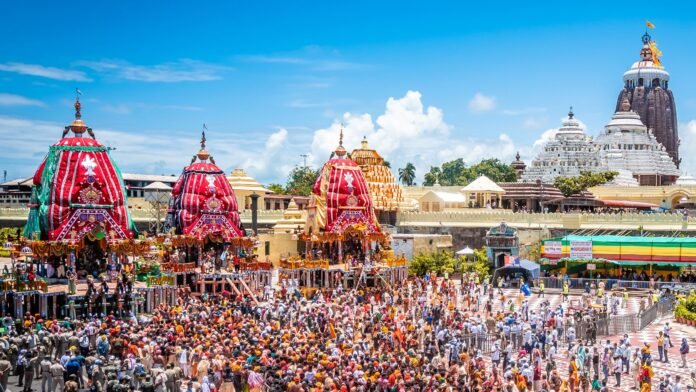
Every year, millions of devotees gather in the sacred city of Puri in Odisha to witness a spectacle unlike any other, the Jagannath Rath Yatra. With towering wooden chariots, chants of “Jai Jagannath,” and devotees pulling the ropes with unwavering faith, the festival is not merely a procession but a profound expression of devotion, equality, and tradition.
Recognised as one of the world’s largest and oldest chariot festivals, the Rath Yatra attracts pilgrims from across India and around the globe, transcending barriers of caste, creed, and nationality.
Who is Lord Jagannath?
Lord Jagannath, whose name means “Lord of the Universe,” is worshipped as a form of Lord Vishnu or Krishna. Along with His elder brother Lord Balabhadra and sister Devi Subhadra, He resides in the centuries-old Jagannath Temple at Puri, one of the four sacred Char Dham pilgrimage sites of Hinduism.
Unlike conventional Hindu idols, the deities of Jagannath, Balabhadra, and Subhadra are carved from sacred neem wood (known as Daru) and have distinctive large round eyes and unfinished limbs. Their unique form symbolises the divine beyond conventional human appearance and reflects an inclusive philosophy that embraces all devotees.
The Origins of the Rath Yatra
The Rath Yatra has been celebrated for centuries, with references found in ancient scriptures such as the Skanda Purana, Brahma Purana, and Padma Purana. Historical records suggest that the festival has been observed in Puri for well over a thousand years, evolving into one of India’s most significant religious gatherings.
According to tradition, the festival commemorates Lord Jagannath’s annual visit to the Gundicha Temple, believed to be the home of His maternal aunt. It is seen as a journey of affection, reunion, and divine grace, allowing devotees who may not be able to enter the sanctum of the Jagannath Temple to receive His blessings.
Why Does Lord Jagannath Leave the Temple Every Year?
Unlike most temple deities who remain within the sanctum, Lord Jagannath comes out among the people once every year.
This symbolic journey represents the Lord stepping out of His abode to meet every devotee without distinction. The procession reinforces the belief that divinity belongs to everyone, irrespective of caste, social status, or background. For many, the Rath Yatra embodies the ideals of compassion, accessibility, and universal acceptance.
Why Are Balabhadra and Subhadra Part of the Journey?
The Rath Yatra is a family pilgrimage. Lord Jagannath is accompanied by His elder brother Lord Balabhadra and younger sister Devi Subhadra, each travelling in a separate chariot.
According to tradition, the siblings undertake the journey together to visit the Gundicha Temple. Their presence signifies familial bonds, harmony, and the importance of togetherness in Hindu philosophy.
The Magnificent Chariots and Months of Preparation
One of the festival’s most remarkable features is the construction of three gigantic wooden chariots, built afresh every year using specific varieties of timber brought from designated forests of Odisha.
Each chariot follows centuries-old traditional measurements and craftsmanship:
●Nandighosha – Lord Jagannath’s chariot, with 16 wheels.
●Taladhwaja – Lord Balabhadra’s chariot, with 14 wheels.
●Darpadalana (also called Devadalana) – Devi Subhadra’s chariot, with 12 wheels.
Hundreds of skilled hereditary artisans begin construction months in advance on the auspicious day of Akshaya Tritiya. Every detail, from the wood and colours to the decorations and dimensions, is governed by sacred tradition that has been preserved across generations.
The Journey to the Gundicha Temple
The three-kilometre procession travels from the Jagannath Temple to the Gundicha Temple, where the deities stay for about seven days.
The Gundicha Temple is revered as the garden palace or the maternal aunt’s home of Lord Jagannath. During this stay, devotees receive the rare opportunity to worship the deities in a different setting before they return to the main temple in the equally significant Bahuda Yatra, or return journey.
Several important rituals accompany the festival, including the Pahandi procession, in which the deities are ceremonially carried to their chariots, and the Chhera Pahanra, where the Gajapati King of Puri sweeps the chariots with a golden broom. This ritual symbolises humility and the belief that everyone is equal before the divine.
A Festival Powered by Faith
Perhaps the most iconic moment of the Rath Yatra is when thousands of devotees pull the enormous chariots using thick ropes. It is considered a sacred privilege, and many believe participating in this act brings spiritual merit and divine blessings.
The streets of Puri transform into a sea of devotion as pilgrims from every corner of India and many parts of the world gather to witness the procession. The atmosphere resonates with devotional songs, traditional music, and chants celebrating Lord Jagannath.
What Makes the Rath Yatra Unique?
The Jagannath Rath Yatra is unique because it brings the deity out of the temple and into the midst of ordinary people. It celebrates accessibility, equality, and the idea that the divine reaches out to humanity rather than remaining distant.
It is also one of the few festivals where new chariots are constructed every year using age-old traditions, preserving a remarkable legacy of craftsmanship. The festival’s rituals, symbolism, and inclusiveness have inspired Rath Yatra celebrations across India and in many countries around the world.
More than a religious procession, the Jagannath Rath Yatra is a living tradition that continues to unite millions in faith, devotion, and shared cultural heritage. Year after year, as the mighty chariots roll through the streets of Puri, they carry with them not just the deities, but centuries of history, timeless traditions, and the enduring message that the path to the divine is open to all.