

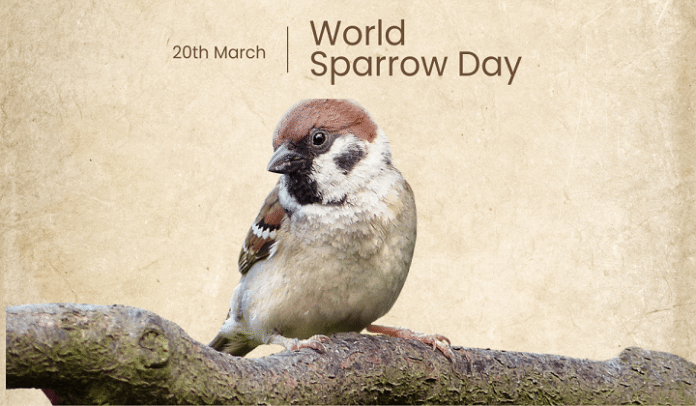
World Sparrow Day is observed every year on 20 March across the globe. It is a day dedicated to raising awareness about the conservation of sparrows and other common birds that live in close association with humans.
History and Origin
The observance began in 2010, initiated by India’s Nature Forever Society in collaboration with international organisations. What started as a small effort to protect a familiar bird has now grown into a global movement, marked in many countries through awareness campaigns, school activities, and conservation drives.
Why is World Sparrow Day Celebrated?
World Sparrow Day draws attention to the alarming decline in sparrow populations, especially in urban areas. Once a constant presence in our homes, courtyards, and streets, sparrows are now rarely seen in many cities.
The day reminds us that even the most common species can become endangered if environmental changes go unchecked. It also encourages people to reconnect with nature and take small but meaningful conservation steps.
Significance of Sparrows in Our Ecosystem
Sparrows play a crucial role in maintaining ecological balance. They feed on insects, helping control pests, and also contribute to pollination and seed dispersal.
Because they live so closely with humans, sparrows are considered indicator species. Their decline signals deeper environmental problems such as pollution, habitat loss, and shrinking biodiversity in urban ecosystems.
Current Condition of Sparrows Worldwide
Although sparrows are still found across many parts of the world, their numbers have been steadily declining. In several regions, especially in cities, their population has dropped significantly over the past few decades.
In India too, sparrows that were once abundant are now missing from many urban landscapes. Their disappearance is gradual but noticeable, raising concerns among environmentalists and researchers.
Why Are Sparrows Disappearing?
The decline of sparrows is the result of multiple factors linked to rapid urbanisation and changing human lifestyles.
Modern buildings, with smooth walls and sealed structures, have eliminated the small spaces where sparrows once built their nests. At the same time, the widespread use of pesticides has reduced insect populations, which are a vital food source for sparrows, especially for their young ones.
Pollution—both air and noise—has further made urban environments less suitable for their survival. The loss of trees and green spaces has also reduced safe habitats.
Another frequently discussed factor is the increase in mobile towers and electromagnetic radiation. While research is still ongoing and not entirely conclusive, several studies suggest that radiation from mobile towers may affect sparrows by disrupting their navigation, breeding patterns, and overall behaviour. This has been widely considered as one of the possible contributors to their decline, especially in densely populated urban areas.
Additionally, changing lifestyles—such as reduced grain storage in homes and cleaner, sealed living spaces—have limited food availability for these birds.
Efforts and What Can Be Done
Conservation efforts are gaining momentum through awareness campaigns and community participation. People are increasingly being encouraged to install nest boxes, provide food and water, and plant native vegetation.
Even simple actions like keeping a bowl of water on balconies or terraces can help sparrows survive, especially during extreme weather conditions.
World Sparrow Day serves as a gentle yet urgent reminder of how rapidly our environment is changing. The disappearance of sparrows is not just about losing a bird—it reflects a deeper imbalance in our ecosystem.
By making small, conscious changes in our daily lives, we can help bring back the familiar chirping of sparrows and ensure that future generations grow up with the same simple joys of nature that we once experienced.