

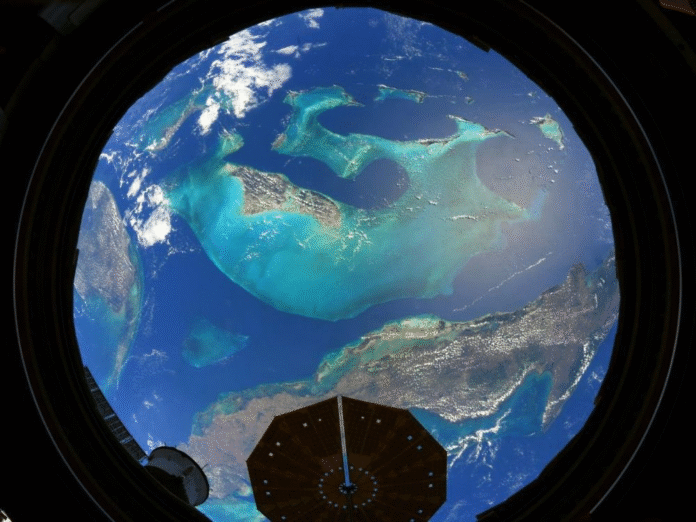
The International Space Station (ISS) is one of humanity’s most ambitious scientific projects in space. Orbiting the Earth at high speed, the ISS serves as a permanent laboratory in space, where astronauts conduct experiments that are impossible to perform on Earth.
A Global Space Collaboration
The ISS has been built jointly by 18 countries, including the United States, Russia, France, and other international partners. It stands as a symbol of global cooperation in science and space exploration.
Orbit and Speed
The space station orbits the Earth at an altitude ranging between 330 km and 435 km. Traveling at an astonishing speed of 28,163 km per hour, the ISS completes one full orbit around the Earth every 90 minutes, meaning astronauts witness about 16 sunrises and sunsets each day.
Construction and History
- The first control unit of the ISS was launched in 1998 using a Russian rocket.
- On November 2, 2000, astronauts arrived for the first time to stay aboard the station for experimental purposes.
- By 2011, the ISS was fully completed and operational.
- At any given time, up to six astronauts can live and work aboard the station.
Life on the ISS
The ISS is equipped with six sleeping rooms, two bathrooms, and a gym. Due to microgravity, astronauts must exercise at least two hours daily to prevent muscle and bone loss.
Size, Cost, and Weight
- The ISS is approximately 109 meters long.
- Its total construction cost is estimated at $150 billion, making it the most expensive man-made structure ever built.
- If weighed on Earth, the station would weigh about 420,000 kilograms.
Record-Breaking Missions
- On September 2, 2017, astronaut Peggy Whitson set a record by spending 665 days in space, the longest by any astronaut aboard the ISS.
- Astronaut Scott Kelly experienced a temporary increase in height by about two inches after spending a year in space, due to spinal elongation in microgravity. His height returned to normal within two days of returning to Earth.
Why the ISS Matters
The ISS plays a crucial role in advancing medical research, climate studies, physics, and space technology. Experiments conducted aboard the station help scientists understand how the human body reacts to long-term space travel—knowledge that is essential for future missions to the Moon and Mars.