

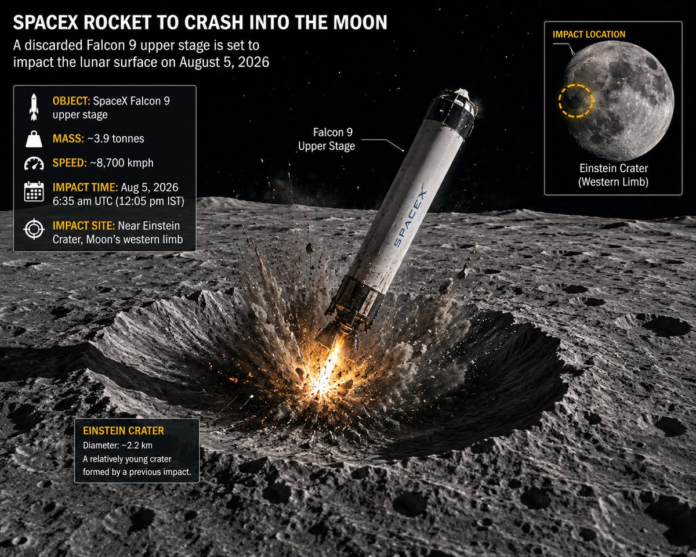
A discarded 9,000-pound SpaceX Falcon 9 upper stage is set to collide with the Moon on August 5. While the impact itself may not be visible from Earth, astronomers say a spectacular plume of debris could briefly be seen through powerful telescopes.
A Rare Human-Made Impact on the Moon
A discarded SpaceX Falcon 9 upper stage is expected to slam into the Moon in the early hours of Tuesday, August 5 (UTC), creating one of the few planned human-made impacts on the lunar surface in recent years. The 45-foot (13.8-meter) rocket stage, weighing approximately 8,000–9,000 pounds (around 4,000 kilograms), was left in space after launching Firefly Aerospace’s Blue Ghost and ispace’s Hakuto-R lunar missions in January 2025. According to astronomers, the rocket is expected to strike the Moon at approximately 06:35 UTC, travelling at nearly 5,400 mph (8,700 km/h).
Where Will the Rocket Hit?
The impact is predicted to occur near Einstein Crater, close to the Moon’s western limb on the Earth-facing side. Although the collision will happen on the side of the Moon visible from Earth, experts say the actual impact flash is unlikely to be seen because the rocket will hit a sunlit region, making any flash difficult to distinguish against the bright lunar surface.
Can You See the Moon Impact From Earth?
While the collision itself is expected to remain invisible to the naked eye, astronomers believe observers may still witness a dramatic ejecta plume—a column of dust and rock blasted high above the Moon’s surface. If the impact generates enough force, debris could rise nearly 100 kilometers (60 miles) above the lunar horizon before gradually falling back.
Because the plume would appear against the darkness of space rather than the illuminated Moon, experienced amateur astronomers using large telescopes equipped with sensitive cameras may have a chance to capture the event.
Astronomer Bill Gray, who first identified the rocket’s future collision course, said the impact could produce several observable effects.
“Maybe we’ll see the flash. Maybe we’ll see rocks ejected from the crater. Maybe we’ll even see both.”
Why Is This Impact Important?
Although spacecraft intentionally crash into celestial bodies at the end of some missions, accidental lunar impacts involving discarded rocket stages remain relatively uncommon.
Scientists are interested in studying the event because it offers an opportunity to better understand:
- How impact craters form on the Moon.
- The behavior of lunar dust and rock during high-speed collisions.
- The composition of material beneath the Moon’s surface.
- The dynamics of impact-generated debris.
Computer simulations suggest the ejecta cloud could provide valuable scientific observations if successfully recorded.
What Is an Ejecta Plume?
An ejecta plume is the cloud of dust, rocks, and debris thrown into space when an object strikes the surface of a planet or moon at high speed. The faster the impact, the larger and higher the debris cloud can rise. In this case, simulations indicate the central plume could soar up to 100 kilometers above the lunar surface, though visibility from Earth will depend on lighting conditions and the amount of material excavated.
Will the Moon Be Damaged?
No. Despite the dramatic nature of the collision, the Moon will not suffer any significant damage. The impact will create only a relatively small crater compared with the countless natural asteroid impacts the Moon has experienced over billions of years.
Why Didn’t the Rocket Return to Earth?
After completing its mission in January 2025, the Falcon 9 upper stage did not have enough fuel to return safely to Earth or move into a stable disposal orbit. As a result, it remained in space until the Moon’s gravity gradually pulled it onto a collision course.
Key Facts at a Glance
- Object: SpaceX Falcon 9 upper stage
- Weight: Around 8,000–9,000 pounds (about 4,000 kg)
- Length: 45 feet (13.8 meters)
- Impact Speed: Around 5,400 mph (8,700 km/h)
- Impact Location: Near Einstein Crater on the Moon
- Expected Time: Around 06:35 UTC on August 5
- Visible to Naked Eye? No
- Possible to Observe? A debris plume may be visible through powerful telescopes if conditions are favourable.
A Rare Opportunity for Skywatchers
Although casual observers are unlikely to notice the impact, the event presents a rare opportunity for astronomers and astrophotographers to witness the aftermath of a high-speed collision on the Moon. If the predicted ejecta plume rises high enough above the lunar horizon, it could offer a brief but remarkable spectacle for those equipped with advanced telescopes and imaging systems.