Home Blog Page 859

Cave Tourism in Rajasthan: Kolvi Caves have Buddhist stupas in desert state

0

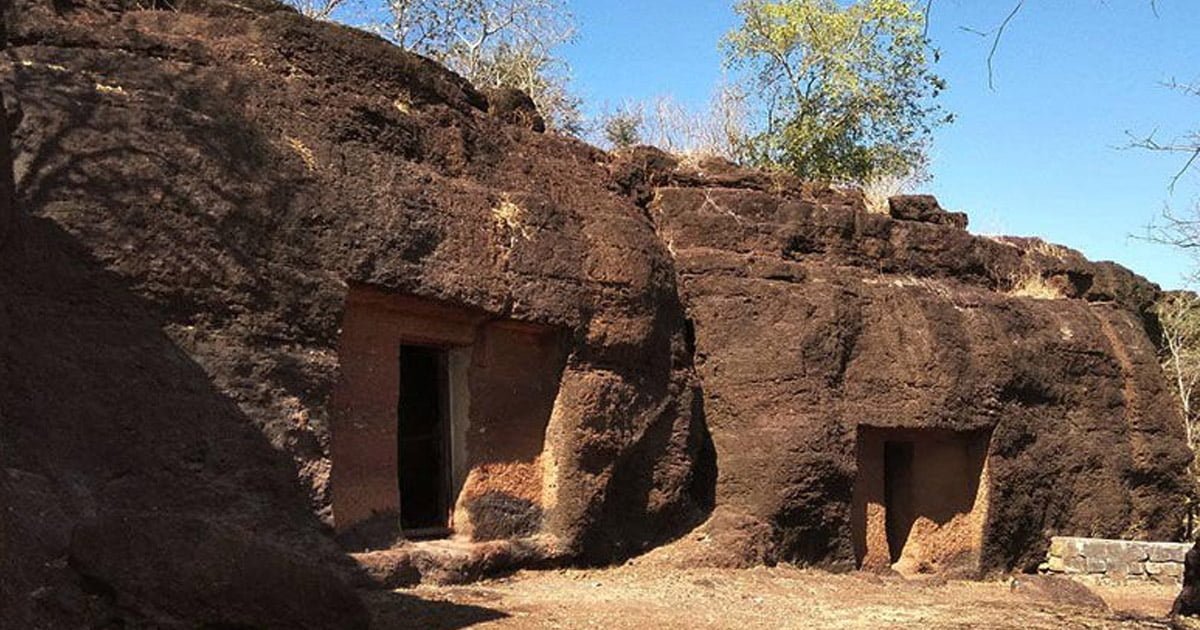
Kolvi Caves, also called as Kholve Caves, are located at Kolvi village in Rajasthan

This Buddhist site has stupas and chaityas containing figures of Buddha

Rajasthan, famous for its royal palaces and havelis, also has Buddhist caves in its vicinity which lures many avid travellers to the Kolvi village of Jhalawar district in the state.

The Buddhist caves and the carved stupas in the caves take you to the towering image of Gautam Buddha. 

Situated 90-100 km north-west of Jhalawar, these caves are well-maintained by the ASI. Those interested in caves can further visit nearby villages, namely, Vinayaka and Hatiyagour which also have many beautiful ancient caves.

It’s official! Electric car company Tesla enters India

0

As a first step to set up an R&D unit and a manufacturing plant for its electric vehicles in the country, US electric car giant Tesla has opened a fully-owned Indian subsidiary in Bengaluru.

It’s official! Electric car company Tesla enters India

Tesla has been incorporated in the state of Karnataka, India on January 8, 2021 with the name of “Tesla India Motors and Energy Private Limited”.

The company also lists 3 Directors for India which includes two Indians.

It’s happening!!

Bharatpur: Its history, legends, tales & Keoladeo Ghana National Park (KNP)

0

Bharatpur history dates back to 5th century BC, during the time of Matsya kingdom. The Matsyas, are known to be allies of the Pandavas in the Mahabharata war. 

Legends: 

The origin of the name Bharatpur goes back to Ramayana era. The city has been named after Bharat, younger brother of Lord Ram.

Also Laxman, the younger brother of Ram, has been given the significant position as that of the family deity of Bharatpur royal family. His name can also be seen in the state seals and coat-of-arms.

Bharatpur: Its history, legends, tales & Keoladeo Ghana National Park (KNP)
Moti Mahal Palace, Bharatpur

History

In the early 18th century, Maharaja Surajmal captured the fort of Bharatpur by conquering Khemkaran, the rival chieftain and laid the foundation for Bharatpur. The brave Maharaja was keen to expand the cities and is credited with building the numerous forts and palaces that dot the kingdom, including the Pleasure Palace Complex at Deeg.

About Keoladeo Ghana National Park (KNP)

Bharatpur is home to one of the world’s best-known bird watching destinations, Keoladeo Ghana National Park (KNP). Around 250 years ago, the then ruler built embankments that allowed flooding of this land, turning it into a marsh. Named after the dense jungle that surrounded an old Shiva Temple, this 29 square kilometre man-made wetland is renowned for migratory birds – ducks, geese, waders, raptors, flycatchers and more. In winter, avid birders and ornithologists flock to the park to observe and study the feathered beauties. With more than 370 recorded species, KNP used to also host the Siberian crane. It is a World Heritage Site.

Makar Sankranti: Celebrated as Sun’s transition to heralding the harvest season

0

Makar Sankranti celebrated on January 14 is also called as Uttarayan

Makar Sankranti marks the end of Malmaas, which is considered as an inauspicious month in the Hindu calendar. It also symbolises Sun’s transition to the zodiacal sign of Makar (Capricorn) which heralds a seasonal change. 

The day of transition is celebrated in different states with different names, but the theme remains common for all which is the ‘harvest season’. In the north, it is celebrated as Lohri, in Assam as Bhogali Bihu and in the south as Pongal.

Makar Sankranti reflects unity in diversity. Every state in India has different ways of celebrating Makar Sankranti but the theme – harvest season – is the uniting factor. 

From Makar Sankranti, the Sun starts its movement towards northern hemisphere, thereby marking winter season’s end and eventually days start getting longer. Hence, Makar Sankranti is known with the name of Uttarayan, which marks the beginning of an auspicious period.

Top 10+ Swami Vivekananda Quotes For Youth on National Youth Day 2021

0

Top 10 Quotes of Swami Vivekananda on National Youth Day 2021 :

Believe in yourself and the world will be at your feet.

The power of concentration is the only key to the treasure-house of knowledge.

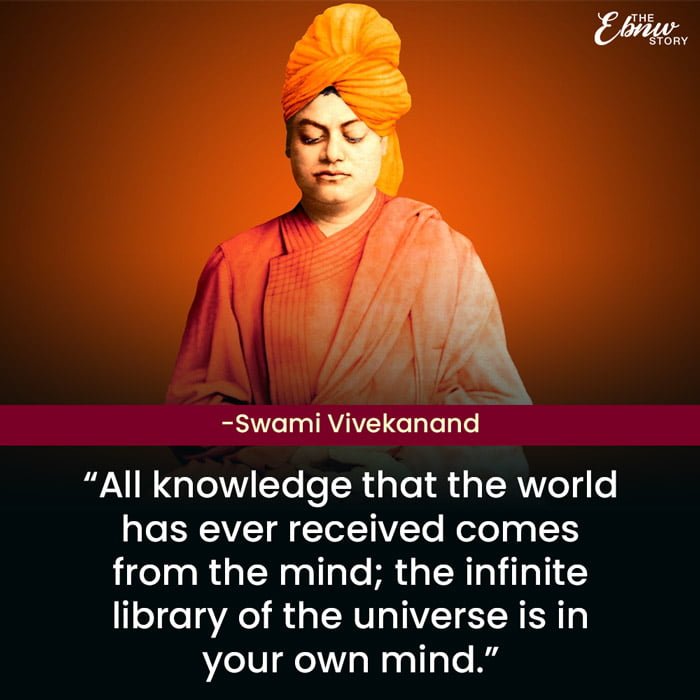
All knowledge that the world has ever received comes from the mind; the infinite library of the universe is in your own mind.

Top 10+ Swami Vivekananda Quotes For Youth on National Youth Day 2021

Strength is life, Weakness is Death.

You cannot believe in God until you believe in yourself.

Great work requires great and persistent effort for a long time..Character has to be established through a thousand stumbles.

The world is the great gymnasium where we come to make ourselves strong.

A brave, frank, clean-hearted, courageous and aspiring youth is the only foundation on which the future nation can be built.

Like fire in a piece of flint, knowledge exists in the mind. Suggestion is the friction which brings it out.

Never be weak, you must be strong; You have infinite strength within you.

Take risks in your life. If you win, you can lead. If you lose, you can guide!

Arise, awake and stop not until the goal is reached.

National Youth Day 2021: Birth Anniversary of Swami Vivekananda

0

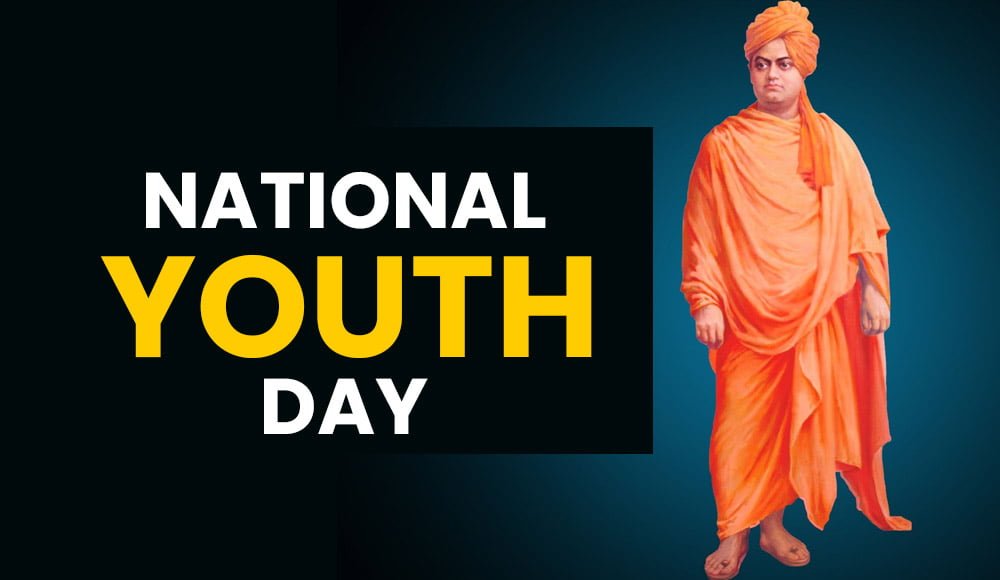
National Youth Day is celebrated on January 12 each year to honor the ideals and philosophy of Vivekananda

National Youth Day is celebrated each year to remember, respect and honor the ideals and thoughts of Swami Vivekananda. Born on January 12, 1863 in Kolkata, Swami Vivekananda has been a spiritual thinker unlike any other monk and played a major role in reviving India’s image as a land of spirituality.

“Sisters and brothers of America,” This is  how Vivekananda started his speech in 1893 at the Parliament of World’s Religions in Chicago. 

This speech immortalised the ideals which the monk believed in globally.

What Swami focussed upon

  • Swami Vivekananda always focused on harnessing youth’s potential.
  • He wanted to inspire the young generation so that they could counter the British and attain Independence.
  • Swami Vivekananda’s weapons of winning the world were education and peace.
  • He always portrayed himself as a ‘Nationalist Saint’ who wanted the youth to get out of their comfort zones to attain anything they desire.
  • Swami Vivekananda had incredible understanding and knowledge of philosophy, religion, literature, Vedas, Puranas, Upanishads, and what not.

Read more about this historic speech here:

7 Jain temples of Jaisalmer: Experience true serenity here!

0

The Jain Temples of Jaisalmer are situated right inside the Jaisalmer Fort campus. There are a total of seven of these temples and each of them give a sight of sheer greatness. 

Containing frescoes, mirrors and other forms of detailing, the temples boast of exquisite designs, with the walls of the temples adorned with human and animal figures in the style of Dilwara temples. 

Upon reaching the Jain Temples in Jaisalmer, you will see Chandraprabhu, the first temple. This temple is dedicated to the eighth tirthankar, and was constructed in 1509. 

Comprising of the mandapa, this temple is nothing short of an iconic one. Then, on turning right, you will get a view of the calm Rikhabdev temple that’s carefully safeguarded with glass cabinets. 

After that, you will find the majestic Parasnath that’s located behind Chandraprabhu. This is followed by a door on the south through which you will reach Shitalnath that’s dedicated to the tenth tirthankar. 

Further, the northern wall will take you to the door of the mesmerising Sambhavanth. The remaining two temples i.e. Shantinath and Kunthunath contain beautiful carvings as well for you to revel in. These Jain temples of Jaisalmer are architectural wonders in their own right, a fact which makes for a compelling visit. To top it off, the Astapadhi Temples are located in the same complex, which just goes on to add to a tranquil experience.

How to reach here:

One can hire or share an auto rickshaw from anywhere in Jaisalmer. The temples are located in the complex of Jaisalmer fort.

Three Colour Coded Cities of Rajasthan: Jaipur, Jodhpur and Jaisalmer

0

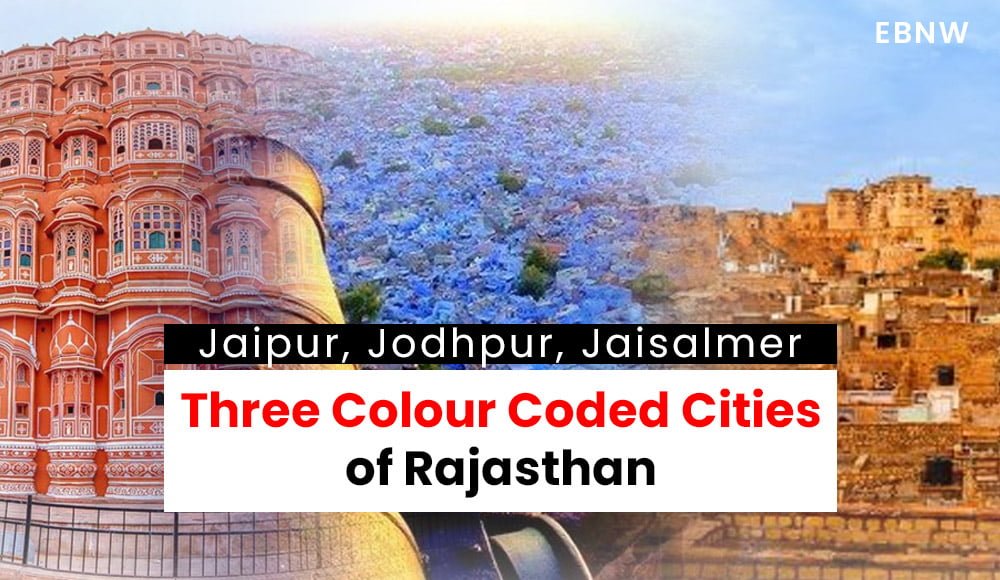
Jaipur is called as Pink City, Jodhpur is called as Blue City and Jaisalmer is called as Golden City. Rajasthan, often associated with its royal palaces, mighty forts and flashes of color, has been luring tourists from across the world in three cities which are known for their three striking shades in particular.

Jaipur – Pink City

Spread through the desert territory, the “Pink City” of Jaipur, the “Blue City” of Jodhpur and the “Gold City” of Jaisalmer has been winnning millions of hearts with their immaculate beauty and glory as they narrate their own historical tales.

The Pink City-Jaipur  is famous for its salmon-hued buildings and meticulous city planning. 

The city was given a rosy hue during a highly anticipated visit from Prince Albert in 1876. The city was painted with pink shade, which symbolizes hospitality in Indian culture.

The building department mixed up a natural dye made of lime and red soil to paint the city pink. Even today, the government repaints the buildings every two years in keeping with tradition.

The pink Old Town area, accommodates the pretty terracotta pink Hawa Mahal palace, City Palace, the Palace of the Winds and Jantar Mantar astronomy observatory.

Another highlight is the Amber Fort, located about six miles outside of the city. Once the residence of the Rajput Maharajas, this red sandstone fort complex features grand courtyards, ornate wall mosaics and opulent halls.

Jodhpur – Blue City

Jodhpur stands synonymous with another color: sky blue.

Now, if you have a question that why it is called as the Blue City, there are many reasons for it.  

Firstly, the city has a very high temperature because it’s surrounded by desert, so people have painted their houses with blue colour to keep things cool inside.

Secondly, Jodhpur is home to Brahmins who worship Lord Shiva. As Shiva is often associated with the color blue, worshipers paint their homes and temples this sacred and soothing shade.

The best place to see the ‘Blue City’ is from atop Mehrangarh Fort. From here, you can see the bright blue clusters and a beautiful sky blue.

Jaisalmer – Golden City

Established in 1156, Jaisalmer got its nickname from the magnificent Jaisalmer Fort which shines with a honey-gold hue during dusk.

Although the fort is made with local sandstone, however, it is cut in a way that it comes out identical to gold and the city gets its name as golden city.

Also, the sand spread around gives a golden hue and hence comes the name!

Take the trip to beautiful havelis (mansions) — such as Salim Singh ki Haveli and Patwon Ki Haveli — with exquisite ornate carvings and open-air courtyards. Located in the heart of the Thar Desert, Jaisalmer is a place to experience camel safaris and desert camps.


Elon Musk is world’s richest man! Know what he said after notching the title…

1

South African-born US entrepreneur Elon Musk is now the world’s richest person, with a net worth of $195 billion.

He overtakes Amazon’s Bezos to become the world’s richest person a net worth of more than $188.5 billion, $1.5 billion more than Bezos.

Musk, the chief executive officer (CEO) of SpaceX and Tesla, in his underwhelming response to his crowning glory moment, tweeted, “How strange” and added, “Well , back to work.”

A 4.8% rally in the electric carmaker’s share price Thursday boosted Musk past Amazon.com Inc. founder Jeff Bezos on the Bloomberg Billionaires Index, a ranking of the world’s 500 wealthiest people.

Chittorgarh (UNESCO World Heritage Site) is the Largest Fort in India & Asia

0

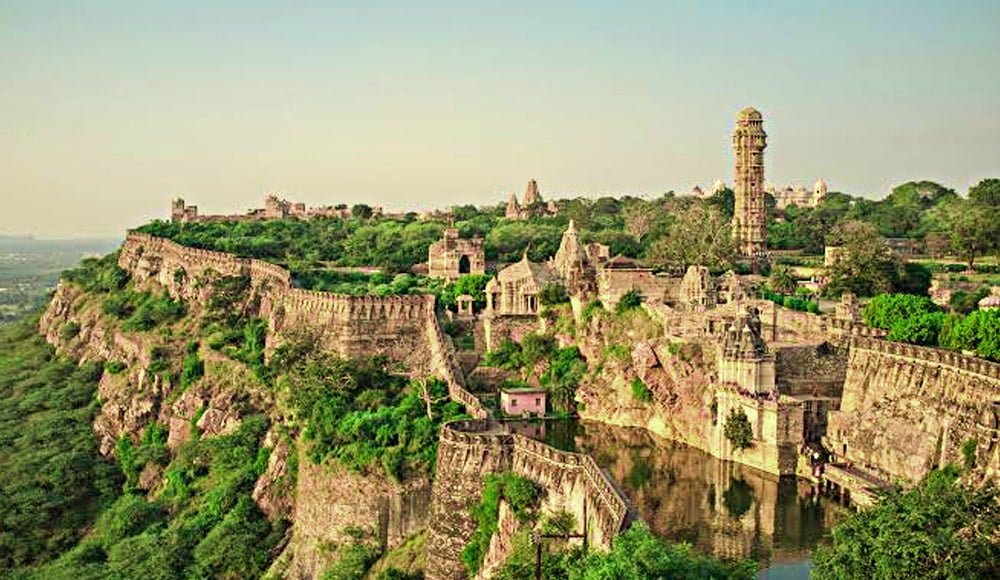
Chittorgarh (UNESCO World Heritage Site) is the Largest Fort in India and Asia. The fort sprawling across 700 acre and has a circumference of 13 km.

It has a long road stretching to one kilometre that takes up to the rampart after passing through seven gates namely: Ganesh gate, Hanuman gate, Padan gate, Jodla gate, Bhairon gate, Lakshman gate and the last and the main gate, Ram gate. These gates were built to protect the fort from the enemy attacks and the arches even protect against the elephants from entering.

Its walls are made of lime mortar and rise up to 500 metre above the ground level. There are four palaces, 19 temples including Jain and Hindu temples, 20 water bodies, and four memorial which make the fort complex.

History

Chittorgarh Fort has withstood three major Muslim invasions starting from Alauddin Khilji, Bahadur Shah and Akbar. However, it has been the hallmark of the Rajput’s bravery.