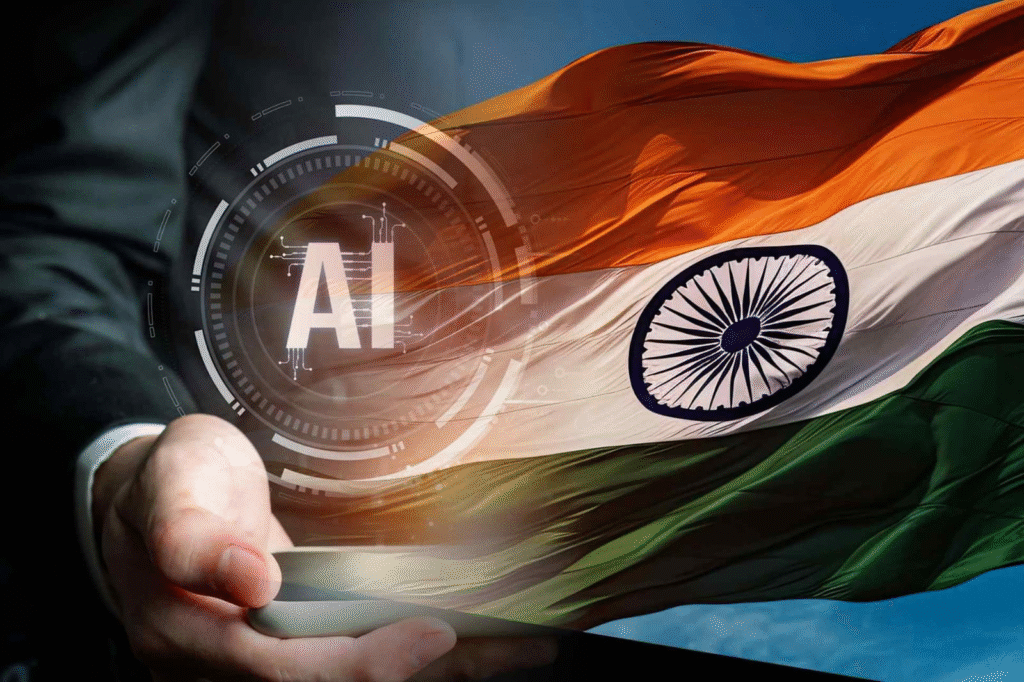
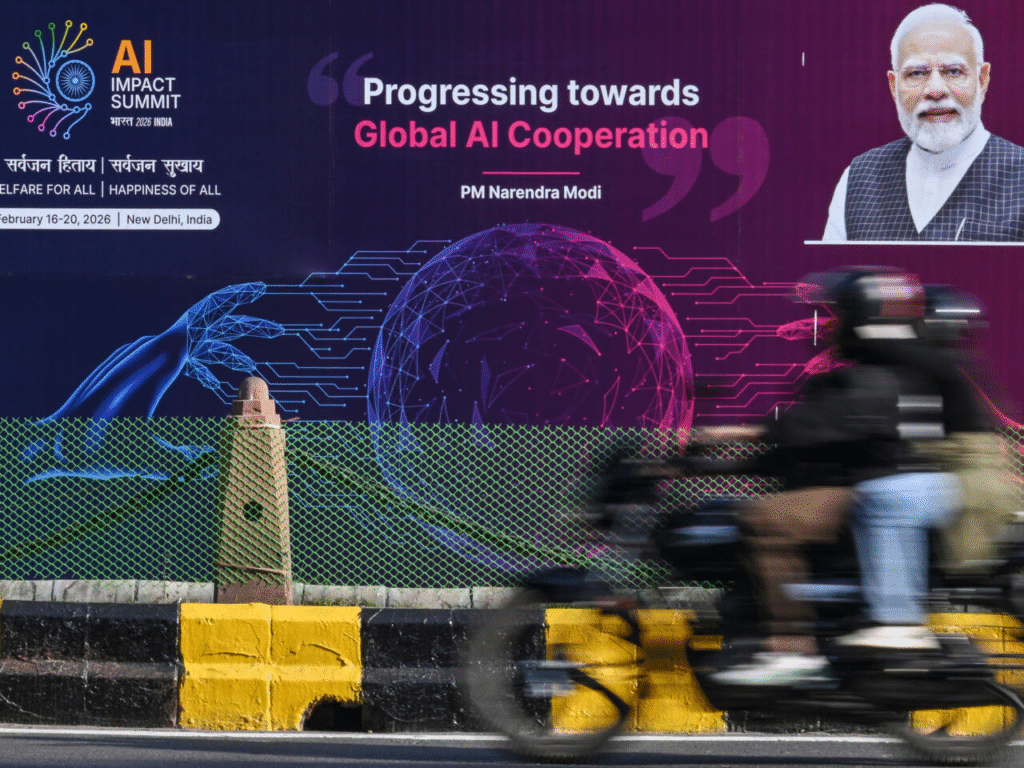
PM Modi Launches Landmark Al Summit in the Global South
New Delhi, February 17, 2026 – Prime Minister Narendra Modi inaugurated the highly anticipated India Al Impact Summit 2026 at Bharat Mandapam in New Delhi on Monday, February 16, marking a pivotal moment as India hosts the first major international Al summit in the Global South.
“Ambition with Responsibility” – Modi’s Vision for Al Leadership
In his address, PM Modi emphasized India’s dual focus on ambition and responsibility in the Al revolution. He highlighted the nation’s commitment to shaping Al solutions not only for India but for the entire world, blending cutting-edge innovation with inclusive growth.
Prime Minister Connects Directly with India’s Al Startups
The Prime Minister toured exhibition pavilions, engaging directly with founders from numerous Indian startups to explore their Al product offerings and discuss technological advancements driving sectors like healthcare, agriculture, education, and governance.
Massive Expo Showcases 600+ Startups and Global Pavilions
The summit, running from February 16 to 20, features an accompanying expo that opened to the public on February 17. It boasts an impressive lineup: over 600 high-potential startups, 300 exhibitors, and pavilions from 13 countries including Australia, Japan, Russia, the United Kingdom, France, Germany, and Italy.
Spanning more than 7,000 square meters across 10 arenas, the event is expected to attract massive crowds, international delegates, investors, and policymakers.
Unprecedented Global Turnout: 100 Countries, 20
World Leaders
Global participation is at an unprecedented scale, with representatives from around 100 countries, including leaders from about 20 nations. Prominent tech figures such as Sundar Pichai (Google) and Sam Altman (OpenAl) are among the attendees, alongside business leaders like Sunil Bharti Mittal, N. Chandrasekaran, and Bill Gates, as well as senior executives from Microsoft, Amazon, Netflix, and Zoom. The gathering underscores India’s rising stature in global Al governance, research, deployment, and collaboration.
Fourth Edition – Building on Global Legacy
This is the fourth edition of the Al Impact Summit, following previous editions in the United Kingdom, South Korea, and France. The program includes over 3,250 speakers and more than 500 sessions, focusing on actionable outcomes through thematic “chakras” centered on people, planet, and progress.
Core Themes: People, Planet, Progress & Social Good
Key areas of discussion include human capital development, inclusion, trust and resilience in Al systems, scientific advancement, resource management, and Al for social good.
High-Level Dialogues: Tech Titans, Policymakers & Global CEOS
Electronics and IT Minister Ashwini Vaishnaw attended the inauguration, reinforcing the government’s push for technological innovation, startup ecosystem growth, and responsible Al deployment. Organizers aim to channel global cooperation toward tangible results, with launches of knowledge compendiums on Al’s role in critical sectors and high-impact keynotes, policy panels, and expert roundtables.
India’s Defining Moment in Shaping the Al Future
As India positions itself at the forefront of the Al transformation, the summit serves as a powerful platform uniting world leaders, industry captains, innovators, policymakers, and researchers to deliberate on investment strategies, job creation, ethical governance, and partnerships that drive sustainable progress. With overwhelming interest and active participation, the India Al Impact Summit 2026 not only showcases India’s expanding Al ecosystem but also solidifies its role in steering the future of artificial intelligence toward humanity-centered, inclusive, and impactful outcomes.
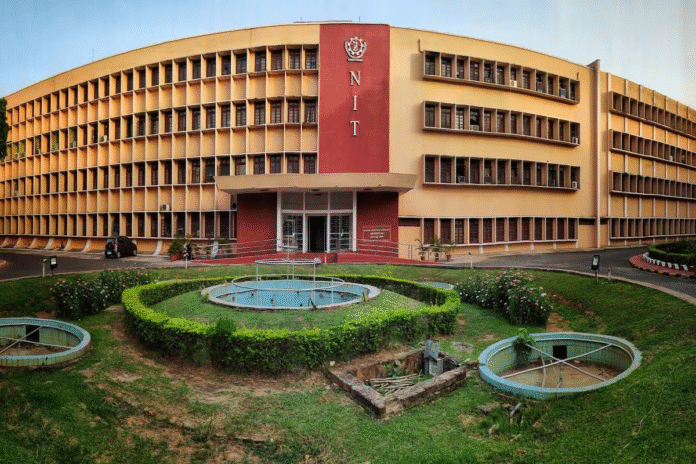
With the declaration of the JEE Main 2026 results, lakhs of students across the country are now preparing for counselling and admission to their preferred engineering colleges. As every year, the National Institutes of Technology (NITs) remain a top choice for high-ranking candidates due to their strong academic reputation, impressive placement records, and robust infrastructure.
Top NIT Colleges in India
1. National Institute of Technology Tiruchirappalli
Located in Tamil Nadu, NIT Trichy is consistently ranked among the top NITs in India. Branches such as Computer Science, Electrical Engineering, and Mechanical Engineering are especially popular. Admission requires a high All India Rank in JEE Main.
2. National Institute of Technology Rourkela
Situated in Odisha, NIT Rourkela is known for its strong focus on research and innovation. It offers programs in engineering, management, and sciences.
3. National Institute of Technology Karnataka Surathkal
Popularly known as NIT Surathkal, this institute is famous for its scenic beachside campus and excellent placement record. Cut-offs for Computer Science and IT branches are typically very high.
4. National Institute of Technology Calicut
One of Kerala’s premier technical institutions, NIT Calicut is recognized for its academic excellence and strong national ranking. It attracts students from across the country.
5. National Institute of Technology Warangal
Located in Telangana, NIT Warangal is among the most prestigious NITs. Admission to core branches requires a strong JEE Main rank.
6. National Institute of Technology Durgapur
A leading technical institute in Eastern India, NIT Durgapur offers solid placement opportunities across engineering disciplines.
7. National Institute of Technology Silchar
The premier NIT in the Northeast region, NIT Silchar offers a wide range of B.Tech and M.Tech programs.
8. National Institute of Technology Patna
Located in Bihar’s capital, NIT Patna is one of the fastest-growing NITs, with improving infrastructure, academics, and placements.
Top NITs in India – NIRF Ranking 2025
According to the NIRF 2025 rankings, the following NITs secured notable positions:
Rank 9 – NIT Tiruchirappalli
Rank 13 – NIT Rourkela
Rank 17 – NIT Surathkal
Rank 21 – NIT Calicut
Rank 28 – NIT Warangal
Rank 42 – Malaviya National Institute of Technology Jaipur
Rank 44 – Visvesvaraya National Institute of Technology Nagpur
Rank 49 – NIT Durgapur
Rank 50 – NIT Silchar
Rank 53 – NIT Patna
What to Do After JEE Main 2026?
After the JEE Main 2026 result is declared, eligible candidates must participate in the counselling process conducted by Joint Seat Allocation Authority (JoSAA).
Seats are allotted based on:
All India Rank (AIR)
Category
Preferred college and branch choices
To secure admission to top NITs, students typically need a strong All India Rank, especially for high-demand branches like Computer Science and Electronics.
Careful choice filling and understanding previous years’ cut-offs can significantly improve the chances of getting into a preferred institute and branch.
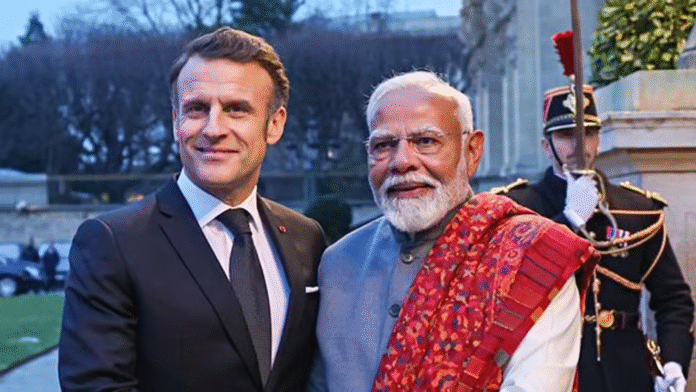
Prime Minister Narendra Modi and French President Emmanuel Macron are set to meet in Mumbai on Tuesday, in what could mark a historic milestone in India–France strategic relations. The meeting is expected to culminate in a massive defence deal worth ₹3.25 lakh crore (approximately $40 billion), under which India will acquire 114 Rafale fighter jets—the largest military procurement in the country’s history by value.
The talks, scheduled for 3:15 PM at Mumbai’s Lok Bhavan, will cover a wide range of issues including defence cooperation, maritime security, Indo-Pacific strategy, emerging technologies, artificial intelligence, and global geopolitical challenges. Later in the evening, the two leaders will inaugurate the India–France Innovation Year 2026, engaging with industry leaders, startup founders, researchers, and innovation experts.
President Macron’s visit to India from February 17 to 19 also includes participation in the AI Impact Summit in New Delhi, underscoring the growing technology partnership between the two nations.
Why This Deal Is a Game-Changer for India
1. Biggest Defence Deal in India’s History
The proposed Rafale acquisition is set to become India’s largest defence procurement ever, surpassing all previous military contracts in financial scale. This deal significantly strengthens India’s air power at a time when regional security dynamics in the Indo-Pacific and along the borders with China and Pakistan are evolving rapidly.
2. India to Get Advanced ‘Super Rafale’ Jets
A key highlight of the agreement is that 24 of the 114 jets will be “Super Rafale” (F-5 version)—the most advanced variant under development by Dassault Aviation.
Most jets in the deal will be F-4 variant, featuring upgraded sensors, AI-assisted systems, improved radar, and enhanced electronic warfare capabilities.
The F-5 Super Rafale, expected post-2030, will represent a next-generation upgrade with cutting-edge stealth and network-centric warfare capabilities.
Currently, the Indian Air Force (IAF) operates F-3 Rafale jets, which are already considered 4.5-generation fighters. The new variants will push India closer to fifth-generation capabilities without waiting for indigenous platforms.
3. Massive Boost to Air Force Strength and Technology
The induction of 114 Rafale jets will dramatically increase the IAF’s combat strength, precision strike capability, and deterrence posture. Rafale aircraft are equipped with:
Meteor long-range air-to-air missiles
SCALP cruise missiles for deep-strike missions
MICA missile systems for multi-role combat
Advanced radar and electronic warfare suites
These capabilities allow India to conduct air superiority missions, deep strikes, nuclear deterrence roles, and network-centric warfare operations.
4. Strengthening Strategic Partnership with France
India and France have shared a strategic partnership since 1998, collaborating in defence, space, nuclear energy, and technology. France has consistently supported India’s strategic autonomy, making it one of India’s most trusted defence partners.
Macron’s visit—the fourth since becoming President—signals deepening trust and alignment between the two democracies in a multipolar world order.
5. Technology Transfer and Defence Ecosystem Growth
Large-scale Rafale procurement is expected to come with technology transfer, local manufacturing, and industrial collaboration, boosting India’s defence manufacturing ecosystem under the ‘Make in India’ initiative. This can strengthen Indian private and public defence companies and create high-skilled jobs.
6. Learning from the First Rafale Experience
India had earlier purchased 36 Rafale jets in a €7.8 billion deal in 2016, with deliveries completed by 2022. These jets are deployed at Ambala (Haryana) and Hasimara (West Bengal) and have already proven to be a major technological leap for the IAF.
The success of the first batch has paved the way for this mega acquisition, giving the Air Force confidence in Rafale’s performance, reliability, and strategic value.
Beyond Defence: Innovation and Indo-Pacific Strategy
Apart from defence, Modi and Macron’s discussions will focus on AI, emerging technologies, maritime cooperation, and Indo-Pacific security architecture. The India–France Innovation Year 2026 reflects a broader partnership beyond weapons—towards research, startups, and deep-tech collaboration.
Conclusion: A Strategic Leap for India
If finalized, this Rafale mega deal will not only modernize India’s Air Force but also reshape its strategic posture in Asia and the Indo-Pacific. With advanced aircraft, deeper technology partnerships, and strong diplomatic alignment with France, India is positioning itself as a major military and technological power in the 21st century.
8 Fascinating Facts About Earth: Our One-of-a-Kind Home Planet
Earth may be only the fifth largest planet in our solar system, but it’s the undisputed champion when it comes to hosting life. As the third rock from the Sun, it’s the only world we know with vast oceans of liquid water on its surface-a feature that sets it apart from every other planet.
Just slightly larger than its scorching neighbor Venus, Earth reigns as the biggest of the four rocky, metallic inner planets (Mercury, Venus, Earth, and Mars). Yet what truly makes it extraordinary isn’t size-it’s the perfect conditions for abundance.
A Name Unlike Any Other
Unlike every other planet, whose English names derive from Greek or Roman gods (Jupiter, Mars, Venus, etc.), Earth’s name comes from Old English and Germanic roots. It simply means “the ground” or “the soil” a straightforward, down-to-earth label that’s about 1,000 years old.
The Cradle of Life
Earth boasts a hospitable temperature range and chemical mix that have nurtured life for billions of years. Liquid water has covered most of the planet for extended periods, providing the perfect starting point for life around 3.8 billion years ago in its ancient oceans. But these life-sustaining features are shifting due to ongoing climate change, reminding us how precious-and fragile—our world is.
Size, Distance, and Orbit
Earth’s equatorial diameter measures 7,926 miles (12,756 km), making it the largest terrestrial planet and fifth largest overall. It orbits the Sun at an average distance of 93 million miles (150 million km)-defining the “astronomical unit” (AU) used to measure distances across the solar system. Sunlight takes about eight minutes to reach us.
Our planet spins once every 23.9 hours and completes an orbit in 365.25 days, which is why we have leap years to sync calendars with reality. The 23.4-degree axial tilt creates our seasons: when one hemisphere tilts toward the Sun, it enjoys summer while the other experiences winter.
Our Loyal Moon
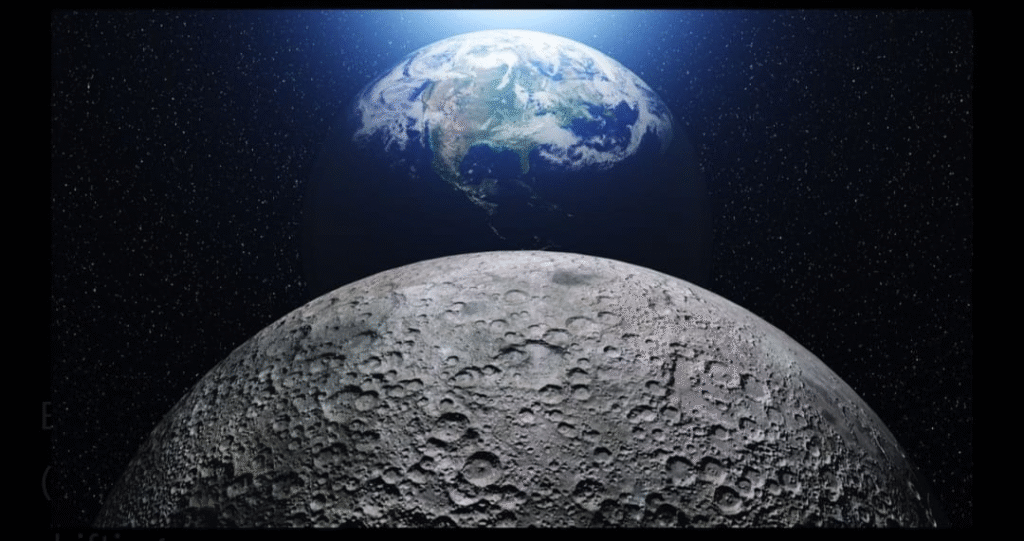
Earth is the only planet with a single natural moon-our familiar companion that brightens the night sky. The Moon stabilizes Earth’s tilt, helping keep climates relatively steady over millennia. It’s likely born from a massive ancient collision that blasted material from young Earth, which coalesced into our satellite.
With a radius of 1,080 miles (1,738 km), the Moon is the fifth largest moon in the solar system. On average, it’s 238,855 miles (384,400 km) away-enough space to fit about 30 Earths lined up between us.
Earth occasionally captures temporary “mini-moons” (asteroids) that orbit for months or years before drifting away.
No Rings, Just Reality
Unlike the gas giants, Earth has no rings.
How Earth Formed and What It’s Made Of
About 4.5 billion years ago, gravity gathered swirling gas and dust to form Earth as the third planet from the Sun. Like other terrestrial worlds, it has a dense core, rocky mantle, and crust.
The structure includes:
A solid inner core of iron and nickel (radius ~759 miles / 1,221 km, scorching at up to 9,800°F /5,400°C).A fluid outer core (~1,400 miles / 2,300 km thick).A thick, caramel-like mantle (~1,800 miles /2,900 km).A thin crust (averaging 19 miles / 30 km on land, just 3 miles / 5 km under oceans).
Dynamic Surface and Vast Oceans
Earth’s surface features volcanoes, mountains, valleys, and more, shaped by shifting tectonic plates that move at fingernail-growth speed-causing earthquakes, mountain-building, and more. Oceans cover ~71% of the surface, averaging 2.3 miles (3.6 km) deep and holding 97% of our water. Hidden underwater are most volcanoes and the planet’s longest mountain range.
Protective Atmosphere and Magnetic Shield
Our air is 78% nitrogen, 21% oxygen, and 1% other gases-ideal for life. It moderates climate, blocks harmful radiation, and vaporizes most incoming meteoroids (creating shooting stars).
The molten core and rapid spin generate a magnetic field that deflects solar wind into a teardrop shape, trapping particles that create dazzling auroras at the poles. The field flips polarity irregularly (about every 300,000 years on average), but these reversals pose no known threat to life.
8 Need-to-Know Things About Our Home Planet
Measuring Up If the Sun were a front door, Earth would be a nickel.
We’re On It – A rocky world with dynamic mountains, canyons, and mostly water-covered surface.
Breathe Easy Perfect 78% nitrogen / 21% oxygen mix for life.
Our Cosmic Companion – One stabilizing Moon.
Ringless No rings here.
Orbital Science – Spacecraft constantly study Earth as a whole system.
Home, Sweet Home – The only known place with life as we know it.
Protective Shield — Atmosphere burns up most meteoroids.
Earth isn’t just a planet—it’s the only home we’ve got. Its unique blend of water, air, stability, and life makes it truly irreplaceable.
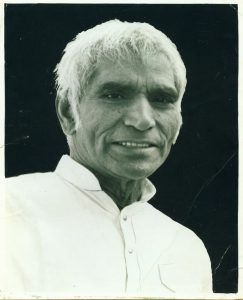
Baba Amte, born Murlidhar Devidas Amte on December 26, 1914, in Hinganghat, Wardha district, Maharashtra (then British India), emerged as one of India’s most revered social activists. Known affectionately as “Baba”—a childhood nickname that stayed with him for life-he dedicated his existence to uplifting the underprivileged, particularly those affected by leprosy, and fighting for environmental and human rights causes. He passed away on February 9, 2008, at Anandwan in Maharashtra, leaving behind a legacy of compassion, selflessness, and transformative social work.
A Privileged Beginning and an Awakening Conscience
Born into an affluent Brahmin family as the eldest of eight children, Amte grew up in comfort. His father, Devidas Haribaji Amte, held a high-ranking position in the British government. Despite the luxuries, young Baba showed early empathy for the less fortunate, often playing with the children of household servants -much to his father’s disapproval.
He pursued law at Hislop College, Nagpur, graduating in 1936 and establishing a successful legal practice. Yet, the stark inequalities around him gnawed at his conscience. He reflected on the injustice of earning large fees while laborers toiled for meager wages, and the disparity between his family’s estate comforts and the servants’ hardships. These realizations deepened his awareness of societal inequities. In the mid-1940s, two pivotal events shaped his path: his marriage to Indu Guleshastri (later Sadhana Amte or Sadhanatai), who became his lifelong partner in service, and his decision to abandon his lucrative career and wealth for full-time social work.
Inspired by Icons and the Freedom Struggle
Amte was profoundly influenced by Mahatma Gandhi, joining the Quit India Movement in 1942. He mobilized lawyers to defend imprisoned leaders and was himself jailed. Gandhi bestowed upon him the title “abhay sadhak” (fearless seeker of truth) after Amte intervened to protect an Indian woman from British soldiers. Thinkers like Rabindranath Tagore, Vinoba Bhave, and Sane Guruji also shaped his ideals. In later years, Amte promoted national unity through the Bharat Jodo Abhiyan (Knit India movement). In 1985 and 1988, he led bicycle journeys from Kanyakumari to Kashmir and Arunachal Pradesh to Gujarat, fostering nationalism amid political and communal challenges.
A Lifelong Mission: Empowering Leprosy Patients
Amte’s most iconic work began with a transformative encounter. Spotting a leprosy-afflicted man named Tulshiram abandoned on the road, Amte initially fled in fear but returned to care for him until his death. This overcame his own prejudices and ignited a lifelong commitment.
In 1949, he founded Anandwan (“Forest of Joy”) in Chandrapur, Maharashtra-a rehabilitation center for leprosy patients, offering medical care, dignity, and self-reliance through agriculture and skills training. To deepen his expertise, he studied at the Calcutta School of Tropical Medicine.
He expanded his vision with Ashokavan in Nagpur (1957) and Somnath in the Tadoba buffer zone (later), providing opportunities for sustainable living. Supported tirelessly by his wife Sadhanatai, these initiatives challenged deep-seated stigma and empowered thousands.
Championing the Narmada Bachao Andolan
In the late 1980s, Amte joined the Narmada Bachao Andolan (Save Narmada Movement), led by Medha Patkar, protesting large dams on the Narmada River that displaced communities and harmed the environment. He relocated near the river in 1990, participated in marches like the Jan Vikas Sangharsh Yatra, undertook hunger strikes, and authored “Cry, the Beloved Narmada” to highlight rehabilitation failures and sustainable alternatives. His involvement amplified the movement’s voice until health issues forced his return to Anandwan.
Recognition and Enduring Legacy
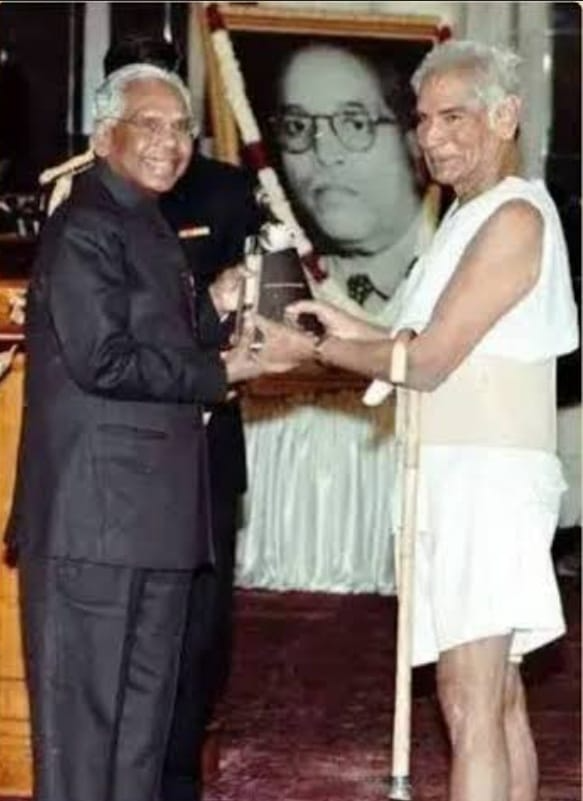
Amte’s contributions earned him India’s Padma Shri (1971) and Padma Vibhushan (1986), the Ramon Magsaysay Award (1985), the UN Human Rights Prize (1988), and a share of the Templeton Prize (1990).
His life exemplified turning privilege into purpose, fear into courage, and isolation into community. Through Anandwan and beyond, his work continues via his family and followers, inspiring generations to serve humanity with empathy and action. Baba Amte remains a beacon of selfless dedication in India’s social reform history.
Phalguna Amavasya, also known as the new moon day or no moon day in the Hindu lunar month of Phalguna, holds profound spiritual importance. This sacred occasion, typically falling in February or March, marks the transition from winter to spring and serves as a powerful time for purification, ancestral homage, and seeking divine blessings.
Spiritual Importance in Hindu Scriptures
In Hindu scriptures, Phalguna Amavasya is revered for its association with Lord Shiva worship, believed to grant desired results, prosperity, and protection from negative energies. As the final Amavasya before the new Hindu year, it symbolizes renewal-cleansing past sins, karmic burdens, and paving the way for festivals like Holi. It is especially dedicated to ancestors (Pitrus), where devotees perform rituals to appease departed souls, remove Pitru Dosh (ancestral curses), and invite peace, blessings, and abundance into their lives.
Mythological and Historical Connections
Myths link this period to the Samudra Manthan (churning of the ocean), where holy dips in sacred rivers like the Ganga, Yamuna, or Shipra are said to bestow immense spiritual merit. Its proximity to Mahashivratri further enhances its significance for Shiva devotees.
Phalguna Amavasya 2026: Date and Timings
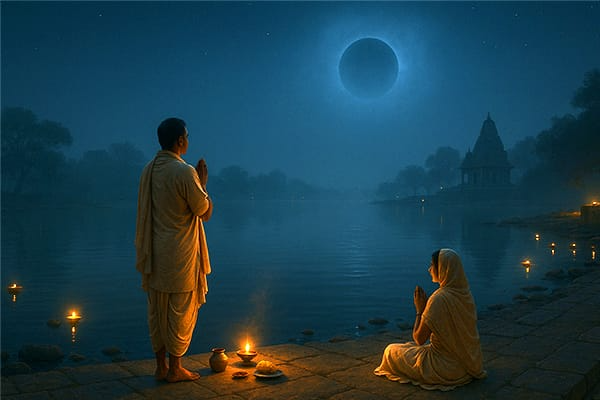
According to reliable sources like Drik Panchang, Phalguna Amavasya 2026 falls on Tuesday, February 17, 2026. This day also coincides with a solar eclipse in some regions (though visibility varies), adding to its rarity and potency.
Key tithi timings (for reference, primarily New Delhi/India standard):
Amavasya tithi begins: 5:34 PM on February 16, 2026. Amavasya tithi ends: 5:30 PM on February 17, 2026. Auspicious periods for rituals, such as holy bathing (Snan), often fall in the early morning hours of February 17 (e.g., around 5:16 AM to 6:07 AM, subject to local panchang variations). As it falls on a Tuesday, this year it is observed as Bhomvati Amavasya, which carries additional auspicious weight in certain traditions
Key Rituals and Practices
Devotees observe this day with devotion and discipline to honour ancestors and seek spiritual growth:
Holy Bath (Snan): Take a sacred dip in holy rivers or water bodies at dawn to wash away sins and impurities.
Tarpan: Offer water mixed with sesame seeds, barley, and kusha grass to ancestors while standing near a river or pond and chanting mantras. Derived from the Sanskrit word “Trup” (to satisfy), Tarpan quenches the “thirst” of departed souls and ensures their blessings for descendants.
Pind Daan: Prepare rice balls (pindas) from cooked rice, barley flour, sesame seeds, and ghee. These symbolize the physical body of the departed and are offered to help liberate their souls, granting them moksha (liberation) and bringing prosperity and harmony to the living
Worship of Lord Shiva: Perform puja, chant mantras, and offer bilva leaves or other items to invoke Shiva’s grace.
Charity and Donations: Donate food, clothes, mustard oil, sesame seeds, black gram, or other essentials to the needy. Such acts are believed to mitigate malefic planetary effects and attract wealth.
Lighting Lamps: Light a mustard oil lamp under a peepal tree for auspicious energy.
Fasting and Meditation: Many undertake a fast, engage in mantra chanting, and meditate for inner peace.
Embracing the Eternal Bond
By performing these rituals with sincerity on Phalguna Amavasya, devotees not only pay respect to their ancestors but also invite renewal, protection, and prosperity into their lives. This sacred day reminds us of the eternal bond between generations and the power of gratitude in Hindu tradition.
Inauguration of Dr. Beena’s exhibition at Jawahar Kala Kendra; documentary highlights mythological significance
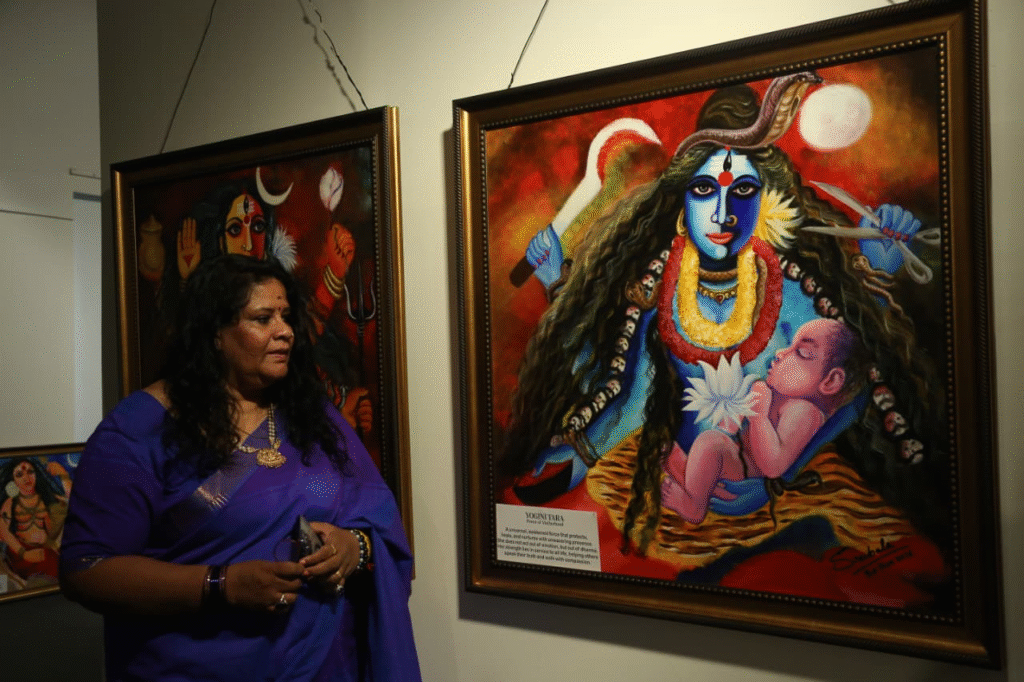
Jaipur: “Naari Tu Narayani”—woman as the embodiment of divinity—is a foundational idea in Indian philosophy. Echoing this life-giving, divine feminine energy, the exhibition ‘Eka: The One’ invites viewers to experience a sacred encounter with spiritual power. The traveling exhibition by senior artist from Kerala, Dr. Beena S. Unnikrishnan, was inaugurated on Monday at the Alankar Gallery of Jawahar Kala Kendra.
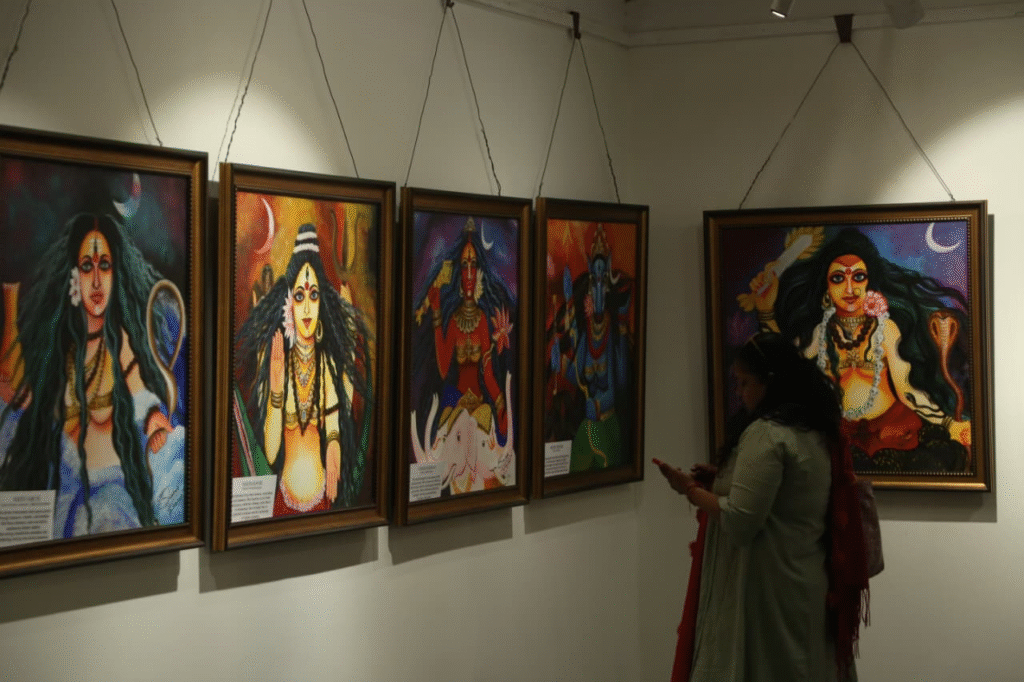
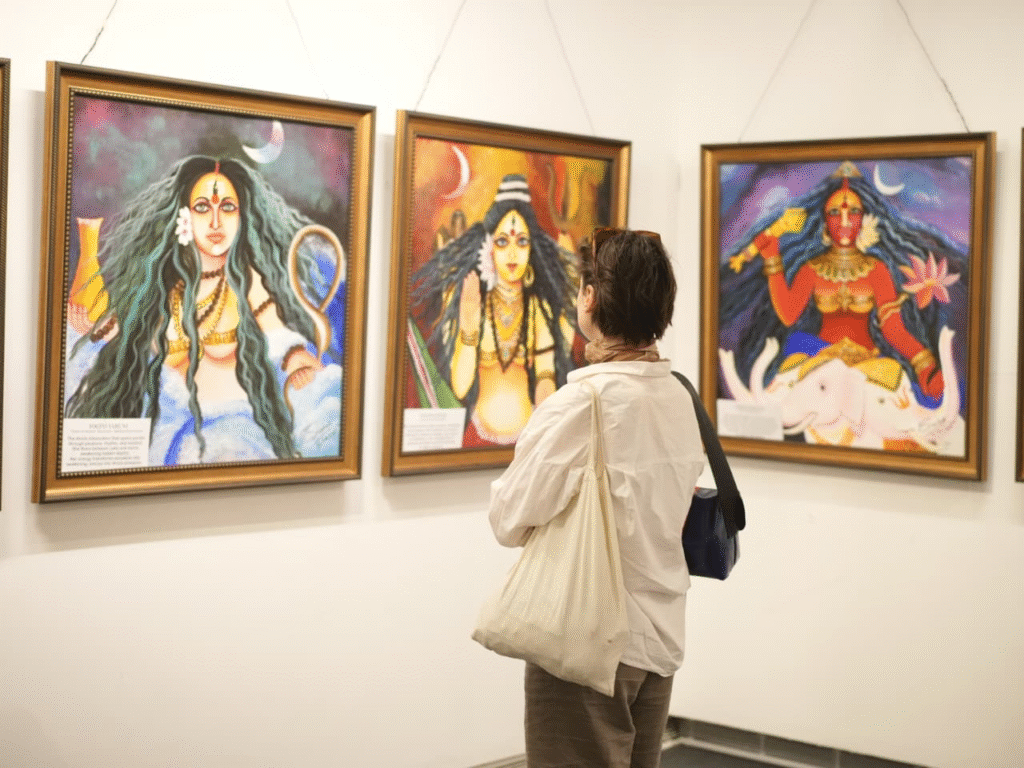
The exhibition showcases paintings of the 64 Yoginis, who hold a significant place in goddess worship. Each Yogini represents a distinct form of energy and is believed to bestow specific spiritual attainments. Through these works, the exhibition enables viewers to sense and engage with these diverse energies.
Dr. Beena created 68 paintings over a period of five years. This artistic journey began with the concept of portraying Maha Tripurasundari, which gradually evolved into an expansive spiritual practice. After traveling to Kochi, Coimbatore, Bengaluru, Mumbai, Bhopal, and Ahmedabad, the exhibition has now reached Jaipur. This spiritual-artistic traveling exhibition spans 81 days, covering 16 states and nearly 10,000 kilometers. It will remain open to art lovers daily from 11:00 am to 7:00 pm until 18 February.
Pilgrimage to Yogini temples after completing the 68 artworks
Dr. Beena shares that it was the feminine energy within her that inspired this artistic path. She believes the divine feminine itself chose her as a medium to manifest its presence through art. After completing the paintings of the 64 Yoginis, she undertook a journey to their temples—an experience she describes as profoundly transformative.
History of the Yoginis depicted in a 60-minute documentary
Each painting presents a distinct depiction of a Yogini—varying in form, adornment, radiant eyes, and flowing hair—reflecting unique energies. On the occasion of the exhibition, a 60-minute documentary was also screened, elaborating on the history, energies, and mythological significance of the Yoginis. The documentary has been produced by the artist herself and directed by Dr. Jain Joseph.
The 64 Yoginis dispel fear, doubt, and overthinking
Speaking about her journey, Dr. Beena noted that her first exhibition was held in 1998. Since then, every painting she has created has contributed to her personal growth. With each artwork, she has evolved into a more refined individual. Her engagement with the 64 Yoginis was not merely an artistic exercise, but a deep inner pilgrimage. These divine energies gradually helped her overcome fear, doubt, and excessive overthinking, granting her confidence, balance, and inner peace. Even today, she strongly feels the constant presence of this divine force—her greatest inspiration, guiding her continuously toward creation, spiritual practice, and self-development.
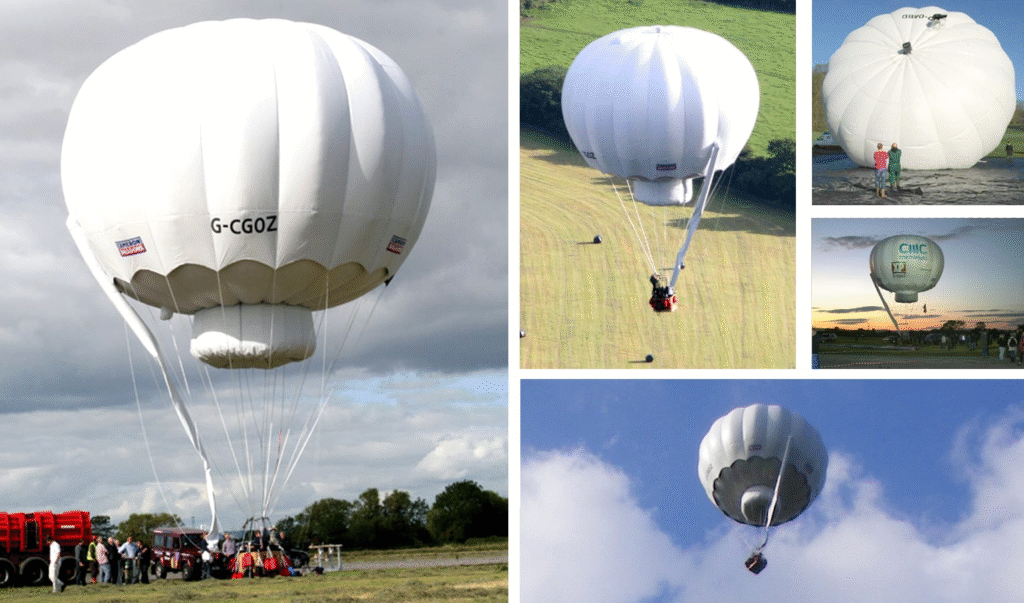
Hydrogen balloons marked one of the earliest triumphs in human flight, offering superior lift compared to hot air alternatives. Yet their extreme flammability led to their eventual replacement by safer gases like helium in most applications.
Why Hydrogen Balloons Explode
Hydrogen gas is highly flammable and reacts vigorously with oxygen to form water (H2O). When a hydrogen-filled balloon bursts, the escaping gas mixes rapidly with surrounding air, creating a highly explosive mixture. Even a tiny spark-such as from static electricity, friction between balloons, or a nearby flame-can ignite it, resulting in a sudden fireball or explosion.
Hydrogen’s dangers stem from several key properties:
High reactivity — With only one electron in its outer shell, hydrogen atoms eagerly bond with oxygen. Low activation energy — The reaction requires roughly one-tenth the energy needed for natural gas, making it easy to trigger.
Wide flammability range – Hydrogen ignites in
air at concentrations between 4% and 75%, allowing explosive conditions even in partially confined spaces like rooms or elevators. These factors make hydrogen far more hazardous than inert gases. The Invention of Hydrogen Balloons in 1783 Hydrogen balloons emerged as a direct improvement over the Montgolfier brothers’ hot-air balloons, which relied on continuous fires and were bulky, limited in range, and altitude.Hydrogen, discovered as “inflammable air” and recognized as the lightest element, provided dramatically better lifting power. This enabled smaller, lighter, and more durable balloons capable of longer flights and higher altitudes.The breakthrough required new material technology: airtight, lightweight envelopes. The Robert brothers developed a solution using silk coated with rubber dissolved in turpentine.
First unmanned launch (August 27, 1783):
Jacques Charles and the Robert brothers released a 35-cubic-meter hydrogen balloon from Paris’s Champ de Mars. Filled using hydrogen generated by reacting sulfuric acid with iron filings, it traveled 21 km before landing and being destroyed by frightened locals.
being destroyed by frightened locals.
First manned flight (December 1, 1783): Just 10 days after the Montgolfiers’ hot-air manned ascent, Jacques Charles and Nicolas-Louis Robert piloted a hydrogen balloon for over two hours, reaching about 550 meters (some accounts note up to 3,500 meters) and covering roughly 36 km. These flights sparked “balloonomania,” driving scientific exploration of the atmosphere with instruments like barometers and thermometers.
Key Historical Milestones and Technological Advances
Early hydrogen balloons used silk envelopes, later improved with goldbeater’s skin (thin animal membrane) for superior gas retention.
Innovations enhanced safety and control:
Drag rope (1830s) For gradual descent and stability. Rip panel (1839) – Allowed quick gas release for emergency landings. Throughout the 19th and 20th centuries, hydrogen balloons supported exploration, research, and military uses, including surveillance in World War II.
Hydrogen vs. Helium: Why the Switch Happened
The switch from hydrogen to helium occurred primarily because of safety. Hydrogen is highly flammable and explosive, as tragically shown by the 1937 Hindenburg disaster where the hydrogen-filled airship caught fire and burned rapidly, killing dozens and ending the era of hydrogen airships. Helium, being an inert noble gas, is completely non-flammable and chemically stable, eliminating the risk of fire or explosion. Although hydrogen provides slightly better lift (about 7-10% more buoyancy) and is cheaper to produce, the overwhelming priority became public safety, leading modern applications-blimps, weather balloons, and party balloons-to use helium despite its higher cost and minor reduction in lifting power.
Cheaper coal gas sometimes substituted for hydrogen in non-critical applications.
Hydrogen’s flammability led to infamous disasters, such as the 1937 Hindenburg airship fire, where hydrogen accelerated a rapid blaze (though debates persist on the exact ignition source, often linked to static electricity or the airship’s flammable outer coating).
Helium became the standard for party balloons, public events, and most commercial uses due to its non-explosive nature-no fireball if popped near a flame. Hydrogen remains in specialized applications like some weather balloons for cost and lift advantages, but helium dominates everyday and safety-critical scenarios.
Hydrogen balloons revolutionized aviation in the late 18th century by overcoming hot-air limitations, but their explosive potential ultimately paved the way for helium’s safer reign in modern ballooning.
An Analytical Policy Brief on India’s Maritime Strategy in the Indo-Pacific
The Indo-Pacific has emerged as the epicenter of global economic and strategic competition, with Sea Lines of Communication (SLOCs) carrying over 95% of India’s trade and a significant share of global energy flows. As geopolitical tensions intensify—particularly amid China’s expanding maritime footprint and the evolving security architecture shaped by initiatives such as AUKUS—the region has become central to India’s strategic calculus.
This brief examines the shifting maritime security landscape, key geopolitical challenges, India’s evolving naval posture, and the strategic imperatives required to sustain regional stability while safeguarding national interests. This paper analyses the evolving maritime security dynamics in the Indo-Pacific, the key challenges, the role of the stakeholders and the strategic imperatives for regional stability.
BACKGROUND
The Indo-Pacific is a vast, integrated geographic and strategic construct encompassing the Indian and Pacific Oceans, it extends roughly from the eastern coast of Africa to the western coast of the Americas, encompassing South Asia, Southeast Asia, East Asia, Australia, and Pacific island nations. Geographically, it bridges two oceans, strategically, it is a contested, high-stakes region defined by over 60% of the world’s population, major maritime trade routes and chokepoints, and intense geopolitical competition. A maritime security strategy is a comprehensive framework of measures, policies, and operations designed to protect a nation’s territorial waters, sea lanes, and maritime interests from various threats, including piracy, terrorism, trafficking, and environmental hazards.
GEOPOLITICAL FAULT LINES IN THE INDO-PACIFIC
The major challenge for India in the Indo-Pacific region lies in intense strategic competition with both China and the United States, which has led to overlapping claims, territorial disputes—particularly in the South China Sea and the Indian Ocean—and rapid military build-ups. China’s territorial assertiveness through its Belt and Road Initiative (BRI) poses a significant strategic challenge for India, as it seeks to establish a “String of Pearls” encirclement strategy through infrastructure projects in Pakistan, especially the China–Pakistan Economic Corridor (CPEC), which passes through Pakistan-occupied Kashmir (PoK).
Projects such as the Hambantota Port in Sri Lanka, Gwadar Port in Pakistan, and the Djibouti military base have expanded China’s military and naval footprint in the Indian Ocean, thereby constraining India’s traditional sphere of influence and creating potential strategic and military bottlenecks.
While the BRI provides much-needed infrastructure financing for developing nations, it has often led to unsustainable debt burdens for smaller countries such as Sri Lanka, Nepal, and Bangladesh. This has raised concerns over “debt-trap diplomacy,” potentially compromising their economic sovereignty and political stability, while simultaneously strengthening China’s ties with India’s neighbors and diminishing India’s influence in South Asia.
AUKUS is a trilateral security partnership formed in September 2021 between Australia, the United Kingdom, and the United States. It focuses on enhancing defense capabilities through two pillars: providing Australia with nuclear-powered submarines (SSNs) and fostering advanced technology collaboration in AI, cyber, and quantum technologies. AUKUS is perceived by Beijing as a direct containment mechanism of BRI, likely leading to further militarization of the South China Sea, tighter China-Russia, and broader, more assertive Chinese naval operations in Indo-Pacific.
“The control of the seas means security. The control of the seas means peace. The control of the seas can mean victory.”— John F. Kennedy
Further the acquisition of nuclear-powered submarines by a non-nuclear weapons state (Australia) sets a precedent, prompting regional actors to enhance their own naval and advanced weaponry increasing the potential for conflict. In diplomatic terms the pact forces Southeast Asian and Pacific nations to choose between aligning with the U.S. or China.
OPERATIONALISING MARITIME STRATEGY
India is strengthening its maritime security in the Indo-Pacific by acting as a “net security provider,” which includes The MAHASAGAR doctrine in 2025 a strategic evolution from the regional SAGAR vision. The doctrine positions India as a “first responder” for Humanitarian Assistance and Disaster Relief (HADR), Strengthening ties with nations like Mauritius, Sri Lanka, Seychelles, and Tanzania through joint exercises, surveillance, and capacity building. Particularly by enhancing Maritime Domain Awareness (MDA) for smaller nations it provides a collaborative, rule-based alternative to other regional powers transactional approaches.
In 2024–2025, the Indian Navy deployed over 10 warships for Operation Sankalp in the Gulf of Aden and Arabian Sea to secure commercial shipping from Houthi attacks. Indian Navy has saved 110 lives in the operations which includes 45 Indians and 65 international citizens during Operation Sankalp and other missions responding to 13 attack incidents in 2024.
Following bilateral talks on 7th of February 2026, India and Malaysia agreed to expand defence ties, including enhanced counter-terrorism, intelligence sharing, and maritime security cooperation including a decision to establish a Consulate General in Malaysia to enhance strategic engagement.
Both prime ministers have appreciated the visit of INS Sahyadri to Kemaman, Malaysia in October 2025 and of hydrographic vessel INS Sandhayak to Port Klang, Malaysia in July 2025. The leaders also welcomed the regular navy-to-navy interactions between the countries, including under bilateral and multilateral naval exercises such as ‘Samudra Laksamana’, MILAN and ASEAN-India Maritime Exercise (AIME).
Along with bilateral talks 9th Indian Ocean Conference is scheduled for April 10–12, 2026 in Mauritius, focusing on “Collective Stewardship for Indian Ocean Governance”.
India is working upon to make an integrated effort to strengthen maritime security in Indo-Pacific through bilateral, multilateral defence pacts and agreements along with vessels and defence equipments expansion in Indian navy by integrating AI advancement into it taking forward its Viksit Bharat 2047 aim.
However, Trump’s imposition of fifty percent tariffs on India and seeming outreach to Pakistan had shattered India-US relations, the administration had already alienated some Asian partners through its repeated tariff negotiations as a result major Asian powers are moving toward Russia and china in view of western trade restraints which includes active involvements of BRICS and ASEAN. Recent news of Indo-US bilateral trade deal reducing tariffs from 50% to 18% seems a more controversial diplomatic topic in news right now than a masterstroke.
The game remains the same for India as always how India can align with both West and Asia primarily safeguarding its maritime boundaries along with maintaining a strong defence position in shifting global dynamics.
(The writer of this article is Himadri Agarwal, student of Kanoria College, Jaipur. She is an undergraduate student of Economics, Geography, and Political Science with research interests in Indo-Pacific geopolitics, maritime security, and India’s foreign policy.)
Leh Dosmochey and Likir Stromochey Festivals Begin Today in Ladakh – Symbolizing the Triumphant End of Harsh Winter.
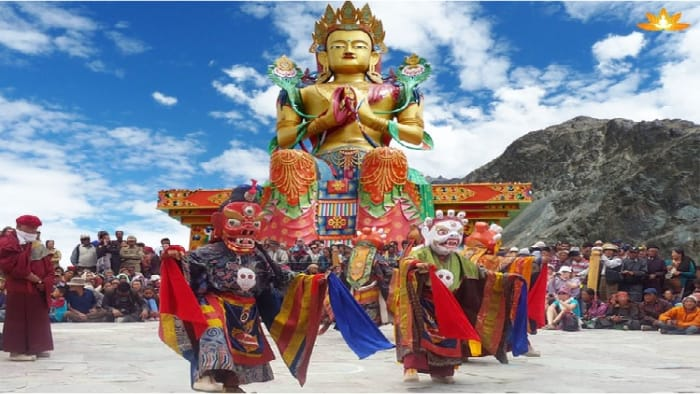
In the breathtaking Himalayan region of Ladakh, two cherished monastic festivals-Leh Dosmochey and Likir Monastery Stromochey-have commenced today, February 16, 2026, ushering in a wave of spiritual energy, cultural vibrancy, and collective optimism. These timeless Buddhist celebrations symbolically mark the conclusion of the region’s unforgiving winter and herald the promise of warmer days, positivity, and protection for the year ahead.Celebrated during the final days of the harsh, cold season, these festivals draw locals, monks, and visitors together in a profound display of faith and tradition. They follow weeks of special prayers for world peace, abundant harvests, and favorable weather, reflecting Ladakh’s deep connection to nature and spirituality.
The Dosmochey Festival: The “Festival of the Scapegoat”
Known as Dosmochey or the “Festival of the Scapegoat,” this is one of Ladakh’s most significant monastic events. Primarily held at Leh Palace and supported by monasteries like Likir and Diskit, it features elaborate sacred rituals led by Buddhist monks.The centerpiece involves the creation of intricate ritual offerings, including dough effigies and thread crosses designed to capture negative energies, evil spirits, and misfortunes accumulated over the long winter. On the final day, these symbolic items are ceremonially burned or destroyed, representing the triumphant removal of negativity and the welcoming of good fortune.Monks perform mesmerizing Cham (masked) dances, blending drama, spirituality, and artistry to depict the eternal victory of good over evil. The atmosphere buzzes with prayer chants, traditional music, and devotees in colorful attire seeking blessings.
The Stromochey Festival at Likir Monastery
Parallel to Dosmochey, the Stromochey Festival unfolds at the ancient Likir Monastery, renowned for its stunning location and rich heritage. This event shines through vibrant Cham masked dances performed by monks in elaborate, intricate costumes.
These ritual performances vividly illustrate the triumph of good over evil while warding off malevolent forces to ensure peace, prosperity, and harmony for the community. The dances, accompanied by rhythmic music and sacred chants, create a captivating spiritual spectacle that captivates all who witness it.
A Celebration of Culture, Community, and Renewal
Both festivals attract a lively mix of residents and tourists eager to experience Ladakh’s profound Buddhist legacy. Prayer ceremonies fill the air with devotion, while traditional music, vibrant attire, and communal gatherings foster a sense of unity and joy.Beyond their religious depth, Dosmochey and Stromochey embody Ladakh’s enduring cultural traditions. Passed down through generations, these rituals strengthen community bonds, preserve ancient practices, and renew hope as the snow begins to recede and preparations for the agricultural season take root. As Ladakh bids farewell to winter’s chill, these monastic festivals serve as powerful reminders of resilience, renewal, and the enduring spirit of the region. If you’re in Ladakh or planning a visit, immerse yourself in this extraordinary cultural moment-where faith, tradition, and nature converge in perfect harmony.