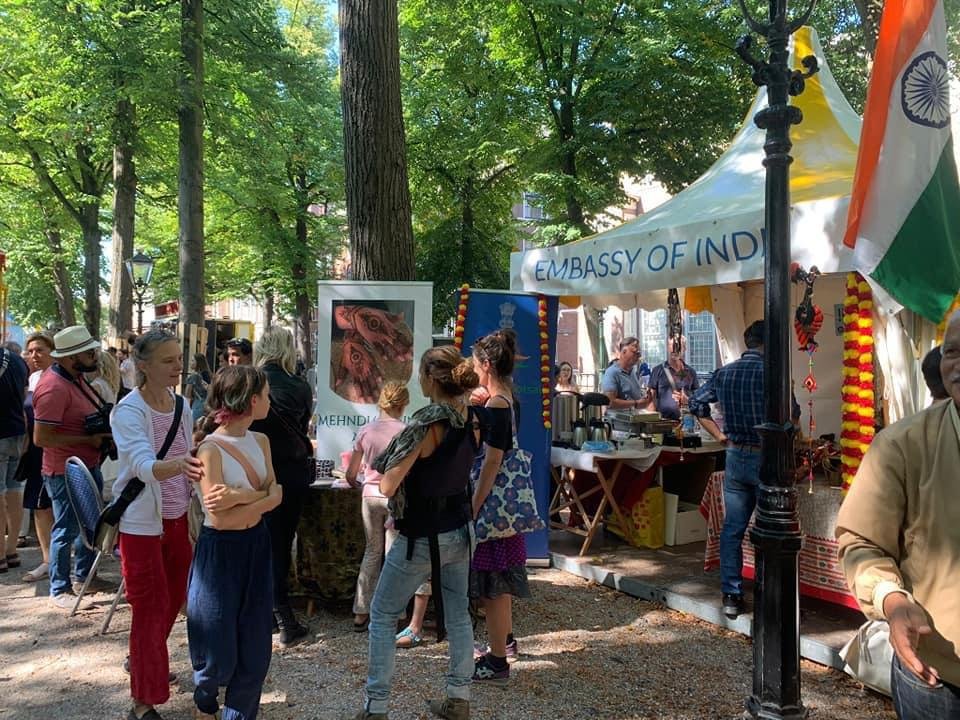
The Indian Embassy in The Hague participated in the 9th Embassy Festival on Sep 3, 2022, in the Lange Voorhout in The Hague, Netherlands, by showcasing the best of Indian diverse culture, food, and dance to the Dutch public.
The annual festival, which returned last weekend after a two-year hiatus due to the Covid-19 pandemic, attracted 55 embassies and more than 50,000 visitors.
Large crowds enjoyed Indian dance, music & food at the Embassy Festival in The Hague.
The India pavilion showcased Indian handicrafts & street food, henna & yoga, and the main attraction of the Punjabi Folk Dance Bhangra performance was a huge success!
Bhangra is a typical folk dance of the state of Punjab and it is associated with the Vaisakhi festival.
This dance is a collaboration between Abhivyakti and Amsterdam Bhangra group. A group of dance enthusiasts came together to spread the joy of folk dance in the Netherlands.
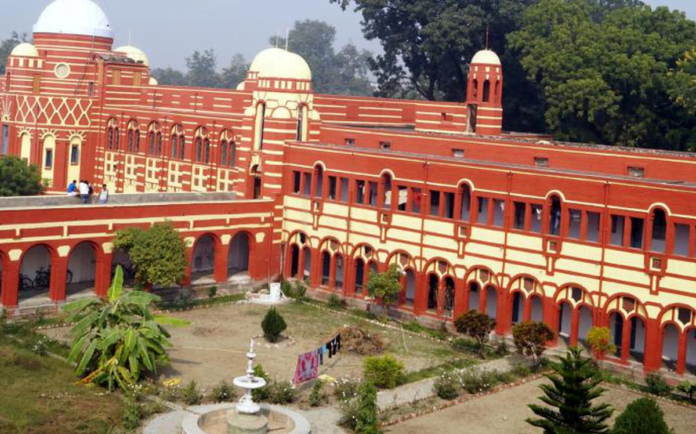
106-year-old astronomical observatory at the Langat Singh College, Muzaffarpur in Bihar was added to UNESCO World heritage observatories list. This observatory is first of its kind in eastern part of India.
It was established in 1916 to give detailed astronomical knowledge to students.
Prof Romesh Chandra Sen was the first one to take initiative to set up the astronomical observatory at the college. In 1914, he talked to an astronomer J Mitchell for guidance.
In 1915, telescope, chronograph, astronomical clock, and other equipment were procured from England.
Finally in 1916, astronomical observatory was started.
In 1946, a planetarium was also established in the college.
However, the condition of astronomical observatory started deteriorating after 1970. No steps were taken for its restoration. Now, authorities are hopeful to get funds from state government for its restoration, after its inclusion in UNESCO list of endangered heritage observatories.
UNESCO World Heritage Sites and observatories in India:
Sites of cultural and natural importance worldwide are recognised under the UNESCO World Heritage Convention which was established in 1972. In India, there are 40 World Heritage Sites, making it the country with 6th largest number of World Heritage Sites. It includes 32 cultural sites, 7 natural sites and 1 mixed site.
The Jantar Mantar in Jaipur is also included among UNESCO World Heritage site. Jantar Mantar is a collection of 19 astronomical instruments, constructed by king Sawai Jai Singh II. It also features the largest stone sundial of the world.
Gayaji Dam was recently inaugurated over Falgu river by Bihar CM Nitish Kumar.
Kumar inaugurated the country’s largest rubber dam and a steel bridge over the Falgu river which is located near Vishnupad temple in Bihar. He had laid its foundation stone on 22 September 2020. EBNW Story features a few of its details…
The banks seen along the Falgu River are developed and a steel bridge is built for pilgrims to visit Sita Kund
The rubber dam is built with 17 mm thick rubber. It is 400 meters wide and 3 meters high. With the construction of the dam, its water will be stored for about two and a half kilometers.
The height of Bar Dam has been retained at three meters which will help in holding water up to three meters. If there is more water, the water from the top of the rubber dam will flow downwards i.e. in the north direction. In special circumstances, arrangements have been made to release water from the rubber dam.
Being a bulletproof structure, experts claim that it will not deteriorate for 100 years. This rubber dam has been built at a cost of about 312 crores which will keep water throughout the year in the Falgu river.
This will help people to take bath, pind daan and perform tarpan. People visit here not only from the country but also from abroad come to offer prayers to the ancestors for salvation.
The Gayaji Dam was constructed by Rubina Company of Austria in collaboration with Nagarjuna Construction Company of Hyderabad on the advice of experts from IIT Roorkee.
Kohinoor’s journey from India to London is quite interesting. As per the reports, the precious stone was first mined in the region of present-day Telangana-Andhra from Kollur Mine which was a series of gravel-clay pits on the south bank of the Krishna River in the Golconda Sultanate of India.
The ownership of this stone passed in different hands as and when the power went to. These included Alauddin Khalji, Nader Shah, Ahmed Shah Durrani, Shuja Shah and Ranjit Singh who had the diamond in their possession throughout the course of history. Finally, the British rulers of India procured it from Ranjit Singh’s son Duleep Singh after the second Anglo-Sikh war which ended in 1849.
Kohinoor
In fact, the British administrators laid out harsh surrender conditions on the young Duleep Singh including the handing over of the Kohinoor to the Queen of England. As there was no option left, Duleep Singh consented and that was how the diamond passed to the British rulers.
Kohinoor: Its travel story
The transfer of this stone London is quite interesting too. The Governor General, Lord Dalhousie faced the challenges of transporting the world’s most valuable diamond from Lahore to Bombay and to London.
He took gem in a secretive manner than taking it in the midst of a heavily armed convoy. He carried the stone in his own private box and went to Bombay. There he handed over the Kohinoor to Captain William Lockyear who boarded a ship named The Medea which was to be sailed to London on 6th April 1850. He was accompanied by Captain Ramsay, nephew of Lord Dalhousie. In absence of deployment of large security staff, two young Captains proceeded to England for a holiday without carrying anything of great value.
While the Medea was almost wrecked in a storm near Africa, it eventually docked in Plymouth on 30th June after which the Kohinoor was formally presented to Queen Victoria on 3rd July 1850 by the deputy chairman of the East India Company. The date was selected to coincide with the Company’s 250th anniversary.
Ever since then the Kohinoor has been with the British monarch.
Reports said that the person that The Queen Consort Camilla, wife of King Charles will now have the right to wear it.
Now the question is that whether the gem will be returned to its historical owners or not remains uncertain.
Hindi Diwas is celebrated each year on September 14 in India. There are many interesting facts regarding the celebration. EBNW Story features it here…
Do you know over 420 million people across the globe speak Hindi as a first language and around 120 million people speak it as a second language?
In fact, Hindi is one of the most widely spoken languages in the world and is also called as Mother Tongue of India. Hindi Diwas is celebrated in India every year on September 14. Hindu language is not only a language but it emerges as a feeling of millions of people across the world who speak Hindi.
Some interesting facts about Hindi Diwas:
1. Hindi is spoken in different countries like Nepal, New Zealand, UAE, Uganda, Fiji, Mauritius, Suriname, Guyana, Trinidad, Bangladesh, Pakistan, USA, UK, Germany and Tobago.
2. Surprisingly, many English words such as bungalow, avatar, guru, jungle, etc have been borrowed from Hindi.
3. Hindi has derived its name from the Persian word ‘Hind’ which means “land of the Indus River”.
4. The first Hindi Diwas was celebrated on September 14, 1953, after the day was officially recognised. In fact, it was September 14, 1949, was the day when the Constituent Assembly of India accepted Hindi, written in Devnagari script, as one of the official languages in India.
5. In 2006, the first time World Hindi Day was celebrated and on January 26, 1950, Hindi was recognized as an official language in Article 343 of the Constitution.
6. Jawaharlal Nehru, the first Prime Minister of the country,, decided to celebrate Hindi Diwas on September 14.
7. World Hindi Day was first celebrated in the year 2006 by former Prime Minister Dr. Manmohan Singh to promote the Hindi language across the world.
8. In 1881, Bihar became the first Indian state to adopt the Hindi language officially
9. Several Hindi words including ‘Achha’, and ‘Surya Namaskar’ are included in the Oxford Dictionary.
Out of the 10 mentioned Temples situated in Pattadkal in Karnataka state of India, Mallikarjuana temples and Virupaksha Temple are the two impressive temples made my Queens.
Alongside the Malaprabha river banks lies a town named Pattadkal in Karnataka state of India
Located towards the north of the state lies this UNESCO World Heritage Site which is popular for its 10 temples (Kadasiddheshwara temple, Jambilingeshwara Temple, Galaganatha Temple, Chandrashekhara Temple, Kashi Vishwanatha Temple, Mallikarjuna Temple, Virupaksha Temple, Papanatha Temple and Jain Narayana Temple) situated in the shrine.
One such prominent and tallest temple among them is the Virupaksha Temple, dedicated to deity Virupaksha (Avatar of Shiva ) and his wife Devi Pampa .
Originally named as Lokeshwara Temple, this temple is considered to be build by a Queen and not King between 740 and 745 CE. Out of the 10 mentioned Temples of this site, Mallikarjuana temples and Virupaksha Temple are the two impressive temples made my Queens.
Queen Lokamana devi,wife of King Vikramaditya ll commissioned this monument to commemorate his husband’s victory over the pallavas of Kuchilapuram. Stories from Mahabharat, Ramayan are engraved within the walls and pillars .
Some of the stories include -Ramayana such as Shri Ram killing Bali, Seeta being abducted by Ravan lifting Kailash Parbat, Jatayu fighting with demon king Ravan and so on, While other include Krishna lifting Goverdhan, Bhishma lying on bed of arrows and many more.
It is believed that the architecture of the structure was inspired by the Kanchipuram’s Kailashnath temple. This nine-storey tower Black bull pavilion(Nandi ) is present towards the north and at present, the main temple consists of a Garbhagraha ( sanctum), three ante chambers, separate entrance or Pravesh dwar ,a pillared hall, a giant kalasha like pot also crowns its top. The temple is decorated delicately with carved pillars and thus it can be said that the temple exemplifies the Dravidian Architectural style.
The name “Muziris” is said to be derived from the port’s native Dravidian name, “Muciri.”
On the Malabar Coast, Muziris was both a historic harbour and a major urban hub. The contacts between South India and Persia, the Middle East, North Africa, and the Greek and Roman Mediterranean area were all facilitated by Muziris. Spices (including black pepper and malabathron), semi-precious stones (beryl), pearls, diamonds, sapphires, ivory, Chinese silk, Gangetic spikenard, and tortoise shells were among the notable exports from Muziris. Gold coins, thin garments, figured linens, multicoloured fabrics, antimony sulphide; copper, tin, lead, coral, raw glass, wine, and orpiment were all carried by the Roman navigators.
Muziris vanished from antiquity’s maps, presumably as a result of a cataclysmic event in 1341, a “cyclone and floods” in the Periyar that altered the region’s geography. The identification of Pattanam as Muziris is a contentious issue among some South Indian historians. The Archaeological Survey of India conducted an excavation in 1969 at Cheraman Parambu, 2 kilometres north of Kodungallur. In the year 1983, Roman coins were found at a site around six miles from Pattanam.
Archaeological research revealed that Pattanam was a Roman port with a long history of habitation dating back to the 10th century BC.
Its trade with Rome peaked between the first and fourth centuries BC. The most remarkable discovery at the Pattanam excavations in 2007 was a brick structural wharf complex with nine bollards to harbour boats and, in the midst of this, a highly decayed canoe perfectly mummified in mud.
The canoe was made of a tree native to the Malabar Coast that is used to make boats. Thousands of beads, sherds of Roman amphora, Chera-era coins made of copper alloys and lead, fragments of Roman glass pillar bowls, terra sigillata, remains of a long wooden boat and associated teak bollards, and a wharf made of fired brick are among the major discoveries from Pattanam.
The once called garden city of India is now combating its most brutal battle because of heavy rains and flood, which had drowned almost all places, be it the private villas or IT sector offices situated at the outer ring road. Floods had seemingly taken everything without limiting to any boundary.
The chaos created in Bangalore is not much different, though. Many places are drastically falling into the rampage of nature.
Many other places have been falling into the distress of floods this year. Places like Brazil, Iran, and Madagascar combated through heavy rainfall surge. Thus, the sites took a long time to find peace. Many scientists have suggested how climate change can be the reason for these unusual floods and heavy rainfalls.
Even so, flood is a very recurring phenomenon on earth and everywhere. However, it is pretty confident that the irregularity of this natural disaster is some warning clue from nature itself.
Floods and many incidents transpired, indicating the growing concerns about natural catastrophes.
Amazon fire was a natural disaster that formed many problems for the fauna and people nearby. The issue also converted into heat waves, resulting in many deaths. Similar wildfires were smeared in Spain and Argentina, where many lives were jeopardized.
As wildfires, there was a similar situation with an altered element. Heavy snowfall in many areas of the world made people uncomfortable, especially in Turkiye, which faced heavy snowfall this year.
Global warming and climate issue from high carbon emission has become a lethal reason behind all this disarray.
Thus, as humans, it becomes our responsibility to take significant steps to bring the greenery back and eliminate the practices affecting our land.
Nestled in the Aravalli range of mountains near the Taragarh Hill, Dargah Ajmer Sharif is a sacred treatise, where petitions from the pure soul never go unanswered.
The rose-scented narrow bylanes around Dargah which remain busy bring along an aura of positive vibes. The divine aroma of the scent sticks and the Qawwali songs have the power to mesmerize the soul, creating a pious atmosphere that attracts people from diverse religions together under one roof for the fulfilment of their wishes. One can witness the universality of this sacred pilgrimage.
A few details from Dargah history-
Dargah’s oldest parts of the modern structure were constructed by Humayun, and date back to the 13th century.
The roots of this dargah are connected with the pious Persian saint Khwaja Moinuddin Chishti, who is considered as the epitome of mercy and had immense spiritual powers.
There are so many soul touching experiences inside Dargah, which are difficult to be woven with words. Here we bring a few of the facts from dargah:
1. Bulland Darwaja
The huge enthralling Bulland Darwaja is the entrance to Ajmer Sharif, serving as a monument in itself. 54 metres in height, there are engravings carved on the gate which speak about the history of this place. Other than this, there are two more gates, Nizam Gate and ShahJahani Gate, which hold some interesting facts.
2. Jaanati Darwaja
To the west of the dargaah, the silver-shuttered Jaanati Darwaja is situated. It is believed that if someone crosses the gate from west to south six times in one stretch, they can surely secure a place for themselves in heaven.
The Jannati Darwaja only opens four times a year.
Near Jannati Darwaja there is a spot where devotees usually meditate to fulfill their wishes.
3. Deg
There is a deg known as Kadhaaye inside the dargaah which was introduced by Akbar around 400 years back where 4800 kg of food can be prepared . The tons of food which is being cooked in the kadhaaye is known as Tabarukk, which is strictly veg. Tabarukk is prepared at night and distributed to devotees after morning prayer.
4. Jalahara
There is a small pond of pure water at Ajmer Dargah which exists from the very beginning of this sanctum. It is said that the water in the pond is the holiest water which is taken to perform rituals and helps to cure many things.
5. Akbari Mosque
There is an Akbari Mosque situated within Dargaah, named after Akbar as he built this as it a present for his son Jahangir.
6. Dua-e-Roshni
Dua-e-Roshni is a ritual performed in Dargah fifteen minutes prior to evening prayer. The prayer is conducted by reciting rhythmic Persian verses and lamping the candles, which are made up of complete wax with without using any meat.
7. Mehfil-e-Sama (Qawwali)
Every day after evening Namaz, traditional Sufi songs known as Qawwali are sung by devotees inside Namazi’s hall.
PM Narendra Modi inaugurated the Karyatavya Path at Delhi-situated India Gate and termed the Rajpath or Kingsway as symbol of bravery.
While addressing the gathering, he said, “If the path is the Rajpath, then how will the journey be Lokmukhi? The Rajpath was for the British Raj, to whom the people of India were slaves. The spirit of Rajpath was also a symbol of slavery, its structure was also a symbol of slavery. Today its architecture has also changed, and its spirit has also changed,” he said.
Prime Minister Modi earlier unveiled a grand statue of Netaji Subhas Chandra Bose near India Gate on the same day which is made of jet black granite and has a height of 28 feet. It will be placed under the Canopy near India Gate.
According to Prime Minister’s Office (PMO), the move symbolises a shift from the erstwhile Rajpath being an icon of power to the ‘Kartavya Path’ being an example of public ownership and empowerment.
Speaking at inauguration of the spectacular 'Kartavya Path' in New Delhi. https://t.co/5zmO1iqZxj