Home Blog Page 649

Bundi Celebrates 782 Years of Rich History and Cultural Heritage

0
Credit: Thrillophilia

Bundi, a historic town located in the southeast region of Rajasthan, India, is celebrating its 782nd anniversary, marking its rich history and cultural heritage. Situated in the picturesque landscape of the Hadoti region, known as the land of the Hadas, Bundi has a significant place in the history of Rajasthan. The Hada Rajputs, a major branch of the Chauhan Agnikula Rajputs, established themselves in the hilly terrain of Mewar in the 12th century. In 1241, Rao Deva Singh of the Meena tribe conquered Bundi, paving the way for the establishment of Hadaoti as the Hadas moved from the Bambaoda region.

The name Bundi is derived from “Bando Naal,” which means a narrow passage between rugged hills. The town is nestled in the cleft of the Aravali hills, offering a medieval ambiance that remains untouched by time. Bundi’s historical significance can be traced back to 1193 when Prithviraj Chauhan lost to Mohammed Gauri. Chauhan nobles sought refuge in the Chambal valley, overpowering the Meena and Bheel tribes. During the 12th century, Bundi came under the dominance of the Chauhans and reached its zenith in medieval times. Later, the Hada sect established independent states of Bundi and Kota on either side of the Chambal River. After India’s independence, Bundi became a part of the state of Rajasthan.

Bundi’s history is closely intertwined with the rise and fall of various Rajput kingdoms in Rajasthan. The Rajputs, known for their valor, were Hindu warrior clans. Bundi was ruled by the Hada Chauhan royal dynasty, which derived its name from the Meena king Bunda Meena. The kingdom was later taken over by Rao Deva Hara in 1342. The region witnessed several conflicts and alliances with the Mughal Empire. Akbar, the Mughal emperor, gained the submission of Bundi and other Rajput kingdoms. Surjan Singh, the ruler of Bundi, surrendered Ranthambore fort to Akbar and became a Mughal vassal, receiving additional territory as a reward.

Bundi boasts several historical landmarks that showcase its architectural splendor. The Taragarh Fort, built in 1345, stands as a magnificent structure on the wooded hills, offering breathtaking views of the surroundings. Bundi Palace, located adjacent to Taragarh Fort, exhibits remarkable craftsmanship and features the famous Chittrashala, showcasing miniature colorful murals depicting the story of Krishna. Chattar Mahal, Ratan Daulat, the eighty-four pillared cenotaph, and Nawal Sagar Lake with its half-submerged temple dedicated to Varuna are other notable attractions.

The culture of Bundi is deeply rooted in the traditions of Rajasthan. The town was formerly known as the “Republic of Meenas” and was conquered by Dev Singh Hara, who established it as an independent state. Bundi is home to various communities, including Meenas, Gujjars, Brahmins, Vaishyas, Ahirs, Dhakars, Malis, and Nais. Festivals such as Gangaur, Diwali, Holi, Teej, Dussehra, Annakot, and Raksha Bandhan are celebrated with great fervor in Bundi. The people of Bundi are devoted to goddesses symbolizing female energy as a source of creation. The region’s language primarily belongs to the Rajasthani language group, with Harauti and Mewari being commonly spoken.

Bundi’s contribution to art and architecture is noteworthy. The Chattra-Mahal and Chitra-Sala within the Bundi Palace are renowned for their exquisite frescoes and intricate murals. These artworks depict scenes from Hindu mythology, Rajput courtly life, and natural landscapes, showcasing the artistic brilliance of the region. The murals are adorned with vibrant colors and intricate detailing, capturing the imagination of visitors.

Another architectural gem in Bundi is the step-well, or baori, known as Raniji ki Baori. Built by Queen Nathavati Ji in the 17th century, it is an impressive example of ancient water conservation and architectural grandeur. The baori features intricate carvings, ornate pillars, and a multi-storeyed structure that descends into the earth, providing access to the water source at the bottom. Raniji ki Baori is not only a functional structure for storing water but also a visual spectacle that showcases the engineering prowess and aesthetic sensibilities of the era.

Bundi is also famous for its miniature paintings, which have a distinctive style and charm. The Bundi School of painting developed during the 17th and 18th centuries, influenced by the Mughal and Rajput styles. These miniatures often depict scenes from mythology, royal court life, and local customs. The paintings are characterized by their intricate detailing, vibrant colors, and delicate brushwork, reflecting the artistic finesse of the region.

The people of Bundi are known for their traditional crafts, including the production of lac bangles, tie and dye textiles, and wooden handicrafts. Lac bangles, adorned with colorful beads and mirrors, are a popular accessory for women in Bundi and are often worn during festivals and special occasions. The tie and dye technique, known as Bandhani, is widely practiced in the region, resulting in vibrant textiles with intricate patterns. Wood carving is another traditional craft, with artisans creating intricately carved furniture, panels, and decorative items showcasing the rich heritage of Bundi.

Bundi’s rich cultural heritage is also reflected in its vibrant folk traditions and performing arts. The region is known for its folk music and dance forms, such as Ghoomar, Bhawai, and Kachhi Ghodi. These art forms are performed during festivals and social gatherings, adding color and liveliness to the cultural fabric of Bundi. The folk music is accompanied by traditional musical instruments like dholak, harmonium, sarangi, and morchang.

In recent years, Bundi has gained popularity as a tourist destination for its historical significance, architectural marvels, and cultural experiences. Travelers from around the world visit Bundi to explore its palaces, forts, step-wells, and immerse themselves in its rich cultural heritage. The town has also hosted various cultural festivals and events to promote its art, music, and traditions, attracting enthusiasts and scholars alike.

Bundi’s 782nd anniversary celebration is an occasion to commemorate the town’s glorious past, pay tribute to its heritage, and showcase the vibrant cultural tapestry that has been preserved over the centuries. It serves as a reminder of the town’s historical significance and its continued relevance as a hub of art, architecture, and cultural traditions in Rajasthan.


Construction Begins on the World’s Largest Ramayan Temple in Bihar

0
Credit: Twitter

Construction work has commenced on what is anticipated to be the world’s largest Ramayan temple in Bihar’s East Champaran district. The ambitious project, undertaken by the Mahavir Temple Trust, began on June 20 with the foundation stone being laid by former IPS officer Acharya Kishor Kunal and former Chief Justice of Rajasthan High Court, Justice S. N. Jha, among others.

The Viraat Ramayan temple, a three-storeyed structure, is expected to be completed by the end of 2025 at an estimated cost of ₹500 crore. It will surpass the height of the renowned 12th-century Angkor Wat temple complex in Cambodia. The temple will occupy a sprawling 3.76 lakh sq. ft. of land in the Kaithwalia-Bahuara villages, located along the Kesaria-Chakia road, approximately 120 km from Patna, the capital of Bihar.

Featuring 12 impressive domes, with the tallest reaching a height of 270 ft, the temple will also encompass 22 sanctum sanctorums dedicated to various deities. Additionally, the complex will house marriage halls and guest accommodations. The temple itself will stretch over 2,800 ft in length, 1,400 ft in width, and stand at a towering height of 405 ft.

An extraordinary element of the temple will be a 33-ft-high black granite Shivling, weighing a staggering 200 tonnes. This remarkable Shivling is being crafted in Mahabalipuram, near Chennai, and upon completion, it will be recognized as the world’s largest Shivling. The installation of the Shivling is scheduled to coincide with Mahashivratri in 2025. With a seating capacity of 20,000 people, the temple aims to accommodate a significant number of devotees at a time.

The architecture of the world’s largest Ramayan temple draws inspiration from renowned structures such as the Angkor Wat complex in Cambodia, the Ramanathaswami temple in Rameshwaram, and the Meenakshi Sundareshwarar temple in Madurai, all known for their architectural grandeur and spiritual significance.

The commencement of construction on this monumental temple marks a significant milestone in Bihar’s religious and cultural landscape. As the project progresses, it promises to attract devotees and admirers from around the world, further enriching the region’s heritage and offering a sacred space for spiritual contemplation and devotion.

“Phone free zone,” an Island in Finland asks travelers to ditch their phones meanwhile their travel

0

Phones have become a very essential part of our lives. From making our lives easier to make a habit of dependency. Thus, this summer the authorities of Finland have asked for a revolutionary step from the travelers.

There are many officials where authorities are encouraging people to use steps to viral the place. However, the southeastern coast of Finland has asked for a different approach.

A place known as Ulko-Tammio, inside the Eastern Gulf of Finland National Park, stated that they are urging people to not use their smartphones. Mats Selin, an expert with Visit Kotka-Hamina, stated in a release, “switch off their smart devices and to stop and genuinely enjoy the islands”

The heartfelt message is heard by the officials of Park and Wildlife Finland, who monitor the nature and wildlife of the island. Outdoor recreation and visitor manager Joel Heino, stated “We encourage visitors to put their phones away voluntarily and to focus their senses on nature rather than on their phones.”

Booking through a non-digital method is also becoming a trend. Where corporate officials are also leaning towards a digital detox retreat.

Khatu Shyam Ji Temple: A Spiritual Journey Across Distances

0

Located in the town of Khatu in the state of Rajasthan, India, the Khatu Shyam Ji Temple is a renowned pilgrimage site. Devotees from all over the country flock to this sacred place to seek blessings and offer prayers. In this blog, we will take you on a virtual journey, exploring the distances from various locations to the Khatu Shyam Ji Temple, allowing you to plan your visit and embark on a spiritual adventure.

  1. From Delhi: If you’re starting your journey from the bustling city of Delhi, you’ll need to cover a distance of approximately 275 kilometers to reach the Khatu Shyam Ji Temple. The most convenient way to travel is by road, with the journey taking around 5-6 hours.
  2. From Jaipur: Jaipur, the capital of Rajasthan, is approximately 85 kilometers away from the temple. The road journey from Jaipur to Khatu Shyam Ji takes around 2-3 hours. Buses, taxis, and private vehicles are readily available for this route.
  3. From Jodhpur: If you find yourself in the beautiful city of Jodhpur, you’ll have to travel a distance of approximately 250 kilometers to reach the temple. The journey usually takes around 4-5 hours by road, offering scenic views of Rajasthan’s countryside.
  4. From Udaipur: Udaipur, known for its lakes and palaces, is located about 340 kilometers away from the Khatu Shyam Ji Temple. The road journey takes around 6-7 hours, and it’s advisable to plan a comfortable overnight stay to break the journey.
  5. From Ajmer: Ajmer, a city famous for the Ajmer Sharif Dargah, is situated around 110 kilometers from the Khatu Shyam Ji Temple. The road journey takes approximately 2-3 hours, and buses or taxis are easily accessible for this route.
  6. From Agra: If you’re visiting the iconic Taj Mahal in Agra, you can plan a visit to the Khatu Shyam Ji Temple as well. The distance between Agra and the temple is approximately 420 kilometers, and it takes around 7-8 hours by road.
  7. From Ahmedabad: For those traveling from Ahmedabad, the distance to the Khatu Shyam Ji Temple is approximately 600 kilometers. The journey by road takes around 10-11 hours, so it’s recommended to plan accordingly and take breaks during the trip.

The Khatu Shyam Ji Temple holds immense spiritual significance and attracts devotees from far and wide. Whether you’re traveling from Delhi, Jaipur, Jodhpur, Udaipur, Ajmer, Agra, Ahmedabad, or any other location, knowing the approximate distances can help you plan your pilgrimage effectively. Remember to consider the travel time, road conditions, and any necessary stops along the way to ensure a comfortable and fulfilling journey to this divine destination. Embark on this spiritual adventure and immerse yourself in the devotion and tranquility that await you at the Khatu Shyam Ji Temple

Discover the Enchanting Udaipur: 10+ Captions for Your Tour Images on Social Media

0

Udaipur, the City of Lakes, is a gem nestled in the heart of Rajasthan, India. With its rich heritage, magnificent palaces, serene lakes, and vibrant streets, Udaipur offers a picturesque backdrop for capturing beautiful memories. To help you enhance your Udaipur tour images on social media, we have curated a list of 10+ captivating captions. From Instagram to Facebook and Twitter, these captions will make your photos stand out and transport your followers to the magical world of Udaipur.

  1. “Embracing the regal beauty of Udaipur, where every street whispers tales of history. #UdaipurDiaries #HeritageUnveiled”
  2. “Mesmerized by the tranquil charm of Udaipur’s lakes. #LakeLife #SereneUdaipur”
  3. “Lost in the vibrant hues of Udaipur’s bustling markets, a kaleidoscope of colors and culture. #ColorsOfUdaipur #MarketWanderlust”
  4. “Capturing moments of serenity in Udaipur’s dreamy palaces. #PalacePerfection #TimelessElegance”
  5. “Udaipur, where time slows down, allowing you to appreciate the beauty of every moment. #SlowLiving #UdaipurVibes”
  6. “Sunrise kisses the rooftops of Udaipur, painting the sky with hues of gold. #SunriseSplendor #MorningBliss”
  7. “Exploring Udaipur’s hidden gems, where history unfolds with every step. #HiddenTreasures #DiscoverUdaipur”
  8. “Udaipur, a symphony of architecture and nature, blending seamlessly to create a visual masterpiece. #ArchitecturalWonders #NatureLove”
  9. “Dipping my toes in the sparkling waters of Udaipur’s lakes, feeling rejuvenated and at peace. #LakeLife #RefreshYourSoul”
  10. “Udaipur’s royal heritage leaves a lasting impression, a testament to the grandeur of the past. #RoyalUdaipur #LivingHistory”
  11. “Udaipur’s sunsets, where the sky meets the water, creating a breathtaking panorama. #SunsetMagic #UdaipurSunsets”
  12. “Udaipur, where traditions and culture come alive, captivating the senses and igniting the soul. #CulturalExploration #UdaipurHeritage”

Udaipur is a destination that enthralls and enchants every traveler with its timeless beauty. These carefully crafted captions will add depth and emotion to your Udaipur tour images on social media platforms. Let your followers experience the magic of Udaipur through your lens, as you share moments that showcase the city’s regal charm, serene lakes, vibrant streets, and captivating heritage. So, go ahead and immerse yourself in the ethereal beauty of Udaipur, while sharing your journey with the world. #UdaipurCalling #MagicalMemories

Minister of State Chandna inaugurated Jungle Safari in Tiger Reserve Ramgarh Vishdhari Wildlife Sanctuary

0

In measures of making more ways for tourism, Chandna State minister inaugrated Jungle Safari. To take the district forward in the field of tourism, the first jungle safari started in Bundi’s Tiger Reserve Ramgarh Vishdhari Wildlife Sanctuary on Friday. Minister of State for Youth Affairs, Sports and Information and Public Relations Shri Ashok Chandna inaugurated the Jungle Safari by flagging it off from Van Naka at Dalelpura.

On this occasion, Minister of State Shri Chandna said, “The launch of Safari in Tiger Century is a lifeline for the entire district. Thus, in the coming times, the doors of employment will open for the young generation. Along with this, new dimensions of development will be established. Tourists coming from every corner of the country will be content and the people of the area will get new opportunities. All the officers of the Forest Department deserve congratulations for this”.

District Collector Dr. Ravindra Goswami while congratulating the people of the district on the commencement of Jungle Safari in Tiger Reserve said, “This will start tourism and connect people with the environment. In the coming days, Bundi will establish new dimensions of development.”

Deputy Conservator of Forests and Deputy Field Director of Ramgarh Vishdhari Tiger Reserve Sanjeev Sharma said, “There is a lot of enthusiasm among the people. It is a historic day for Bundi. Due to the increase in tourism people will get employment and there will be development here. He said that due to an increase in tourism activities in the future, there will be immense development in Bundi as well. He later added that in the jungle safari that started on Friday, 4 foreign and 14 native tourists were taken on a jungle tour through Gypsy.

He stated, “Tiger Reserve Ramgarh Vishdhari Wildlife Sanctuary has many features. It is about 1500 sq. km. It is spread over forest in a core area of ​​500 sq. km. Various species of creatures and animals reside in it. With all these features, this sanctuary will emerge as a major center of attraction for tourists in the coming days.”

Tiger, panther, chitli, deer, bear, wild cat, chital, sambhar, fox, nilgai, chital, stag, monkey, langur, mongoose, squirrel, porcupine, etc will be seen in this sanctuary. In this haven of nature, these faunas will be seen on the route of jungle safari. Apart from this, about one hundred birds including peacock, quail, pigeon, heron, eagle, vulture, owl, sparrow, and parrot will also be witnessed.

Bhavani Devi became the first Indian to win Asian Fencing Championship Medal

0

Bhavani Devi, the trailblazing Indian fencer, has soared to new heights following her bold move to France. With a historic bronze medal from the Asian Fencing Championships held in China’s Wuxi, Bhavani firmly believes she has transformed into a superior fencer compared to her time at the Tokyo Olympics. The catalyst behind this remarkable metamorphosis? Bhavani’s decision to train under the expert guidance of sabre master Christian Bauer.

Reflecting on her journey, Bhavani expressed, “I truly believe that I am a better fencer now than during my Tokyo days. My entire fencing style and approach have undergone a profound change. I have gained a deeper understanding of the game and its intricacies. The preparation and experiences from Tokyo have immensely contributed to this growth.” Delving into the nuances, she added, “My positioning on the piste, my attacking strategies, and the meticulous planning of tactics have all witnessed a significant transformation. Each coach brings their unique perspective, and this shift from my previous coach, Nicola Zanotti, has made a world of difference.”

The turning point came when Bhavani relocated to Orleans, France, in 2021, to embark on a training journey under the esteemed mentorship of Christian Bauer, renowned for nurturing sabre fencers to Olympic success. Bauer’s coaching prowess has been instrumental in shaping the careers of numerous accomplished athletes, including Aldo Montano, the individual gold medalist at Athens 2004, and the formidable Chinese women’s sabre team, who clinched silver at Beijing 2008. His expertise was also evident in the achievements of Russian sabre fencers at both London 2012 and Rio 2016, where the European powerhouse secured multiple medals, including those in Bhavani’s event, earned by Yana Egorian and Sofya Velikaya.

The transition to Bauer’s training methods and distinct style was not without its challenges for Bhavani, who was accustomed to the Italian approach under Zanotti. She shared, “The shift from Livorno to Orleans marked a colossal change in my fencing journey. Bauer, being a seasoned coach, operates at an elite level. The training environment became more competitive, and the strategic nuances evolved. Although the techniques were similar, their application differed. Personally, it was a significant adjustment. Adapting to the Italian style under Zanotti had come naturally to me, but this new chapter posed challenges. Sustaining consistency throughout the season was demanding. However, I always believed that one day, the results would manifest.”

The arduous journey bore fruit when Bhavani triumphed over the formidable Japanese fencer, Emura Misaki, with a resounding 15-10 victory in the quarter-finals. Previously, Bhavani had encountered defeat in all their three prior encounters. Reflecting on this momentous win, Bhavani shared, “My primary focus was to fight till the very end against Misaki. I was determined to rectify the mistakes I made during our previous meeting at the Asian Championships. I aimed for rhythm and precise control on the piste, which paid off. I maintained the right distance and timing, ultimately securing the win.”

The victory over Misaki, although not without its fair share of drama, symbolized Bhavani’s unwavering spirit. Despite a momentary setback when the score leveled at 10-10, Bhavani remained undeterred. She recalled, “In fencing, anything can happen. When it became 10-10, I felt a touch of insecurity as Misaki rapidly bridged the gap from 2-8. It was an impressive

 comeback on her part. However, I refused to surrender. Employing indirect attacks and counter-attacks, I secured five consecutive points.”

This historic bronze medal holds immense significance for Bhavani, not only as an individual accomplishment but also for Indian fencing as a whole. She stated, “For a country like India, our focus in fencing has primarily been on improving rankings or reaching the Round of 32 or 64. It was crucial for us to break this pattern and ascend to the podium. This achievement marks a pivotal milestone for Indian fencing, following my groundbreaking qualification for the Olympics. The medal has instilled an unshakeable confidence in myself and the work I put in.”

Bhavani Devi’s phenomenal journey continues to inspire and reshape the landscape of Indian fencing. Her triumph at the Asian Fencing Championships represents a significant breakthrough, solidifying her status as a true pioneer in the sport. As she continues to master her artistry, Bhavani leaves an indelible mark on the rich tapestry of Indian fencing history.

Bhadla Solar Power Plant: Revolutionizing Solar Energy in Rajasthan

0

India’s largest state, Rajasthan, has achieved a groundbreaking milestone in the field of renewable energy with the construction of the world’s largest solar park, the Bhadla Solar Power Plant. Spanning an impressive 14,000 acres of land and boasting a capacity of 2,245 megawatts, this solar park represents India’s unwavering commitment to clean and sustainable energy. Among the top ten solar parks globally, Bhadla Solar Power Plant is a significant achievement in India’s journey towards renewable energy.

Construction and Phases:

The Bhadla Solar Power Plant project commenced in 2015 with a remarkable investment of $1.4 billion. Situated in the arid Bhadla region of Rajasthan, where temperatures can reach a scorching 48 degrees Celsius, the project faced substantial challenges due to the harsh climatic conditions. However, with the determination and expertise of project developers like the Rajasthan Solar Power Park Company Limited, Saurya Urja Company of Rajasthan, and Adani Renewable Energy Park, these obstacles were overcome by dividing the project into four phases.

The initial phase involved the installation of solar panels, generating 65 megawatts of energy. Subsequent phases witnessed the installation of additional solar panels, ultimately reaching a capacity of 500 megawatts in the final stage. Overall, the Bhadla Solar Power Plant stands as a testament to India’s renewable energy goals, boasting an impressive capacity of 2,245 megawatts.

Features and Advancements:

The remote location of the solar power plant, approximately 50 kilometers away from the nearest urban habitation in Phalodi, has allowed the park to harness the region’s abundant solar radiation. Equipped with advanced technology, the solar park ensures optimum energy generation throughout the year. With a staggering 10 million solar panels, the Bhadla Solar Power Plant can generate the massive capacity of 2,245 megawatts. Robotic systems clean the panels to maintain their efficiency, while human operators continuously monitor their performance.

Environmental Impact and Economic Benefits:

The Bhadla Solar Power Plant marks a turning point in India’s energy sector, where coal-based electricity generation has contributed to environmental concerns. By harnessing the power of the sun, this solar park plays a crucial role in reducing India’s carbon footprint and combatting climate change. Additionally, the construction of the park has created significant employment opportunities, stimulating economic growth and improving the lives of local communities.

India’s Solar Energy Vision:

The Bhadla Solar Power Plant exemplifies India’s broader vision for solar energy. With over 34 large-scale solar projects at various stages of development and approvals for a cumulative capacity of 20,000 megawatts across 21 states, India aims to achieve a 40% share of renewable energy in its total energy mix by 2032. Solar power is set to play a vital role in realizing this ambitious goal.

The Bhadla Solar Power Plant in Rajasthan stands as a remarkable achievement in the field of renewable energy. As the world’s largest solar park, it symbolizes India’s unwavering commitment to clean and sustainable development. Overcoming the challenges posed by the region’s climate, this project highlights India’s determination to harness solar energy as a viable alternative to fossil fuels. With its environmental benefits and significant economic impact, the Bhadla Solar Power Plant sets a benchmark for solar energy projects globally and paves the way for a cleaner, greener future.

Modi leads Yoga event at UN, emphasizes Yoga’s universal nature and accessibility

0
Source: PTI

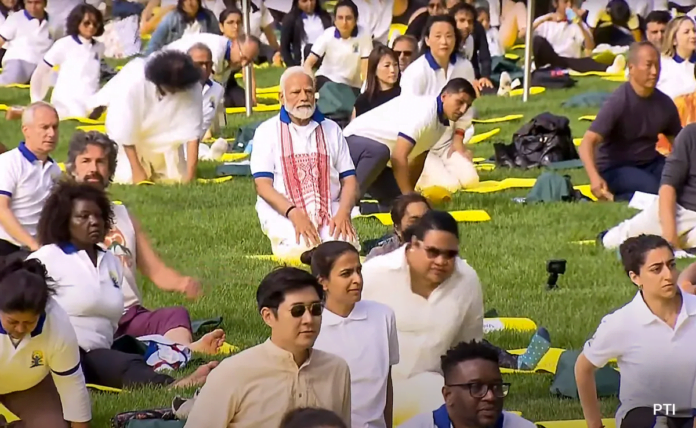
Prime Minister Narendra Modi took the lead in a momentous event at the UN Headquarters in New York to commemorate the 9th International Day of Yoga. Attended by top UN officials, diplomats, and distinguished individuals, the event showcased the universal appeal of Yoga and highlighted its freedom from copyrights and patents.

Modi, donning a custom-made white yoga T-shirt and trousers, commenced the event by paying his respects to the bust of Mahatma Gandhi at the North Lawn of the UN headquarters. The gathering achieved a Guinness World Record for the participation of people from the most nationalities, symbolizing the global unity in celebrating Yoga.

Expressing his gratitude, Modi addressed the attendees with a warm ‘Namaste’ and acknowledged their presence from various corners of the world. He was joined by President of the 77th session of the UN General Assembly, Csaba Korisi, deputy Secretary-General Amina Mohammed, and New York City mayor Eric Adams. Eminent personalities like Hollywood actor Richard Gere, Iyengar yoga exponent Deidra Demens, and American singer Mary Millben also participated in the event, which lasted nearly 45 minutes.

During his speech, Modi reminisced about his proposal to celebrate the International Day of Yoga at the UN nine years ago and expressed his joy at witnessing the world unite once again for Yoga. He described Yoga as an ancient Indian tradition that is both living and dynamic. Emphasizing its inclusive nature, Modi highlighted that Yoga is adaptable to people of all ages, genders, and fitness levels. He stressed that Yoga is free from copyrights, patents, and royalty payments, making it accessible to all. The yoga enthusiasts present at the event performed various asanas, including Tadaasan, Brahmari, Padahastaasan, Vrajaasan, Bhujangaasan, and Ardhchakraasan, on the yellow yoga mats spread across the ground.

The ambiance was further enhanced by LED screens displaying videos showcasing Indian culture and heritage. Modi reiterated that practicing Yoga not only promotes physical fitness but also brings mental calmness and emotional contentment. He expressed his delight at the scientific validation of Yoga and urged everyone to utilize the power of Yoga to foster kindness, friendship, peace, and a sustainable future.

The event garnered participation from UN officials, ambassadors, delegates from member states, and notable individuals from the global and diaspora community. People from 135 countries came together to celebrate the practice of Yoga. In a video message, UN Secretary-General Antonio Guterres recognized Yoga as a unifying force that connects body and mind, humanity and nature. He highlighted the benefits of Yoga, such as reducing anxiety, promoting mental well-being, and instilling discipline and patience. Guterres emphasized the significance of unity and encouraged building a more harmonious world for the betterment of people, the planet, and ourselves.

The International Day of Yoga, first commemorated in 2015, has become a global phenomenon with sessions and events held at iconic locations worldwide. The UN underscored that Yoga is an ancient practice originating in India, encompassing physical, mental, and spiritual aspects. The word ‘yoga,’ derived from Sanskrit, signifies the union of body and consciousness.

Yoga continues to grow in popularity and is practiced in various forms across the globe. In recognition of its universal appeal, the UN proclaimed June 21 as the International Day of Yoga, following a draft UNGA resolution proposed by India and endorsed by a record 175 member states. Prime Minister Modi introduced the proposal during the opening of the 69th session of the UN General Assembly.

In a video message, Modi highlighted that Yoga expands inner vision and connects individuals with the consciousness that unifies all living beings. He also noted the special participation of researchers at India’s research stations in the Arctic and Antarctica in this year’s International Day of Yoga celebrations, underscoring the global reach and significance of the practice.

India’s Culinary Delights: Introducing the Top 10 Masala Companies Shaping the Industry

0

The vibrant and diverse cuisine of India owes much of its flavor and aroma to the rich assortment of spices and masalas. Today, we are excited to unveil the list of the top 10 masala companies in India, who have made an indelible mark on the country’s culinary landscape. These companies have consistently delivered high-quality spices, capturing the essence of Indian cuisine and adding a touch of magic to every meal.

  1. Everest Spices: Celebrating over five decades of excellence, Everest Spices has emerged as a leading name in the masala industry. Renowned for its premium quality and extensive range of products, Everest Spices offers a wide variety of spice blends, delighting taste buds across the nation.
  2. MDH (Mahashian Di Hatti): With a legacy spanning more than a century, MDH has become a household name in India. Synonymous with authentic Indian spices, MDH offers a diverse range of spice powders and blends, meticulously prepared using the finest ingredients.
  3. Catch Spices: Known for their commitment to purity and natural flavors, Catch Spices has garnered a loyal consumer base in India. Their extensive range includes spice powders, whole spices, and ready-to-use spice mixes, offering convenience without compromising on taste.
  4. Eastern Condiments: Eastern Condiments has carved a niche for itself in the Indian masala market by delivering consistent quality and traditional flavors. Their impressive range of masalas caters to regional preferences, including blends for dishes like biryani and sambar.
  5. Badshah Masala: Steeped in rich heritage, Badshah Masala is recognized for its unwavering commitment to quality. Offering a wide range of spices and spice blends, Badshah Masala ensures an authentic taste experience in every culinary creation.
  6. MTR Foods: While renowned for their ready-to-eat meals and snacks, MTR Foods also excels in providing authentic Indian spice mixes. Their masalas capture the essence of various regional cuisines from across India, making every dish a true delight.
  7. Pushp Masale: Hailing from Maharashtra, Pushp Masale has earned a reputation for its pure and aromatic spices. Their extensive product line includes spice powders, ready-to-use masala mixes, and specialty blends that cater to the distinct tastes of Maharashtra’s cuisine.
  8. Bedekar: Originating from Maharashtra, Bedekar has emerged as a trusted name in the masala industry. Their unique spice blends, such as the Kolhapuri Masala, have gained popularity for their authentic taste and regional flavors, delighting consumers across the country.
  9. Sakthi Masala: With a strong presence in South India, Sakthi Masala offers an extensive range of spice blends that capture the diverse culinary traditions of the region. Their commitment to sourcing the finest ingredients and maintaining stringent quality control has made them a preferred choice among consumers.
  10. Kitchen Treasures: Although a relatively new player, Kitchen Treasures has quickly gained recognition for its high-quality products. Their wide range of spice blends caters to both traditional Indian flavors and innovative combinations, catering to the evolving tastes of modern consumers.

These top 10 masala companies have not only contributed to India’s culinary heritage but have also played a pivotal role in promoting the country’s flavors globally. Their commitment to quality, innovation, and preserving traditional recipes continues to elevate the masala industry in India.