Dr. Saloni Wagh, Director of Supriya Lifescience, has lauded the Union Budget 2024-25 as a significant step towards realizing the vision of a developed India. She highlighted the budget’s focus on key areas such as employment, skill development, MSME growth, and the upliftment of the middle class.
“This budget is a clear roadmap to a Vikasit Bharat, with a strong emphasis on the welfare of the poor, women, youth, and farmers,” Dr. Wagh stated. “The allocation of substantial funds for employment, skill development, and education is a commendable move that will create a skilled workforce, essential for driving innovation and growth.”
Dr. Wagh particularly appreciated the full exemption of basic customs duties on three cancer treatment medicines, emphasizing its positive impact on both the pharmaceutical sector and cancer patients. She also expressed optimism about India’s burgeoning pharmaceutical industry, stating that with the ₹2,143 crore allocation under the PLI scheme, India is poised to emerge as a global leader in pharmaceuticals.
“The budget’s emphasis on innovation, R&D, and education is crucial for India to become a global manufacturing hub,” she added. “These initiatives will foster a robust research ecosystem, enhance education quality, and create a skilled workforce capable of driving technological advancements.”
Dr. Wagh concluded by stating that the budget’s measures are aligned with the government’s ambitious target of achieving a $5 trillion GDP in three years and a $7 trillion economy by 2030.
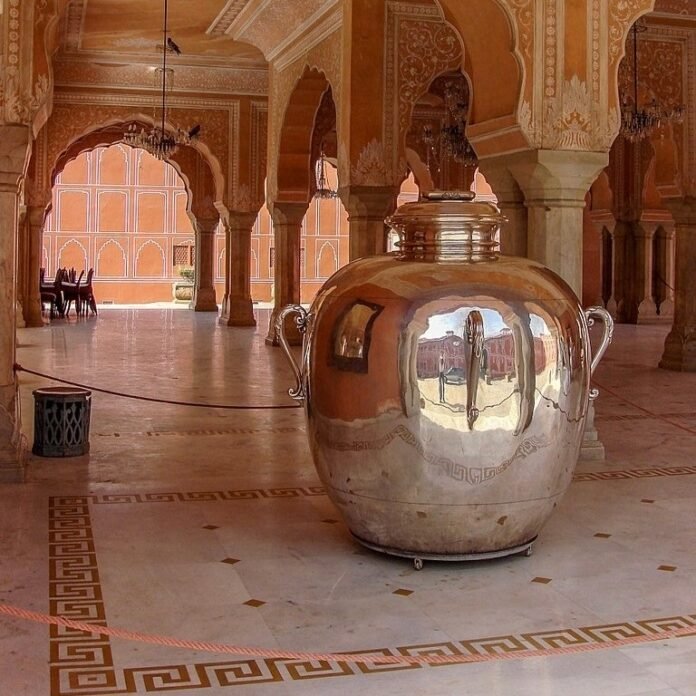
The City Palace in Jaipur houses two remarkable silver jugs that hold a unique place in history. These jugs were made by melting 40,000 silver coins, and what makes them even more special is that they were crafted without any joints. These magnificent urns were created under the direction of Maharaja Madho Singh II for his visit to London in 1902 to attend the coronation of King Edward VII.
Maharaja Madho Singh II was a devout Hindu who did not consider European water suitable for drinking and needed Ganges water for his religious ceremonies. These silver vessels, known as Gangajalis (Ganges water vessels), were filled with water from the River Ganges. The 8,000 liters of water stored in these jugs were sufficient for the Maharaja’s short visit to England. The pair of these grand water containers are now located in the private audience hall, the Diwan-i-Khas, at the City Palace in Jaipur.
Historical Significance and Construction
Ancient India was known for its silver artifacts, and during those days, silver was inexpensive, costing as low as one anna or six paisa per gram. Temples and royal palaces often had numerous silver items weighing several kilos. Among these, the most famous are the three heavy water jugs now kept in the City Palace of Jaipur. These jugs weigh 345 kg each, stand five feet three inches tall, and have a circumference of nearly 15 feet, with a carrying capacity of 4,091 liters each. According to the Guinness Book of World Records, these are the heaviest silver artifacts in the world.
The Jaipur state archives reveal that these jugs were made in 1894, after two years of labor by palace silversmiths. Although it is not known why these huge artifacts were originally made, they found their use within six years for Maharaja Madho Singh II’s journey to the United Kingdom to attend the coronation of King Edward VII in 1902.
Religious Dilemma and the Journey to England
Following the death of Queen Victoria in 1901, King Edward VII took over the British Empire and invited important Indian maharajas to his coronation. Maharaja Madho Singh II faced a religious dilemma as orthodox Hindus were not allowed to cross the ocean to Europe. The Maharaja consulted religious heads, who allowed him to travel under certain conditions: he would travel in a ship where no beef had ever been cooked or served, take idols of his family deity, spread earth from Jaipur under the deity’s throne and his bed, eat only prasad, and drink only Gangajal during his three-month stay in England.
The three huge silver jars from the Jaipur treasury became crucial for this journey as they could hold 4,091 liters of Ganges water each. The Maharaja’s travel agents chartered a newly completed ship, Olympia, ensuring no beef had ever been cooked or served on it. The entire arrangement, including the ship charter, cost a princely sum of Rs 1.5 million (equivalent to Rs 750 million today).
Six luxurious suites were prepared on the ship, one for the family deity Gopalji, one for the Maharaja, one for the royal priest, one for a close relative, and the remaining two for other members of the group. Ganga water stored in the jars was exclusively for the Maharaja and for preparing prasad for the family deity.
The Eventful Voyage
Before departure from Bombay, 25 Hindu priests conducted ceremonies to appease the presiding deity of the ocean, Lord Varuna. During the voyage, the ship encountered heavy storms in the Red Sea. The agitated priests advised the Maharaja to dump one of the three huge silver jars into the sea to calm Lord Varuna, which was done, and the seas calmed.
The voyage ended without further mishaps, and the British were astounded to see the huge silver jars. King Edward VII even made a personal visit to the Maharaja’s camp to see the jars. Today, these two silver jars are the star exhibits at the Sawai Man Singh City Palace Museum in Jaipur, attracting visitors from around the world to marvel at their grandeur and historical significance.
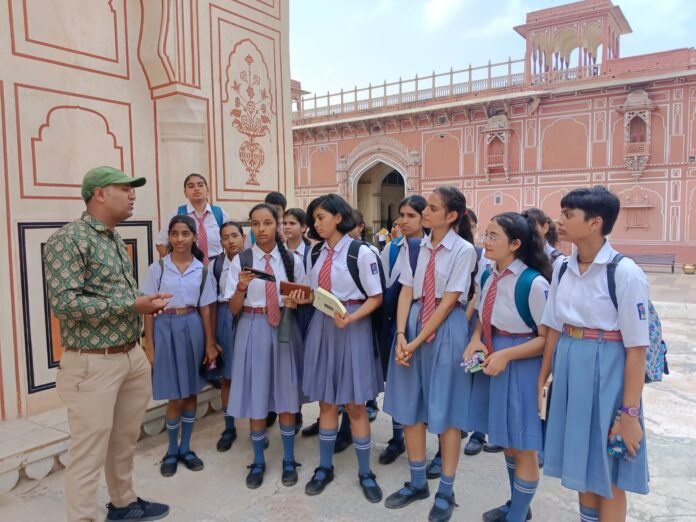
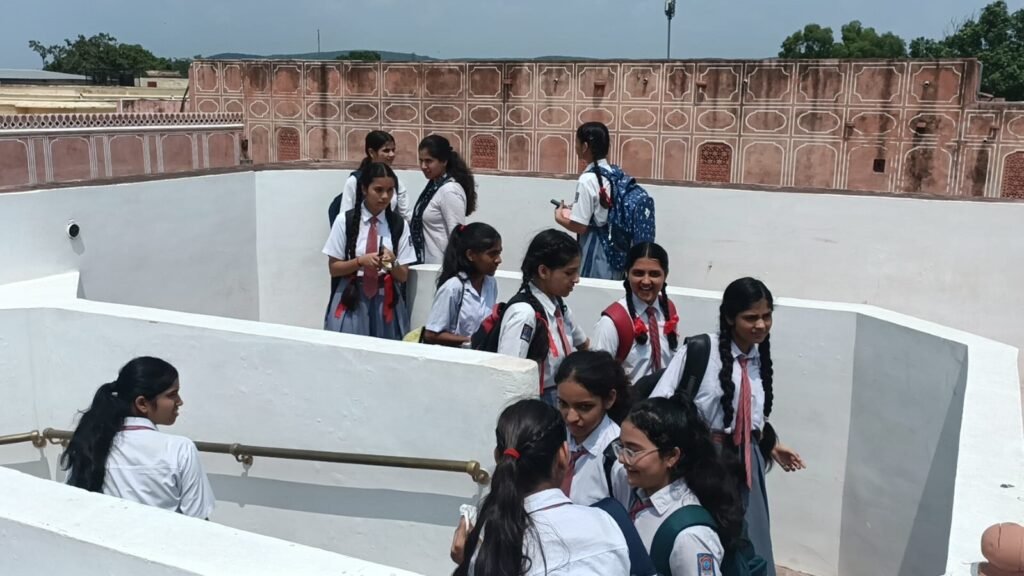
On the 20th of July 2024, students from Army Public School, part of the Media Masterclass Program of Saksham Sanchar Foundation, embarked on an educational journey to the Maharaja Sawai Man Singh II Museum in Jaipur. This visit, organized in collaboration with the Army Wives Welfare Association (AWWA), aimed to provide students with a firsthand look into Jaipur’s rich history and cultural heritage.
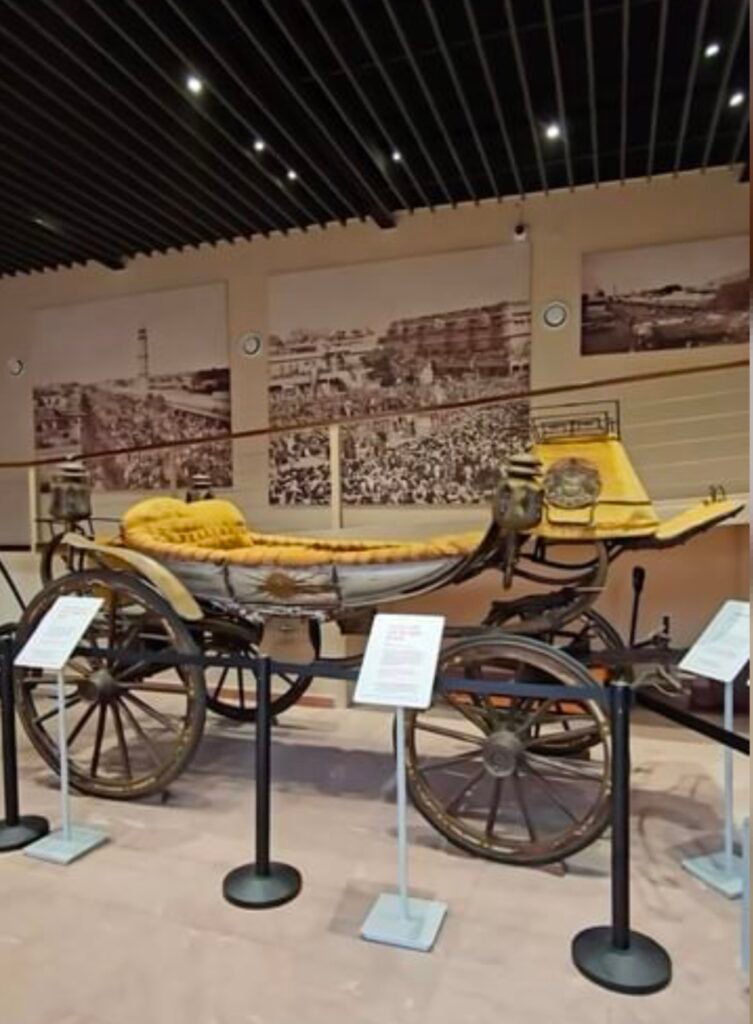
During their visit, the students explored Rath Khana, a unique museum inside the City Palace dedicated to royal carriages and palanquins. This section showcases a remarkable collection of vintage carriages, European cabs, old palanquins, and chariots used by the Jaipur royal family for ceremonial occasions and daily transportation.
Highlights of Rath Khana
Royal Carriages: The museum houses various royal carriages, including the famous Victoria Baggi. This elaborate carriage is adorned with intricate designs and gold plating, highlighting the opulence of the Jaipur royalty.
Historical Significance: Each exhibit in Rath Khana provides insights into the luxurious lifestyle and rich cultural heritage of the Jaipur royalty. The carriages and palanquins showcase the craftsmanship and artistry of the period.
Ceremonial Carriages: Notable exhibits include the Gold Plated Livery, used for grand processions and important state occasions. These carriages were often drawn by well-decorated horses, adding to the spectacle.
European Influence: The collection also includes European cabs, reflecting the influence of Western styles and designs on Indian royalty during the British colonial period.
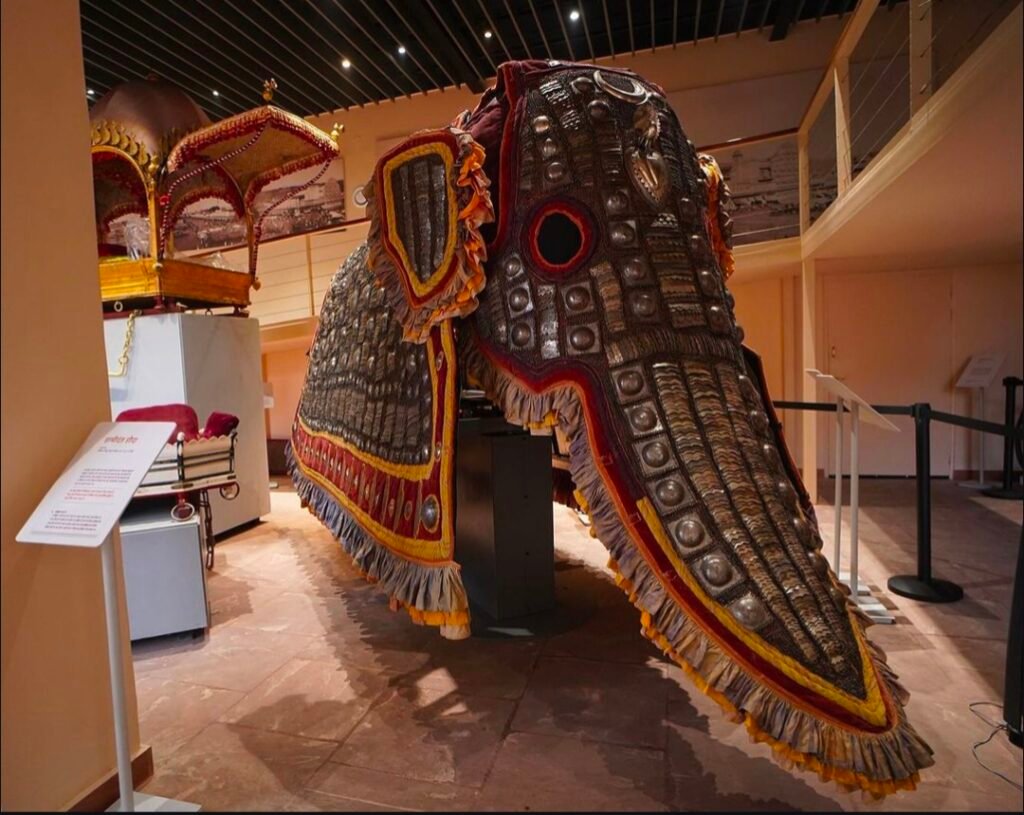
Suit of Elephant Armour: This magnificent suit, dating back to the early 20th century, features molded silver ornamentation and hundreds of metal plates and chain mail stitched on. It was worn by elephants during wars and special events.
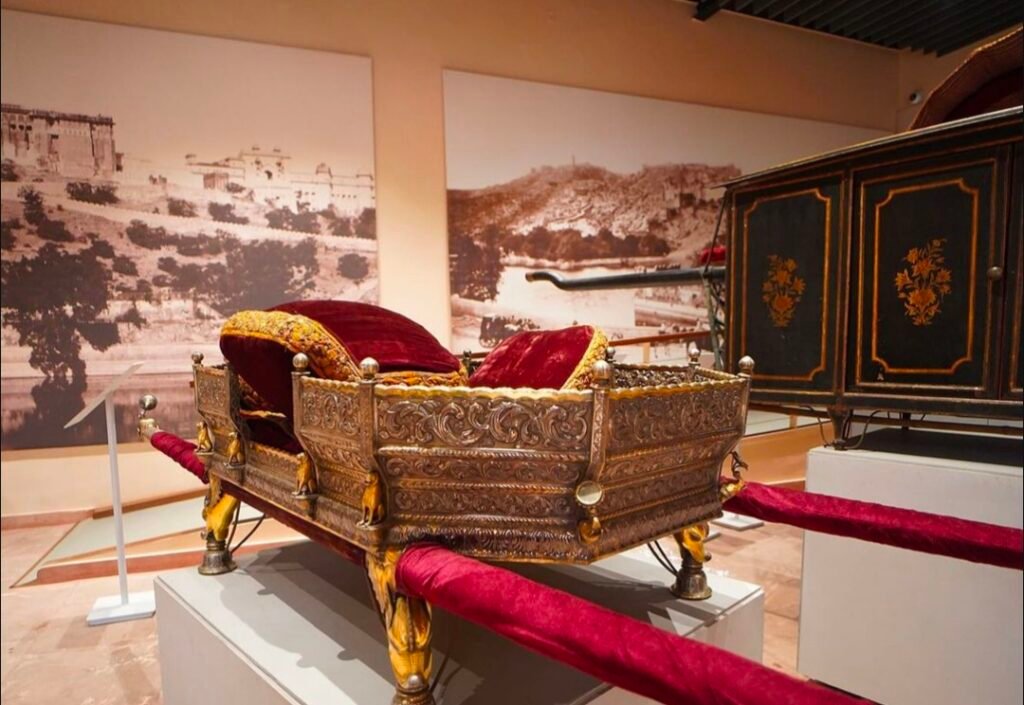
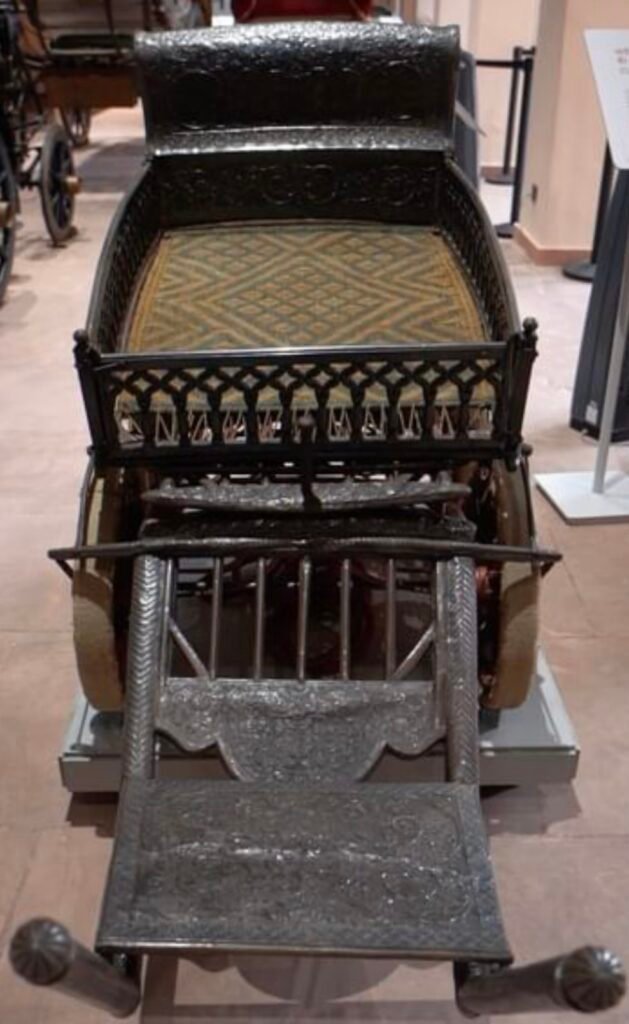
Takht-E-Rawaan: A portable throne used to transport the ruler on special occasions, this transport is embellished with gold and silver accents in an effect known as ‘Ganga-Jamuni’.
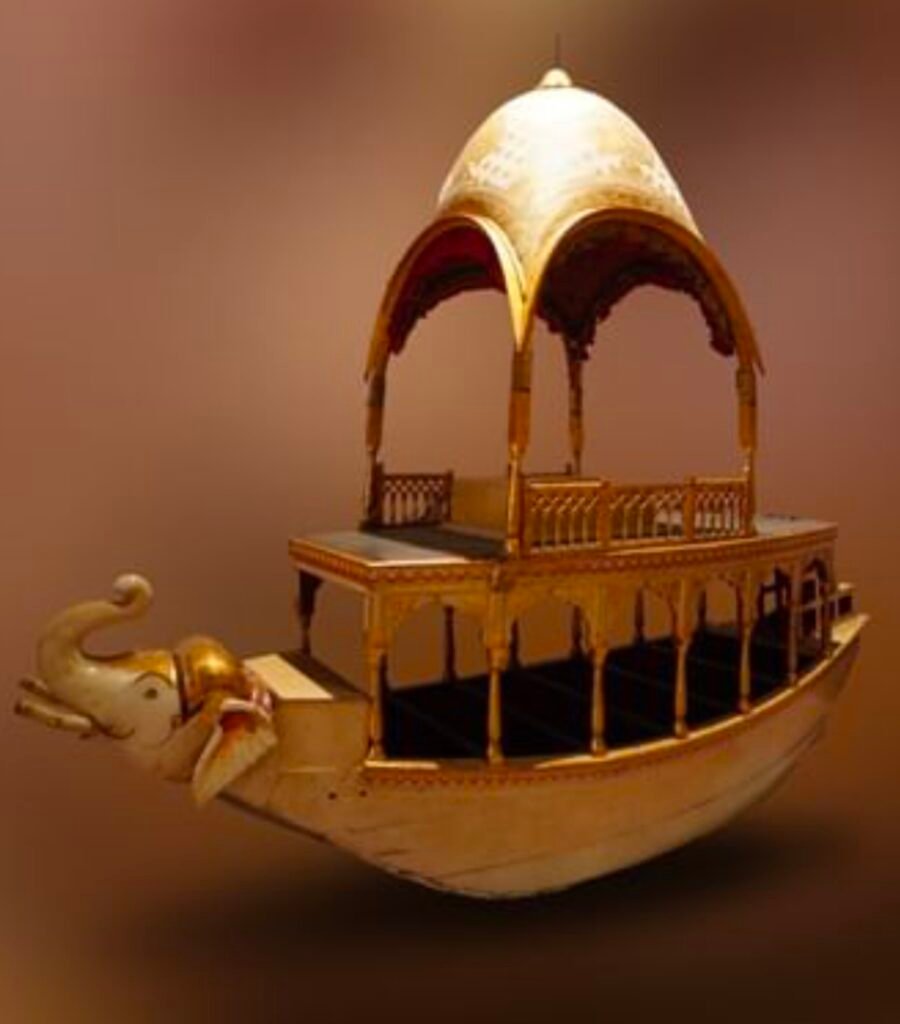
Jal Jhulni Boat: Made of wood, metal, and cloth, this boat was used on the auspicious occasion of Jal Jhulni Ekadashi to take an idol of Lord Krishna for a boat ride on Talkatora Lake, near the City Palace. The boat-shaped palanquin, made in the 19th century, is coated in gold.
Maharaja Sawai Madho Singh II’s Buggy: This buggy was a favorite of Maharaja Sawai Madho Singh II and was used by Maharaja Sawai Man Singh II for his Silver Jubilee celebrations in 1947. One notable baggi, made in the 20th century, was a favorite of Maharaja Sawai Man Singh II. This modern carriage featured electrical lamps, beautiful glasswork with embroidered flowers, and comfortable seating with yellow accents. So proud was the Maharaja of this baggi that he used it to go the event for his silver jubilee celebration in it instead of a car.
Silver Cart: This 18th-century hand-drawn cart, made of silver on wood, epitomizes luxury and is decorated with floral motifs. It was used to carry the toys of the Rajkumar (prince).
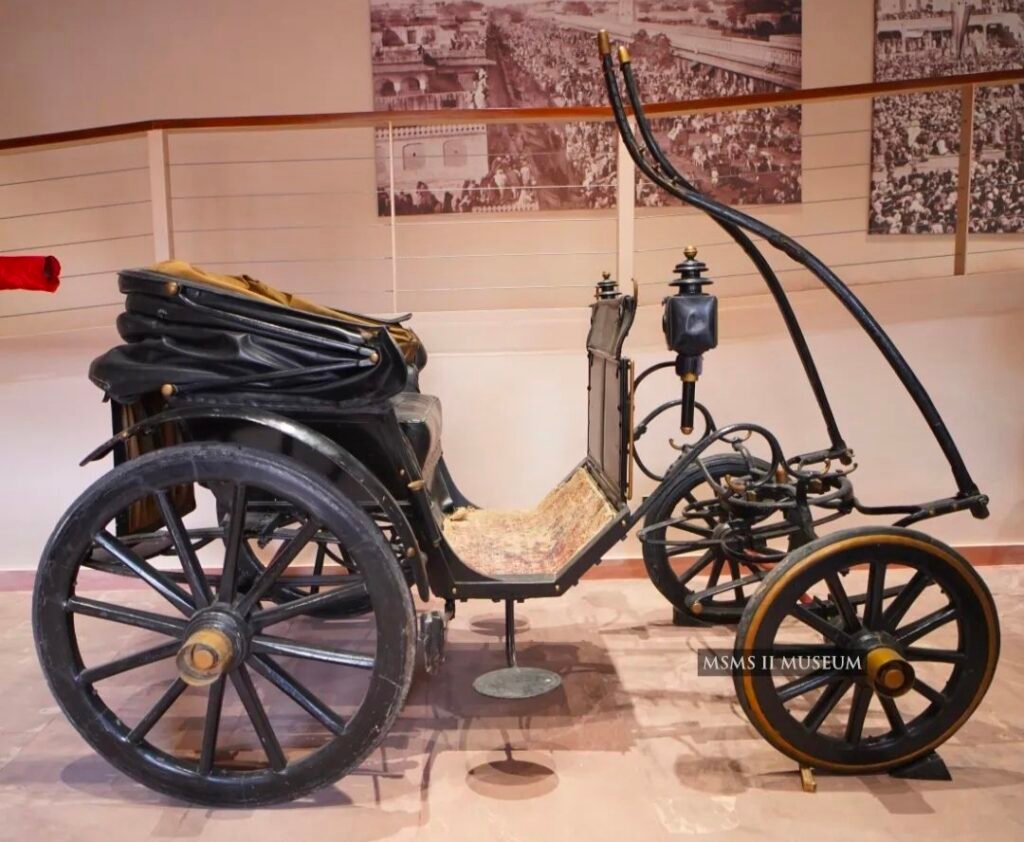
Victorian Buggy: This buggy, believed to be a gift from Queen Victoria to Maharaja Sawai Ram Singh II of Jaipur, is a must-see exhibit. With no space for a coachman, it was pulled by a pony with the reins in the hands of its occupant. The complex front axle made it easy to maneuver. It is believed to have been received in 1876 during the visit to Jaipur by Albert Edward, the Prince of Wales.
Visiting Rath Khana
Visitors to Rath Khana can glimpse the opulence and grandeur of the past, as well as the evolution of transportation methods used by the royals. Baggi Khana is situated within the City Palace complex in the heart of Jaipur. The City Palace, including Baggi Khana, is generally open to visitors from 9:30 AM to 5:00 PM. Entrance to Baggi Khana is included in the City Palace ticket, with various ticket options available, including combined tickets offering access to multiple sections of the palace. Photography is prohibited in the area, ensuring the preservation of these historic artifacts.
Through this visit, students gained valuable insights into the history and royal life of Jaipur’s Rajas and Ranis, enriching their understanding of India’s cultural heritage.
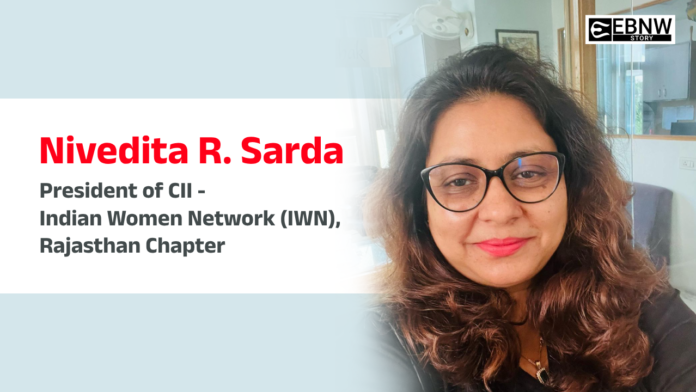
Nivedita R. Sarda, President of the Confederation of Indian Industry (CII) – Indian Women Network (IWN), Rajasthan Chapter, has lauded the Union Budget 2024-25, terming it visionary and emphasizing its positive impact on micro, small, and medium enterprises (MSMEs), exports, and employment generation.
In an exclusive interview, Nivedita highlighted several key aspects of the budget that are poised to drive economic growth and empower various segments of society:
MSME Boost: The budget allocates significant resources to support MSMEs, recognizing their crucial role in India’s economy. Nivedita praised the Rs 2 lakh crore package earmarked for five schemes aimed at job creation and skill development for 4.1 crore youth across the country. This substantial investment is expected to provide a robust push to employment opportunities.
Focus on Women, Farmers, and Youth: Nivedita commended the budget’s focus on women, farmers, and youth. The government’s commitment to skilling programs will empower young individuals, enabling them to access better employment prospects. Additionally, provisions for hostels and creches will facilitate women’s participation in the workforce, contributing to the nation’s progress.
Mudra Loan Enhancement: The budget’s announcement regarding an increased Mudra Loan allocation for women entrepreneurs was well-received. Nivedita believes that this move will encourage more women to start and expand their businesses, fostering economic independence and growth.
E-Commerce Hubs: Nivedita welcomed the government’s plan to establish e-commerce hubs. These hubs are expected to boost online trade, create jobs, and enhance India’s digital economy. By providing a conducive environment for e-commerce businesses, the budget aims to drive innovation and competitiveness.
In summary, Nivedita R. Sarda expressed optimism about the budget’s potential to transform India’s economic landscape. As President of CII – IWN, she believes that the budget’s visionary approach aligns with the aspirations of women, youth, and entrepreneurs, setting the stage for inclusive growth and prosperity.
About Nivedita R. Sarda: Nivedita R. Sarda is a prominent business leader and advocate for women’s empowerment. As the President of CII – IWN, Rajasthan Chapter, she actively promotes gender equality, entrepreneurship, and sustainable development.
In a significant development, FORTI Women’s Wing President Alka Gaur has lauded the recently unveiled Budget 2024-25, highlighting five pivotal points that promise to uplift various segments of society. Her endorsement comes as the nation grapples with economic challenges and seeks targeted measures to spur growth and welfare.
Here are the key highlights from Alka Gaur’s assessment:
EPFO Assistance for New Registrants:
Individuals earning less than Rs 1 lakh annually, who register with the Employees’ Provident Fund Organization (EPFO) for the first time, will receive a much-needed boost. They are eligible for a financial aid of Rs 15,000, disbursed in three installments. This move aims to alleviate financial strain for low-income earners and encourage formal employment.
Empowering Higher Education:
The budget introduces an ambitious education loan scheme. Candidates pursuing higher education can now access loans of up to Rs 10 lakh. What sets this apart is the nominal three percent interest rate, making education more affordable. Additionally, students will receive an annual e-voucher equivalent to 3 percent of the loan amount, directly supporting their academic pursuits.
Holistic Schemes for Development:
Alka Gaur emphasized the government’s commitment to holistic development. Various schemes will be rolled out to benefit farmers, youth, women, and economically disadvantaged sections. These initiatives aim to address multifaceted challenges and create a more inclusive society.
Comprehensive Farmer Database:
The budget allocates resources to compile detailed information on 6 crore farmers through land registries. This data-driven approach will enhance targeted policy interventions, improve agricultural productivity, and ensure equitable distribution of benefits.
Revamped Kisan Credit Cards:
Recognizing the pivotal role of farmers, the budget proposes issuing new Kisan Credit Cards in five states. These cards provide farmers with access to credit, enabling them to invest in modern farming practices, purchase inputs, and manage crop cycles effectively.
Alka Gaur’s endorsement underscores the government’s efforts to address pressing socio-economic challenges. As the budget takes effect, citizens eagerly await the implementation of these transformative measures.<!– Provide a closing statement or call to action if needed.
On the 20th of July 2024, students from Army Public School engaged in the Media Masterclass Program of Saksham Sanchar Foundation embarked on a memorable educational journey to the Maharaja Sawai Man Singh II Museum in Jaipur. This visit, facilitated through collaboration with the Army Wives Welfare Association (AWWA), aimed to provide students with firsthand insights into Jaipur’s illustrious history and cultural heritage.
Interaction with Rama Dutt
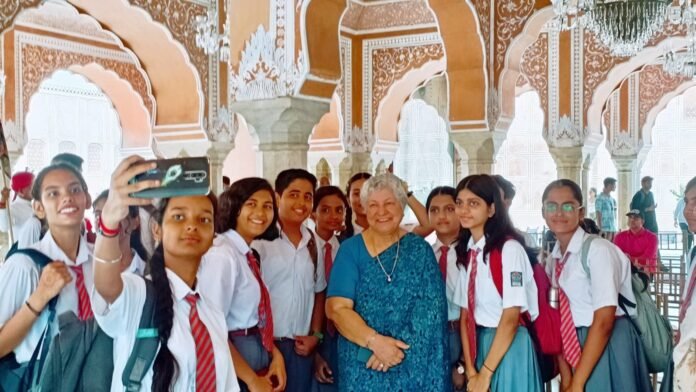
The highlight of the visit was students’ interaction with Rama Dutt, the esteemed executive trustee of the museum, who graciously shared her extensive experience and knowledge. Dutt’s association with the royal family spans over three decades, including seven years in her current role. Her deep connection to the museum and its heritage was evident as she recounted stories of her involvement since her retirement, which was facilitated by the Rajmata and princess to oversee the trusts.
She captivated the students with detailed narratives about the museum’s significance, the influx of international tourists it attracts, and the enduring legacy of Jaipur’s royal family, including insights into King Padmanabh Singh and his grand mother Rani Sahiba.
Insights into Heritage Conservation
Students were eager to learn about the conservation techniques employed at the museum. Dutt explained the strategic use of limestone in the palace’s construction, which effectively insulates the interiors from Rajasthan’s extreme temperatures, providing comfort year-round. Her explanation of the thick rock and limestone walls underscored the museum’s commitment to maintaining historical integrity while adapting to modern needs.
Personal Anecdotes and Cultural Insights
Beyond the technical aspects, Mrs. Dutt shared personal anecdotes, including her family’s deep-rooted connection to the army and their enduring love for Jaipur. She reflected on the city’s evolution since her arrival in 1970, noting its expansion and cultural richness that captivates residents and visitors alike. Her narrative encompassed touching stories about Diya Kumari’s father, Brigadier Bhawani Singh, whose dedication to national duty left a lasting impression on her as he worked at Rs 1 for the Indian Army.
Student Engagement and Q&A
Throughout the session, students actively engaged with Mrs. Dutt, posing thoughtful questions about Jaipur’s history, the daily operations of the museum, and the royal family’s contributions to sports and cultural heritage. Mrs. Dutt graciously addressed each query, fostering a dynamic learning environment that encouraged curiosity and exploration.
Summing Up
The visit to Maharaja Sawai Man Singh II Museum was not merely an educational excursion but a transformative experience for the students of Army Public School. Dutt’s profound insights into heritage preservation, coupled with her personal anecdotes and historical narratives, left an indelible mark on the students’ understanding of Jaipur’s cultural significance. This session underscored the importance of preserving cultural heritage for future generations and inspired students to cherish and contribute to their own cultural legacies.
In essence, the collaboration between AWWA, Saksham Sanchar Foundation, and Maharaja Sawai Man Singh II Museum provided a platform for meaningful learning and cultural appreciation, reinforcing the museum’s role as a custodian of Jaipur’s royal history and heritage.
On 20th July 2024, students from Army Public School who enrolled in Media Masterclass Program of SSF had an enriching visit to the Maharaja Sawai Man Singh II Museum, organized in collaboration with the Army Wives Welfare Association (AWWA) and Saksham Sanchar Foundation. The visit was a remarkable opportunity for the students to gain practical knowledge about the rich history of Jaipur.
The museum, housed in the historic City Palace, showcased an impressive collection of old baggis (carriages), intricate jewellery, traditional clothes, exquisite textiles, and beautiful paintings. This collection offered the students a tangible connection to the past, enhancing their understanding of Jaipur’s royal heritage.
A highlight of the visit was the timeless Kathputli (puppet) show, which captivated the students with its vibrant storytelling and cultural significance.
Rama Dutt, the executive trustee of the MSMS II Museum, provided the students with invaluable insights into the maintenance of royal heritage. She shared fascinating details about the number of tourists from different countries who visit the museum, the history of Jaipur, and the present royal family, including the King Padmanabhan Singh and Rani Sahiba of Jaipur. She also highlighted the royal family’s connection to golf, emphasizing King Padmanabhan Singh’s achievements as a great golf player who also contributed to the Indian national team and led from the front as captain in 2017. The students, inquisitive to know more about the past, asked questions to her and she did reply to all their queries. Students asked her on why the palace was cool when there was so much of heat outside and she replied it is because of limestone use which is a bad conductor of heat and cold Further the students were delighted to explore the history, art, craft and culture of Jaipur inside this pristine palace.
Vishakha Vasnani, Social Media Manager at Cyntexa delivered an engaging guest lecture on social media usage and camera handling. She taught the students practical skills on how to effectively use social media and cameras, emphasizing the importance of post timings and the impact of different types of angle shots. Her session provided the students with valuable knowledge that bridges traditional learning with modern technology.
Overall, the visit was a fun and educational experience for the students, offering them a blend of historical insights and practical skills that will be beneficial in their academic and personal lives.
MSMS Museum also posted this reel on Instagram of APS Students https://www.instagram.com/reel/C9rdVW2SOhg/?igsh=MXgwZmVya2ozOWNk
In the rush of modern life, beaches offer a serene escape, and Odisha is blessed with some of the most picturesque coastal stretches in India. Whether you seek solitude, adventure, or just a relaxing time by the sea, Odisha’s beaches have something for everyone. Here’s a curated list of the top beaches you must visit on your next trip to Odisha:
1. Puri Beach, Puri
Puri Beach is not just a scenic spot but also holds religious significance as the abode of Lord Jagannath. Known for its golden sands and vibrant local culture, Puri Beach attracts tourists year-round. The annual Rath Yatra (Chariot Festival) is a spectacle that draws millions of pilgrims and tourists alike.
Best Time to Visit: October to February
Famous for: Jagannath Temple, Rath Yatra, Longest golden beach
2. Gopalpur Beach, Ganjam
Gopalpur Beach offers a tranquil atmosphere with its pristine coastline dotted with coconut and casuarina trees. Famous for its sunsets and lagoon boating, Gopalpur is perfect for those seeking a quiet retreat away from the crowds.
Best Time to Visit: October to February
Famous for: Coconut and casuarina groves, Chilka Lake, Serene environment
3. Chandrabhaga Beach, Konark
Located close to the Sun Temple at Konark, Chandrabhaga Beach is known for its clean waters and mesmerizing sunrise views. It recently received the Blue Flag certification, making it one of India’s environmentally sustainable beaches.
Best Time to Visit: October to February
Famous for: Blue Flag certification, Sun Temple, Annual International Sand Art Festival
4. Ramchandi Beach, Konark
Ramchandi Beach offers a serene escape with its clean sands and picturesque surroundings. Situated at the confluence of River Kushabhadra and the Bay of Bengal, it’s perfect for water sports enthusiasts and nature lovers alike.
Best Time to Visit: September to February
Famous for: Ramachandi festival, Water sports, Serene environment
5. Chandipur Beach, Balasore
Chandipur Beach is unique for its disappearing sea phenomenon where the sea recedes up to 5 kilometers during low tide, allowing visitors to walk deep into the sea. It’s a haven for nature lovers and those seeking solitude.
Best Time to Visit: October to March
Famous for: Disappearing sea line, Long beach walks, Red crabs
6. Konark Beach, Konark
Adjacent to the Konark Sun Temple, Konark Beach offers a tranquil environment with its golden sands and clear waters. It’s less crowded compared to nearby beaches, making it ideal for a peaceful day by the sea.
Best Time to Visit: September to March
Famous for: Konark Sun Temple, Water sports, Scenic beauty
7. Talsari Beach, Balasore
Talsari Beach is known for its serene surroundings and magnificent views of sunrise and sunset. Surrounded by coconut and casuarina trees, it offers a perfect blend of natural beauty and tranquility.
Best Time to Visit: October to December, February to April
Famous for: Fishing village, Coconut and casuarina trees, Seafood
8. Dagara Beach, Balasore
Dagara Beach is a pristine stretch known for its sandy coastline and breathtaking sunsets. It’s less commercialized, offering visitors a peaceful atmosphere to relax and unwind.
Best Time to Visit: October to February
Famous for: Clean beach, Mesmerizing sunsets, Red crabs
9. Pati Sonepur Beach, Berhampur
Pati Sonepur Beach is nestled at the confluence of River Bahuda and the Bay of Bengal, offering panoramic ocean views and a serene ambiance. It’s ideal for a quiet getaway amidst nature.
Best Time to Visit: October to June
Famous for: Gopalpur Lighthouse, Maa Tara Tarini Hill Shrine, Scenic beauty
10. Gahirmatha Beach, Kendrapara
Gahirmatha Beach is renowned for being the nesting ground of the endangered Olive Ridley Turtles. Located near the Bhitarkanika National Park, it offers a unique opportunity to witness these turtles in their natural habitat.
Best Time to Visit: October to February
Famous for: Olive Ridley Turtles, Gahirmatha Marine Sanctuary, Clean beach
Summing Up
Odisha’s coastline is a treasure trove of natural beauty, cultural richness, and serene landscapes. Whether you’re seeking spiritual solace, adventure, or simply want to unwind by the sea, these beaches offer the perfect escape. Plan your trip to Odisha and explore these stunning beaches for an unforgettable experience.
The Mahabodhi Temple in Bodh Gaya stands as a majestic testament to Buddhist faith and architectural brilliance, embodying over two millennia of spiritual significance and historical evolution. Located in Bihar, northeastern India, this sacred site is revered globally as the place where Siddhartha Gautama, the Buddha, attained enlightenment under the Bodhi Tree.
Built initially by Emperor Ashoka in the 3rd century BCE, the Mahabodhi Temple complex has undergone several transformations over the centuries, reflecting diverse architectural styles and religious influences. The current structure, towering impressively at 55 meters (180 feet), is a masterpiece of ancient brickwork and stone craftsmanship. Its pyramidal tower, adorned with intricate niches, arch motifs, and delicate engravings, symbolizes the zenith of Indian temple architecture.
Central to the temple’s sanctity is the Vajrasana, a stone platform traditionally believed to mark the exact spot where the Buddha sat in meditation. Adjacent to the temple stands a descendant of the original Bodhi Tree, revered as a direct descendant of the tree under which the Buddha attained enlightenment. The temple complex is enclosed by historic stone railings adorned with ornate carvings, adding to its sacred ambiance.
Designated a UNESCO World Heritage site in 2002, the Mahabodhi Temple complex spans 4.8 hectares (11.9 acres), encompassing not only the main temple but also ancient shrines and modern additions built by successive generations of Buddhist devotees. These additions reflect the ongoing spiritual and cultural significance of Bodh Gaya as a pilgrimage site for Buddhists from around the world.
Throughout history, temple architecture has served as a cornerstone of religious expression and cultural identity. From the towering ziggurats of Mesopotamia to the intricate pagodas of East Asia, temples have not only housed religious rituals but also served as symbols of community, identity, and architectural innovation.
The Mahabodhi Temple’s influence extends far beyond its physical structure. It continues to inspire scholars, artists, and spiritual seekers alike, embodying the enduring legacy of the Buddha’s teachings on compassion, wisdom, and inner peace. The temple complex remains a vibrant center of Buddhist worship and pilgrimage, welcoming visitors from diverse cultural and religious backgrounds to experience its profound spiritual aura.
Bodh Gaya, the town surrounding the Mahabodhi Temple, retains its tranquil charm, nestled beside the Niranjana River amidst serene natural surroundings. It serves as a living testament to the enduring power of Buddhism and the profound impact of the Buddha’s enlightenment on human history and spirituality.
In conclusion, the Mahabodhi Temple in Bodh Gaya stands as a timeless symbol of enlightenment and spiritual awakening, embodying the profound teachings of the Buddha amidst the rich tapestry of Indian cultural heritage. Its preservation and reverence underscore its significance as a global icon of peace, harmony, and spiritual fulfillment.
Gaya, nestled in the heart of Bihar, India, is not just another city; it is a profound spiritual center revered across millennia. Its spiritual significance is deeply rooted in Hindu mythology, with its pivotal role in rituals like Pind Daan (offering to ancestors) and Pitra Tarpan (ancestor worship) making it an essential pilgrimage site for Hindus worldwide. At the heart of this spiritual tapestry lies the Vishnupad Temple, a testament to faith and devotion.
Ancient Origins and Mythological Significance
Legend has it that Gaya was formed when Gayasur, a demon king, was granted a boon to become the holiest of the holy. His reckless use of this power prompted Lord Vishnu to intervene, leading to Gayasur’s transformation into the land upon which Gaya now stands. Vishnupad Temple marks the exact spot where Lord Vishnu pressed his feet upon Gayasur, imprinting his divine presence for eternity.
Architectural Marvel and Spiritual Ambiance
The Vishnupad Temple, reconstructed in the 18th century under the patronage of Queen Ahilyabai Holkar, stands tall as a masterpiece of Nagara style architecture. Its towering Vimana and ornate pillared Mandapa reflect not just craftsmanship but a deep reverence for Lord Vishnu. Within its precincts, devotees encounter Lord Vishnu’s footprints, etched in stone, surrounded by symbols of his divine attributes.
The temple complex is not just a place of worship but a spiritual journey through history. The pillared courtyard, aligned with the natural contours of Gayasur’s rocky form, retains an ancient charm that speaks volumes about its enduring sacredness.
Surrounding Spiritual Sites
Gaya is not just about Vishnupad Temple; it’s a constellation of sacred sites. The Mangla Gauri temple, an important Shaktipeeth, stands nearby, dedicated to the divine feminine energy. The Akshaya Vat shrine, adorned with an ancient Banyan tree, echoes with legends from the Ramayana, adding layers to Gaya’s spiritual aura.
A Pilgrimage of Spiritual Renewal
For pilgrims, a visit to Gaya is more than a journey; it’s a transformative experience. The ritualistic practices of Pind Daan at the Phalgu river banks and the ascetic solitude of Dungeshwari caves, where Buddha sought enlightenment, offer spiritual solace and contemplation.
Preserving Heritage Amidst Changing Times
Despite its ancient origins, Gaya has endured periods of turmoil and transformation. Kings and queens throughout history have safeguarded its sanctity, ensuring that rituals and traditions continue unabated. Today, amidst the hustle of modernity, Gaya stands as a beacon of spiritual heritage, drawing pilgrims from all corners of the globe.
Summing Up
Gaya and its Vishnupad Temple epitomize the confluence of history, myth, and spirituality. From the sanctified rituals of Pind Daan to the architectural splendor of its temples, every aspect of Gaya exudes a timeless appeal. It remains not just a destination but a sacred obligation for Hindus seeking to honor their ancestors and connect with their spiritual roots. As we navigate through the annals of Gaya’s rich legacy, it becomes evident that its significance transcends mere religious practice—it’s a journey of spiritual awakening and cultural preservation that continues to inspire and enrich lives.