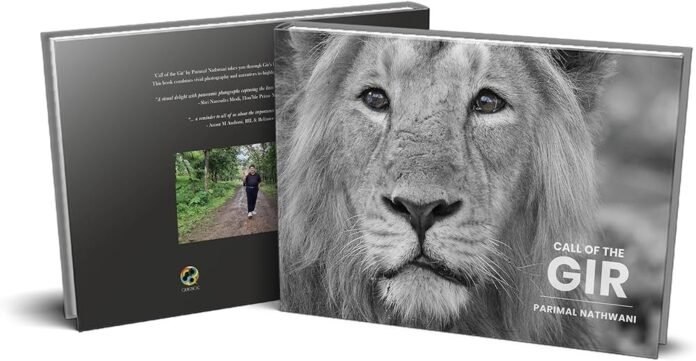
Parimal Nathwani, a lion enthusiast from a young age, takes readers on an extraordinary journey through the landscapes of Gir with his book, Call of the Gir. This work beautifully combines vivid photography and compelling narratives to emphasize the urgent need for conservation efforts to protect the Asiatic lions that inhabit this unique region.
Nathwani’s passion for lions has been a constant throughout his life, persisting even as he assumed significant responsibilities in his professional career. As Director-Corporate Affairs at Reliance Industries Limited (RIL), Nathwani successfully managed various high-profile projects, including land acquisition for the Jamnagar Mega Complex, the establishment of retail outlets, and the development of cross-country pipelines and optical fibre cable networks. His dedication to Gir and its lions has also influenced RIL’s corporate social responsibility activities, directing efforts and resources towards the region.
Nathwani’s commitment to the conservation of Gir’s lions is evident in his proactive measures to reduce lion-cub fatalities around Gir. Notably, he initiated the construction of parapets over 1,294 open wells in the periphery of Gir to prevent accidental drownings. With the lion population increasing substantially, Nathwani recently pledged to cover an additional 2,000 wells, of which 1,150 have already been completed. Furthermore, he has committed to establishing three fully equipped hospitals in Gir and Greater Gir for wildlife treatment, showcasing his unwavering dedication to the cause.
In his capacity as a member of the Advisory Committee of Gir Sanctuary & National Park, Nathwani has been a frequent visitor to Gir since his youth. He is also the founder-director of the GEET Foundation, an NGO that promotes environmental and ecological tourism in Gir. His earlier book, Gir Lion: Pride of Gujarat, published in 2018, also focused on the conservation of Gir’s lions and was met with acclaim.
Prime Minister Narendra Modi has lauded Call of the Gir, acknowledging Nathwani’s enduring passion for wildlife. In a social media post, the Prime Minister expressed his belief that the book would greatly benefit all those interested in the majestic Gir lions. Nathwani recently had the honor of presenting his book to the Prime Minister, further highlighting the book’s significance.
Call of the Gir offers a profound exploration of Gir’s landscapes, renowned for their Asiatic lions. Through stunning photography and engaging narratives, Nathwani underscores the urgency of conservation efforts, calling attention to the fragile beauty of this region and its need for protection. This book is not only a visual and literary delight but also a clarion call for preserving the natural heritage of Gir for future generations.
The 30th meeting of the Working Mechanism for Consultation and Coordination (WMCC) on India-China Border Affairs took place in New Delhi, marking a significant step in the ongoing efforts to manage the complex dynamics along the Line of Actual Control (LAC). This meeting comes at a crucial time, as both nations seek to restore peace and tranquility in the border areas, a prerequisite for normalizing their bilateral relations.
The Indian delegation was led by Gourangalal Das, Joint Secretary (East Asia) from the Ministry of External Affairs, while the Chinese delegation was headed by Hong Liang, Director General of the Boundary & Oceanic Department of the Chinese Ministry of Foreign Affairs. The discussions were described as in-depth, constructive, and forward-looking, reflecting a mutual commitment to resolving outstanding issues promptly.
Focus on Peace and Tranquility
Building on recent discussions between the two Foreign Ministers in Astana and Vientiane, the delegations reviewed the current situation along the LAC. Both sides emphasized that the restoration of peace and tranquility, as well as respect for the LAC, are crucial for the normalization of bilateral relations. They agreed on the necessity to jointly uphold peace and stability in the border areas, adhering to relevant bilateral agreements, protocols, and understandings reached between their governments.
Commitment to Diplomatic and Military Channels
The meeting underscored the importance of maintaining momentum through established diplomatic and military channels. The leader of the Chinese delegation also paid a visit to the Indian Foreign Secretary, Ambassador Misri, who previously served as the Indian ambassador to China, further demonstrating the commitment to dialogue and cooperation.
High-Level Engagements
During an official visit to Laos on July 25, Indian External Affairs Minister Dr. S. Jaishankar met with Chinese Politburo member and prominent diplomat Wang Yi. Both leaders attended the Foreign Ministers’ Meetings under the ASEAN framework, including sessions of the ASEAN-India, East Asia Summit (EAS), and ASEAN Regional Forum (ARF). Jaishankar shared on X (formerly Twitter), “Met with CPC Politburo member and FM Wang Yi in Vientiane today. Continued our ongoing discussions about our bilateral relationship. The state of the border will necessarily be reflected in the state of our ties. Agreed on the need to give strong guidance to complete the disengagement process. Must ensure full respect for the LAC and past agreements. It is in our mutual interest to stabilize our ties. We should approach the immediate issues with a sense of purpose and urgency.”
Historical Context and Ongoing Efforts
The history of India-China relations has been marked by tension and periodic engagement, especially following the border clash in Ladakh in 2020. Since then, numerous high-level talks have aimed at de-escalating tensions and managing the border situation. These efforts include Corps Commander-level talks, diplomatic engagements at the BRICS summit, and bilateral meetings at international forums. Despite these discussions, the border remains a sensitive issue, with both nations maintaining a significant military presence along the LAC.
Economic Ties Amidst Tensions
Despite the ongoing tensions, economic ties between India and China have persisted. India has taken measures to reduce its economic dependence on China, such as banning several Chinese apps and increasing scrutiny of Chinese investments. Nevertheless, China remains one of India’s largest trading partners. In FY 2024, bilateral trade between the two countries totaled $118.4 billion, with imports from China at $101.7 billion and exports from India to China at $16.67 billion.
Summing Up
The 30th WMCC meeting marks a constructive step in the ongoing dialogue between India and China, reflecting a shared commitment to peace and stability along the LAC. While challenges remain, the continued engagement through diplomatic and military channels provides a framework for addressing and resolving outstanding issues. As both nations navigate this complex relationship, maintaining open lines of communication and mutual respect will be essential for fostering long-term stability and cooperation.
India is set to host its largest international military exercise, ‘Tarang Shakti,’ an extensive air exercise that will unfold in two phases across Tamil Nadu and Rajasthan. The announcement was made by Indian Air Force Vice Chief Air Marshal AP Singh, highlighting the scale and strategic importance of this monumental event.
The ‘Tarang Shakti’ exercise aims to bring together military forces from across the globe to strengthen strategic relations and enhance mutual understanding of air operations. Invitations have been extended to 51 countries, with confirmations received from ten countries that will participate with their assets, and 18 countries attending as observers. This collaborative effort marks a significant step in fostering global military cooperation and sharing best practices among the participating nations.
Phase One: Sulur, Tamil Nadu
The first phase of ‘Tarang Shakti’ will be conducted at Sulur in Tamil Nadu from August 6 to August 14. This phase will see active participation from four prominent countries: France, Germany, Spain, and the United Kingdom. These nations will bring their military assets to the exercise, engaging in complex missions designed to enhance operational understanding and interoperability among the forces.
“This exercise aims to strengthen strategic relations with our friends from the international community. Complex missions are planned to enhance our mutual understanding of air operations. It is an excellent opportunity for all of us to share our best practices with each other,” stated Vice Chief Air Marshal AP Singh.
Strategic Significance and Objectives
The ‘Tarang Shakti’ exercise is not merely a display of military might but a crucial platform for the participating countries to exchange knowledge and experience. The focus will be on conducting complex missions that challenge the participants and promote a deeper understanding of diverse air operations. By sharing best practices and operational techniques, the exercise aims to improve the efficiency and effectiveness of the participating air forces.
Additionally, ‘Tarang Shakti’ serves as a testament to India’s commitment to fostering international cooperation and peace. The exercise underscores India’s strategic position and its ability to host such a large-scale, multifaceted military event. It also provides an opportunity for India to showcase its advanced military capabilities and infrastructure.
Looking Ahead
As the exercise unfolds in the coming months, it will be closely watched by military analysts and strategists worldwide. The successful execution of ‘Tarang Shakti’ will likely set a new benchmark for international military exercises, paving the way for future collaborations and joint operations. The knowledge and experience gained from this exercise will undoubtedly contribute to the participating nations’ operational readiness and strategic capabilities.
In conclusion, ‘Tarang Shakti’ represents a significant milestone in India’s military history, bringing together a diverse coalition of nations to enhance global security and cooperation. Through this exercise, India reaffirms its role as a key player on the international stage, committed to fostering a collaborative and peaceful global environment.
If you’ve ever ventured along the scenic Manali-Leh highway, you might have encountered the intriguing and somewhat eerie Gata Loops. Nestled within the picturesque landscapes and winding roads of this 10-kilometer stretch lies a curious and haunting tale that has captivated the imaginations of travelers for decades. This tale revolves around a ghost temple situated at the 19th bend of the Gata Loops, where travelers leave offerings of water bottles and cigarette packets for a restless spirit.
The Unfortunate Incident That Sparked a Legend
The story begins in the harsh winter of 1999, a time when the cold on the Manali-Leh highway was unbearable, and the roads were treacherous with snow and ice. A truck, navigating the treacherous bends of Gata Loops, faced mechanical issues. The driver and his helper struggled to fix the vehicle, but their efforts were in vain. The truck was stranded at the 19th bend, and the helper, who was already feeling unwell, stayed behind while the driver set off on foot to find help in the nearest village, Sarchu.
Tragically, the driver’s quest for help was hindered by the severe weather conditions. By the time he could return, days had passed, and he found his helper had succumbed to the elements—hunger, thirst, and the bitter cold. Devastated, the locals decided to bury the helper’s body at the very spot where he had perished.
The Birth of the Ghost Temple
Shortly after this tragic event, travelers began to report eerie encounters near the 19th bend. Many claimed to see a ghostly figure asking for help and water. These stories spread, and locals, in an attempt to appease the restless spirit of the truck helper, built a small shrine at the site. Thus, the Ghost Temple of Gata Loops was born.
Visitors passing through the Gata Loops began to leave offerings of water bottles and cigarette packets at the shrine. It is believed that these offerings are meant to quench the thirst and soothe the spirit of the departed helper, ensuring safe passage for travelers through this haunted stretch.
A Story Passed Through Generations
Over the years, the legend of the Ghost Temple has been passed down through generations of travelers and locals. Some claim to have experienced the eerie presence themselves, while others remain skeptical. Whether you believe in the supernatural or not, the sight of water bottles and cigarette packets strewn around the 19th bend of Gata Loops is a testament to the enduring power of this chilling story.
The Manali-Leh highway is renowned for its stunning beauty and challenging terrain, but it is also home to this haunting legend. As you navigate the twists and turns of the Gata Loops, keep an eye out for the ghostly shrine and remember the tragic tale that has left an indelible mark on this remote and beautiful region. What do you think of the Ghost Temple of Gata Loops? Would you dare to leave an offering for the restless spirit?
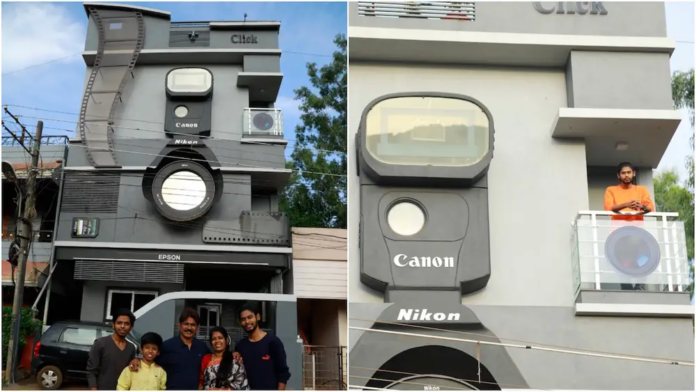
In the heart of Shastri Nagar, Belgaum, Karnataka, stands a house that is as unique as it is striking—a three-story structure that resembles a giant camera. This architectural marvel, aptly named “Click,” is the brainchild of professional photographer Ravi Hongal. Built over two years at a cost of approximately 7.5 million Indian rupees ($102,500), this house is more than just a residence; it’s a testament to Hongal’s lifelong passion for photography.
A Tribute to Photography
Ravi Hongal’s love for cameras is evident not just in the design of his home but also in the names of his three sons—Canon, Nikon, and Epson. Each floor of the house is dedicated to one of his sons, featuring design elements that represent a life-sized camera of their namesake. The exterior boasts intricate details, including film reels from old cameras and a Sony memory card, all contributing to the house’s unique aesthetic.
A Childhood Fascination
Hongal’s fascination with photography began at the tender age of 13. Growing up in a small town in the Belgaum district, he was deeply influenced by his photographer cousin, Mahadev. “When I entered the dark room where my cousin would spend hours developing photographs, it was love at first sight,” Hongal recalls. The ability of a small device to capture a moment and turn it into a lasting memory was awe-inspiring to him.
His passion led him to establish his own photo studio in Belgaum. It was there that he met his wife, Kripa, who shares his love for photography. Their mutual passion even influenced their decision to name their first child Canon, despite the mixed reactions they received. The tradition continued with their next two sons, Nikon and Epson.
Bringing the Dream to Life
Ten years ago, Hongal envisioned building a house shaped like a camera. However, it took eight years to save enough money to start the project. In 2018, he enlisted Key Concepts Interiors, a Bangalore-based architecture firm, to bring his dream to fruition.
The house’s exterior is meticulously designed to resemble various camera models, but Hongal did not want the interior to lack extraordinary features. “From the gate to the window grills, we got everything customized with a symbol of the camera. Our main door has a camera on it too, and also a Sony pen drive to represent different aspects of being on the job,” he explains. Even the ceilings are crafted to reflect the various facets of a camera, making every inch of the home a homage to his profession.
A Nod to Their Roots
For Kripa, the house is more than just a unique dwelling; it’s a tribute to the profession that has enabled them to live their dream life. “This house is a nod to the profession that has given us the means to live the life we aspired to have,” she says.
Despite any criticism they might have faced, the Hongals are proud to have put their hometown on the map with their extraordinary home. “I look at my house and every time I see this life-sized camera looking at me, I pinch myself and my eyes well up with tears,” Hongal shares. “I cannot believe I’m living my dream.”
A Home and a Landmark
The giant camera house in Belgaum is not just a home for Ravi Hongal and his family; it’s a landmark that celebrates a lifelong passion and the professional journey of a photographer who dared to dream big. It stands as a symbol of creativity, dedication, and the boundless possibilities that come with pursuing one’s passion.
Nestled amid the pine forests near the village of Darwa in the Solan district of Himachal Pradesh, NAAR is Chef Prateek Sadhu’s latest culinary venture. This 16-seater restaurant, perched at the edge of a cliff, offers an extraordinary destination dining experience that promises to be worth every mile traveled. With six menus across six seasons, each tailored to the distinct flavors of the Himalayas, NAAR invites guests into a world of gastronomic delight and breathtaking views.
A Journey to Remember
Autumn has woven its magic into the hills, drying out the last of the waterfalls and turning the trees a stunning green-gold. Here, at the edge of a cliff, sits NAAR, marking the return of one of India’s most celebrated chefs in a truly unexpected location. To understand Sadhu’s new venture, one must embark on a journey. NAAR is about two and a half hours from Chandigarh and 45 minutes from Kasauli, requiring a plan, a flight, and a scenic drive.
The Essence of NAAR
As guests arrive, they are welcomed into the first of the two ‘mountain huts’ that comprise NAAR, where cocktails and canapés are served. This initial space introduces guests to Sadhu’s concept of Himalayan dining. A dinner plate-sized moon rises on cue, illuminating the terrace with a view that extends across the valley to Shimla. The main restaurant building and its adjacent dishwashing space are nearby, forming a cluster of wood and slate structures reminiscent of mountain homes.
Inside, the final touches are being added. Beautifully embroidered Kashmiri shawls drape over low couches, and moody photographs of a single morel, a trout, and a pine cone are ready to print. Taking inspiration from its name (NAAR means fire in Kashmiri), the signage gleams bright in the dark, and the name is emblazoned into the grating of the wood-fired angithis, promising a dramatic glow on a cold winter’s night.
A Culinary Journey Through the Seasons
The meal at NAAR is part theatre, part education, and part culinary journey through the Himalayas, from the north to the east. NAAR boasts six different logos to represent the six distinct menus that follow the seasons—spring, summer, monsoon, autumn, pre-winter, and winter. Each dish is framed by a stunning view, enhancing the dining experience.
Prateek Sadhu’s ambitions as a chef, restaurateur, and culinary innovator are encapsulated in this intimate setting. NAAR’s 16-seater restaurant in the mountains is a first-of-its-kind in India, offering a menu firmly rooted in the Himalayan region.
From Baramulla to NAAR
Sadhu’s journey to NAAR began many years ago when his family left their home in Baramulla in 1990, joining a mass exodus of Pandits from the Kashmir Valley. For refugees like the Sadhus, Kashmiri food and language became a matter of cultural preservation and nostalgia. This connection to his roots inspired Sadhu’s culinary philosophy, which he developed further during his time at Masque, an ingredient-driven restaurant in Mumbai.
In March 2022, at the peak of his success, Sadhu left everything behind and set off for the Himalayas to seek inspiration. During a pop-up in Ladakh, he met Deepak Gupta, founder of Amaya, and soon after, NAAR was born. What was once an old cow shed became a research center and pantry, transforming into a laboratory and larder of hill produce, sauces, pickles, ferments, and charcuterie.
The Making of NAAR
NAAR’s creation is a testament to serendipity and Sadhu’s vision. The prototype villa that was Sadhu’s home became the site of the new restaurant. Louvred windows from the bedroom found new life as restaurant doors, and the old kitchen counter became a pass for the new restaurant. The shared love for the aesthetics of mountain life made Sadhu and Gupta align once again, furthering each other’s philosophies and businesses.
A Labour of Love
Everything at NAAR is a labor of love and a leap of faith, from the light fixtures to the playlist, staff uniforms, and the menu. Sadhu and his team are creating, recreating, and designing a new chapter of their story every day. The food at NAAR is a culmination of Sadhu’s many trips across the Himalayas, reflecting his journey back home.
The meal unfolds as a three-hour experience, celebrating local produce and the rich colors of the season. The first part of the meal, cocktails and canapés, is served in the salon. The journey continues with dishes like a Himachali snack called iklu, a cured trout sandwich, and a chinar-shaped buckwheat biscuit with a smoked sausage and eggplant filling.
For mains, guests enjoy pork with a selection of chutneys and lamb neck smoked with juniper leaves, served with mushq budij rice from Kashmir. A seabuckthorn granita with timroo cream cleanses the palate before the final course, Pine Pine Pine—a pine nut ice cream drizzled with pine oil and fermented pine syrup, accompanied by a lemon pastry shaped like a pine cone.
A Future in the Hills
As patrons leave NAAR, they carry not just boxes of chocolates, but an appreciation for the artistry, ethics, and passion embedded in each creation. The experience resonates far beyond the last bite, leaving memories that linger and a desire to revisit this realm of chocolate craftsmanship and culture.
Prateek Sadhu surveys the land, the blue hills in the distance, and the little homes where lights come on one by one. “I was born in the hills. I love being here,” he says. “This is where I want to cook. This is where I want to rest.”
Jaipur, known as gems and jewellery paradise, has received yet another jewellery store Indriya, which comes with bedazzling designs and is sure to take you in awe of its delicacy and craftsmanship.
Coming in Vaishali Nagar, the store is set to make a mark amongst the chain of leading retail stores.
A brainchild of the Aditya Birla Group, it aims at becoming one of the top three jewellery retailers in India within the next five years.
Indriya initially opened four stores in Delhi, Indore, and Jaipur, and has set plans to expand to over ten cities within six months. These stores, each over 7,000 square feet, are significantly larger than the average national brand stores and will offer a wide range of jewellery, starting with an assortment of 15,000 curated pieces, including over 5,000 exclusive designs. New collections will be introduced every 45 days to keep the offerings fresh and appealing.
Indriya: Know What It Means
The brand name ‘Indriya’ has been derived from Sanskrit, which symbolises the five senses and reflects India’s rich cultural heritage. The brand insignia, a Female Gazelle, embodies beauty, grace, and empowerment, aligning with Indriya’s commitment to creating jewellery that celebrates and empowers its wearers.
Backed by an investment of ₹5,000 Crore, Indriya represents a major diversification of the Group’s consumer offerings. Leveraging its extensive experience in retail, design, and brand management.
Through this launch, the Aditya Birla Group aims to revolutionize the jewellery retail landscape in India, catering to the growing consumer preference for branded jewellery and tapping into the expanding formal jewellery market. Indriya is poised to become a significant player in the Indian jewellery market, offering unique designs and an unmatched customer experience.
The Aditya Birla Group, headquartered in Mumbai, India, is a leading Indian multinational conglomerate. The group’s diverse business interests span metals, cement, fashion and retail, financial services, renewables, fibre, textiles, chemicals, real estate, trading, mining, and entertainment. With a presence in 36 nations, the Group generates a combined annual revenue of $75 billion, with over half of this revenue coming from its overseas operations.
Nestled in the heart of Banjara Hills, Hyderabad, Manam Chocolate Karkhana isn’t merely a store; it’s a gateway to a fully immersive wonderland of innovative chocolate delights. Imagine yourself as a child, eyes wide with wonder, as you’re swept into the enchanting tale of Willy Wonka and his mystical chocolate factory. Fast forward to today, and that magical essence becomes a reality as you step into the extraordinary realm of Manam Chocolate Karkhana.
Close your eyes and take a deep breath – the air around you is infused with the intoxicating aroma of freshly roasted cacao beans, promising a journey into the world of velvety richness. As you step into this chocolate haven, you’re warmly greeted by none other than Chaitanya Muppala, who spearheads Manam Chocolate. Certified as a Level 3 Chocolate Taster, Chaitanya is not just your guide; he’s your maestro through this delectable symphony of flavors. This isn’t a mere tour; it’s an immersive experience that will awaken all your senses, sweep you through a variety of tastes, make you understand the difference between industrial and craft chocolate, take you through the art of chocolate making, and reveal the captivating saga of chocolate’s history.
The Story of Origin
The current state of craft chocolate in India is marked by a burgeoning movement that seeks to redefine the chocolate landscape, and Chaitanya echoes this sentiment. The passionate entrepreneur tells us that his aim is not just to make quality chocolate but to elevate the appreciation of chocolate as an art form, spark a wave of curiosity and appreciation among consumers, and showcase the endless possibilities with chocolate. Chaitanya’s quest for quality Indian chocolate led to the establishment of Distinct Origins Private Limited (DOPL) in 2021, which sourced fine flavor cacao fruit from West Godavari to ferment, roast, and turn into decadent chocolate varieties. This marked the inception of India’s largest Cacao Fermentery, uniting over 100 farmers across 1,500 acres. Anchored by a passionate team, including Chef Ruby Islam, Chef Sukumar Maharathy, and Anand Sinha, Manam Chocolate boasts the potential to emerge as a testament to the potential of craft chocolate in India.
Immersive Chocolate Karkhana (Factory) Tour
Enter the Manam Chocolate Karkhana for quality chocolate, confections, and snacks, and stay for an immersive tour. At this one-of-a-kind space, cacao beans transform into treasures in glass-enclosed rooms that can be witnessed from a distance. From the initial roasting of cacao beans, where their flavors deepen and intensify, to the delicate cracking of shells and precise winnowing to remove husks – every step is a symphony of expertise and requires human and machine intervention from time to time.
As the cracked nibs are meticulously milled into a luscious paste, the air fills with the promise of velvety texture. You then move on to witness cacao butter pressing, conching, tempering, and finally being used at the chocolaterie to create snacks and confections. It’s an interesting showcase of artistry and science, where each stage contributes to the final masterpiece that graces our taste buds.
Unwrapping the World of Chocolate
The Manam Chocolate Karkhana has a small space assigned for Manam Classroom. This area is for enthusiasts who want to delve deeper into the world of chocolate, engage with like-minded individuals, experience tasting sessions, and enjoy more nuanced experiences with chocolate. The chocolate-tasting session at the Manam Classroom begins with the essence of chocolate – raw cacao beans. Progressing through various chocolate types and varieties – including 100% dark and 60% dark from West Godavari, Oat Mylk, 82% Dominican Republic, and 42% Vietnam Milk – the tasting experience becomes a journey of diverse flavors and textures.
Each craft chocolate, as it melts on the tongue, unveils a symphony of flavor notes and textures. The complexity of craft chocolates reveals layers that evolve with each passing second. In stark contrast, industrial chocolates, though pleasant, lack the depth and character of their craft counterparts.
Beyond Bean-to-Bar: The Endless Possibilities
Manam Chocolate goes beyond the usual bean-to-bar approach to showcase the innumerable possibilities that chocolate offers. Currently, it has 45 categories reflected in 250+ unique products including signature tablets (bars), bonbons, truffles, nama, barks, fudge, palettes, macarons, brownies, snacks, drinking chocolate, spreads, cakes, and pastries.
With the Manam Signature Tablet Collection, patrons can explore 43 meticulously crafted tablets, each a testament to delicate flavors. These include a single farm series that pays homage to their partner farmers in West Godavari, a single origin series that celebrates diverse Indian cacao regions, a creative fermentation series that blends native ingredients, and signature infusions that meld West Godavari cacao with unique flavors, and then there’s the alternative series, which offers jaggery and Oat Mylk (oat milk) as dairy alternatives.
The signature bonbons, truffles, nama, fudges, brownies, and palettes fall under their chocolatier’s indulgence collection; while clusters, barks, macarons, delicate thins, and pâte de fruit, under their snacking collection. Manam also has a baker’s collection that boasts baking cacao nibs, chocolate tablets and pods, cacao butter tablets, and baking cacao powder. Their drinking chocolate comes in a rustic yet elegant mug, which is reusable. In addition, the store is filled with layer cakes, entremets, ice creams, sorbets, and more, to ensure consumers have plenty of reasons to revisit.
Commitment to Ethics
Transparency and sustainability permeate every corner of Manam Chocolate Karkhana. Each chocolate product narrates its origin story, embodying the journey from the farm to the final product. Beyond storytelling, the carbon footprint of each product is displayed, prompting conscious choices. Manam exemplifies fair-trade practices by directly collaborating with farmers and taking charge of the cacao fruit’s journey from field to drying and fermentation. It’s a symphony of craftsmanship, each step carefully orchestrated to attain flavor perfection.
A Future Crafted in Chocolate
As patrons leave Manam Chocolate Karkhana, they carry not just boxes of chocolates, but an appreciation for the artistry, ethics, and passion embedded in each creation. The experience resonates far beyond the last bite, leaving memories that linger and a desire to revisit this realm of chocolate craftsmanship and culture.
PM Narendra Modi recently spoke on Rajasthan’ Kulhadi Bandh Panchayat’ in his 112th edition of ‘Mann Ki Baat’ programme. Do you know the significance of this project?
This was the Panchayat – due to which the second part of Ranthambore forest (Karauli) was saved and the forest was restored yet again.
This unique panchayat was established around 32 years back when the forests here started dwindling in size due to the sheep menace and hence the project was launched.
At that time, a large number of people from Marwar used to travel to MP with herds (flock of sheep and goats) via Sawai Madhopur, Karauli and Dholpur.
As a part of Kaila Devi forest also came here, permits were issued by the Forest Department to pass through this track. Meanwhile, it was found that while going through the forest, villagers started camping here for two to three months and allowed their cattle to graze in this forest.
As the leaves started depleting because of the sheep, villagers started chopping the trees. In 1991, the monsoon grass got depleted in the winter itself.
Here, when the grass started getting depleted, the villagers also started cutting the branches of the Dhok trees and took them away. The fodder and leaves for the cattle started getting depleted. Only the trunks were visible in place of the trees.
The forest department team and the villagers started getting worried seeing the lush green forests getting destroyed. The villagers said that strictness should be imposed on taking axes in the forest. But, it was not possible to make rules for any one village.
So it was decided that a campaign would be started with the help of the forest department and local villagers. 32 years ago in the year 1991, it was decided in the Panchayat that now there will be strictness on carrying axes in these forests. If anyone takes an axe to the forest, he will be fined Rs 500 by the Forest Department and the Panchayat.
Along with this, to make people aware, it was also decided that whoever gives information about those carrying axes in the forest will be given a reward of Rs 100.
During this period, about 20 people were caught carrying axes and were fined Rs 500. Out of these Rs 500, Rs 100 was given as a reward to the informer and the rest was the revenue of the department.
In just two years, this area of Kaila Devi and Dang started becoming green again. Once again, greenery started spreading in it like before. However, this idea of the Panchayat remained confined to this Tiger Reserve.
While talking about tiger conservation on International Tiger Day, PM Modi said – “The ‘Kulhadi Bandh Panchayat’ campaign which started from Ranthambore in Rajasthan has an interesting story. The local communities themselves have taken an oath that they will not go to the forest with an axe and will not cut trees. Due to this one decision, the forests here have become green once again. A better environment is being created for tigers.”
The reason for this Panchayat, which started 32 years ago, is yet again interesting.
In the heart of Central Mumbai stands a revolutionary building where children are encouraged to break free from traditional constraints and explore the world through play, discovery, learning, and growth. The Museum of Solutions (MuSo), inaugurated last month, promises to transform the landscape of children’s museums in India. This 10-storey facility, located in the Kamla Mills Complex in Lower Parel, is the brainchild of Tanvi Jindal Shete. Backed by the Jindal South West (JSW) Foundation, which invested nearly ₹210 crore in the project, MuSo aims to inspire children to think innovatively and experiment creatively.
Traditional schools often emphasize rules and rote learning, discouraging curiosity and innovation. However, MuSo is designed to do the opposite. Here, children can ask questions, get their hands dirty, and engage with their surroundings in a meaningful way. This not-for-profit museum seeks to galvanize the spirit of change in young minds, empowering them to become agents of positive transformation.
Tanvi Jindal Shete, daughter of industrialist Sajjan Jindal and director of the JSW Foundation, spent two years visiting children’s museums around the world to gather insights and inspiration. She cites OliOli in Dubai, the Exploratorium in San Francisco, and Experimentarium in Denmark as key influences. “Adults have failed to solve the world’s problems. So, why not let children try?” Shete’s vision is to create an experiential and educational environment that encourages children to look beyond textbooks and imagine a world of possibilities.
Abha Narain Lambah, a conservation architect, praised the museum’s unique model. “The Museum of Solutions is a unique model, creating an experiential and educational experience for children that encourages them to look beyond textbook rote learning, and opens up their vision to a world of possibilities… I love the fact that this empowers them to design solutions for their own future as they are the inheritors of our planet,” she said.
Stepping ‘Out of the Box’
MuSo’s three main activity floors each offer a distinct theme and experience. The Play Lab, focused on air, invites children to engage with simple yet magical scientific principles. Here, scarves are propelled through tunnels by air, making concepts like velocity clear and memorable through hands-on play.
The Discover Lab, located a floor above, is dedicated to water. It features interactive exhibits and activities that explain the importance of water and the challenges related to its preservation. A highlight is “Puddles – The Turtle Story,” an immersive film narrated by Jackie Shroff and Dia Mirza, which follows a sea turtle’s journey and highlights the impact of plastic pollution on marine life. “The immersive film made by Amoghavarsha J.S. is a wonderful way to teach young people the magic of the deep blue, and the plastic pollution marine life is contending with,” Mirza remarked.
The Make Lab is a haven for creativity, offering children the tools and space to design, build, and innovate. Activities include 3-D printing, carpentry, photography, film-making, laser cutting, podcasting, and metal fabrication. The Grow Lab, on the other hand, focuses on sustainable living practices, with workshops on beekeeping, composting, gardening, and sustainable farming.
Inspired Learning and Community Engagement
MuSo employs a young and dynamic team of architects, designers, museum educators, and students of art and design. The museum is committed to making its resources accessible to children from all communities, including the underprivileged. Special initiatives, such as ‘Free Mondays,’ aim to reach over 50,000 children annually. Additionally, the museum plans to host around 250 school groups each year and establish the MuSo Changemakers Council, a leadership training program for Mumbai’s youth.
The museum’s influence extends beyond its walls, with plans to bring its innovative ideas to local schools. “We have teachers asking us to bring our ideas to their schools,” Shete said. The museum’s collaborative and inclusive approach ensures that it serves as a beacon of inspiration and learning for all children.
Entry to the Museum of Solutions is ticketed at ₹750, with free admission on Mondays. This initiative represents a bold step forward in children’s education and empowerment, offering a space where young minds can explore, innovate, and grow. Through MuSo, Mumbai is setting a new standard for children’s museums in India, fostering a generation of curious, creative, and conscientious thinkers.