Home Blog Page 329

India Becomes Global Leader in Locomotive Manufacturing; Surpasses US, Europe & Australia

0

India has emerged as a global leader in railway locomotive manufacturing, achieving a record production of 1,681 locomotives in the financial year 2024-25. This milestone surpasses the total locomotive production of regions such as the United States, Europe, South America, Africa, and Australia, reaffirming India’s growing dominance in the global railway sector.

India Becomes Global Leader in Locomotive Manufacturing; Surpasses US, Europe & Australia

Indian Railways’ locomotive manufacturing units have achieved a remarkable milestone by producing 1,681 locomotives in various categories during the financial year 2024-25. This marks an increase of 209 locomotives, or 19%, compared to the 1,472 locomotives produced in the previous financial year 2023-24. This record-breaking production is the highest ever for locomotive manufacturing in the country, reflecting the significant achievements of all units in enhancing railway infrastructure and capacity.

The continuous rise in locomotive production is a direct result of strategic decisions taken to strengthen the “Make in India” initiative. Between 2004 and 2014, India produced a total of 4,695 locomotives, with a national annual average of 470. In contrast, from 2014 to 2024, locomotive manufacturing witnessed a significant surge, with 9,168 locomotives produced, raising the annual average to approximately 917.

In the financial year 2024-25, Indian Railways achieved a record production of 1,681 locomotives across its manufacturing units. The production was distributed as follows: Chittaranjan Locomotive Works manufactured 700 locomotives, Banaras Locomotive Works produced 477, Patiala Locomotive Works contributed 304 locomotives and 100 locomotives each were manufactured at the Madhepura and Marhowrah units

The majority of the locomotives produced in the country were intended for freight trains. Among the 1,681 locomotives produced in the financial year 2024-25, the breakdown is as follows:

  • WAG-9/9H locomotives: 1,047
  • WAG-9HH locomotives: 7
  • WAG-9 Twin locomotives: 148
  • WAP-5 locomotives: 2
  • WAP-7 locomotives: 272
  • NRC locomotives: 5
  • WAG-12B locomotives: 100
  • WDG 4G/6G locomotives: 100

Poonam Gupta Is New Deputy Governor at RBI. Know Her Qualification And Professional Background…

0

India on Wednesday appointed former World Bank and International Monetary Fund economist Poonam Gupta as a Deputy Governor at the Reserve Bank of India (RBI). Gupta’s appointment comes at a crucial time, as the RBI is in the midst of a monetary policy easing cycle.

According to a report by Bloomberg, an Indian official, speaking on condition of anonymity in line with government regulations, stated that Gupta has been appointed for a three-year term. Her expertise in global finance and policy is expected to contribute significantly to the RBI’s decision-making process during this period of economic transition.

The Appointments Committee of the Cabinet has approved the appointment of Poonam Gupta, a member of the Economic Advisory Council to the Prime Minister. Before leading the National Council of Applied Economic Research (NCAER), she served as Lead Economist for Global Macro and Market Research at the International Finance Corporation. Her past roles also include professor at the Indian Council for Research on International Economic Relations and the Delhi School of Economics, as well as a researcher at the International Monetary Fund (IMF).

Educational Background

  • Ph.D. in Economics – University of Maryland, College Park (1998)
  • Specialization: Macroeconomics, International Finance, and International Trade
  • M.A. in Economics – University of Maryland, College Park (1995)
  • M.A. in Economics – Delhi School of Economics (1991)
  • B.A. in Economics – Hindu College, Delhi University (1989)

She won the 1998 EXIM Bank award for her PhD in international economics.

Jantar Mantar: India’s Timeless Observatory That Still Reads the Cosmos Precisely

0

The Jantar Mantar in Jaipur stands as one of the most extraordinary astronomical observatories in the world. Constructed in the early 18th century by Maharaja Sawai Jai Singh II, this observatory is a remarkable fusion of science, astronomy, and architectural ingenuity. Designed to observe celestial bodies with the naked eye, its instruments embody precision and monumental craftsmanship. Today, Jantar Mantar is not just a UNESCO World Heritage Site but a testament to India’s advanced understanding of astronomy centuries ago.

Historical Significance

Maharaja Sawai Jai Singh II, an erudite ruler with a deep passion for astronomy, commissioned five observatories across India—Jaipur, Delhi, Ujjain, Mathura, and Varanasi. The Jantar Mantar in Jaipur, completed in 1734, is the most extensive and well-preserved among them. Jai Singh II drew inspiration from Islamic, Hindu, and European astronomical traditions, making Jantar Mantar a unique confluence of scientific cultures. It was used to refine astronomical tables, improve calendar calculations, and provide astrological predictions.

The Astronomical Instruments and Their Uses

The Jantar Mantar consists of around 20 large-scale astronomical instruments, each designed with a specific purpose. These instruments remain operational and provide insight into celestial movements even today.

1. Samrat Yantra (The Supreme Instrument)

Jantar Mantar: India’s Timeless Observatory That Still Reads the Cosmos Precisely
  • The world’s largest sundial, towering at 27 meters, accurately measures time down to 2 seconds.
  • The shadow cast by its gnomon moves approximately the width of a human hand every minute, demonstrating the precision of ancient Indian astronomical tools.
  • It also helps determine the declination of celestial bodies.

2. Jai Prakash Yantra (The Celestial Hemisphere)

Jantar Mantar: India’s Timeless Observatory That Still Reads the Cosmos Precisely
  • This hemispherical instrument consists of two complementary structures, allowing for accurate readings of celestial altitudes.
  • It helps determine the positions of stars and planets with impressive precision.

3. Ram Yantra (The Altitude-Measuring Device)

Jantar Mantar: India’s Timeless Observatory That Still Reads the Cosmos Precisely
  • Used to measure the altitude and azimuth of celestial objects.
  • Features open circular structures with suspended crosswires that enable direct observations.

4. Rashivalaya Yantra (Zodiac Instruments)

Jantar Mantar: India’s Timeless Observatory That Still Reads the Cosmos Precisely
  • A collection of 12 separate devices, each dedicated to one zodiac sign.
  • Used to calculate the positioning of planets relative to different zodiac constellations, playing a vital role in astrological forecasts.

5. Narivalaya Yantra (Equatorial Sundial)

Jantar Mantar: India’s Timeless Observatory That Still Reads the Cosmos Precisely
  • Measures time based on the equatorial plane and functions with remarkable accuracy.
  • One of its two hemispherical dials remains functional throughout the year, depending on the Earth’s tilt.

6. Kapali Yantra

Jantar Mantar: India’s Timeless Observatory That Still Reads the Cosmos Precisely
  • A sophisticated instrument used to determine the coordinates of celestial bodies.
  • It allows astronomers to accurately locate stars and planets in the night sky.

7. Dakshin Bhitti Yantra (Meridional Instrument)

Jantar Mantar: India’s Timeless Observatory That Still Reads the Cosmos Precisely
  • Primarily used for observing the transit of celestial objects across the local meridian.
  • Aids in calculating the precise longitude of stars and planets.

Architectural Ingenuity and Relevance

The Jantar Mantar was an architectural marvel for its time. Each instrument was built using stone and marble, ensuring durability while allowing fine calibrations. The observatory’s layout was designed to facilitate maximum accuracy in readings without the aid of telescopes or modern tools. Today, Jantar Mantar remains relevant as a center for historical and educational study in observational astronomy.

Modern-Day Significance

Jantar Mantar’s contributions to astronomy extend beyond its historical era. While technology has evolved, the principles behind its instruments continue to be referenced in modern astronomical studies. Scholars and researchers analyze its measurements, and the site is an essential stop for students, historians, and astronomy enthusiasts. The instruments, despite their age, still function with astonishing precision, reaffirming the genius of ancient Indian astronomical science.

The observatory is also deeply tied to India’s cultural and astrological traditions. Astrologers often visit the site to study planetary alignments and make horoscopic predictions. Furthermore, it stands as a symbol of India’s scientific heritage, inspiring future generations to explore the mysteries of the cosmos.

Preservation and Challenges

Although the Jantar Mantar has survived centuries, exposure to the elements and urban expansion pose challenges to its preservation. The Rajasthan Monuments Archaeological Site and Antiquities Act of 1961 protects the observatory, but ongoing conservation efforts are crucial. Tourists and researchers must be encouraged to respect the site, ensuring that it remains a well-preserved window into India’s astronomical past.

Conclusion

The Jantar Mantar is more than just an ancient observatory; it is a bridge between the past and the future of astronomical study. The precision of its instruments showcases India’s rich scientific tradition, while its historical and cultural significance continues to inspire. As the world delves deeper into space exploration, sites like Jantar Mantar remind us that the quest to understand the cosmos is a timeless endeavor. Whether you are a scientist, historian, or curious traveler, a visit to Jantar Mantar offers a glimpse into the brilliance of India’s astronomical legacy.

The Mewar Festival: A Celebration of Heritage, Culture, and Devotion

0

Nestled in the heart of Rajasthan, the city of Udaipur comes alive each year with the vibrant hues of the Mewar Festival, a grand celebration marking the arrival of spring. This centuries-old festival, deeply rooted in Rajasthani traditions, is not just an event but a living testimony to the rich cultural heritage of the Mewar region. For locals and visitors alike, it offers an unparalleled experience of devotion, music, dance, and artistic splendor.

A Festival of Renewal and Devotion

The Mewar Festival coincides with Gangaur, a significant festival dedicated to Goddess Gauri (Parvati), symbolizing marital bliss and prosperity. Women, both married and unmarried, actively participate in rituals to seek the goddess’s blessings for a harmonious married life or a good husband. Adorned in exquisite traditional attire, they carry beautifully decorated idols of Gauri and Shiva through the streets of Udaipur, culminating in a grand procession to Lake Pichola, where the idols are immersed in its sacred waters.

Udaipur: The Perfect Canvas for Celebration

Udaipur, often called the City of Lakes, provides a breathtaking backdrop for the Mewar Festival. The city’s historic havelis, temples, and ghats are illuminated with thousands of lamps, casting an enchanting glow across the shimmering waters of its lakes. The grand palaces, intricate architecture, and serene boat rides add an ethereal charm to the festivities, making it an unforgettable experience for travelers and photography enthusiasts.

A Cultural Extravaganza

Beyond its religious significance, the Mewar Festival is a showcase of Rajasthani culture and artistry. The streets echo with the rhythms of folk music and dance performances like Ghoomar and Kalbeliya, capturing the essence of Rajasthan’s vibrant spirit. Skilled artisans and craftsmen set up stalls displaying intricate handicrafts, jewelry, miniature paintings, and textiles, offering visitors a chance to take home a piece of Mewar’s artistic heritage.

Food is another integral part of the festival, with stalls serving authentic Rajasthani delicacies such as dal baati churma, ghewar, and mirchi vada, tantalizing the taste buds of locals and tourists alike.

Bridging the Past and the Present

What sets the Mewar Festival apart is its seamless blend of ancient traditions with contemporary celebrations. While rooted in devotion and folklore, it has evolved into an event that promotes tourism and cultural exchange. Tourists from across the globe gather to witness and participate in this vibrant festival, making it a true representation of India’s diverse yet unified spirit.

Conclusion: An Experience Like No Other

The Mewar Festival is more than just a festival; it is a celebration of life, love, and legacy. It captures the heart and soul of Rajasthan’s rich traditions, allowing visitors to immerse themselves in a world of colors, devotion, and joyous festivities. Whether you seek spiritual fulfillment, cultural immersion, or simply the charm of Rajasthan, the Mewar Festival in Udaipur is an experience that lingers in the heart long after the celebrations fade.

So, if you’re planning a visit to India, ensure that Udaipur during the Mewar Festival is on your itinerary—it’s an enchanting spectacle that promises memories for a lifetime!

Lighting the World in Blue: Understanding and Embracing Autism on World Autism Awareness Day

0

Every year on April 2nd, the world comes together to observe World Autism Awareness Day, a time dedicated to fostering understanding, acceptance, and support for individuals on the autism spectrum. Recognized by the United Nations since 2007, this day serves as a powerful reminder that autism is not a disorder to be “fixed” but a unique way of experiencing the world that deserves respect and accommodation.

What is Autism?

Autism Spectrum Disorder (ASD) is a neurological and developmental condition that affects social interaction, communication, and behavior. The term “spectrum” signifies the vast range of abilities and challenges that autistic individuals may experience—some may require significant support in daily life, while others are highly independent.

Common traits of autism include:

  • Differences in communication – ranging from nonverbal individuals to those with highly developed language skills.
  • Sensory sensitivities – heightened or reduced responses to stimuli like light, sound, or touch.
  • Repetitive behaviors and routines – a preference for predictability and structured environments.
  • Deep interests and talents – exceptional skills in areas like mathematics, music, or art.

The Importance of Awareness and Acceptance

While awareness is the first step, acceptance is the ultimate goal. The challenges faced by autistic individuals often stem not from autism itself but from societal barriers. Misconceptions and stereotypes can lead to exclusion, discrimination, and a lack of opportunities in education and employment.

Inclusion matters. A world that embraces neurodiversity is one that benefits from the unique perspectives, creativity, and talents that autistic individuals bring. Many famous figures, such as scientist Temple Grandin, entrepreneur Elon Musk, and artist Stephen Wiltshire, have used their autistic strengths to make groundbreaking contributions in their fields.

How the World Observes Autism Awareness Day

Organizations and individuals around the world mark this day through various activities:

  • “Light It Up Blue” Campaign – Famous landmarks, from the Empire State Building to the Sydney Opera House, are illuminated in blue to symbolize support for autism awareness.
  • Educational programs and workshops – Schools and workplaces organize discussions to spread knowledge about autism and the importance of inclusion.
  • Fundraising and charity events – Nonprofit organizations work towards providing resources, research, and support services for autistic individuals and their families.
  • Autism-friendly initiatives – Businesses and public spaces implement sensory-friendly events, ensuring accessibility for those with sensory sensitivities.

Supporting Autistic Individuals Beyond April 2nd

Autism awareness shouldn’t be limited to just one day. Here’s how we can support autistic individuals every day:

  • Listen and Learn – Engage with the autistic community to understand their needs and perspectives.
  • Promote Inclusivity – Advocate for accessible education, workplaces, and social environments.
  • Challenge Stereotypes – Reject outdated myths and embrace the concept of neurodiversity.
  • Support Autism Organizations – Contribute to initiatives that provide services and resources for autistic individuals and their families.

A Future of Acceptance and Empowerment

As society continues to evolve, so must our approach to autism. The vision for the future is not just one of awareness but of complete acceptance, empowerment, and celebration of autistic individuals as valued members of the global community.

This World Autism Awareness Day, let’s go beyond lighting up buildings in blue—let’s light up minds and hearts with empathy, understanding, and action. Because when we make the world a more inclusive place for autistic individuals, we make it better for everyone.

Sunita Williams says India is amazing from space, ‘for sure going back to my father’s home country’

0

NASA astronaut Sunita Williams, a seasoned space traveler, has always had a special connection with India. As the daughter of an Indian immigrant from Gujarat, her ties to the country go beyond professional admiration—they are personal, rooted in heritage and pride. During a recent press conference at the NASA Johnson Space Center on March 31, 2025, Williams shared her breathtaking perspective of India from space, expressing awe at its beauty and enthusiasm for the country’s growing role in space exploration.

A Stunning View from Space

When asked how India appeared from her vantage point aboard the International Space Station (ISS), Williams described an awe-inspiring sight that left an indelible mark on her.

“India is amazing. Every time we went over the Himalayas, I was just stunned. The way the mountains ripple across the landscape, a clear result of tectonic forces from millennia ago, is incredible. Butch [Wilmore] got some incredible pictures of the Himalayas—just amazing,” she said, referencing her fellow astronaut.

Williams vividly painted the picture of India’s diverse geography as seen from orbit. “When you approach from the east and head towards Gujarat and Mumbai, you can spot the fishing fleets off the coast. It’s like a beacon guiding us in. At night, the country is even more mesmerizing—a vast, interconnected web of lights, with big cities shining bright and smaller towns forming intricate networks,” she recalled with admiration.

The spectacle of India from space, she explained, is one of contrasts—majestic mountains in the north, vast plains stretching into the heart of the country, and the long, bustling coastline where the land meets the sea. She emphasized how the vibrant topography and human settlements create an extraordinary image, whether viewed in daylight or the shimmer of nighttime city lights.

A Deep Connection to India

Beyond its stunning landscape, Williams holds India close to her heart for deeply personal reasons. Her father, Dr. Deepak Pandya, emigrated from Gujarat to the U.S. in 1958 to pursue a career in medicine. Williams, born in Ohio, grew up with a deep appreciation for her Indian roots, a connection she has carried throughout her career.

Her admiration for India extends to its aspirations in space exploration. She expressed excitement about the upcoming participation of Indian astronaut Shubhanshu Shukla in the Axiom Mission 4 (Ax-4), making him only the second Indian citizen to travel to space since Rakesh Sharma in 1984.

“India is taking confident strides in space exploration. The upcoming Ax-4 mission will have a hometown hero—someone from India who will bring a new perspective to the International Space Station. It’s an incredible moment for India, a nation with a rich scientific and space heritage, now making its mark among the world’s leading spacefaring countries,” she remarked.

Looking Forward to Visiting India

Williams is eager to return to India and share her experiences with its people, hoping to inspire future generations of astronauts, engineers, and dreamers.

“I hope, and I think for sure, I’m going to be going back to my father’s home country, visiting people, and getting them excited about India’s advancements in space,” she said enthusiastically.

When fellow astronaut Butch Wilmore jokingly asked if she would take her crew members along on her trip to India, she laughed and replied, “Absolutely! You might stick out a little bit, but that’s okay. We’ll get you all primed with some spicy food, and you’ll be good!”

A Proud Moment for India and the World

India’s growing presence in space exploration is a source of immense pride for Williams. She emphasized the importance of collaboration between NASA and the Indian Space Research Organisation (ISRO), highlighting the shared goal of advancing human spaceflight and exploration.

“India is a great country, another wonderful democracy that’s stepping into the spacefaring nations’ arena. We would love to be part of that journey and help them along in any way possible,” she said, reaffirming her support for India’s ambitions in space.

A Mission of Perseverance and Grit

Williams’ reflections came shortly after her return to Earth from the SpaceX Crew-9 mission, which lasted over nine months instead of the initially planned eight days. Along with fellow astronaut Wilmore, she had faced significant challenges, including helium leaks and thruster failures in the Boeing Starliner capsule, which eventually returned without them in September 2024.

Their endurance and determination during the mission earned praise worldwide, including from Indian Prime Minister Narendra Modi, who commended their courage and perseverance.

“Theirs has been a test of grit, courage, and the boundless human spirit. Sunita Williams and the Crew-9 astronauts have once again shown us what perseverance truly means. Their unwavering determination in the face of the vast unknown will forever inspire millions,” he remarked.

Inspiring the Next Generation

Williams’ journey—from being a naval officer to a NASA astronaut and a two-time space traveler—continues to inspire people worldwide. Her deep appreciation for India, both from her heritage and from the unparalleled view from space, reflects the global nature of space exploration and the unity it fosters among nations.

As she prepares for future engagements, including her much-anticipated visit to India, she remains a role model for aspiring astronauts and scientists, reminding them that the sky is not the limit—it’s just the beginning.

This Flower Ended Generations of Struggle for Maharashtra’s Tribal Farmers

0

In the early hours of the morning, under the soft glow of battery-powered torches, Mahendra Kurkute and his parents, Tara and Krishna, step into their jasmine fields at the foothills of Mahuli in the Sahyadri range. With practiced hands, they pluck the greenish-white buds, placing them carefully into cloth bags slung over their shoulders. By midday, traders arrive to weigh and collect the flowers, setting them on a journey to bustling markets in Kalyan and Dadar. Every fortnight, these blooms translate into cash payments, providing a steady income to families like the Kurkutes.

For the tribal communities of Shahpur in Maharashtra, jasmine cultivation has been nothing short of life-changing, bringing prosperity and stability—just like the flowers themselves.

The Fragrance of Change

Not long ago, the lives of these tribal families were far from beautiful. The Katkari and Kokani tribes have long struggled with poverty, landlessness, and seasonal migration. Many relied solely on rain-fed paddy farming during the Kharif season, their livelihoods dictated by erratic rainfall. Ironically, despite living near the Tansa dam—a major water source for Mumbai—they lacked access to irrigation.

After the harvest, men were often forced to migrate to nearby towns, taking up menial jobs as brickmakers or construction laborers, while women stayed behind, tending to children and scraping together meals from dwindling supplies. Government efforts to uplift them had limited impact, leaving them in a cycle of uncertainty.

A Fight for Land and Livelihoods

Land ownership was another battle. Despite cultivating these lands for generations, tribal families lived in fear of eviction, as forest officials refused to recognize their rights. However, the landmark Forest Rights Act (FRA) of 2006 changed everything, empowering forest dwellers by granting them legal rights to their land.

In 2017, after years of struggle, 416 hectares of forest land in Koshte village were officially recognized for habitation and self-cultivation. “This was a long fight,” recalls Mahendra, an ITI-trained fitter who lost his job during COVID-19. “Now, we can farm peacefully.”

Jasmine: A Sustainable Solution

Recognizing the challenges faced by these communities, the JSW Foundation and Watershed Organization Trust (WOTR) sought to create a sustainable livelihood alternative. The solution? Jasmine cultivation.

“Mogra (jasmine) was the perfect fit,” explains Dnyaneswar Ade, WOTR’s project manager. “It’s drought-resistant, easy to cultivate, and has a high market demand.” With Mumbai’s flower markets just a short distance away, farmers could directly sell their produce, reducing their dependency on seasonal agriculture.

Since its launch, the initiative has supported 234 tribal families across 18 villages, distributing nearly one lakh jasmine saplings. Each family received 300–500 plants, along with subsidies for fencing, pit digging, and drip irrigation systems worth ₹27,400 per farmer, funded by Maharashtra’s Agriculture Department.

Blossoming Incomes, Brighter Futures

Jasmine thrives in tropical and subtropical climates, making it ideal for this region. Varieties like Jasminum sambac, commonly known as mogra, are highly sought after, particularly Udupi Malligai, which holds a Geographical Indication (GI) status and is exported to West Asian markets.

For farmers like Subhash Ramchandra Zugare from Khor village, jasmine offers multiple benefits: “Mogra survives droughts, requires minimal fertilizers, and has a stable market demand.”

The financial returns are equally rewarding. Jasmine flowers sell for ₹150 per kg on regular days and up to ₹300 per kg during festivals. Traders collect the flowers directly from villages, eliminating transportation costs for farmers. On average, families earn an additional ₹7,000 annually, with monthly incomes ranging from ₹2,000 to ₹3,000, ensuring a more secure livelihood.

Beyond Jasmine: Community Empowerment

Encouraged by the success of jasmine cultivation, WOTR has expanded its efforts to foster economic independence through Self-Help Groups (SHGs). Women-led enterprises now produce incense sticks, papads, and paper plates, while community-run flour mills save residents from traveling long distances for basic needs. Kitchen gardens and poultry farms are also on the rise, further strengthening food security and financial independence.

A New Chapter for Adivasis

The shift to jasmine farming has significantly reduced migration. “Those who embraced mogra farming no longer need to leave their homes for work,” shares Vandan Kakdya Tumbda from Barafpada. For many, the journey from hardship to hope has been marked by resilience and renewal.

Today, the jasmine buds that once adorned their palms have blossomed into a sustainable future—one where life is not only stable but truly sundar.

Feeling Burnt Out? These 8 Stunning Art Retreats in India Offer the Reset You Need

0

In a world where notifications never sleep and deadlines chase us like clockwork, our minds are constantly in overdrive—buzzing, busy, and barely breathing. But deep within, there’s a quiet voice calling us back—to slowness, to silence, to the joy of creating something with our own two hands.

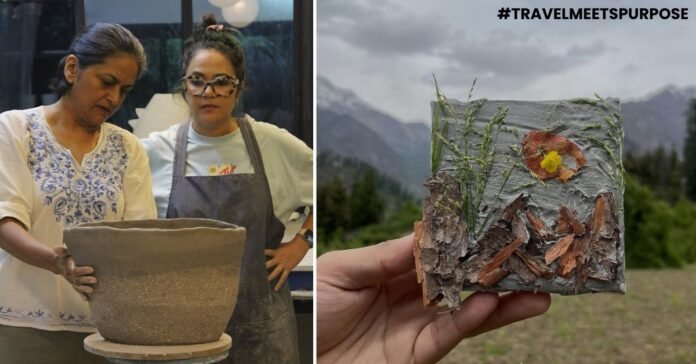
Whether you’re yearning for a break from the digital whirlwind, a deeper sense of peace, or simply a chance to play with clay and color, India is full of hidden retreats that offer just that. From the misty hills of Himachal Pradesh to the red earth of West Bengal, these eight creative getaways invite you to pause, explore, and reconnect—with art, nature, and yourself. Ready to swap your screen for a spinning wheel or a sketchbook? Let’s dive in.

1. Andretta Pottery and Craft Society, Himachal Pradesh

Tucked away in the picturesque village of Andretta, this studio has been a hub for ceramic artists since 1983. Founded by Mansimran ‘Mini’ Singh and his wife Mary, it continues the legacy of renowned potter Sardar Gurcharan Singh. Here, you can immerse yourself in wheel-throwing, hand-building, and glazing techniques, all while surrounded by the breathtaking Dhauladhar ranges.

The studio offers intensive three-month residential courses as well as shorter seven-day retreats. Beyond pottery, you can explore nature trails and unwind with bonfire nights, making it a holistic creative escape.

2. Dharamkot Studio, Himachal Pradesh

Nestled amidst the serene forests of Dharamshala, Dharamkot Studio is a community-driven art space offering year-round pottery workshops. Whether you’re shaping clay on the wheel or exploring the world of painting, the experience is designed to be deeply meditative.

Beyond the workshops, the studio blends art with wellness, offering yoga, meditation, and nature walks—perfect for those seeking a creative yet rejuvenating retreat.

3. Project Aaina

Founded by Rajvi Vats, Project Aaina is a transformative retreat that seamlessly blends art, movement, music, and meditation. With the tagline “Let’s travel outside, to dive within,” these retreats are crafted for self-discovery and creative healing.

Each retreat is unique, hosted in offbeat locations across India, and designed to help participants explore their inner worlds through diverse artistic expressions.

4. Aura Pottery, Punjab

If you dream of a luxurious pottery retreat, Aura Pottery near Chandigarh is your answer. Set on a lush estate with organic gardens, meditation spaces, and even a pool, this contemporary ceramic studio offers workshops ranging from weekend getaways to 12-week residencies.

Participants can explore various pottery techniques while soaking in the tranquil environment, making it a perfect blend of creativity and deep relaxation.

5. Smell Of The Earth, West Bengal

This farmstead retreat in Birbhum is all about sustainable living and eco-conscious creativity. Here, participants can learn organic farming, eco-friendly construction, and mindful living practices while also exploring art and nature.

Workshops focus on blending traditional wisdom with modern sustainability, offering a deeply grounding experience that goes beyond just art.

6. Vulcan Art Gallery, Punjab

A vibrant artistic hub, Vulcan Art Gallery offers workshops in art therapy, sand texture painting, and even underwater painting. The retreat also hosts drum circles, musical evenings, and guided yoga sessions, making it a sanctuary for both creative expression and soulful rejuvenation.

Whether you’re a seasoned artist or a curious beginner, this space welcomes all who seek to explore their creativity.

7. Clayfingers Pottery Retreat, Kerala

Housed in a restored heritage tile factory, Clayfingers Pottery Retreat is a haven for ceramic enthusiasts. Specializing in sculptural ceramics, glazing, and even traditional Kerala mural painting, this retreat beautifully blends historical charm with contemporary artistic exploration.

By working to revive forgotten art forms, Clayfingers provides an experience that is as culturally enriching as it is creatively fulfilling.

8. The Norbulingka Institute, Himachal Pradesh

Dedicated to preserving Tibetan culture, The Norbulingka Institute offers immersive workshops in thangka painting, woodcarving, and weaving. Participants stay in serene guesthouses and learn age-old artistic traditions from skilled Tibetan artisans.

Beyond art, this retreat offers a deeply spiritual experience, allowing for creative expression intertwined with cultural preservation.


Time to Unplug & Create

These creative retreats are more than just workshops—they are doorways to mindfulness, artistic growth, and self-discovery. So if you’re looking to swap the chaos of daily life for a brush, a pottery wheel, or the meditative rhythm of handwoven threads, consider stepping into one of these artistic sanctuaries.

Because sometimes, the best way to find yourself is to create something with your own two hands.

Lakshyaraj Singh Mewar’ Gaddi Utsav To Be Performed Today

0

The historic tradition of Gaddi Utsav of Dr. Lakshyaraj Singh Mewar, a member of the former royal family of Mewar, will be performed today (Wednesday). This ceremony is being organized following the demise of his father, Arvind Singh Mewar. The event will take place at the City Palace premises from 9:30 AM to 1:30 PM.

Horse Worship at 3 PM

The traditional Ashwa Poojan will commence at 3 PM. Following this, according to the customs of the former royal family, Lakshyaraj Singh Mewar will visit Shri Eklingnathji Temple in Kailashpuri at 4:20 PM. Later in the evening, Hathipol Gate will be worshipped at 7 PM. The traditional Rangpaltai Dastur ceremony for Bhaipa and Sardars will take place at 8:15 PM.

Dress Code for Attendees

A dress code has been set for those attending the ceremony.

  • Men: White kurta-pyjama
  • Women: White suit or traditional white dress

Temple Visit at Night

At 9 PM, Lakshyaraj Singh Mewar will visit Jagdish Temple for darshan.

Recent Loss in the Mewar Royal Family

Arvind Singh Mewar, a respected member of the Mewar royal family, passed away on March 16 after a prolonged illness.

Earlier, Mahendra Singh Mewar, the elder brother of Arvind Singh Mewar, passed away on November 10, 2024. Following his demise, the coronation ceremony of his son, Vishvraj Singh Mewar, who is also the Nathdwara MLA, was held at the Chittorgarh Fort.

Meet the Engineer Who Grew Kashmiri Saffron in Kerala & Earned Rs 12 Lakh in a Year

0

In a groundbreaking feat of agricultural innovation, Seshadri Shivakumar, a civil engineer by profession, has successfully cultivated Kashmiri saffron in the unlikely climate of Kerala. His journey is a testament to perseverance, scientific ingenuity, and a passion for breaking boundaries in traditional farming.

A Vision Beyond the 9-to-5

Seshadri’s journey began with a desire to escape the monotony of a conventional nine-to-five job. Unlike many who dream of career shifts, he took a bold leap into the world of aeroponic farming—a highly technical method that requires precise environmental conditions. Given Kerala’s hot and humid climate, which starkly contrasts with the cool conditions necessary for saffron cultivation, many were sceptical of his ambitious endeavor.

However, Seshadri was undeterred. Determined to make his vision a reality, he conducted extensive research, visited farms, and immersed himself in understanding the complexities of aeroponics.

Turning a Dream into Reality

Armed with knowledge but no prior farming experience, he made an initial investment of Rs 10 lakh and procured 400 kilograms of saffron bulbs. In a compact 225 sq ft space, he meticulously designed a controlled environment for saffron growth, integrating chillers, dehumidifiers, and specialised grow lights. His fully automated and remotely controlled setup allowed him to balance multiple ventures while ensuring optimal growing conditions for the delicate saffron flowers.

A Remarkable Success Story

Defying expectations, Seshadri’s venture flourished. Within just a year, he reaped a remarkable profit of Rs 12 lakh from his saffron cultivation. His success was not only a financial victory but also an inspiration to aspiring farmers and agripreneurs.

Recognising the potential of his achievement, he took on the role of a mentor, sharing his knowledge with over 100 individuals interested in replicating his success. His willingness to educate and guide others has helped spread the possibilities of saffron farming beyond traditional geographic boundaries.

Redefining Agriculture in India

Seshadri Shivakumar’s story is a shining example of how innovation, determination, and technological advancements can revolutionise agriculture. By challenging conventional wisdom and embracing scientific farming methods, he has opened new doors for saffron cultivation in unexpected terrains. His journey serves as an inspiration to those who dare to defy the odds and turn ambitious dreams into thriving realities.