Home Blog Page 305

Similipal: Odisha’s Living Crown Jewel Earns Its Place Among India’s National Parks

0

In the heart of Odisha, where ancient sal forests whisper tales of tigers and elephants, a momentous chapter in India’s conservation story has just been written. Similipal, a land teeming with life and mystery, has been formally declared a national park by the Odisha government — a decision decades in the making, and one that promises a vibrant future for the state’s natural legacy.

Covering 845.70 square kilometers, Similipal now stands as Odisha’s largest national park and proudly joins the esteemed ranks as India’s 107th national park. But beyond the numbers lies a story of persistence, hope, and the timeless bond between nature and humanity.


A Dream Four Decades in the Making

The journey to Similipal’s new status traces back to 1980, when the idea of national park recognition first took root. Even then, the region’s breathtaking biodiversity — its leopards slipping through the mist, its herds of elephants stirring the riverbeds, and its forests alive with birdcalls — was undeniable.

Before that, in 1975, Similipal was declared a wildlife sanctuary, a protective cloak that nevertheless fell short of the stricter, enduring safeguards a national park designation offers. For nearly half a century, conservationists, forest officials, and local communities worked tirelessly, their dreams fueled by the vision of securing Similipal’s place among India’s most cherished wild spaces.

At long last, that vision has become reality.


An Ecological Wonderland

Similipal is not merely a stretch of forest; it is a symphony of life.

  • 55 species of mammals roam its depths — from the stealthy leopard to the majestic elephant.
  • 361 species of birds paint the sky with flashes of vibrant color and song.
  • 62 species of reptiles and 21 species of amphibians lurk under leaf and stone, weaving an intricate web of life often hidden to the casual eye.

Much of Similipal’s soul is entwined with the Similipal Tiger Reserve, a sprawling conservation area covering 2,750 square kilometers. Its core critical tiger habitat, notified in 2007, spans 1,194.75 square kilometers — a heartland fiercely protected for one of the world’s most iconic predators.

In every tree, every flowing stream, every footprint on the forest floor, Similipal whispers of ancient Earth, still breathing, still wild.


The Struggles Behind the Glory

But achieving national park status was no fairy tale.

One of the thorniest challenges was human habitation. Six resilient villages nestled within the park’s proposed core zone — generations of families with deep spiritual and survival ties to the land. The government, walking a delicate line between conservation and human rights, successfully relocated several communities. Yet Bakua village remains, its presence too rooted, too vital to uproot.

In a decision reflecting respect as much as pragmatism, Bakua was carefully excluded from the national park’s final boundary. The landscape, it seems, tells not just a story of wildlife, but of human endurance, memory, and belonging.


A New Dawn for Conservation

With national park status, Similipal’s guardians — the forest department — are now armed with stronger conservation powers. Stricter enforcement against encroachments, poaching, and deforestation is now possible. Greater funding and resources can flow into habitat restoration, research, and community engagement.

But this is about more than just policing or preserving. It’s about reimagining a relationship between people and wilderness — one where protection, livelihood, and pride can grow together.

The Odisha government envisions Similipal not as a sealed fortress of biodiversity, but as a living landscape where sustainability and heritage walk hand in hand.


Walking Together with the Tribes of the Forest

For the tribal communities who call the forest their mother and muse, this declaration carries a profound promise.

Conservation efforts tied with sustainable development initiatives mean improved infrastructure, education, healthcare, and livelihood options — all while honoring traditional knowledge and cultural practices that have long coexisted harmoniously with nature.

Rather than being sidelined by conservation, the local tribes are being invited to become stewards of Similipal’s future. Their voices, their stories, and their wisdom will be vital in ensuring the forest doesn’t just survive — but thrives.


A Living Legacy

Similipal today stands at a luminous crossroads — a bridge between the past and the possible.

As monsoon rains nourish its ancient groves and the sun dapples its clearings in gold, the park hums with an ageless truth: we are part of the wild, and it is part of us. Protecting it is not an act of charity, but one of remembering who we are.

With this new designation, Similipal doesn’t just earn a title.
It reclaims its rightful place — as a crown jewel of Odisha, a treasure of India, and a hope for the world.

Mount Kailash: The Sacred Enigma 6666 Kilometers from Everywhere

0

In the remote vastness of western Tibet, a lone peak rises like a sentinel from the heavens — stark, unyielding, and utterly mesmerizing. Mount Kailash, with its perfect symmetry and eternal snows, has been revered for millennia as the spiritual center of the world. But recently, a curious observation has whispered its way into the annals of the mountain’s many mysteries: Mount Kailash’s distance from several significant places is eerily close to 6666 kilometers.

Coincidence? Cosmic joke? Or a deliberate signature of an intelligence far older than recorded time?

The mountain, it seems, is guarding its secrets well.

A Mountain Like No Other

Mount Kailash: The Sacred Enigma 6666 Kilometers from Everywhere

Kailash is not just a mountain; it is a symbol, a legend, a riddle.
For Hindus, it is the abode of Lord Shiva, where he sits in eternal meditation.
For Buddhists, it is the cosmic center, Mount Meru, connecting the heavens and the earth.
For Jains, it marks the place of spiritual liberation.
For followers of Bon, the ancient shamanic faith of Tibet, it is the very navel of the world.

Unlike Everest or K2, no human has ever climbed its summit — nor have they been permitted to. It is said that to disturb its sacred peak would invite calamity. Even the most ambitious mountaineers turn away, whispering that the mountain must remain untouched, that its power is not meant to be conquered but revered.

It stands alone, untamed, a monument to the unknowable.


The Curious Case of 6666

Enter the strange and whispered numbers.

It has been noted — with an almost mischievous mathematical precision — that the distance from Mount Kailash to several key locations hovers astonishingly close to 6666 kilometers.

  • To the North Pole — approximately 6666 km.
  • To certain ancient sites like Stonehenge, Easter Island, and even the Great Pyramids — similar magical ratios and alignments appear, tantalizingly close, as if a hidden geometry ties them together.

The number 6666 — perfectly symmetrical, flowing, balanced — invites both mathematicians and mystics to speculate.
Is it a fluke?
Or is there an ancient blueprint, long forgotten, etched into the very bones of the Earth?

If you listen closely to the stories whispered on cold Himalayan winds, some say Mount Kailash is not just a mountain but an ancient, colossal pyramid, its dimensions aligned with an unseen grid of energy crisscrossing the planet.
A cosmic generator.
A timeless temple.
A still-beating heart of something vast and eternal.

Science Meets the Sacred

Of course, the rational mind leans in, arching an eyebrow: measuring from the summit or the base? From sea level or ground level? Tiny shifts could account for hundreds of kilometers. Global positioning isn’t always as precise as we like to think, especially when tracing lines across a living, breathing Earth.

Yet — and this is crucial — the mystery persists.

Because whether or not every calculation stands up to modern GPS standards, the symbolism remains unnervingly resonant. Ancient builders, from Egypt to the Andes, revered numbers, distances, alignments. They built temples, tombs, and cities with breathtaking astronomical precision — without the aid of computers, satellites, or even telescopes as we know them.

It begs the question:
Did they know something we have forgotten?
Did they trace the Earth not merely as land and sea, but as sacred space — a living, breathing web of energy and intention?

If so, Mount Kailash may be more than a geographical marvel; it could be the silent anchor of an entire planetary consciousness.

The Whisper of the Infinite

Even today, pilgrims circle the mountain — performing the Kora, a sacred circumambulation — believing that each step erases the sins of a lifetime. Some say completing 108 revolutions brings enlightenment, a shortcut to nirvana itself.

No one climbs it.
No one desecrates it.
Because something deeper than law — something felt in the very marrow of the bones — tells us:
Here, the Earth touches the Divine.

Mount Kailash, standing 6666 kilometers from the known, the familiar, and the explainable, reminds us that some mysteries are not meant to be solved — only honored.

Perhaps the real secret of Kailash is not the number, not the distance, but the invitation it offers:
To marvel.
To wonder.
To remember that, in a world rushing toward certainty, there are still places that hum with the music of the unknown.

Unlocking the Sun’s Secrets: A New Chapter in the Story of Helium

0

For centuries, humanity has gazed up at the Sun — our ever-blazing cosmic neighbor — with awe and curiosity. Yet even in this age of rovers on Mars and telescopes peering into the dawn of time, some mysteries remained frustratingly out of reach. One such puzzle was deceptively simple: how much helium is really floating around in the Sun’s photosphere?

Thanks to recent advancements in astrophysics, that mystery is finally cracking open. A team at the Indian Institute of Astrophysics has made history by providing the first direct observation of helium abundance in the Sun’s photosphere — a breakthrough that doesn’t just add a feather to our scientific cap but could reshape our understanding of how the Sun’s light and heat reach Earth.

Let’s dive into this celestial detective story.


Helium: The Silent Architect of the Stars

Helium, the quiet second-place holder after hydrogen in the cosmic popularity contest, might seem like just the stuff inside birthday balloons. But in the grand theatre of the cosmos, helium plays a starring role.

Within the Sun, helium acts as a backstage manager, influencing the opacity of the photosphere — the very outer layer we see glowing so fiercely. Opacity governs how energy flows from the Sun’s core to its surface and then streams out across the solar system. A small change in opacity here can ripple outward to affect everything from space weather to climate patterns on Earth. No pressure, helium.


The Traditional Guesswork: Helium’s Hide and Seek

Until now, trying to measure helium in the photosphere was like trying to hear a whisper in a rock concert. Helium, notoriously, doesn’t leave clear spectral fingerprints in the Sun’s visible surface.

Astronomers had to get creative, estimating its abundance by looking at hotter stars where helium shouts a little louder, or by studying the solar corona — that wispy outer atmosphere only visible during eclipses. Another clever trick was helioseismology, the study of ripples and waves coursing through the Sun’s interior (think of it like ultrasound, but on a star). These methods were brilliant but inherently indirect, a bit like deducing the contents of a locked box by listening to it rattle.


The Breakthrough: A New Way to Listen

Enter the recent innovation: a novel method that brings the mystery box into the light.

Researchers at the Indian Institute of Astrophysics turned to spectral lines of neutral magnesium and carbon, combining their analysis with hydrogenated molecules. This clever cocktail allowed them to infer the amount of helium directly — for the first time — right from the photosphere itself.

And guess what? Their results showed a helium-to-hydrogen ratio of around 0.1, aligning beautifully with earlier helioseismological estimates. It’s like finally getting a direct answer from a very shy friend, and realizing you had understood them pretty well all along.

This new method didn’t just pull numbers out of thin (solar) air; it required meticulous cross-checks. The magnesium and carbon abundances had to match perfectly with their atomic and molecular spectral lines. If they didn’t, the whole helium measurement would have been about as useful as a sundial in a blackout.


A Historical Journey: From Eclipse to Enlightenment

The story of helium is one of the most charming tales in scientific history.

Back in the early 19th century, Joseph von Fraunhofer was busy identifying strange dark lines in the Sun’s spectrum — celestial Morse code that no one yet understood. Fast forward to 1868, during a solar eclipse, when Pierre Janssen and Norman Pogson independently spotted an odd yellow line that didn’t match any known element on Earth.

Cue the drumroll: scientists realized they had discovered a new element — one that existed first in the heavens before being found on Earth. They named it helium, after Helios, the Greek god of the Sun. You can almost picture the moment: a bunch of 19th-century scientists gasping dramatically while sipping their tea.


Why It Matters: More Than Balloons

Today, helium is much more than a party trick. It cools the magnets inside MRI machines, enabling life-saving medical imaging. It keeps spacecraft and cryogenics systems humming. It’s a critical player in cutting-edge tech industries.

Yet despite being the second most abundant element in the universe, helium is strangely rare on Earth — produced mainly through the slow drip of radioactive decay underground. Here’s a plot twist: we’re actually facing a helium shortage on Earth. Meanwhile, the Sun casually burns it by the boatload.

Understanding helium’s role in the Sun isn’t just an academic exercise. It feeds into a bigger picture: predicting solar behavior, safeguarding satellites, improving climate models, and yes, maybe even finding new ways to sustain our technological civilization as we reach further into space.


The Road Ahead: A Brighter Sunlit Path

This first direct helium measurement is like stepping onto a brand-new trailhead. Scientists can now refine their models of solar physics with greater precision. Future missions — from solar observatories to Earth climate studies — will benefit from this clearer understanding of the Sun’s elemental makeup.

In a universe filled with enigmas, cracking open the Sun’s secrets reminds us: even in the 21st century, there’s magic in discovery. And sometimes, that magic is hidden in something as simple — and as profound — as a quiet atom of helium.

Former ISRO Chief K. Kasturirangan Passes Away at 84: Architect of NEP 2020 and Recipient of All Three Padma Awards

0

Former ISRO Chairman Dr. Krishnaswamy Kasturirangan passed away in Bengaluru on Friday at the age of 84. His mortal remains will be kept at the Raman Research Institute for last respects on Sunday, April 27. Dr. Kasturirangan had suffered a minor heart attack two years ago and had been unwell since.

At the time of his passing, he was serving as the Chancellor of the Central University of Rajasthan and NIIT University.

K. Kasturirangan: Early Life and Education

Born on October 24, 1940, in Ernakulam, in the erstwhile Kingdom of Kochi, Dr. Kasturirangan hailed from a Tamil family that later settled in Kerala. He completed his early education at Sri Rama Varma High School. He pursued his undergraduate studies in science at Ramnarain Ruia College, Mumbai, followed by a Master’s degree in Physics from the University of Mumbai. In 1971, he earned his Ph.D. in High Energy Astronomy.

Dr. Kasturirangan married Lakshmi soon after completing his Ph.D. in 1969. The couple had two sons, Rajesh and Sanjay. Lakshmi passed away in 1991.

K. Kasturirangan: A Stellar Career at ISRO

Dr. Kasturirangan served as the Chairman of ISRO for nine years, overseeing some of India’s most significant space missions. He also held the positions of Secretary of the Department of Space and Chairman of the Space Commission.

As Director of the ISRO Satellite Centre, he played a pivotal role in the development of the INSAT-2 series, India’s remote sensing satellites, and scientific satellite missions. He was the project director for Bhaskara-I and Bhaskara-II, India’s first Earth observation satellites.

Under his leadership, India made major strides in space exploration, including the development of the Polar Satellite Launch Vehicle (PSLV) and the Geosynchronous Satellite Launch Vehicle (GSLV). His vision and groundwork led to the launch of Chandrayaan-1, India’s first mission to the Moon.

K. Kasturirangan: Contribution to Education Policy

Beyond space science, Dr. Kasturirangan made an indelible mark on India’s education system. He chaired the committee that drafted the National Education Policy (NEP) 2020, laying the foundation for transformative reforms in the sector. In September 2021, he was appointed chairman of the 12-member committee tasked with developing the National Curriculum Framework (NCF), whose recommendations are now being integrated into school curricula.

He also served as a trustee of the Raman Research Institute, Bengaluru.

K. Kasturirangan: Relationship with Nambi Narayanan

During the controversial ISRO espionage case in 1994 involving scientist Nambi Narayanan, Dr. Kasturirangan was Narayanan’s senior. Although he was not directly involved, some later criticized him for not publicly supporting Narayanan during the ordeal.

K. Kasturirangan: Awards and Honors

Dr. Kasturirangan was among the rare individuals to receive all three of India’s top civilian honors—the Padma Shri, Padma Bhushan, and Padma Vibhushan—in recognition of his outstanding contributions to science, education, and the nation.

Top Travel Apps You Must Have in 2025 for the Best Trip Ever

0

Planning vacations in 2025 gets easier and more sensible with some new and powerful apps. Right from booking flights, hotels, local travel, or even getting your visa through Atlys, these apps cover it all. You don’t need to think too much—these apps are made to make you enjoy the ride and care less. Whether you’re doing a quick getaway or a long-haul trip, these apps are part of your phone.

  1. Agoda: Agoda is a decent hotel booking app that is quite robust in Asia and the rest of the globe. It offers decent discounts and last-minute deals. There are also genuine user reviews available there along with price comparison. Various forms of alternative stays such as homes, hotels, and hostels are also covered in the app.
  1. Moovit: This is a handy public transport app with information for most cities across the world. It shows real-time bus and train timings, routes, and schedules. It’s useful when one is traveling to cities where taxi fares are high or when one wishes to travel like a native. It even informs you when to exit.
  1. Atlys: Atlys makes it incredibly easy and swift to get a visa. You can apply for tourist visas for most nations through your phone. It’s an easy, clear, and secure process. It saves you tremendous effort and time, especially when you are going on a trip at short notice. In 2025, it’s among the best travel apps for visa services.
  1. Travel List: Travel List helps you plan and keep track of what to pack on your trip. You just input the destination, date, and type of trip, and the app gives you a comprehensive list of what to pack. It even reminds you of what you might forget. It’s incredibly handy for those who pack at the last minute or forget little things.
  1. iTranslate: iTranslate helps you to speak and hear different languages while traveling. You can translate text through typing, voice, or camera. It is helpful in reading signages, talking with locals, or reading menus. The voice translation is easy to hear and fast, and the app is quite working even during slow internet.
  1. Wise: Wise is the top-rated travel money management app. You can hold more than one currency and exchange it for a low fee. And it also offers real-time exchange rates. You can spend cash through the app or its card directly. It keeps you from carrying too much cash and prevents you from unsafe spending while traveling abroad.

Conclusion

Travel in 2025 is just fantastic when you’ve got the right apps on your phone. From trip planning to managing your money, and visa arrangements in a hassle-free manner with Atlys, every app has a little something special to it. All these travel apps make every part of the journey convenient, intelligent, and hassle-free. Simply download them before you pack!

Madhya Pradesh Has A Rich Contribution to Bollywood. From Marble Rocks to Movie Icons, The Show Goes On…!

0

By Anjali Solanki

Madhya Pradesh’s contribution to Bollywood is as diverse as its landscapes, from producing legendary talents like Lata Mangeshkar and Salman Khan to offering breathtaking filming locations like Bhedaghat and Chanderi. The state’s proactive policies and cultural richness have made it a cornerstone of Indian cinema, bridging the gap between heartland stories and global audiences. As Bollywood continues to evolve, Madhya Pradesh remains a vital force, providing the talent, settings, and support that keep the industry thriving.

Truly, MP is not just the heart of India but also a beating pulse of Bollywood’s creative soul.

So the story begins in the bustling streets of Indore, where a young boy named Salman roams with a mischievous grin. Born in this lively city, he’s got big dreams tucked into his pocket. Fast-forward a few decades, and that boy is Salman Khan, Bollywood’s ultimate Bhai, ruling the box office with Dabangg swagger and a heart big enough to start Being Human, a charity that lights up lives. But Salman is not alone. In the same city, a little girl named Lata hums melodies that will one day echo across the world. Lata Mangeshkar, the Nightingale of India, grows up to sing timeless hits for Bollywood’s golden era, her voice weaving magic in every Dilwale Dulhania Le Jayenge romance.

Madhya Pradesh Has A Rich Contribution to Bollywood. From Marble Rocks to Movie Icons, The Show Goes On...!
House where Lata Mangeshkar was born in Indore

Travel a bit further to Khandwa, where a quirky kid named Kishore daydreams by the Narmada River. That’s Kishore Kumar, whose soulful “Mere Sapno Ki Rani” and playful “Ek Ladki Bheegi Bhaagi Si” become the heartbeat of Bollywood’s music.

And in Gwalior, a young Kartik Aaryan is cracking jokes with friends, unaware that his charm will soon light up theaters in Pyaar Ka Punchnama. From Bhopal’s Annu Kapoor, the voice of Antakshari, to Jabalpur’s Raghubir Yadav, stealing hearts in Lagaan, Madhya Pradesh is a treasure chest of talent, churning out stars who make the youth scream, cry, and dance.

But it’s not just about the people. Let’s zoom into Bhedaghat, where the Narmada carves through marble rocks that shimmer like they’re straight out of a Bollywood dream sequence. Picture Shah Rukh Khan romancing Kareena Kapoor here in Asoka, the song “Raat Ka Nasha” making every teenager swoon. Or head to Chanderi, where the spooky yet hilarious Stree unfolds amidst ancient forts and narrow lanes, giving Gen Z a horror-comedy to binge. Maheshwar’s serene ghats and Ahilya Fort star in Padman, while Sehore’s dusty villages bring Laapata Ladies to life, proving MP’s small towns can tell big stories that vibe with today’s youth.

Now, let’s pull back the curtain on how MP makes these cinematic dreams come true. Imagine a young director, script in hand, scouting locations. She’s stressed permits, budgets, chaos But Madhya Pradesh rolls out the red carpet. The state’s Film Tourism Policy is like a superhero sidekick a single-window system zaps permissions in 15 days, subsidies up to ₹10 crore keep budgets in check, and discounts on cozy MP Tourism hotels make shoots a breeze. From Dunki to Panchayat, over 300 projects have danced to MP’s tune in just four years. Bhopal is buzzing with plans for film cities and studios, ready to turn MP into Bollywood’s next big hub.

And the story doesn’t end with the credits. MP’s Bollywood stars are heroes off-screen too. Salman’s Being Human funds schools and hospitals, inspiring young fans to give back. Palak Muchhal, Indore’s singing sensation, performs to save kids’ lives, proving you can chase dreams and change the world. These are the role models MP gifts to Bollywood people who show the youth that stardom isn’t just about fame; it’s about heart.

Madhya Pradesh Has A Rich Contribution to Bollywood. From Marble Rocks to Movie Icons, The Show Goes On...!

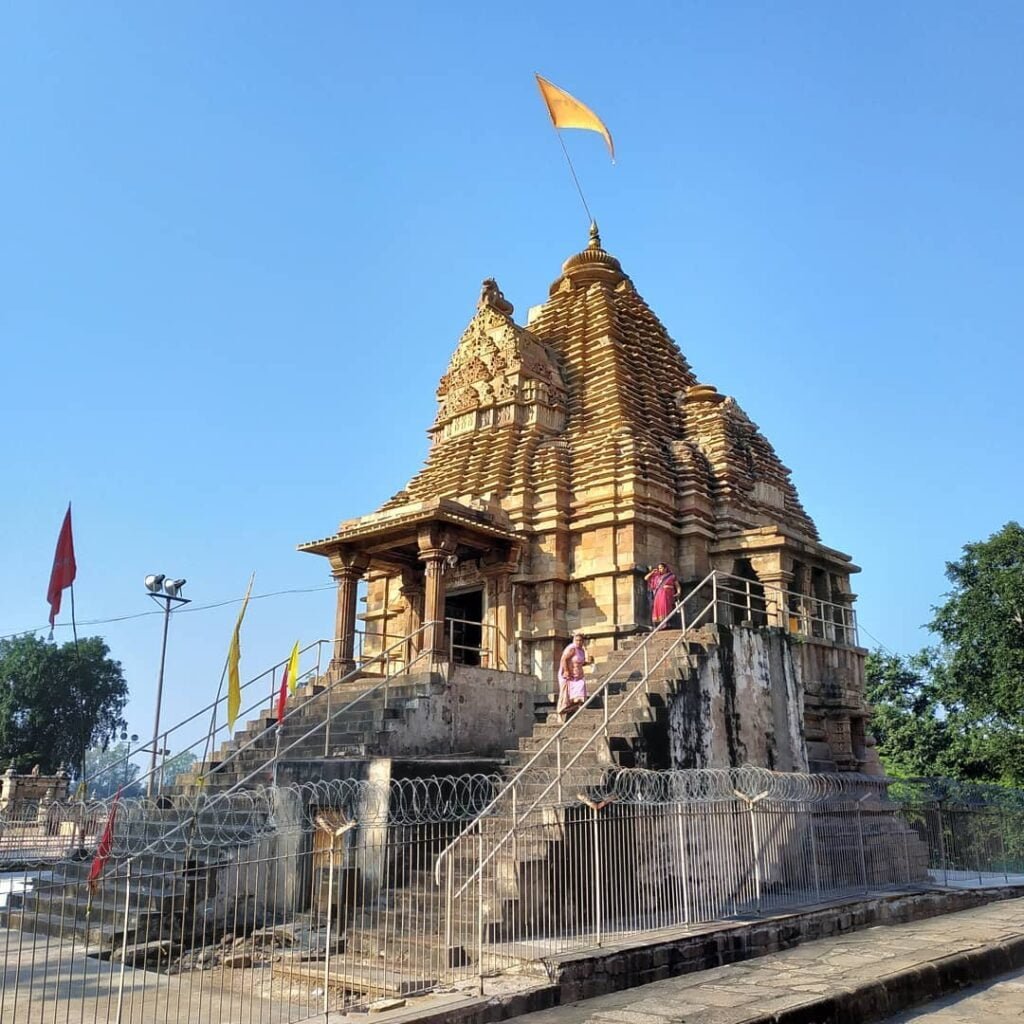
As the sun sets over Khajuraho’s ancient temples, casting golden hues on a film crew wrapping up a shoot, Madhya Pradesh hums with possibility. It’s a place where a kid from a small town can become a superstar, where a quiet village can steal the spotlight, and where every story finds a home. For the youth dreaming of their big break whether behind the camera, on the mic, or in the spotlight MP is proof that the heartland can light up the silver screen.

So, the next time you’re lost in a Bollywood song or cheering for your favorite hero, remember: Madhya Pradesh is the unsung melody, the hidden set, the spark behind the magic. This is no ordinary state it’s Bollywood’s beating heart, and its story is just getting started.

When Curtains Rose in Deeg, So Did History As Play on Malwa Queen Ahilyabai Was Staged at Site of Her Husband’s Demise

0

Recently, a mesmerising play was staged in the historic town of Deeg, Rajasthan — a place where marble fountains whisper stories and old palaces breathe with the weight of time. But on this particular evening, the spotlight wasn’t on royalty or grandeur. It was on inspiring and empowering story of Queen Ahilyabai Holkar who would become one of India’s greatest rulers: Maharani Ahilyabai Holkar.

As the play beautifully staged the strong character of Ahilya, few amongst those present there knew the fact that Ahilyabai lost her husband, Khanderao Holkar near Kumher.

The death of her husband was a pivotal event that forever altered the course of her life—and in many ways, Indian history. The audience were mesmerised, some tearful, others thoughtful watching different chapters from her life, right from her childhood, to her marriage and then into her new role as queen. And most were shocked to learn something history often leaves tucked away in the margins:

Her husband died right here in Kumher — not far from Deeg.

A Death That Changed a Dynasty

It was March 24, 1754, and war drums echoed across Kumher Fort, not far from present-day Bharatpur. Khanderao Holkar, heir to the Holkar throne and commander of Maratha forces, was overseeing the siege from an open palanquin. As fate would have it, a cannonball, fired by the defending Jat soldiers, struck him down in an instant.

He never returned to his queen.

Back in Indore, Ahilyabai was devastated. At just 29 years old, she was not only a widow, but a woman standing at the edge of a societal expectation that could have claimed her life: sati.

She prepared for it. She was ready to follow Khanderao into death.

But in that darkest moment, a voice stopped her.

Her father-in-law, Malhar Rao Holkar, broken with grief himself, pleaded with her not to end her life. “If you go,” he told her, “you take my last strength with you.” He saw not just a grieving wife, but a future queen, a leader.

Ahilyabai stepped back from the pyre—and into history.

A Tribute from an Enemy

But the story doesn’t end with grief. It finds an unlikely footnote in compassion and mutual respect.

When Curtains Rose in Deeg, So Did History As Play on Malwa Queen Ahilyabai Was Staged at Site of Her Husband’s Demise

In a stunning gesture of humanity, it was Maharaja Suraj Mal of Bharatpur—the very ruler whose troops had fired the fatal shot—who ordered the construction of a chhatri (cenotaph) for Khanderao Holkar. Built at the cremation site in the nearby village of Gangar Soli, the memorial still stands, silent and forgotten by most, but sacred in its intent.

Few know it exists. Fewer still visit.

But that chhatri, nestled among mustard fields and village trails, holds a kind of quiet power. It speaks of sorrow, yes—but also of respect across enemy lines, of valor, and of a widow’s strength to rise after the fall.

A Play that Reopened Old Pages

The recent play in Deeg did more than entertain — it reawakened a slumbering chapter of history. For many in the audience, it was the first time hearing of Khanderao’s death in Kumher, or of the memorial in Gangar Soli. It bridged centuries in a single evening, revealing the raw human emotion behind the stoic portraits and gilded statues.

It reminded us that Ahilyabai’s reign of justice and compassion began not in a palace, but in mourning. That her strength was born not of privilege, but of personal tragedy. And that sometimes, leadership doesn’t begin with a coronation—it begins with the decision to keep living.

Where the Past Still Waits

Deeg and the surrounding region, with its crumbling forts and echoing halls, still holds this history in its bones. If you listen closely near Kumher Fort, or visit the lone chhatri at Gangar Soli, you can feel the pulse of a story that ended too soon—and the dawn of a legend who would go on to illuminate an entire kingdom.

So next time you’re in Deeg, don’t just visit the palaces.

Visit the place from where a new history was scripted.

Because in that heartbreak, Ahilyabai Holkar found a destiny which went far leaving a long lasting impact of women leadership in India. And Rajasthan—quietly, reverently—still carries the echo of that choice.

300 Women, 3000 Homes: Meet The Solar Sisters Bringing Light to Rural India

0

Nestled in the folds of towering mountains in Rajasthan’s Nichlagarh panchayat, the village where Thavri Devi grew up once knew nothing but darkness. Days melted into nights without the flicker of a bulb. Life was dictated by the rhythms of the sun, and when it set, so did the village’s activity.

Thavri’s world was shaped by the dust of unpaved roads, the hush of mud huts, and the silence of evenings without light. Her family survived on meagre earnings from her husband’s work as a construction labourer. Pulled out of school after Class 5, her days revolved around household chores and tending sheep—her dreams kept as small and contained as the flickering flames of kerosene lamps.

Then came an opportunity that sparked more than just curiosity—it ignited a quiet rebellion. A five-month solar engineering training programme was being launched in Harmada, and the village needed women to participate. Amid the hesitant murmurs of tradition and the weight of generational norms, her name came up.

300 Women, 3000 Homes: Meet The Solar Sisters Bringing Light to Rural India

No woman from her community had ever travelled alone. And yet, Thavri went.

As she boarded her first train en route to Kishangarh, a crowd gathered. Women wept. Men watched silently. Her journey was more than a physical one; it was a step into a future her village hadn’t dared imagine.

Powering Change, One Panel at a Time

In Harmada, Thavri was introduced to the world of circuits, solar panels, batteries, and wiring. She fumbled. She learned. She succeeded.

300 Women, 3000 Homes: Meet The Solar Sisters Bringing Light to Rural India

Returning to her village, she brought more than technical skills—she carried light. Literally.

She became a solar engineer. Her work now powers her community. She earns a monthly income of ₹5,700, and with it comes a newfound status, pride, and influence. Her children look at her differently. Her village sees her as a pioneer. She is no longer just a caretaker of goats—she’s a bearer of energy, agency, and change.

Thavri’s journey is far from unique. It’s part of a growing grassroots energy revolution that has transformed over 300 rural women across 10 states—including Jharkhand, West Bengal, Mizoram, and Nagaland—into certified solar engineers. These women don’t just install solar panels; they repair, maintain, and power up their communities with confidence, grit, and technical know-how.

The Man Behind the Movement

At the centre of this transformative wave is Harsh Tiwari, director of EMPBindi International. Once a corporate engineer chasing deadlines in boardrooms, Harsh’s perspective changed during a rural fellowship with the State Bank of India. Immersed in India’s heartland, he witnessed the stark contrast between urban privilege and rural potential. He saw talent waiting to be unleashed, solutions waiting to be implemented.

300 Women, 3000 Homes: Meet The Solar Sisters Bringing Light to Rural India

That clarity led to a pivot—away from corporate comfort and into the grassroots trenches.

Harnessing his engineering background, Harsh launched a training programme designed to empower women in regions where electricity was intermittent or absent. The programme was audacious in its simplicity: take a skill traditionally dominated by men, break it down, and make it practical, accessible, and empowering for women.

Over five months, women learn everything from soldering and fault-detection to battery setup and panel installation. And it’s not just theory. Trainees build lighting systems dozens of times until they can do it with the ease of tying a sari. By the end, they earn a certification from the Ministry of Renewable Energy, formally recognising them as solar engineers.

More Than Light: A New Model of Power

These women are now the go-to energy experts in their villages. If a panel fails, they fix it. If a system falters, they diagnose it. And they don’t stop there.

300 Women, 3000 Homes: Meet The Solar Sisters Bringing Light to Rural India

EMPBindi’s model builds two distinct yet connected groups: solar engineers, who serve as village-level technicians and infrastructure managers, and solar sakhis, who take the entrepreneurial baton to surrounding areas.

It’s a hub-and-spoke model—engineers form the solid hub keeping the village lit, while sakhis act as mobile spokes, expanding access to new technologies, promoting livelihood-based solar solutions, and engaging in customer outreach. Some help introduce solar-powered irrigation systems; others bring in solar dryers for produce or solar cookstoves for cleaner kitchens.

This adaptability ensures women can shift roles based on their mobility, interests, or aspirations. Whether they stay in the village or travel to neighbouring ones, their work carries weight.

Illuminating Mindsets and Breaking Moulds

Convincing families to allow women to join the programme wasn’t easy. It took rounds of community meetings, assurances of safety, and, above all, persistence.

300 Women, 3000 Homes: Meet The Solar Sisters Bringing Light to Rural India

But once trained, these women returned as forces of nature. Their newfound roles disrupted the old order. One woman, newly certified, walked into a male-dominated panchayat meeting and pulled up a chair for herself at the centre. She didn’t wait to be asked. She claimed her space and declared her authority.

Stories like these are now common across the villages touched by EMPBindi’s programme. Gender roles are shifting. Children are seeing their mothers not just as homemakers but as engineers, changemakers, and leaders.

The numbers tell part of the story: 3,000 households, schools, and health centres now powered; 6,000 solar devices distributed. But the bigger impact is harder to quantify—it’s in the quiet confidence of a woman who once feared travelling alone, now fixing panels in multiple homes. It’s in the glint of pride in a daughter’s eyes when she watches her mother lead a workshop.

A Future Lit by Women

For Harsh, the goal is much bigger than rural electrification. It’s about rewriting the narrative of who gets to bring change. The hope is to scale this model sustainably, nurturing a future where rural women lead the charge in adopting clean, decentralised energy solutions.

When villages are lit by systems built and maintained by local women, the impact is not just electrical—it’s cultural, social, and deeply personal. It’s about more than energy access; it’s about empowerment, economic resilience, and self-determination.

This isn’t just a story of lighting homes. It’s a story of lighting lives.

And in places that once knew only darkness, these women are becoming the brightest stars.

Reclaiming Power: Dalit Women and the Journey Toward True Equity

0

The Quiet Revolution: How Dalit Women Are Leading India’s Most Radical Grassroots Change

In 1942, B.R. Ambedkar addressed a gathering of Dalit women with a powerful conviction—that the upliftment of the Dalit community was intrinsically tied to the empowerment of its women. More than eighty years later, that vision is quietly taking shape—not in policy rooms or prime-time news—but in village meetings, self-organised federations, and local classrooms.

Dalit women are redefining what leadership looks like. They are running organisations, holding institutional power, confronting caste and gender injustice, and reshaping the very systems that were built to exclude them. These aren’t isolated achievements; they are the foundation of a deeper movement—one that has often gone unrecognised, but never without impact.

Let’s step into their world.


Manohari Doss: The Architect of Collective Power

Reclaiming Power: Dalit Women and the Journey Toward True Equity

In a Tamil Nadu village, a young girl defied convention just by staying in school. That girl—Manohari Doss—grew up to co-found the Institute for Self Management (ISM) in 1982. With her late husband, Edward Doss, she helped create an organisation that would go on to transform lives across the state.

Over the next forty years, ISM, the Women Development Resource Centre, and the Tamil Nadu Labour Union worked at the intersection of livelihoods, rights, and education. At the heart of this work lies the Federation for Dalit Women Empowerment—a state-wide collective of 65 Dalit women-led NGOs across 20 districts.

This federation, formally registered in 2024, focuses on building leadership, creating dignified employment, increasing access to education, and enabling women to step into positions of authority. The goal is ambitious: to impact 100 grassroots organisations across Tamil Nadu, with an approach that is deeply intersectional, feminist, and community-rooted.

Under Manohari’s leadership, the federation has become a platform for solidarity and systemic accountability. It trains women leaders, forges alliances with broader movements, and shapes a space where Dalit women set the agenda, rather than waiting for a seat at someone else’s table.

Her work has also extended beyond borders, influencing international policy and advocacy, and earning her recognition at the global level. But her proudest legacy is the growing ecosystem of women who are empowered to lead—and who are bringing others with them.


Prabha Yadav: Reclaiming Education in Migrant Lands

In Solapur’s sugarcane belt, where droughts are frequent and poverty entrenched, Dalit families often migrate seasonally for survival. This constant displacement tears children, especially girls, from school and into cycles of unpaid labour, domestic work, and early marriage.

In 1987, a group of young returnees from Mumbai, frustrated by the lack of opportunity in their hometown, founded the Dr. Ambedkar Agriculture Development & Research Institute (ASVSS). Among them emerged Prabha Yadav—a woman who would later lead the organisation into its next chapter.

Under Prabha’s stewardship, ASVSS has become a lifeline for hundreds of children and families. The organisation runs after-school centres, provides tuition support, and operates crèches for working mothers. It has introduced foster care for children of migrant labourers and provided counselling support for caregivers.

These efforts have helped children stay in their communities, continue their education, and experience stability in otherwise unstable lives. ASVSS has also tackled the root economic drivers of migration, introducing organic farming experiments and improving local agricultural practices.

In a bold step, the organisation restructured its leadership to reflect the people it serves. Prabha’s elevation to leadership, alongside a new women-led board, marked a paradigm shift. Decision-making now rests with those who have lived the struggle, ensuring more relevant, lasting solutions.


Kalavapalli Lavannya: Dismantling Discrimination, One System at a Time

In Andhra Pradesh, Kalavapalli Lavannya had every opportunity to take a different path. A successful career in the IT sector, a comfortable life—but she chose something else. She returned to the grassroots, taking over the leadership of Navajeevan, an organisation founded by her father and dedicated to sanitation workers.

Reclaiming Power: Dalit Women and the Journey Toward True Equity

Sanitation work in India remains one of the most dangerous and socially stigmatised jobs—often inherited by Dalit families and sustained through systemic neglect. Though manual scavenging is legally banned, it persists in many areas, denying workers safety, dignity, and rights.

Under Lavannya’s leadership, Navajeevan became the implementing partner of a national initiative promoting mechanised sanitation. Through this partnership, sanitation workers now receive guaranteed annual incomes and access to safer, more dignified employment.

Lavannya also turned her attention to the next generation. She identified and supported 200 children of sanitation workers, offering foundational education and enrolling them in government schools. The impact has been profound—helping break the cycle of caste-based labour through education and opportunity.

Her leadership matured during the COVID-19 crisis, when she spearheaded relief efforts for sanitation workers. She has since reoriented the organisation’s focus, blending technical solutions with an unapologetically rights-based approach. The result is a model that places the tools of change in the hands of those who need them most.


Reimagining Power from the Ground Up

The women leading these movements are not distant voices speaking on behalf of someone else’s suffering. They are living the realities they seek to transform. Their leadership is shaped by direct experience, sharpened by resilience, and grounded in the everyday needs of their communities.

And yet, in the institutions and movements that speak of inclusion and social justice, grassroots leaders—particularly Dalit women—remain the last to be recognised, the last to be funded, and the last to hold real decision-making power.

True inclusion goes beyond visibility. It’s about shifting where power resides, who is trusted to lead, and whose wisdom is considered legitimate.

That’s where initiatives like the Rebuild India Fund come in. With support extended to over 500 grassroots organisations—many led by women—it is creating a network that trusts proximity to the problem as a strength, not a liability. It’s investing in long-term capacity, not just momentary visibility.


A Growing Movement, A Shared Future

What Manohari, Prabha, and Lavannya are building is not just change—it’s infrastructure. It’s the scaffolding of a new India, one that doesn’t merely include Dalit women, but is shaped by their leadership.

Their stories are not exceptions. They are blueprints.

As we reflect on Dalit History Month, the question is no longer whether Dalit women are leading—it’s whether society is ready to recognise, support, and follow them.

The revolution is already underway. It’s unfolding quietly, steadily, and with immense purpose.

And it’s not waiting for permission.

Meet Gajendra Singh Rathore, A Visionary Who Innovated Cycle of Growth Model To Take A Govt School on Top of the World…!

0

CM RISE School Vinoba, Ratlam, a government school serving kindergarten through secondary grades in Madhya Pradesh, India, has emerged as a beacon of innovation in public education. Originally established to educate girls from a marginalised community in the urban slums of Ambedkar Nagar, the school faced severe challenges, including low enrollment, poor attendance, and crumbling infrastructure.

Rejuvenated in 2022 under new leadership, the school began a transformative journey built on resilience, innovation, and a vision to empower its 577 students. This transformation culminated in the school winning the World’s Best School Prize for Innovation 2024, awarded by the global education platform T4 Education.

CM RISE School Vinoba is not just a school; it’s a movement. Positioned in a challenging urban environment, the school has redefined what is possible for government education in India. The leadership—under Vice Principal Gajendra Singh Rathore—has developed an innovative model called the “Cycle of Growth”, which focuses on continuous professional development for teachers and holistic engagement for students.

This model reversed the school’s declining trajectory—dramatically improving student attendance, academic performance, and participation in extracurricular activities. Through strategic collaboration with the community and the support of organizations like Peepul and the Madhya Pradesh Department of School Education, the school has become a lighthouse for innovation.

Meet Gajendra Singh Rathore, A Visionary Who Innovated Cycle of Growth Model To Take A Govt School on Top of the World...!

Mr. Gajendra Singh Rathore, a National Teacher Awardee (2017) and educationist with 29 years of experience, took over as Vice Principal in 2022. Upon arrival, he and his team encountered a school disconnected from its community and facing deep-rooted challenges—from students skipping school to severe infrastructure neglect.

Rathore and his team knew that transformation required more than just planning; it needed a culture shift. They began by instilling trust, creating joyful learning spaces, and focusing on teachers as the core change-makers.

His self-designed Cycle of Growth became the foundation of this transformation—an ongoing system of appreciation, teacher training, classroom observations, feedback loops, and collaborative planning. Innovative mechanisms like “Teacher of the Month”, team huddles, and data-driven progress tracking fostered a culture of ownership and excellence.

Empowered teachers led to empowered students. Classroom culture shifted, with practices like social-emotional learning spaces, entry-exit routines, student reward systems, and daily morning sports sessions.

Students began showing remarkable self-discipline, academic curiosity, and engagement. Tools like learning level-based assessments (L1, L2, L3), custom trackers, and a herbal garden project enhanced learning while embedding values like leadership and self-reflection.

In a community where parental involvement was once below 5%, CM RISE Vinoba now boasts 85–90% participation in parent-teacher meetings—some classes even reaching 100%. This success is credited to the Vinoba Model of Parental Engagement, a blend of offline and online strategies including:

  • Capsule online PTMs,
  • Feedback diaries,
  • WhatsApp groups,
  • One-on-one home feedback,
  • Live community teaching based on NCERT content, and
  • Recognition programs for student and parent achievement.
  • Enrollment waitlist exceeds 700 students.
  • Attendance increased from 25–37% to 90%.
  • Students now compete at state and national levels in sports, science, literature, and the arts.
  • 13 athletes at the state level; 2 at the national level.
  • Recognised as a “Daksh School” and declared a “Lighthouse School” by the State Education Department.
  • Awarded the prestigious World’s Best School Prize for Innovation 2024 by T4 Education (USD $10,000 prize).

Vikas Pota, Founder of T4 Education, said:

“It is my great honour to bestow upon CM RISE School Vinoba, Ratlam in India the World’s Best School Prize for Innovation 2024. The difference you have made will inspire educators and policymakers alike. Your work lights the way to a better future.”

Gajendra Singh Rathore said:

“We never imagined that our school would be recognised globally. Our journey started by simply confronting challenges, innovating, and staying persistent. This honour validates that real transformation is possible in government schools, even in the most marginalized communities.”

CM RISE School Vinoba is now a symbol of what’s possible when leadership, community, and educators come together with a shared vision. With its “Cycle of Growth” model, the school has not just transformed lives—it has rewritten the narrative for public education in India.

“We are proud to be a government school. We are Team Vinoba, said Rathore.

Gajendra Singh Rathore is widely recognised in Madhya Pradesh’s educational community as a visionary innovator and a dedicated education influencer. Here comes a few credentials of Rathore which has impacted education standards in India as well as on global map:

  1. He was honored with India’s highest teaching accolade—the National Teacher Award (President’s Award)—in 2017. His distinguished career includes numerous prestigious awards, notably the Innovative Science Teacher Award of Madhya Pradesh in both 2001 and 2016.
  2. Currently, Rathore serves as the Vice Principal (High School Principal) of CM Rise School Vinoba, Ratlam, Madhya Pradesh, India. Under his leadership, the institution has gained global recognition, being awarded the World’s Best School Prize for Innovation by T4 Education, a renowned international organization. Furthermore, Rathore holds the copyright to his innovative “Cycle of Growth” model, officially recognized by the Government of India.
  3. A state-level master trainer in school management, Rathore has made substantial contributions to curriculum development and has been involved in several departmental publications focused on school leadership and innovation.
  4. Rathore is also an active educational content creator. His digital outreach includes platforms focusing on topics such as Science and Physics Teaching, Scientific Explanation of Miracles, and Low-Cost Teaching Resources, engaging lakhs of students and teachers across the country. His YouTube channel, named Gajendra Singh Rathore, has amassed over 1.35 lakh subscribers and millions of views.
  5. In 2024, he was invited as an educational speaker at the World School Summit in Dubai, marking another significant milestone in his global recognition.
  • Gajendra Singh Rathore received his primary to secondary education in Piploda village, Ratlam, M.P., India, consistently ranking at the top of his class. He was nationally recognized for his talent in theatre and drama during his student years and actively participated in the Literacy and People’s Science Movement.
  • He secured a top university rank in MSc Physics and B.Ed., following which he was appointed as a Lecturer in the School Education Department of Madhya Pradesh. His dedication to teaching and innovation earned him the Best Innovative Science Teacher of Madhya Pradesh awards in 2001 and 2016, the Best School Principal Award in 2006, and the National Teacher Award in 2017.
  • Rathore received advanced leadership and management training from the National Institute of Educational Planning and Administration (NIEPA) and IIM Indore.
  • As the school leader and principal of CM Rise School Vinoba, Rathore played a pivotal role in guiding the institution to win the World’s Best School Prize for Innovation from T4 Education.
  • His commitment to accessible education continues post-COVID, with free online classes and Sunday sessions, reinforcing his role as a beloved educational influencer in Madhya Pradesh.
  • His leadership excellence was also acknowledged by the Directorate of Public Instruction (DPI), Madhya Pradesh, with the school earning an ISO 9001:2015 certification and receiving a special commendation for its innovative contributions to education.