Every year on May 15, the world comes together to celebrate the International Day of Family, a day dedicated to honoring the cornerstone of society our families. Established by the United Nations in 1993, this day is more than just a nod to togetherness; it’s a global call to recognize the vital role families play in shaping individuals, communities, and the world. Let’s dive into its history, themes, significance, and ways to make it interactive and engaging, with a sprinkle of fun to keep the connection alive!
History: How It All Began
it’s the 1980s, and the world is changing fast. Economic shifts, social transformations, and new challenges like urbanization and migration are reshaping family structures. The United Nations, always on the pulse of global needs, starts focusing on family-related issues. In 1983, the Economic and Social Council and the Commission for Social Development urge the UN to shine a spotlight on families, recognizing their role in development and the struggles they face.
Fast forward to 1989, when the UN General Assembly declares 1994 as the International Year of the Family . This sets the stage for a global conversation about families’ importance. In 1993, the UN takes it a step further, proclaiming with resolution A/RES/47/237, officially proclaiming May 15 as the International Day of Families, starting in 1994. Since then, it’s been a yearly celebration of family bonds, diversity, and resilience.
Themes:
A New Focus Each Year Every year, the UN picks a theme to highlight a pressing issue affecting families. These themes spark conversations and inspire action. For2025, the theme is
“Family-Oriented Policies for Sustainable Development: Towards the Second World Summit for Social Development”.
This theme emphasizes how family-focused policies can tackle megatrends like climate change, technology, and urbanization while supporting the UN’s 2030 Sustainable Development Goals. Past themes have tackled diverse topics:
2024: “Families and Climate Change” focused on how families can drive sustainable habits to combat environmental challenges.
2023: “Demographic Trends and Families” explored how aging populations and declining birth rates impact family dynamics.
2022: “Families and Urbanization” highlighted the need for family-friendly urban policies.
2021: “Families and New Technologies” dove into the impact of digital tools on family life. Each theme is a chance to reflect on how families adapt to a changing world pretty inspiring, right?
Significance:
Why It Matters Families are the glue holding society together, and the International Day of Families reminds us whynFoundation of Society: Families provide emotional support, shape values, and nurture future generations. Strong families = strong communities.
Tackling Challenges: The day raises awareness about issues like poverty, migration, gender equality, and climate change, encouraging policies that empower families.
Celebrating Diversity: It honors all family structures traditional, blended, chosen, or otherwisenpromoting inclusivity.
Global Unity: Over 150 countries celebrate, fostering collaboration and idea-sharing on family-friendly policies. Think of it like a global family reunion, where we celebrate love, resilience, and the power of togetherness!
Why It’s More Than Just a Day
The International Day of Families isn’t just a date on the calendar—it’s a chance to pause, connect, and celebrate the people who make life special. Whether you’re sharing a meal, planting a garden, or advocating for better family policies, you’re part of a global movement to strengthen bonds and build a better future.
The Chausath Yogini Temple, located just 25 km from Jabalpur, is a mystical site that unfolds after a climb up a series of steps. Recently included in UNESCO’s tentative list, this temple is a priceless treasure of history and culture. Accompanied by the thundering roar of the Dhuandhar Waterfall, the enchanting marble rocks, and the divine experience of the Gwarighat Aarti, this destination offers a remarkable blend of nature and spirituality in a single journey. Come, let’s immerse ourselves in the magic of Madhya Pradesh’s divinity and natural grandeur studying the unique perspectives of this temple which is nestled amidst lush green hills, ancient craftsmanship, and spiritual devotion,
Location and Setting
The Chausath Yogini Temple is perched atop a hill in Bhedaghat, a scenic town on the banks of the Narmada River, approximately 25 km from Jabalpur, Madhya Pradesh. The temple is accessible after climbing around 150 steps, offering breathtaking views of the surrounding greenery, marble rock formations, and the serene flow of the Narmada. Bhedaghat itself is renowned for its natural beauty, with the iconic Dhuandhar Waterfall and the marble cliffs that glow under moonlight, creating a surreal backdrop for this spiritual site.
Historical Background
The Chausath Yogini Temple, dating back to the 10th century, was constructed during the Kalachuri dynasty (circa 950–1000 CE), making it one of the oldest surviving Yogini temples in India. Dedicated to the 64 Yoginis divine female attendants of Goddess Durga the temple reflects the Tantric traditions prevalent during the period. The Kalachuris, known for their patronage of art, architecture, and Shaivism, built this temple as a center for esoteric worship and spiritual practices.
The temple’s historical significance lies in its association with Tantric rituals, which were integral to the worship of Shakti (divine feminine energy). The Yoginis are believed to represent various aspects of cosmic energy, and their worship was considered a pathway to spiritual liberation. The temple’s inclusion in UNESCO’s tentative list in 2023 underscores its global importance as a rare example of early medieval Indian temple architecture and Tantric heritage. Architectural Features
The Chausath Yogini Temple is a stunning example of circular temple architecture, a hallmark of Yogini temples in India. Unlike traditional temples with towering spires, this temple is hypaethral (open to the sky) and features a circular courtyard surrounded by 64 small shrines, each dedicated to a Yogini. The central sanctum houses a shrine dedicated to Lord Shiva and Goddess Parvati, symbolizing the union of masculine and feminine energies.
Key architectural highlights include:
Circular Layout: The temple’s circular design, with a diameter of about 125 feet, is symbolic of the cosmic wheel (chakra) and is unique to Yogini temples.
Yogini Shrines: Each of the 64 shrines contains a carved image of a Yogini, though some idols are damaged or missing due to the passage of time. The Yoginis are depicted in various postures, adorned with ornaments, and exude an aura of power and mystique.
Intricate Carvings: The temple showcases the exquisite craftsmanship of the Kalachuri period, with detailed stone carvings that reflect the artistic finesse of the era.
Open Courtyard: The open-to-sky courtyard enhances the temple’s spiritual ambiance, allowing devotees to connect with the cosmos during rituals. The temple’s architecture is distinct from other contemporary temples, emphasizing its Tantric roots and its role as a sacred space for meditative and ritualistic practices.
Cultural and Spiritual Significance
The Chausath Yogini Temple is a revered site for devotees of Shakti and practitioners of Tantra. The 64 Yoginis are considered manifestations of the divine feminine, each embodying unique powers and attributes. Worship at the temple is believed to grant spiritual strength, protection, and enlightenment. The temple remains an active place of worship, with regular rituals and offerings performed by priests. The temple’s location near the Narmada River adds to its sanctity, as the Narmada is one of India’s holiest rivers, often associated with purification and divine grace. The nearby Gwarighat, where evening aartis are performed, enhances the spiritual experience, drawing devotees and tourists alike.
In 2023, the Chausath Yogini Temple was added to UNESCO’s tentative list of World Heritage Sites, recognizing its outstanding universal value as a cultural and historical monument. This inclusion highlights the temple’s role in preserving India’s Tantric heritage and medieval architecture. The recognition has also boosted tourism, drawing attention to Bhedaghat as a destination that seamlessly blends history, spirituality, and natural beauty.
The Chausath Yogini Temple is a captivating blend of history, spirituality, and architectural brilliance, set against the stunning natural backdrop of Bhedaghat. Its ancient origins, Tantric significance, and recent UNESCO recognition make it a must-visit destination for history enthusiasts, spiritual seekers, and nature lovers. Combined with the allure of the Dhuandhar Waterfall, marble rocks, and Gwarighat’s divine aarti, a trip to this sacred site promises an unforgettable journey into the heart of Madhya Pradesh’s cultural and natural splendor.
When it comes to securing your family’s financial future, term insurance is often the first step. Term insurance plans offer high coverage at affordable premiums, ensuring that your loved ones are financially secure even in your absence. With so many options available in India, choosing the best term insurance plan in India can seem overwhelming. In this article, we will unlock the mysteries of term insurance types and assist you in choosing the ideal term insurance policy in India according to your requirements.
What is Term Insurance?
Term insurance is a type of life insurance policy that provides coverage for a specific period, or “term”. If the policyholder passes away within the term, the nominee receives a death benefit. Term insurance, however, unlike other types of life insurance, does not pay maturity benefits. That makes it a low-cost way to provide financial security for your loved ones.
Why Choose Term Insurance?
Cost-Effective Premiums: Term policies are cheaper than other life insurance policies.
Financial Protection: Provides that your family’s financial requirements are met after you.
Personalisation: Most term insurance policies have add-ons like critical illness riders or accidental death benefits.
Flexibility: Provides several options for payouts, such as lump sum, regular income, or a mix of both.
Varieties of Term Insurance
It is important to understand the differenttypes of term insurance to make a well-informed choice. Let us discuss the most popular ones out there:
1. Level Term Plans
This is the most basic and most popular form of term insurance. The sum assured is fixed throughout the policy duration, and the premiums are level. These plans are best for those who desire straightforward financial security.
Best For: New insurance shoppers, young adults, and others seeking straightforward life cover.
2. Increasing Term Plans
With this, the assured amount rises annually by a fixed percentage but the premium stays the same. This term policy is designed to combat inflation and ensure your coverage grows with your financial burden.
Best For: Young policy owners who expect that their financial burden will increase with time.
3. Decreasing Term Plans
Here, the guaranteed sum reduces over the policy term, typically against a decreasing financial obligation like a mortgage. These plans are affordable and suitable for individuals whose top priority is covering a specific liability.
Best For: House owners having decreasing loans or nearing retirement.
4. Return of Premium Plans
Unlike the standard term insurance, these policies give back the premium amount if the policyholder survives the term. Even though it is costlier, they benefit from the double advantage of savings and financial security.
Best For: Those looking for a maturity benefit along with life cover.
5. Convertible Term Plans
These policies enable you to transfer your term policy to some other insurance policy, like whole life or endowment, within the policy term.
Best For: Individuals who are uncertain about their future financial requirements but need flexibility in the policy.
6. Group Term Insurance
Group term insurance is provided by organisations or employers to their members or employees. It offers basic cover at a lower premium.
Best For: Organisational members or employees seeking low-cost life coverage.
7. Term Insurance with Riders
They are standard term policies with some extra benefits or riders like critical illness cover, accidental death benefit, or waiver of premium.
Best For: Policyholders seeking a comprehensive cover beyond life insurance.
How to Choose the Best Term Insurance Plan in India
Choosing the right term insurance plan in India involves several factors. Below are some steps to guide you:
1. Evaluate Your Financial Requirements
Estimate how much money your dependents would require to live comfortably, settle their debts, and meet future aspirations such as education or a wedding.
2. Choose the Policy Term
Select a policy term to match your repayment period. For example, if your home loan has a 20-year tenure, choose a term of 20 years and above.
3. Compare Premiums
Affordability is important but do not cut corners on the amount of cover. Utilize comparison websites on the internet to compare premiums for the same cover among various insurers.
4. Check Claim Settlement Ratio
The company’s claim settlement ratio (CSR) is the probability that your claim will be paid. Choose companies with high CSR.
5. Be Aware of Add-On Features
Rider policies or flexible benefits policies are ideal. Accidental death and critical illness riders are value additions to your policy.
6. Read the Fine Print
Make sure you understand terms and conditions, including exclusions and waiting periods, before buying a policy.
Top Benefits of Term Insurance
Peace of Mind: To be sure that the future of your loved ones is secure can be most reassuring.
Tax Benefits: Term insurance premium can be availed of a deduction under Section 80C of the Income Tax Act and death benefit exemption under Section 10(10D).
Payout Option: Pick between lump sum, income regular, or combination payout according to your loved ones’ needs.
Affordable Coverage: Low premium with high sum assured, making it within the reach of most families.
Common Myths About Term Insurance
Myth 1: Term Insurance is a Waste if You Survive the Term
Fact: Term insurance is similar to any other type of insurance product. You’re paying for cover, not a return on investment. Return of premium plans are for those who want to have some monetary gain at maturity.
Myth 2: Term Insurance is Only for Breadwinners
Fact: Home makers are also a part of a family’s well-being and might need coverage to reimburse them for their precious services.
Myth 3: All Term Plans are Similar
Fact: Term plans are not the same in features, benefits, and flexibility. Compare and select one which suits your requirements.
Wrapping Up
Selecting the best term insurance policy in India is an important decision that you should make while considering your long-term financial needs, obligations, and future perils. You can make the right choice once you know the different terms of term insurance and hence choose the optimal coverage to make you feel comfortable. Don’t forget, the right phrase insurance policy is not only about how much it will cost, but also how to best take care of your loved ones no matter what. Take time to compare and research, even seek professionals if necessary, to make a well-informed decision. Your family’s financial security is worth the effort.
Let’s face it, life gets in the way. Stress, work, kids, bills… all these things can take a toll on us, and sometimes, the first thing to go is our desire for intimacy. You’re not alone. Many people experience a dip in their sexual desire at some point in their lives. But when does a temporary dip become something more, and what can you do about it? Maybe you’ve found yourself thinking, “Is this normal? Am I broken?” You’re not. Understanding the root causes is the first step to getting back to feeling like yourself again.
Unraveling the Mystery: What Causes Low Sexual Desire?
Low libido is a complex issue, and there’s rarely a single culprit. It’s often a tangled web of physical, psychological, and relationship factors all working together. Think of it like trying to bake a cake – if you’re missing a key ingredient or the oven temperature is off, the whole thing just doesn’t turn out right.
On the physical side, hormonal imbalances can play a huge role. Think of testosterone, not just a “male” hormone but crucial for desire in women too! Fluctuations, often due to age, medication, or even thyroid problems, can throw things off balance. Medical conditions like diabetes, heart disease, and even chronic pain can also impact libido. Imagine trying to feel romantic when you’re constantly battling fatigue or discomfort. Some medications, particularly antidepressants, have also been linked to decreased sexual desire. It’s definitely worth chatting with your doctor about any potential side effects.
But it’s not all about the body; the mind plays a massive part too. Stress is a HUGE libido killer. When you’re constantly worried or overwhelmed, your body goes into survival mode, and sex just isn’t a priority. Think about it: Would you rather be worrying about work deadlines or enjoying a sensual moment with your partner? Depression and anxiety can also significantly dampen desire. Mental health is just as important as physical health, and both can have a huge impact on your sex life.
Then, there’s the relationship aspect. Are you and your partner feeling connected? Are you communicating well? Resentment, unresolved conflicts, or just plain boredom can all lead to a decrease in sexual interest. Remember that spark you had when you first met? Sometimes, it needs a little tending to keep it alive. And let’s be honest, after years together, things can sometimes get a little… predictable.
When to Seek Help: Recognizing the Signs and Symptoms
Okay, so you know the potential causes, but how do you know when it’s time to seek professional help? It’s a personal decision, but here are some signs that it might be time to consult a professional, particularly at a sexual health clinic bangalore:
It’s important to remember that there’s no shame in seeking help. Sexual health is an important part of overall well-being, and addressing any concerns is a sign of strength, not weakness. You deserve to feel good about your sexuality.
How a Sexologist Can Help: Your Guide to Rekindling the Flame
So, you’ve decided to seek help. Great! But what exactly does a sexologist do, and how can they help you reignite your passion?
A sexologist is a trained professional who specializes in the study of human sexuality and sexual behavior. They can help individuals and couples address a wide range of sexual concerns, including low libido, erectile dysfunction, premature ejaculation, and difficulty with orgasm. They often work in clinics, sometimes as part of a larger group practice specializing in sexual health clinic bangalore services.
Unlike a general physician, a sexologist has specialized knowledge and training in the complexities of human sexuality. They can provide a comprehensive assessment, identify the underlying causes of your low libido, and develop a personalized treatment plan tailored to your specific needs.
A sexologist might use a variety of approaches, including:
The key is open and honest communication with your sexologist. Don’t be afraid to share your concerns and feelings, even if they’re embarrassing or uncomfortable. The more information you provide, the better equipped your sexologist will be to help you. Remember that the goal is to create a safe and supportive environment where you can explore your sexuality and work towards a more fulfilling sex life. Many of the people posting on places like Reddit and Quora emphasize how vital the therapist’s demeanor and ability to create a safe space can be for them to feel comfortable opening up.
Simple Steps You Can Take Right Now to Boost Your Libido
While seeking professional help is a great step, there are also some things you can do on your own to boost your libido. Think of these as small, everyday practices that can add up to a big difference over time.
Remember, it’s not about overnight transformations; it’s about making small, sustainable changes that gradually improve your overall well-being and sexual desire.
Finding the Right Specialist: Choosing a Sexologist in Bangalore
If you’ve decided that you’d like to speak to a sexologist or find low libido treatment options, Bangalore has many options available. Here’s how to approach finding the right specialist for you:
Reclaiming Your Passion: A Journey, Not a Destination
Low libido can be a frustrating and isolating experience, but it’s important to remember that you’re not alone. There are many potential causes, and there are also many effective treatments. Whether you seek help from a sexual health clinic bangalore or begin making lifestyle changes on your own, remember that reclaiming your passion is a journey, not a destination. Be patient with yourself, celebrate small victories, and don’t be afraid to ask for help along the way. The spark is still there – it just needs a little rekindling.
Nestled amidst the lush greenery of the Satpura Range in Pachmarhi, Madhya Pradesh, the Chauragarh Temple stands as a timeless testament to devotion, history, and the indomitable spirit of pilgrims. Perched atop the Chauragarh Peak, the third-highest in the region at 1,326 meters, this revered shrine dedicated to Lord Shiva is more than a temple it is a confluence of nature, culture, and spirituality that has drawn devotees and adventurers for centuries. The journey to the temple, a grueling climb of over 1,300 steps through dense forests and rugged terrain, is as much a test of faith as it is a communion with the breathtaking beauty of Pachmarhi, often called the “Queen of Satpura.” This is the story of Chauragarh Temple, woven with its historical roots, mythological significance, and enduring legacy.
The Historical Foundations
The history of Chauragarh Temple is deeply intertwined with the rich tapestry of Pachmarhi’s past. The region, part of the Hoshangabad district, was once under the rule of the Gond Dynasty, a powerful tribal kingdom that flourished in central India. The temple is believed to have been established during the reign of King Sangram Shah, a prominent Gond ruler in the 16th century. Sangram Shah, known for his patronage of art and architecture, is credited with constructing the Chauragarh Fort near the temple, remnants of which still whisper tales of a bygone era. The fort and the temple together served as a strategic and spiritual stronghold, commanding panoramic views of the Satpura Range.
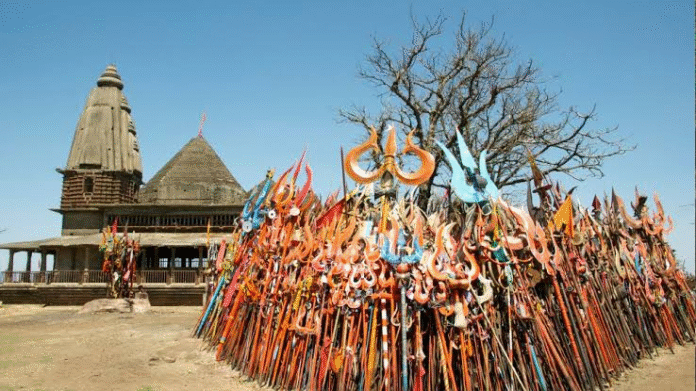
The temple’s architecture reflects the simplicity and elegance of Gond-style construction, with a small sanctum sanctorum housing an ancient Shivalinga, said to have been installed by Sangram Shah himself. The surrounding courtyard, adorned with thousands of trishuls (tridents) offered by devotees, is a unique feature that sets Chauragarh apart. These tridents, ranging from small inch-long offerings to massive structures weighing up to two quintals, symbolize the fulfillment of vows and the unwavering faith of pilgrims.
Pachmarhi’s prominence grew during the British colonial period in the 19th century when it was developed as a hill station and summer capital of the Central Provinces. The British, enchanted by the region’s cool climate and scenic beauty, popularized Pachmarhi as a retreat, inadvertently bringing attention to its spiritual landmarks like Chauragarh. The temple’s remote location and challenging ascent made it a magnet for both pilgrims seeking divine blessings and adventurers craving the thrill of the trek.
The Mythological Significance
The spiritual aura of Chauragarh Temple is amplified by a compelling myth that ties it to Lord Shiva and the demon Bhasmasur. According to legend, Bhasmasur, a devoted follower of Shiva, performed intense penance to please the deity. Pleased with his devotion, Shiva appeared before him and offered a boon. Bhasmasur, driven by ambition, first sought immortality, which Shiva denied. Undeterred, he asked for a peculiar power: the ability to reduce anyone to ashes by touching their head. Shiva, bound by his promise, granted the boon, unaware that Bhasmasur intended to use it against him to become the supreme destroyer. Realizing the danger, Shiva fled, with Bhasmasur in pursuit. The chase led Shiva to the rugged peaks of Chauragarh, where he sought refuge using his divine attributes his snake, trident, and matted locks to conceal himself. Desperate, Shiva called upon Lord Vishnu for aid. Vishnu, ever the strategist, transformed into a beautiful maiden, Mohini, and lured Bhasmasur into a dance. During the performance, Mohini tricked Bhasmasur into mimicking her movements, leading him to touch his own head. In an instant, the demon was reduced to ashes, and Shiva was saved. The Chauragarh Temple, it is believed, marks the spot where Shiva took shelter, making it a sacred site imbued with divine energy. This myth has cemented Chauragarh’s status as a powerful spiritual center, particularly during Mahashivratri, when devotees flock to the temple to honor Shiva’s triumph and seek his blessings. The tradition of offering trishuls, a symbol of Shiva’s weapon, is said to have originated from this tale, as pilgrims express gratitude for fulfilled wishes or pray for divine protection.
The Pilgrimage: A Journey of Faith
The journey to Chauragarh Temple is not for the faint-hearted. From the base at Mahadev, approximately 5 km from Pachmarhi town, pilgrims must undertake a 3.5-km trek that includes ascending 1,156 to 1,365 steps (accounts vary) carved into the hillside. The path winds through dense forests of the Satpura National Park, where the air is thick with the scent of oak, pine, and medicinal herbs. The trail is flanked by verdant valleys, cascading streams, and the distant roar of waterfalls, offering a visual feast that soothes the soul even as the body tires. For devotees, the climb is a sacred ritual. Many carry heavy trishuls on their shoulders, some weighing several quintals, as offerings to Lord Shiva. This practice, particularly prominent during Mahashivratri and Nagpanchmi, transforms the trek into a profound act of devotion. The sight of thousands of trishuls stacked in the temple courtyard, glinting in the sunlight, is awe-inspiring, a testament to the collective faith of countless pilgrims over centuries. During these festivals, the temple comes alive with chants of “Bam Bam Bhole” and the rhythmic clanging of bells, creating an atmosphere charged with devotion. The trek is not without challenges. The steep ascent, coupled with the lack of signage or artificial lighting, demands physical stamina and mental resolve. Local guides are often recommended, especially for first-time visitors, to navigate the rugged terrain. Monkeys, abundant in the area, pose a playful yet persistent threat, known to snatch food or water bottles from unsuspecting trekkers. Pilgrims are advised to carry ample water, wear comfortable shoes, and start early between 8 AM and noon to complete the 5-6 hour round trip safely.
Cultural and Natural Significance
Chauragarh Temple is more than a religious site; it is a cultural and ecological gem. The temple’s location within the Pachmarhi Biosphere Reserve, a UNESCO-designated area since 2009, underscores its environmental significance. The surrounding forests teem with rare flora, including mango, jamun, and medicinal plants, and are home to diverse wildlife within the Satpura Tiger Reserve. The temple’s commitment to sustainable tourism, supported by the Madhya Pradesh Tourism Development Corporation, ensures that its natural heritage is preserved for future generations. Culturally, Chauragarh is a vibrant hub during festivals. Mahashivratri, in particular, sees a grand mela (fair) that rivals those at Ujjain’s Mahakal and Omkareshwar temples. Pilgrims from across India converge here, carrying trishuls and coconuts, participating in rituals that date back centuries. The temple’s Dharmashala offers respite for weary travelers, fostering a sense of community among devotees.
The temple also holds a special place in the hearts of trekkers and nature enthusiasts. The panoramic views from Chauragarh Peak, especially at sunrise, are legendary. On clear days, the vista stretches for tens of kilometers, encompassing rolling hills, deep valleys, and the distant lights of towns like Itarsi. The trek, with its mix of wilderness, tribal encounters, and cave-like paths, is an adventure that leaves an indelible mark on every visitor.
The Legacy of Chauragarh
Today, Chauragarh Temple continues to thrive as a beacon of faith and a symbol of Pachmarhi’s enduring allure. Its historical roots, tied to the Gond Dynasty and enriched by British-era recognition, lend it a unique place in India’s cultural landscape. The mythological tale of Shiva and Bhasmasur infuses the temple with spiritual potency, while the arduous trek and stunning natural surroundings make it a destination for both the devout and the adventurous. For those planning a visit, the best time is from October to June, when the weather is pleasant, and the forests are at their lush best. Pachmarhi is accessible by road from Pipariya (47 km), the nearest railway station, or by air via Bhopal’s Raja Bhoj Airport (230 km). Local jeeps and buses ferry visitors to the base of the trek, and accommodations, including Madhya Pradesh Tourism hotels, offer comfortable stays in heritage bungalow-style settings.
To visit Chauragarh is to embark on a journey that transcends the physical. It is a pilgrimage through history, myth, and nature, where every step up the 1,300 stairs brings you closer to the divine and the sublime beauty of Pachmarhi. As you stand before the Shivalinga, surrounded by a sea of trishuls and the whispers of ancient tales, you realize that Chauragarh is not just a temple it is a sacred summit that touches the heart and soul, leaving memories that linger long after the descent.
So, if you find yourself in Pachmarhi, heed the call of Chauragarh. Climb the steps, offer a prayer, and let the magic of this sacred peak weave its spell on you.
Welcome to The Beehad Sariska, the ultimate luxury resort experience nestled near the majestic Sariska Tiger Reserve where eco-friendly retreat extends a harmonious blend of modern comfort and nature’s tranquility. You can experience the luxury and wild together in its premium cottages and luxury Swiss tents, designed to provide an unforgettable stay amidst the wilderness.
The cozy, well-appointed cottage or a tent brings you closer to nature, as you enjoy top-tier amenities and warm, personalised hospitality. The Beehad further stays committed to sustainable tourism, ensuring minimal environmental impact without compromising on luxury.
The property remains perfect for nature lovers, birdwatchers, couples, and families alike
The Retreat is perfect for jungle walks, star gazing and quiet getaways, says Shruti Pandey, Founder, Synergi Hospitality Marketing.
Sariska Tiger Reserve is nestled in the lap of Aravali hills. Currently home to numerous animals apart from tigers, the reserve showcases nature in its best form. Animals like jungle cats, rhesus macaque, sambhar, chital, wild boar, etc., are found here. Not only animals, you get to see a number of bird species, such as sand grouse, harbor quails, crested serpent eagles, etc. here as well.
The property also allows different experiences including Jeep Safari, bird watching and candle light dinner.
Jeep Safari
You can embark on an exhilarating Jeep Safari adventure through the rugged terrains of the Sariska Tiger Reserve while riding in powerful 4×4 vehicles guided by expert naturalists as you explore diverse landscapes, from dense forests to open grasslands.
Keep your eyes peeled for majestic wildlife, including sambar deer, leopards, and the elusive Bengal tiger. Each safari promises not just adventure, but a deep connection with nature and Rajasthan’s rich biodiversity. This is your gateway to the wild — a must-do experience for every wildlife enthusiast.
Birdwatching Paradise
Tucked into the heart of pristine wilderness, The Beehad Sariska is a true haven for birdwatchers and nature lovers. Wake up to the symphony of chirping birds and discover a variety of avian species right from your doorstep.
The luxury accommodations here provide the perfect vantage point to observe both migratory and native birds in their natural habitat. Whether you’re an avid birder or a curious traveler, the resort here offers an immersive, soul-soothing experience in nature’s embrace.
Candlelight Dinner
Experience romance under the stars at The Beehad Luxury Resort with exclusive candlelight dinner. Surrounded by the gentle whispers of the forest and lit by flickering candles, you can experience an intimate dinner in our enchanting outdoor setting with a curated selection of gourmet cuisine, fine wines, and personalised service — all prepared to perfection by expert chefs.
Canter Safari
Enjoy a group wildlife experience with Canter Safari, ideal for larger families or groups of friends. Traverse the heart of the Sariska Tiger Reserve aboard a spacious open-roof vehicle that offers ample opportunity for wildlife sightings and photography.
Led by experienced forest guides, the Canter Safari is both educational and thrilling, offering a deeper understanding of Sariska’s ecosystem and its incredible inhabitants.
So if you want to dive into adventure into the wild, pack your bag and visit this place where each turn holds the promise of something extraordinary.
Zari Zardozi origins trace back to the opulent courts of the Mughal Empire in the 16th century, a time when emperors like Akbar reveled in the splendor of art and culture. The word Zardozi, from Persian zar (gold) and dozi (embroidery), described a craft that wove molten gold and silver threads into silk, velvet, and brocade, creating garments fit for royalty.
Artisans, or karigars, summoned from Persia and Central Asia, transformed fabric into tapestries of grandeur with intricate patterns of flowers, vines, and celestial motifs. These designs, drawn from Mughal miniature paintings, reflected the divine beauty of the cosmos. Zardozi was more than embroidery; it was a symbol of power, prestige, and divine favor. Palaces shimmered with Zardozi-embellished tapestries and throne covers, while royal wardrobes boasted angarkhas and lehengas that caught the light like stars.
From Palaces to Bazaars: Zardozi’s Evolution
The craft flourished under Mughal patronage, with workshops in Delhi, Agra, and Lucknow buzzing as artisans used fine metal wires twisted into zari threads, adorned with pearls and gemstones. The process was painstaking threads were hand-twisted, needles danced through heavy fabrics, and every stitch was a labor of love. But as the Mughal Empire waned in the 18th century, royal patronage dwindled, and Zardozi faced decline. Relegated to smaller workshops and local markets, its gleam dimmed but never faded. By the 19th and 20th centuries, the craft adapted, finding new patrons among local elites and a growing middle class, its intricate designs gracing wedding trousseaus and festive attire.
Bhopal’s Enduring Embrace: A Sanctuary for Artisans
In the narrow lanes of Bhopal’s old city, Zardozi found a new home. Madhya Pradesh, with its rich cultural mosaic, became a sanctuary for this art. Bhopal’s karigars preserved traditional techniques, using the ari (a hooked needle) to create raised, textured patterns in cramped, dimly lit rooms. Their hands steady, their eyes trained on the dance of thread and fabric, they wove stories of heritage and resilience into every piece. Each garment or decor item was a testament to the unyielding spirit of artistry, keeping the craft alive as it transitioned from royal courts to vibrant bazaars.
Modern Renaissance: Zardozi on Global Runways
In recent decades, Zardozi has experienced a renaissance, fueled by a global fascination with Indian craftsmanship. Designers like Sabyasachi and Manish Malhotra have reimagined Zardozi for modern runways, blending its regal motifs with contemporary silhouettes. Bridal lehengas, sarees, and fusion wear now shimmer with gold and silver threads, paired with sequins and beads for a modern twist. Beyond fashion, Zardozi adorns home decor cushion covers, wall hangings, and table runners carry its intricate charm. Bhopal remains a hub, with artisans training younger generations. Government initiatives and Madhya Pradesh’s handicraft boards promote Zardozi through exhibitions and e-commerce, connecting karigars to global markets.
Challenges and Triumphs: Sustaining the Shimmer
Yet, challenges persist. Machine-made embroidery threatens the livelihoods of traditional artisans, whose handcrafted work is time-intensive and costly. Many in Bhopal’s old city earn modest wages despite their skill. However, sustainable fashion movements and a demand for authentic, handcrafted goods have spotlighted Zardozi. Designers collaborate directly with artisans, ensuring fair pay and creative freedom, while social media showcases the mesmerizing process from thread-twisting to final stitching captivating audiences worldwide. In Bhopal’s bustling bazaars, the glow of Zardozi endures. Each stitch weaves together the grandeur of Mughal courts, the resilience of local artisans, and the aspirations of a modern world. It is a living tapestry of India’s history, culture, and unyielding brilliance, shining brighter with every new creation.
Probability is a complicated aspect of our everyday life, as it plays an important role in the decisions we take and the way we relate to reality. It is a mathematical idea that allows us to quantify the likelihood of an event occurring, which influences our thoughts and actions.
Probability in everyday decision-making
We use probability in daily life but hardly ever recognize it. For example, by checking the weather forecast, we use probability to determine whether to take an umbrella or wear a raincoat. An 80% chance of rain means that historically, it has rained 80 out of 100 times on days similar to today. This gives us some insight into preparing to meet the day.
Likewise, in the sports sector, probability is used for play-game prediction. Both fans and analysts look back at prior performances, consider the strength of a team, and assess their present form to estimate a team’s chances of winning. Well, this application of probability makes the game more captivating and serves as a good reference for bettors.
Human psychology of probability
Probability plays an important part in human psychology — it distorts our view of risks and rewards. When it comes to medical treatments, for example, people tend to inquire about the success rate of a procedure before moving forward. The success rate is a probability number that patients can use when balancing risks and benefits.
Another domain where probability is employed is billing, in this case, by insurance providers. They evaluate the probability of certain events, such as an accident or natural disaster, and modify premiums in light of that. This ensures that those at a significantly higher risk will pay more.
Probability in politics and social interactions
Election prediction in politics is also based on probability. Analysts try to ascertain the probability of victory for a candidate or party using polls and past electoral results. Voters and policymakers all rely on probability to better ascertain likely outcomes.
Probability can affect how we perceive others in our social interactions. If someone seems to regularly arrive late, we assume they will be late again, as past behaviour predicts future behaviour. This prediction is essentially a probability that leads us to expect or respond in certain ways.
What are the chances of winning the Lotto
The most fascinating yet ever-seen example of probability from real life is the chance of winning a lottery. However, the odds of winning the lottery are exceptionally low. By way of example, the odds in a six-number lottery draw may be one in several million at best. Still, many people continue to gamble, knowing full well the near-impossibility of winning — drawn instead to the psychological push-pull of an almost life-changing prize.
Conclusion
All things considered, probability is a key feature in daily life and affects our lifestyles, from simple decisions to conflicts in society. It influences human psychology at its core in areas such as our perception of risk, decision-making, and socialization. Moreover, the impact of probability on health choices is particularly significant, as it guides medical decision-making by helping individuals and healthcare providers assess risks and benefits. As we manoeuvre through the uncertainties of life, knowing about probability will always be required for making decisions and forecasting results.
Mark Zuckerberg needs no introduction today. From being an unknown college student to building a $1.29 trillion tech empire, his journey is as remarkable as it is inspiring. But behind his massive success lie some lesser-known but fascinating truths that shaped his path.
1. He Is Language Expert too More Than Just a Tech Prodigy
Zuckerberg’s interests weren’t confined to just technology. He had a deep passion for languages and eventually became fluent in French, Hebrew, Latin, and Ancient Greek. His linguistic flair added to his intellectual depth, painting a portrait of a truly multi-talented individual.
2. He StartedEarly Programming Roots
Mark’s foray into programming began long before Facebook was even a concept. Encouraged by a supportive family—his father being a dentist and his mother a psychiatrist—Zuckerberg started coding in his early teens. He even built “ZuckNet,” a private messaging system for his family, foreshadowing his future in digital communication.
3. He converted His Dream Into Mission When He was in Harvard
In 2002, Zuckerberg enrolled at Harvard University, pursuing a double major in psychology and computer science. His coding skills quickly gained attention. He created CourseMatch, a tool to help students pick classes based on peer choices, and Facemash, a controversial but popular site where students could rate each other’s photos. Although Facemash was soon shut down for violating university policies, it marked Zuckerberg’s first viral creation.
4. He Created Facebook
In early 2004, from his Harvard dorm room, Zuckerberg launched “TheFacebook,” initially limited to Harvard students. The platform quickly expanded to other elite universities and then beyond. Its rapid growth and investor interest demonstrated that this was far more than a college project—it had global potential.
5. A Defining Decision: Dropping Out
With Facebook’s explosive growth, Zuckerberg made a bold move. In his second year, he dropped out of Harvard to focus entirely on the platform. Relocating to Palo Alto, California, he teamed up with Andrew McCollum, Eduardo Saverin, Dustin Moskovitz, and Chris Hughes to scale the business. His decision wasn’t just a leap of faith—it was a calculated bet on the future of digital connectivity.
Zuckerberg’s Harvard years were pivotal, laying the foundation for what would become one of the world’s most influential social media platforms. His journey is a testament to how early passion, relentless focus, and a willingness to take risks can lead to world-changing innovation.
Adampur Airbase…Not many are aware of its location. Basically, it is located 6.7 km (4.2 mi) from Adampur city in Jalandhar district, 28 km (17 mi) from district and 27 km (17 mi) from Hoshiarpur, and lies along National Highway 3 (NH-3).
Best Places to Visit Near Adampur
There are numerous sites in Adampur that provide a glimpse of the local history. Visit the famous Devi Talab Mandir dedicated to Goddess Durga, for a serene and mystical experience. It is one of the 51 Shakti Peethas. Another popular attraction that you must visit is the Pushpa Gujral Science City. This is a premier educational and entertainment center where you get to learn about earthquakes, understand the various mechanisms of the human body and enjoy some excellent movies. Besides, you can also visit Shri Guru Ravidas temple and enjoy exploring the local culture. Several flights run from various cities of India to Adampur Airport, providing easy travel.
Adampur is a beautiful city in the state of Punjab, with impressive historical sites and cultural heritage. Flying to Adampur? You get some cheap flight options and discounts to choose from.
Best time to fly
Wondering when to fly to Adampur? The months of February and March are cool and have pleasant weather that makes your travel to Adampur worthwhile. You can explore the city comfortably during these months. Another favorable time to visit the city of Adampur is from July through September. The months have great weather so that you can enjoy outdoors and get a glimpse of the local culture. The summer months from April to June have high temperatures while humidity level is high during October, posing some challenges for exploration. Hence, the crowd is less during these months. You can get all the details regarding domestic flights to the city and book them easily at makemytrip.com.
Major Airlines flying to Adampur
SpiceJet Airlines provides flight services to Adampur. You can reach Adampur easily by flights from major cities that will take you to Adampur via Delhi. The flights run on daily basis from Adampur to Delhi and vice-versa. The tickets are available at cheap rates and can be easily availed. Upon reaching the city, you can book your stay in premium hotels like Sarover Portico or Best Western Summerlea.
PM Narendra Modi visited the airbase on May 13 and hence it is trending all over.