October in India is a month of joy, devotion, and cultural unity. With the festive season in full swing, people across the country prepare to celebrate some of the most significant religious and cultural events. From Durga Puja and Dussehra to Diwali and Chhath Puja, October 2025 is packed with public holidays, bank holidays, and regional observances.
Below is the complete list of holidays in October 2025 for different categories.
List of Public Holidays in October 2025
Date
Day
Holiday
States/Regions Observed
1 Oct
Wed
Maha Navami
Arunachal Pradesh, Assam, Bihar, Jharkhand, Karnataka, Kerala, Meghalaya, Nagaland, Odisha, Puducherry, Sikkim, Tamil Nadu, Tripura, Uttar Pradesh & West Bengal
Dubai – Team India has stormed into the final of the Asia Cup 2025 with a convincing 41-run win over Bangladesh in the Super-4 stage at the Dubai International Stadium on Wednesday. India is now set to face the winner of today’s Pakistan–Bangladesh clash in the title match. If Pakistan triumphs, it will mark the first-ever India–Pakistan final in the 41-year history of the tournament.
India Secures Final Spot Early
Winning the toss, Bangladesh invited India to bat first. Powered by Abhishek Sharma’s blistering 75 off 37 balls, India posted 168/6 in 20 overs. Despite a middle-order collapse—where Shivam Dubey (2), Suryakumar Yadav (5), and Tilak Verma (5) failed—Hardik Pandya’s 38 off 29 balls lifted India to a competitive total.
Bangladesh, in reply, was bowled out for 127 in 19.3 overs. India’s fielding was sloppy, with five dropped catches, but Bangladeshi batters squandered the lifelines. Abhishek Sharma was named Player of the Match for his explosive knock.
Dead Rubber Against Sri Lanka
With this win, India has secured top spot in the Super-4 group with four points. Friday’s India–Sri Lanka encounter now becomes a dead rubber, as Sri Lanka is already out of contention after losing both their earlier matches.
The Pakistan–Bangladesh clash later today will decide India’s opponent in the final. The winning side will also reach four points, while the loser will finish with two. Sri Lanka, even with a win, can only reach two points, confirming its elimination.
India’s Rich Asia Cup Record
India will now contest the Asia Cup final for the 11th time and the second consecutive edition, having won the ODI format in 2023. Since the tournament’s inception in 1984, India has lifted the trophy eight times and is aiming for a record ninth.
Indian Players Dominate Rankings
India’s young opener Abhishek Sharma leads the batting charts with 248 runs at a strike rate of 206.66, while Kuldeep Yadav tops the bowling charts with 12 wickets in five matches, underlining India’s dominance in this edition.
If Pakistan wins today, cricket fans could finally witness the historic clash—a high-voltage India–Pakistan Asia Cup final.
Every winter, the city of Harbin in China’s Heilongjiang Province transforms into a spectacular frozen world during the Harbin International Ice and Snow Sculpture Festival. Known as China’s “Ice City,” Harbin hosts one of the largest and most impressive winter festivals on the planet, drawing millions of visitors with its breathtaking ice architecture, glowing lights, and rich cultural displays.
A Festival Born of Tradition
The festival was first held in 1963 and later relaunched in 1985 after a brief pause. Since then, it has grown into a massive international event that typically begins in early January and runs through late February, depending on weather conditions. With winter temperatures often dropping below -38°C (-36°F), Harbin’s extreme climate provides the perfect environment for creating and maintaining massive ice and snow structures.
Main Attractions
Ice and Snow World is the largest attraction, covering over 600,000 square meters. It features towering ice castles, full-scale replicas of famous landmarks, and intricate sculptures built from blocks of ice harvested from the Songhua River. At night, these structures are illuminated by millions of colorful LED lights, creating a surreal, glowing landscape.
Sun Island Scenic Area hosts the International Snow Sculpture Art Expo, showcasing finely detailed sculptures made from compacted snow. These works often depict scenes from Chinese mythology, nature, or world culture, and highlight the artistry of snow carving.
Zhaolin Park, one of the festival’s oldest venues, is famous for its Ice Lantern Garden Party. Here, hundreds of smaller ice sculptures and glowing lanterns line the paths, offering a magical and family-friendly experience.
Artistry and Engineering
Over 180,000 cubic meters of ice and 150,000 cubic meters of snow are used each year. Thousands of skilled workers and artists—many of them participants in global ice carving competitions—spend weeks shaping the materials using traditional tools like chisels and saws. Modern lighting and design technology enhance the sculptures, especially after dark, turning the entire city into a luminous winter spectacle.
Economic and Cultural Impact
Harbin invests more than $500 million annually in the festival’s construction, lighting, and maintenance. This significant investment reflects the festival’s global status and its importance to local tourism and economy. With up to 18 million visitors each season, the festival is not only a celebration of winter but also a major driver of regional development.
Tips for Visitors
Due to the extreme cold, visitors should dress in layers with insulated jackets, gloves, hats, and boots. In addition to the ice sculptures, guests can enjoy snow sports, ice swimming, and local foods like Harbin sausages and candied hawthorn skewers. Blending creativity, culture, and engineering, the Harbin Ice and Snow Festival offers a once-in-a-lifetime experience and stands as a shining example of what can be achieved in even the coldest conditions.
As the beats of the dhol reverberate through the air and cities across India shimmer with colour during Navratri, one voice continues to dominate the celebrations year after year — Falguni Pathak, lovingly crowned the “Dandiya Queen”. With her unique blend of traditional Gujarati folk, catchy pop melodies, and unmatched live energy, Falguni has become a cultural icon whose music transcends generations.
Humble Beginnings in Mumbai
Born on March 12, 1969, in Mumbai, Falguni Pathak was the youngest of five sisters in a traditional Gujarati family. Music flowed naturally in the household, and Falguni was drawn to it from a young age. However, her musical journey wasn’t always smooth — her father initially disapproved of her passion. But her determination outshone resistance. Her first brush with the stage came when she was just nine years old, performing on Independence Day for a local event. She was paid ₹25 for that performance — a small amount, but a monumental beginning. From there, there was no looking back.
Finding Her Sound
In the late 1980s, Falguni began performing with a local dandiya group called The Beaterzz. Her natural flair for folk music and her soulful, folksy voice started catching attention. By the mid-90s, she formed her own band called “Ta Thaiya”, laying the foundation for her signature sound — a fusion of traditional Gujarati garba rhythms with contemporary pop arrangements. Her music started gaining popularity not just for dance performances but also for its emotional and relatable lyrics.
The Breakthrough: Yaad Piya Ki Aane Lagi
Falguni’s big break came in 1998 with the release of her debut album “Yaad Piya Ki Aane Lagi”. The song, paired with a nostalgic music video, became an instant hit. It wasn’t just a musical success — it became an anthem for a generation. Following this, a string of successful tracks like “Maine Payal Hai Chhankai”, “Chudi Jo Khanki Haathon Mein”, and “Meri Chunar Udd Udd Jaye” cemented her place in the Indian pop and folk music scene. These songs were not just chartbusters — they became Navratri essentials.
Rise of the Dandiya Queen
What truly set Falguni Pathak apart was her deep connection to the festival of Navratri. Every year, she would perform live during the nine-night festival, especially in Mumbai, where her dandiya shows became iconic. Venues like Borivali’s Pushpanjali Gardens would see thousands flocking to dance to her tunes. Her performances are more than concerts — they are cultural events. Her live band, colorful traditional outfits, and the sheer joy she brings to the stage make every show memorable. The consistency of her presence, her unique voice, and her deep respect for Gujarati culture earned her the affectionate title of “Dandiya Queen” — a crown she has worn for over two decades.
A Symbol of Cultural Pride
Falguni Pathak’s appeal goes beyond music. She represents authenticity, tradition, and empowerment. In an era where many artists chase Bollywood fame, Falguni chose a different path — one rooted in live performance, community, and celebration. Her androgynous style, warm persona, and refusal to conform to typical industry standards have also made her a role model for many — especially young women seeking to break stereotypes.
Today, she continues to perform across the world, from New Jersey to Nairobi, proving that the love for garba and dandiya knows no border. More than just a singer, Falguni Pathak has become a tradition. Her music plays in every household, society event, and garba ground during Navratri. For many, Navratri isn’t complete without dancing to her hits at least once.
She once said in an interview:
“When people call me ‘Dandiya Queen’, I feel proud. But more than the title, I feel joy when I see thousands dancing to my music — that’s my biggest reward.”
In a world of fleeting fame and viral sensations, Falguni Pathak’s story is one of perseverance, passion, and cultural pride. She turned her love for folk music into a phenomenon, and in doing so, became the voice of one of India’s most beloved festivals. As the lights go up and the beats begin each Navratri, one thing is certain — Falguni Pathak will once again reign as the Dandiya Queen
Plinko is an exciting online casino game that has gained immense popularity among players in India, especially when accessed through mobile applications. This game blends simplicity with the high-stakes thrill of chance, making it appealing to both novice and experienced players. The essence of Plinko lies in the unpredictability of the ball’s movement on a pyramid-shaped board filled with pins. To play without being tied to a place and time, players are advised to complete the Plinko game download process.
When players throw the ball from the top, it bounces off the pins in a chaotic manner before settling into one of the cells at the bottom. Each of these cells contains a multiplier, determining the payout based on the initial bet. This unpredictability and straightforward gameplay are major reasons why Plinko is treasured by many enthusiasts.
What makes Plinko even more engaging is the player’s ability to customise their experience. The choice of risk level—low, medium, or high—puts control in the hands of the player. On mobile, the Plinko app surfaces these risk controls clearly for quick adjustments mid-session. A low-risk setting offers frequent but modest wins, ideal for those who prefer steady progress. Medium risk offers a balance, creating a fair mix of moderate-sized payouts and occasional significant wins.
For thrill-seekers, the high-risk mode is the ultimate choice, offering the potential for massive multipliers of up to x1000 or even more, albeit with higher chances of losing the bet. Choosing a Plinko game app with flexible row settings lets players fine-tune volatility further. Additionally, players in India enjoy the flexibility of tweaking the number of rows in the pyramid, which adds another layer of challenge and strategy to hitting the highest multipliers.
Why Mobile Apps Appeal to Indian Players
The increasing popularity of playing Plinko through mobile applications is no coincidence. With the convenience of smartphones and robust mobile networks across urban and rural areas in India, players can access their favourite game anytime, anywhere. A quick Plinko app download makes it easy to jump in during commutes or short breaks without desktop access.
Another enticing feature for Indian players is the inclusion of multiple payment options tailored to local preferences. These mobile platforms support secure transactions through widely-used methods such as UPI, Paytm, or Google Pay, eliminating any hassle during deposits or withdrawals. Additionally, reputable apps provide a one-tap Plinko download from their official sites, keeping setup simple and safe. This convenience, coupled with the thrilling features of Plinko, makes it an excellent entertainment option for on-the-go gaming.
Combining Simplicity and High Rewards
Plinko’s charm lies in its straightforward but exhilarating gameplay. On mobile, the game becomes even more accessible: it takes only minutes to download Plinko game and start dropping balls to chase multipliers. Whether one seeks the adrenaline rush of high-stakes gaming or prefers the steady pace of consistent, smaller payouts, Plinko caters to all preferences with its customisable settings.
Online casino enthusiasts in India are drawn to Plinko not only because of its potential for high multipliers but also for the ability to personalise their game experience. Many operators maintain dedicated Plinko casino download pages with step-by-step guidance, ensuring that the setup is smooth and trustworthy. The game’s simplicity, combined with the high-quality mobile gaming experience, ensures that Plinko continues to captivate players nationwide. With just a few taps on their smartphones, users can immerse themselves in the fascinating world of Plinko, all from the comfort of their mobile devices.
Choosing the Best Mobile App
When it comes to selecting the right mobile application for playing Plinko on online casino platforms in India, there are several important factors to consider. With the rise of mobile gaming, choosing a reliable and user-friendly app can greatly enhance a person’s gaming experience. Below are key aspects to evaluate when deciding on the ideal mobile app for playing Plinko.
User Interface and Navigation. A seamless and intuitive user interface is crucial for a smooth gaming experience. Players should select an app where games like Plinko are easy to locate and the navigation is straightforward. Complex or poorly designed interfaces can detract from the enjoyment of the game.
Game Performance and Compatibility. It’s essential to ensure the app is well-optimised for mobile devices, providing stable performance without crashes or glitches. Compatibility with different operating systems, such as Android and iOS, is another important consideration, as players should be able to access the app regardless of their device.
Bonuses and Promotions for Plinko. Players should look for apps that promote Plinko-specific bonuses such as free spins, cashback, or higher multipliers. These additional benefits can significantly increase potential rewards and make the game even more engaging.
Customer Support. Reliable customer support is a vital feature of any casino app. For enthusiasts of Plinko, quick responses to queries or technical issues can enhance the gaming experience. Look for apps with live chat options or 24/7 support services.
Top Apps for Playing Plinko in India
Below is a curated list of the three best mobile applications for playing Plinko in India, along with their unique advantages. Highly recommended for study for those players who do not know where to play Plinko.
1Win: 1Win has gained popularity among Indian players as a top choice for Plinko enthusiasts. One of its standout features is the attractive Plinko-specific bonuses available to users. These promotional offers are tailored to increase a player’s chances of winning bigger payouts while enjoying the pattern-dropping gameplay. Additionally, 1Win maintains a secure payment system that supports a wide variety of local banking methods, making it convenient for Indian users.
Melbet: Melbet’s mobile app stands out for its incredible optimisation and smooth gameplay experience. Players of Plinko can expect uninterrupted gaming due to the app’s stability and quick load times. Furthermore, Melbet offers highly customisable Plinko settings, allowing users to adjust the game according to their preferences. Whether it’s changing payout multipliers or tweakable stakes, Melbet gives Indian players the freedom to personalise their Plinko experience.
1xBet: 1xBet is another excellent option for Plinko fans in India. This application is particularly notable for its advanced visual and sound effects that make playing Plinko an immersive and enjoyable experience. The realistic graphics and engaging animations enhance the thrill of watching the ball drop across the pegs, while the crisp sound effects add to the excitement during gameplay. Additionally, the app is regularly updated to ensure a top-notch user experience.
Also, if you want to study free applications in which you can better study the mechanics of the game, then pay attention to the Plinko balls XY app.
Downloading and Installing the App on Android
To begin enjoying the Plinko app on an Android device, players need to follow a few simple steps. The process is designed to be user-friendly, ensuring quick and hassle-free installation. If you’re wondering how to download Plinko game, use the official APK only and follow the steps below.
Choose the Right App: Before proceeding, make sure you have selected the best app for your Plinko experience. Refer to the options mentioned earlier and consider features like graphics, user experience, and compatibility.
Enable App Installation from Unknown Sources: Since many Plinko apps not available on the Google Play Store, you need to download the installation file directly from the app’s official website. To do this, go to your device’s settings, locate the “Security” or “Privacy” menu, and enable the option to install apps from unknown sources. This ensures your device can install the downloaded file.
Visit the Official Website: Open your preferred browser and visit the official website of the chosen Plinko app. It is crucial to download the APK file directly from the official site to ensure safety and authenticity.
Download the APK File: On the app’s website, look for the “Download for Android” button. This is often labeled as Plinko APK download; in some cases you’ll see Plinko game download APK as an alternative label. Depending on your internet speed, this process should only take a few moments.
Install the App: Once the download is complete, locate the APK file in your device’s “Downloads” folder. Tap on the file to start the installation. Follow the on-screen prompts to complete the process.
Launch the App and Create an Account: After the app is successfully installed, open it and create an account if required. Fill in the necessary details, verify your account if prompted, and get ready to enjoy the thrilling Plinko game on Android.
Downloading and Installing the App on iOS
To get started with the app on iOS, users need to follow a few simple steps to ensure a smooth download and installation process. Not sure how to download Plinko app on iPhone? The guide below outlines everything required to set up the app quickly and efficiently.
Confirm App Availability on the App Store: For iOS users, it is essential to verify whether the selected Plinko app is listed in the Apple App Store. Some apps that offer Plinko might need to be downloaded through official third-party links, so always check the app’s website for instructions.
Go to the App Store: If the app is available on the App Store, open the App Store on your iPhone or iPad, and use the search bar to look for the app by name. Alternatively, follow the link provided on the app’s website for direct access.
Download the App: Once you locate the app, tap on the “Get” button. The app will begin downloading automatically. Ensure you have enough storage space on your device for a smooth installation.
Complete the Installation: After the app has been downloaded, it will be installed automatically. Wait for the process to finish, and a new icon will appear on your home screen.
Sign Up and Start Playing: Launch the app and follow the on-screen instructions to sign up for an account. Provide the necessary information and verify your details to gain full access to the gameplay features. You’re now ready to enjoy the game!
Manage Time and Budget Effectively
Winning at Plinko is as much about wise resource management as it is about strategies for gameplay. Ensuring that one’s time and budget are managed prudently is key to prolonging an enjoyable and steady experience.
Set a Budget Limit: It’s essential for users to establish a predetermined budget for gameplay and stick to it. Avoid chasing losses or making impulsive decisions based on emotions. Many responsible gaming apps include tools to help users set such limits.
Avoid Playing in Long Spurts: Momentum is important in a game like Plinko, but extended playing sessions can lead to fatigue or rash decisions. Players should take regular breaks to refresh their minds and keep focus intact.
Play During Non-Peak Hours: For Indian players using mobile apps with live features, playing during off-peak hours can provide smoother performance due to reduced server load, ensuring uninterrupted gameplay.
Actress Parineeti Chopra delighted fans on Tuesday by sharing a new video on her YouTube channel titled Take Two of My YouTube Journey. The upload comes eight months after her debut on the platform, and she opened the video with a cheeky line: “It’s been eight months… of my YouTube journey.”
The biggest highlight of the video came moments later, as Parineeti stepped into the frame and proudly flaunted her baby bump for the first time in public. Dressed in a comfortable white T-shirt layered with a floral-printed dress, the actress looked radiant as she embraced this new phase of her life.
Reflecting on her journey as a content creator, Parineeti admitted she initially had no idea what direction to take or how to begin. In her signature humorous style, she said she couldn’t share her daily routine or cooking videos because her culinary skills stop at making black coffee. “We will have to call Dilip (Farah Khan’s cook),” she quipped.
She further added that she doesn’t know how to host podcasts or create reaction videos but promised her fans a more authentic and unfiltered glimpse into her life through regular uploads going forward.
Parineeti and Raghav to Embrace Parenthood Last month, Parineeti and her husband, politician Raghav Chadha, announced that they are expecting their first child. In a joint Instagram post, the couple shared a picture of a white and gold cake with 1 + 1 = 3 written on it, along with baby feet motifs. They captioned it: “Our little universe… on its way. Blessed beyond measure.”
The heartwarming post also included a short clip of Parineeti and Raghav walking hand-in-hand in a park, leaving fans and friends overjoyed with congratulatory messages.
Shikhar Pahariya is an Indian entrepreneur, polo player, and philanthropist, best known for being the maternal grandson of former Maharashtra Chief Minister and Union Home Minister Sushilkumar Shinde. He has carved out his own identity through business ventures, sports achievements, and social initiatives, while also drawing public attention for his rumored relationship with Bollywood actress Janhvi Kapoor.
Family Background Coming from a prominent political family, Shikhar is the son of a businessman. His maternal grandfather, Sushilkumar Shinde, has held some of the most significant positions in Indian politics, including Union Home Minister. His aunt, Praniti Shinde, is a three-time MLA from Maharashtra.
Entrepreneurship Shikhar showed an entrepreneurial streak early in life, starting a consultancy for pet owners at a young age. He also gained professional experience as an investment analyst in London before turning to the entertainment and gaming industry. In 2018, he co-founded Indiawyn Gaming with his brother Veer Pahariya, aiming to create opportunities in the rapidly growing gaming sector.
Sports and Polo Career Apart from business, Shikhar has a strong sporting background. A skilled polo player, he has represented India in several international tournaments. He has played for the prestigious Royal Jaipur Polo Team and even competed at the Berkshire Polo Club in London. His passion for the sport has made him a recognized figure in India’s polo circuit.
Philanthropy Beyond his entrepreneurial and sporting pursuits, Shikhar is also engaged in philanthropy. He actively supports initiatives for women’s empowerment and works with environmental groups, reflecting his commitment to social responsibility.
Public Profile Shikhar Pahariya frequently makes headlines due to his rumored relationship with actress Janhvi Kapoor. The two have been spotted together on several occasions, sparking speculation about their personal lives, though neither has officially confirmed the relationship.
With his mix of business acumen, sporting achievements, and high-profile connections, Shikhar Pahariya continues to attract public interest as both a young achiever and a prominent social figure
Sky247 mobile application has been the top priority for the Indian bettors, offering them with tons of opportunities in casino games or sports events. To start enjoying all the benefits of the platform, download Sky247 from the official website. Besides the range of betting options which can be found here, it also offers an extensive welcome bonus, which may not be highly rewarding, but it will surely help you to elevate your experience. This application is available for Android devices only as of now, and an app for iOS is expected to be launched soon. Take a look at this guide to know how you will be able to activate the welcome bonus via the app.
Step-by-Step Guide to Activate the Welcome Bonus
Activating the welcome bonus on the mobile app is a simple process, which will be completed by following the steps given below:
Download and Install the Sky247 App
Visit the official Sky247 India website and click on the App Download option from Menu.
Select the Download Now option to start the APK file download on your devices.
As the download begins, quickly go to your device settings and allow your browser to install apps from unknown sources.
Upon app’s download, open its APK file from the download manager and install the same on your devices.
iOS users will have to add a shortcut to the website on their home screens.
Create a New Sky247 Account in the App
As the Sky247 app gets downloaded, open the same and click on the register option.
Select the currency as Indian rupee, and proceed by choosing a username and password for your account.
Enter your full name (as per official documents) and your phone number.
Now, click on the Submit option and verify it with the help of the verification code sent by the app, and your account will be created.
Check Bonus Offer Details
Navigate to the Promotions section on the Sky247 app.
Scroll down and click on the First Deposit Offer being displayed at the page.
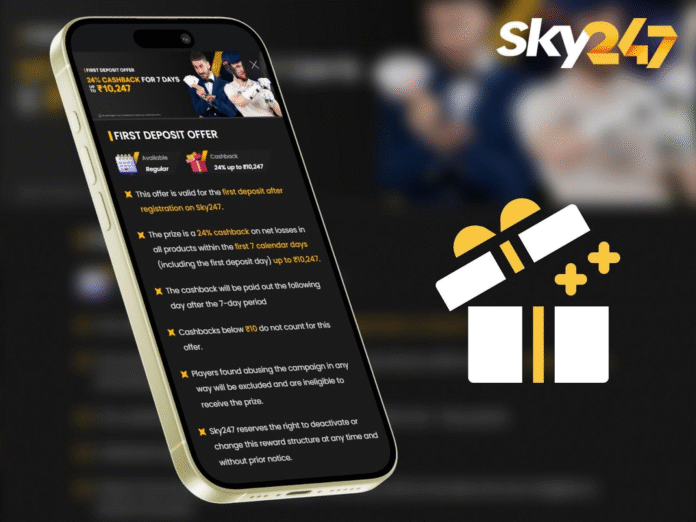
You’ll be eligible to receive 10% cashback on the losses you incur within the first 7 days of registration.
Make Your First Deposit
Go to the Sky247 deposit page, and choose among options such as Paytm, Google Pay, PhonePe, etc.
Enter the deposit amount, noting that the minimum deposit starts at 247 INR for all methods.
Complete the payment using the chosen payment method, and funds will be added instantly to your account.
Confirm Bonus Activation
Navigate back to the Sky247 promotions page and now check whether the first deposit offer has been activated.
Eligibility and Key Terms of Sky247 App
In order to be eligible for this bonus, it is necessary for you to be a new user of the Sky247 app. Along with that, it is also compulsory to complete a first deposit of at least 247 INR after registering an account. This bonus can be claimed only on the losses incurred within 7 days of registration, and if the cashback you’re eligible to receive is below 10 INR, you won’t be able to receive it. If you want to take a detailed look at its terms and conditions, check them out the same from the promotions page.
Tips to Maximize Your Welcome Bonus at the Sky247 App
To maximise the benefits of your welcome bonus at the Sky247 app, take a look at these tips:
Read the Terms Carefully: Ensure that you are crystal clear with the terms and conditions of the offer.
Bet Strategically: Check which games are not eligible for the bonus, and bet strategically to ensure that 24% of your losses go above 10 rupees.
Use Live Betting: By using the live section, you’ll be able to complete the wagering requirements of cashback easily.
In a world where traditional retirement is becoming less attainable or appealing, a new concept is gaining momentum—Micro-Retirement. Especially popular among Gen Z and younger millennials, this trend is reshaping how we view work, rest, and life balance. But what exactly is micro-retirement? Why is Gen Z adopting it? And what do people actually do during these breaks? Let’s dive into this emerging lifestyle shift.
What is Micro-Retirement?
Micro-retirement refers to taking intentional, extended breaks from work—usually lasting several weeks to months—to rest, explore passions, travel, or simply recharge. Unlike a traditional retirement that comes after decades of work, micro-retirements are sprinkled throughout a person’s life. It’s not about quitting your career—it’s about stepping away temporarily with a plan to return to work later, often with renewed purpose and clarity.
Why Gen Z is Embracing Micro-Retirement
Challenging Traditional Life Structures Gen Z isn’t sold on the “work hard until 60, then relax” formula. They value experiences over possessions, and prioritize mental health and personal growth. Micro-retirement allows them to enjoy life throughout, rather than deferring joy to an uncertain future.
Burnout and Mental Health Awareness With rising awareness around burnout, anxiety, and depression, many young people are opting to pause and reset before hitting a crisis point. These breaks help protect long-term health and prevent career fatigue.
Rise of Remote and Flexible Work The gig economy, freelancing, remote jobs, and project-based work give Gen Z more freedom to design their careers. Micro-retirement fits perfectly into this flexible structure.
Financial Strategy Over Accumulation Rather than saving for decades, some are planning shorter, intentional sabbaticals using modest savings, side gigs, or minimalism. They live more frugally to afford these lifestyle breaks without sacrificing long-term security.
What Do People Do During Micro-Retirements?
Micro-retirement isn’t just about doing nothing. Here’s what many people actually do:
Travel and Explore Cultures Many take this time to explore new countries, volunteer abroad, or live as digital nomads.
Pursue Passion Projects From writing a book, starting a podcast, to creating art or music—these breaks allow creative freedom.
Learn or Upskill Some use this time to study, earn certifications, or pivot careers. Online learning makes it easier than ever.
Reconnect with Life Spending time with family, focusing on wellness, spiritual exploration, or simply enjoying slow living is a big part of micro-retirement.
Start a Side Hustle Many use their break to build a small business or side income source they’re passionate about.
Is Micro-Retirement for Everyone?
While appealing, micro-retirement requires planning, financial discipline, and career flexibility. It’s more accessible for freelancers, remote workers, or those in creative fields. However, even traditional professionals can plan a 3-6 month break between jobs or after major milestones. It’s not about being wealthy—it’s about conscious lifestyle design.
Final Thoughts: A Retirement Revolution in Reverse
Micro-retirement reflects a deeper shift: life is not just about work. Gen Z is leading the way by choosing to live now, not just prepare for later. They are designing lives that prioritize health, freedom, creativity, and happiness—not just status or salary. As this trend grows, companies may need to rethink policies around sabbaticals, flexible work, and mental health support. And individuals? They may just find that taking a pause can lead to their most productive—and meaningful—chapters yet.
Navratri 2025: Wanna see how Nita Ambani celebrated Navratri in a dazzling ensemble, blending traditional Banarasi fabrics with vibrant colours, and exquisite jewellery, setting a perfect style inspiration for Garba nights.
Image Credit : Instagram
Nita Ambani embraced the festive spirit with a Banarasi lehenga skirt featuring a patchwork of fabrics, intricate zari work, and delicate hand embroidery. The skirt’s ornate laces added extra charm, while her pink blouse with short sleeves showcased shimmering gold and bronze embroidery along the neckline and sleeves. A vibrant pink leheriya dupatta, draped in a seedha pallu style, completed the traditional yet modern look.
Image Credit : Instagram
Colourful Tribute to Goddess Durga
Her Navratri attire seems to have been curated to reflect all nine colours associated with Goddess Durga. Nita’s ensemble symbolically captured the essence of the festival, combining tradition with a contemporary fashion sensibility.
Image Credit : Instagram
Opulent Jewellery
To complement her outfit, Nita opted for perfect jewellery. She wore a multi-layered diamond necklace adorned with green emeralds, along with matching earrings, a maang tika, colourful bangles, and an oversized ring. The jewellery added a regal touch, elevating her festive appearance.