Home Blog Page 153

Elon Musk’s Starlink Begins Hiring in India Ahead of Satellite Internet Launch. Know More Details…

0

Elon Musk’s Starlink has started hiring in India as it prepares to launch its satellite broadband services in the country, marking a major step toward expanding its global internet network. The SpaceX-owned satellite internet company has posted multiple openings on LinkedIn and the SpaceX careers portal, inviting applications for finance and accounting positions based in Bengaluru, its operational hub in India.

The available roles include:

  • Tax Manager
  • Accounting Manager
  • Payments Manager
  • Senior Treasury Analyst

According to the listings, these positions will focus on financial reporting, compliance, and statutory operations to support Starlink’s India rollout. The company has clarified that no remote or hybrid work options are available—only local applicants with valid work authorization will be considered.

Starlink Prepares for India Launch

Starlink’s India hiring drive comes as the company gears up to launch its satellite internet services by late 2025 or early 2026. In compliance with government regulations, Starlink is setting up ground infrastructure and conducting security trials across India.

Earlier this year, the company demonstrated its broadband service in Mumbai to officials from the Department of Telecommunications (DoT) as part of the security and lawful interception requirements necessary for spectrum allocation.

Gateway Stations and Expansion Plans

Reports indicate that Starlink has applied for permission to establish three gateway stations in Mumbai, Chennai, and Noida. Following the launch, it plans to open 9–10 additional gateways in major cities, including Chandigarh, Kolkata, and Lucknow, to strengthen network connectivity across India.

Competition and Regulatory Framework

Once operational, Starlink India will compete with Jio Satellite and Eutelsat OneWeb, both of which have already secured regulatory clearances and await final spectrum allocation.

Meanwhile, the Department of Telecommunications (DoT) and the Telecom Regulatory Authority of India (TRAI) are finalising the frameworks for satellite broadband spectrum pricing and allocation, which will determine how soon Starlink can officially begin commercial services.
Prince Andrew Loses Titles and Windsor Mansion as King Charles Takes Decisive Action. Know Inside Story…

0

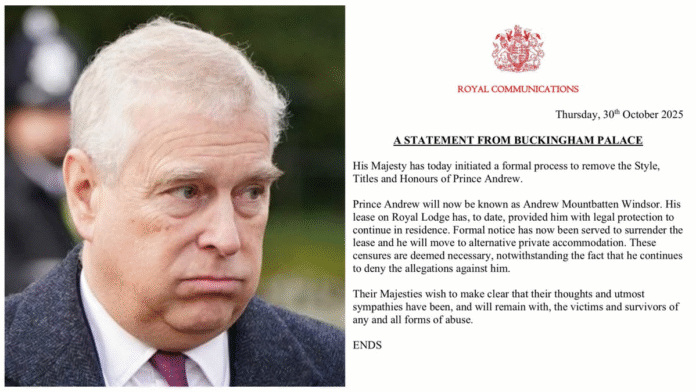
Buckingham Palace is in news after it confirmed that Prince Andrew has been stripped of his royal titles and will vacate his Windsor residence, Royal Lodge. The instance marks one of the most significant royal shake-ups in decades. The Palace announced that King Charles III has “initiated a formal process to remove the style, titles, and honours of Prince Andrew.” Going forward, the King’s younger brother will be known simply as Andrew Mountbatten Windsor.

According to Palace officials, Andrew, 65, has not objected to the King’s decision.

Buckingham Palace Statement on Prince Andrew

In a rare and strongly worded statement, Buckingham Palace said:

“His Majesty has today initiated a formal process to remove the Style, Titles and Honours of Prince Andrew.
Prince Andrew will now be known as Andrew Mountbatten Windsor.”

The statement also confirmed that Andrew’s lease on Royal Lodge will be terminated:

“Formal notice has now been served to surrender the lease and he will move to alternative private accommodation.”

The Palace emphasized that this decision was made “notwithstanding the fact that he continues to deny the allegations against him.”

Royal Experts: “A Brutal but Necessary Move”

Royal historian Kelly Swaby described the language of the Palace statement as “brutal,” adding:

“Public opinion is firmly against Andrew. The Palace knows this, and the tone reflects that.”

Reports suggest that Prince William urged his father to act decisively before his upcoming overseas engagements. Former royal correspondent Jennie Bond said:

Where Will Prince Andrew Live Now?

Andrew is expected to relocate to the Sandringham Estate in Norfolk, though the Palace has not disclosed which property he will occupy. Sources confirm that Sarah Ferguson, Andrew’s ex-wife, will also leave Royal Lodge and make her own living arrangements. The move is expected to take place “as soon as practicable,” following formal notice to surrender the Windsor lease.

Financial Support from King Charles

Although Andrew’s public funding was cut off last year, royal sources say the King will privately fund his accommodation at Sandringham and make “appropriate private provision” for his brother. Andrew has reportedly sought independent income streams since stepping down from royal duties, including business ties in the Gulf States, China, and Europe.

What Titles Has Prince Andrew Lost?

Under the King’s directive, Andrew will lose the following titles:

  • Prince
  • Duke of York
  • Earl of Inverness
  • Baron Killyleagh
  • The right to be called His Royal Highness (HRH)

In addition, his honours — Order of the Garter and Knight Grand Cross of the Victorian Order — will also be revoked.

Princess Beatrice and Eugenie, Andrew’s daughters, will retain their titles under the 1917 Letters Patent issued by King George V.

How He Got His Name and Meaning of ‘Mountbatten Windsor’

The surname Mountbatten Windsor was introduced in 1960, combining the names of Queen Elizabeth II and Prince Philip.

The Windsor name replaced the Germanic Saxe-Coburg and Gotha in 1917, while Mountbatten derives from the anglicized Battenberg — reflecting a period of anti-German sentiment in Britain during the First World War.

The Epstein Connection and Public Backlash

Prince Andrew’s removal from royal life follows years of scrutiny over his association with convicted sex offender Jeffrey Epstein.

Despite Andrew’s repeated denials, public and political pressure on the monarchy intensified after fresh documents and emails resurfaced this month linking him to Epstein as late as 2011.

What Happens Next?

Royal historians believe Andrew will remain excluded from all public royal duties, appearing only at private family events.

Campaign groups such as Republic have renewed calls for a wider investigation into what senior royals knew about Andrew’s connections with Epstein.

Key Takeaways

  • King Charles formally strips Prince Andrew of royal titles.
  • Andrew will move from Royal Lodge to Sandringham Estate.
  • Titles lost include Prince, Duke of York, and HRH.
  • The King will privately fund Andrew’s future accommodation.
  • Andrew remains eighth in line to the throne despite the changes.

Six-Million-Year-Old Ice Discovered in Antarctica Offers Unprecedented Glimpse into a Warmer Earth

0

In a groundbreaking discovery, U.S. scientists have uncovered the oldest directly dated ice and air ever found on Earth in the Allan Hills region of East Antarctica — ice that dates back six million years. The finding provides an extraordinary window into a time when the planet was significantly warmer and sea levels were far higher than today.

The study, published in the Proceedings of the National Academy of Sciences (PNAS), was led by Sarah Shackleton of the Woods Hole Oceanographic Institution and John Higgins of Princeton University, as part of the Center for Oldest Ice Exploration (COLDEX) — a National Science Foundation-funded collaboration of 15 U.S. research institutions led by Oregon State University (OSU).

“Ice cores are like time machines that let scientists look back at what our planet was like in the past,” said Shackleton. “The Allan Hills cores take us much further back in time than we ever thought possible.”

COLDEX Director Ed Brook, a paleoclimatologist at OSU, called the discovery the project’s most significant achievement so far.

“We knew this ice was ancient, but we only hoped to find ice up to three million years old. Discovering samples twice that age is beyond our wildest expectations,” Brook said.

While other international teams have drilled continuous ice cores up to 1.2 million years old deep in Antarctica’s interior, COLDEX researchers explored a different approach. They worked on the edges of the East Antarctic ice sheet, drilling only 100–200 meters deep where a combination of rugged topography, fierce winds, and extreme cold helps preserve ancient ice close to the surface.

“We’re still learning how such old ice can survive near the surface,” Shackleton explained. “It’s probably a mix of cold temperatures and persistent winds that strip away newer snow, leaving ancient layers exposed — though it also makes Allan Hills one of the harshest places on Earth to work.”

Using argon isotope analysis, scientists were able to directly date the ice — a rare achievement in paleoclimate research. These samples represent “climate snapshots” up to six times older than any previous ice core data.

Preliminary results show that the Allan Hills region has cooled by about 12°C (22°F) over the past six million years, marking the first direct measurement of long-term Antarctic temperature decline. Researchers are now analyzing trapped air bubbles to reconstruct ancient greenhouse gas levels and ocean heat content, offering valuable insights into how natural climate systems respond to global warming.

Brook said COLDEX teams will return to Allan Hills in the coming months to drill deeper and search for even older ice.

“This discovery opens up a new chapter in Antarctic exploration,” he said. “Between 2026 and 2031, we plan an extensive study to push the boundaries of our understanding of Earth’s ancient climate.”

Collaborating Institutions: Oregon State University, Princeton University, Woods Hole Oceanographic Institution, University of Washington, Scripps Institution of Oceanography (UC San Diego), University of Maine, Tongji University (China), and University of Minnesota.

Funding: The research was supported by the National Science Foundation (NSF) through its Office of Polar Programs, Science and Technology Center Program, and the U.S. Antarctic Program, with ice drilling support from the NSF U.S. Ice Drilling Program and sample curation by the NSF Ice Core Facility in Denver, Colorado.

About OSU’s College of Earth, Ocean, and Atmospheric Sciences (CEOAS):
The college is globally recognized for excellence in earth, ocean, and climate science, advancing understanding of environmental change and developing solutions for a sustainable future.

Atlas Moth, One of World’s Largest Moths, Sighted in Karnataka

0

A rare Atlas Moth (Attacus atlas)—one of the world’s largest moths—has been recorded from the Karwar region of coastal Karnataka, underscoring the rich monsoon biodiversity of the Western Ghats. Native to tropical Asia, the species occurs sporadically across India, including along the humid evergreen and semi-evergreen forest belts of the Ghats.

Sighting and Location

The recent observation from coastal Karnataka fits within the Atlas Moth’s known Indian distribution. It typically inhabits moist forest zones rich in host plants. Naturalists have documented similar sightings in other Western Ghats stretches, especially during the rainy season, when adults often emerge after heavy showers and rest on tree trunks, walls, or shrubs.

Species Profile and Size

Renowned for its immense wingspan, Attacus atlas ranks among the largest lepidopterans on Earth. Females commonly span 25–27 cm, while exceptional individuals may reach 30 cm. The moth’s rust-brown wings feature bold white and black markings, and the forewing tips resemble snake heads, a mimicry adaptation thought to deter predators. Females are typically larger and heavier, whereas males appear broader-winged and more agile in flight.

Life Cycle, Feeding and Behaviour

Atlas Moth caterpillars feed voraciously on citrus, guava, cinnamon, and several other host plants, storing energy for metamorphosis inside a silken cocoon. Adults, however, have non-functional mouthparts and do not feed; they live briefly—about one to two weeks—devoted solely to mating and egg-laying. Males use their feathery antennae to detect female pheromones over long distances. Following reproduction, adults die naturally, often falling prey to birds, ants, or wasps.

Original Facts

  • Atlas Moth adults do not feed; all energy is stored during the larval stage.
  • Typical wingspan: 25–27 cm; exceptional individuals reach 30 cm.
  • Larval host plants: Citrus, guava, cinnamon, and related trees.
  • Forewing tips mimic snake heads to deter predators.

Habitat, Seasonality and Conservation Notes

The Atlas Moth thrives in warm, humid forest habitats—both coastal and montane—where dense foliage supports larval growth. The monsoon months mark peak visibility, as fresh adults emerge and remain conspicuous with wings spread. Although not globally threatened, local factors such as habitat degradation, pesticide drift, and light pollution may reduce populations. Conservationists emphasize maintaining native mixed-tree cover and minimizing artificial lighting near forest edges to help sustain healthy populations across the Western Ghats corridor.

Gogabeel Lake is New Addition to Ramsar Site in india

0

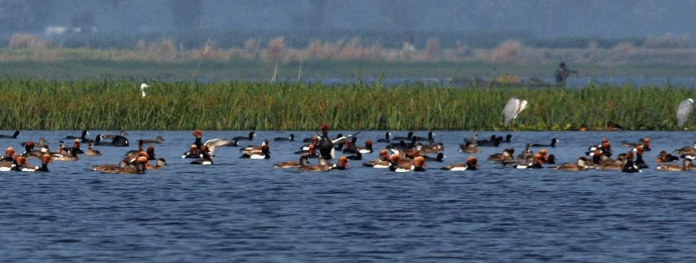
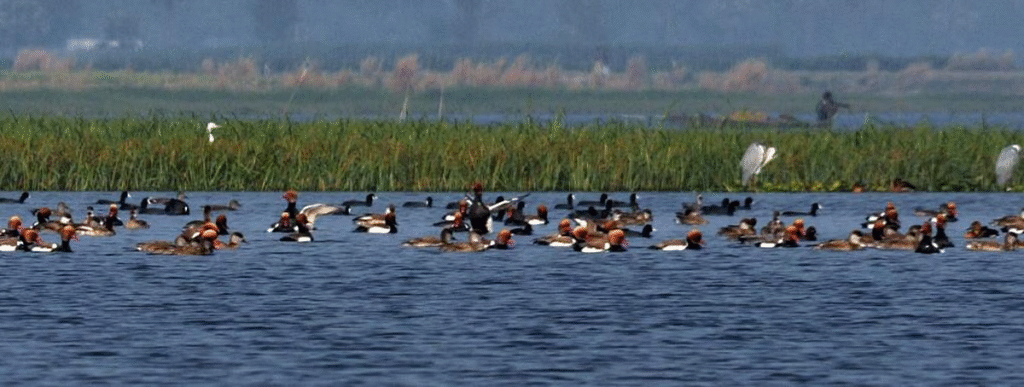
Gogabeel Lake (86.63 ha) in Katihar district, a conservation and community reserve, conserved and managed by the local community has been added as a new Ramsar site. Gogabeel, an ox-bow lake in Bihar’s Katihar district, in fact, earlier has been declared as the state’s first ‘Community Reserve’.

Gogabeel Lake is New Addition to Ramsar Site in india

Now, Bihar has six Ramsar sites and stands at third position in the country. The lake is used wisely by the local community for livelihood. With this recognition, the total no. of Ramsar sites in the country rises to 94, addition of 67 sites in last 11 years, covering an area of 13,60,805 hectares.

Union Minister Bhupendra Yadav said, “With PM Shri @narendramodiji leading the way for environmental conservation, India continues to be the first in Asia and third in the world in terms of total number of Ramsar sites in a country, demonstrating the importance laid on these wetlands of international importance for national and global biodiversity, climate resilience, ecotourism, and sustainable livelihoods of local communities.”

Royal Rendezvous: Rajasthan’s Top Wedding Venues Where Fairytales Come Alive…

0

From Jaipur’s regal corridors to Udaipur’s lake-kissed villas and Jaisalmer’s golden dunes, Rajasthan continues to reign supreme as India’s ultimate wedding destination.

Where Love Wears a Crown

If fairytales could take form, they would unfold in Rajasthan — where every fort tells a story, every palace hums a melody of love, and every sunset seems painted just for you. Whether you dream of a grand royal celebration or an intimate, starlit ceremony, Rajasthan’s luxury hotels transform your “I do” moment into an unforgettable royal saga.

We explore three magnificent wedding venues making waves for their exceptional blend of heritage, hospitality, and heart.

ITC Rajputana, Jaipur — The Pink City’s Jewel

Stepping into ITC Rajputana feels like entering a living palace — one that breathes the romance of a bygone era. Inspired by the traditional havelis of Rajasthan, its red-brick façade, sunlit courtyards, and gently tinkling fountains evoke nostalgia and nobility in equal measure.

“Our weddings are more than events; they’re immersive royal experiences,” shares the in-house wedding specialist. “Every detail — from floral arrangements to fine dining — is crafted with care and precision.”

The hotel’s Suryavanshi Mahal is a stunning pillar-less ballroom that hosts up to 550 guests in pure elegance. For couples who care for the planet as much as each other, ITC Rajputana also offers Green Banquets, featuring locally sourced cuisine, eco-conscious décor, and a commitment to sustainability without sacrificing grandeur.

Where modern luxury meets timeless tradition — Jaipur’s royal spirit shines brightest here.

Ananta Udaipur — Lakeside Love & Lavish Dreams

Royal Rendezvous: Rajasthan’s Top Wedding Venues Where Fairytales Come Alive...

Set against the breathtaking Aravalli Hills, Ananta Udaipur feels like a dream sequence come alive. Spread over 90 acres of lush greenery, the resort’s 244 villas, open-air lawns, and serene water features create the perfect canvas for your fairytale wedding.

Imagine saying your vows as the golden sun dips behind the hills, followed by a grand reception in Neelgiri, the property’s crown jewel — a spectacular banquet hall with an adjoining 47,500 sq. ft. lawn that can host a celebration fit for royalty.

“Udaipur weddings are about more than luxury — they’re about emotion, setting, and soul,” says a recent bride who tied the knot here. “At Ananta, we felt like we were living in our own love story.”

Between its rejuvenating spa, curated cuisine, and stunning décor, Ananta Udaipur blends the opulence of a palace with the intimacy of a home — making it a destination where every moment feels personal and profound.

Jaisalmer Marriott Resort & Spa — Golden Sands, Eternal Vows

Royal Rendezvous: Rajasthan’s Top Wedding Venues Where Fairytales Come Alive...

In the heart of the Thar Desert, The Jaisalmer Marriott Resort & Spa rises like a mirage of elegance. Overlooking the fabled “Golden City,” the resort captures the soul of Rajasthan — where the golden hues of sand meet the shimmer of celebration.

“Dream weddings don’t just happen — they’re planned,” smiles one of Marriott’s Certified Wedding Planners. With expertise in cultural, luxury, and destination weddings, the team ensures every ceremony — from mehendi under the desert sun to a moonlit reception by the dunes — unfolds flawlessly.

With event spaces accommodating up to 1,500 guests, exquisite culinary experiences, and desert-inspired décor, the resort creates magic in every frame.

Here, beneath the desert sky, every heartbeat echoes like a drum of celebration.

A Royal Ending — or Perhaps, A Beginning

Rajasthan doesn’t just host weddings — it crafts legacies. From the grandeur of Jaipur, to the serene romance of Udaipur, to the golden glow of Jaisalmer, each venue offers its own flavor of fantasy.

So if your love story deserves a royal chapter, let the Land of Kings be your muse — where every vow is sacred, every setting majestic, and every moment… pure magic.

Quick Picks for the Regal Couple:
Best for Grandeur: ITC Rajputana, Jaipur
Best for Lakeside Luxury: Ananta Udaipur
Best for Desert Drama: Jaisalmer Marriott Resort & Spa

Who is Jemimah Rodrigues? She Played Multiple Sports But Then Emerged as Brightest Cricketing Star…

0

Is it even legal to play Under-19 cricket at 13 years of age? And then shine in multiple sports — basketball, football, and hockey — before becoming one of India’s brightest cricketing stars? Jemimah Rodrigues has done all that and more.

Born and raised in Mumbai, Jemimah Rodrigues displayed extraordinary athletic talent from a young age. Before dedicating herself fully to cricket, she represented her school in basketball and football and even played hockey at the national level. Her cricketing journey took off when she debuted for Mumbai’s Under-19 side in the 2012–13 season — at just 13.

Her breakout moment came in 2017 when she became only the second Indian woman after Smriti Mandhana to score a double-century in the domestic Under-19 One-Day Trophy, blasting an unbeaten 202 against Saurashtra. That season, Rodrigues amassed over 1,000 runs at an average of 112.56 and took 19 wickets with her off-spin — a rare all-round feat. The performances earned her a maiden call-up to India’s ODI squad for the 2018 South Africa tour, where she made her international debut across formats the same year.

Rodrigues’ rise was also a story of sacrifice and support. Her family moved from Bhandup to Bandra in Mumbai to access better facilities, with her father, Ivan Rodrigues, serving as her first coach. Since then, Jemimah has been a mainstay in India’s white-ball setup — known for her calm temperament, quick footwork, and dynamic stroke play.

Initially an opener in age-group cricket, she later adapted to the middle order in ODIs under coach Amol Muzumdar, who recognized her ability to accelerate during the death overs. Her first two ODI hundreds came from the No. 4 and No. 5 positions, solidifying her as India’s go-to finisher. After briefly being dropped from the T20I side, she reworked her power-hitting — a move that paid off handsomely.

Beyond batting, Rodrigues is regarded as one of India’s finest fielders, agile both inside the circle and on the boundary. She also began her Test career impressively, scoring three half-centuries in just five innings, including a fifty on debut against England.

Globally, she’s a sought-after T20 talent, having played in premier leagues such as England’s Kia Super League, The Hundred, Women’s Big Bash League (WBBL), and Caribbean Premier League (WCPL). Her explosive stint with the Northern Superchargers in The Hundred’s inaugural season — where she scored 249 runs at a strike rate of 150.90 — marked her return to India’s T20I team.

In the inaugural Women’s Premier League (WPL) auction, Rodrigues was snapped up by Delhi Capitals for ₹2.2 crore, underlining her stature as one of Indian cricket’s most valuable and versatile stars.

India Storms into Women’s World Cup Final: Jemimah Rodrigues Shines with Unbeaten 127 in Win Over Australia

0

Team India created history on Thursday by defeating seven-time champions Australia to book their place in the final of the Women’s ODI World Cup. In a thrilling semi-final at the DY Patil Stadium, India chased down a mammoth target of 339 runs, winning by 5 wickets with 9 balls to spare.

Jemimah Rodrigues emerged as the star of the match, playing a magnificent unbeaten innings of 127 runs, steering India to victory alongside Amanjot Kaur, who remained not out on 15.

Earlier, Harmanpreet Kaur led from the front with a brilliant 89, while Richa Ghosh contributed 26. Openers Smriti Mandhana (24) and Shafali Verma (10) gave India a steady start before both were dismissed by Kim Garth, who also took the key wicket of Harmanpreet. Deepti Sharma (24) was run out in a mix-up.

Batting first, Australia posted a challenging 338 for 9 in their 50 overs, powered by Phoebe Litchfield’s 119, Ellyse Perry’s 77, and Ashleigh Gardner’s 63. However, India’s bowlers kept the pressure on in the death overs. Spinners Shree Charani and Deepti Sharma took two wickets each, while Kranti Gaur, Amanjot Kaur, and Radha Yadav picked up one apiece. Three Australian batters were run out due to sharp fielding.

With this memorable win, India has stormed into the final and will now aim for their first-ever Women’s ODI World Cup title, carrying the hopes of millions of fans across the nation.

laying XI of Both Teams

India: Harmanpreet Kaur (captain), Smriti Mandhana, Shafali Verma, Amanjot Kaur, Jemimah Rodrigues, Richa Ghosh (wicketkeeper), Deepti Sharma, Radha Yadav, Kranti Goud, Shree Charani, Renuka Singh Thakur.

Australia: Alyssa Healy (captain and wicketkeeper), Phoebe Litchfield, Ellyse Perry, Beth Mooney, Annabel Sutherland, Ashleigh Gardner, Tahlia McGrath, Kim Garth, Sophie Molineux, Alana King, Megan Schutt

Richa Ghosh departs for 26; Sutherland strikes again
Richa Ghosh was dismissed by Annabel Sutherland on the final ball of the 46th over. Attempting a cut shot off a slower delivery, Richa found Kim Garth at short third man, who completed a comfortable catch.

Richa’s fireworks take India past 300
India crossed the 300-run mark in the 45th over. Richa Ghosh smashed consecutive boundaries off Ashleigh Gardner — including a massive 83-metre six followed by a four — to bring India closer to the target.

Jemimah gets another reprieve
Jemimah Rodrigues survived again in the 44th over. Her lofted shot off Annabel Sutherland went towards long-off, but Tahlia McGrath couldn’t hold on as the ball deflected off her hand. Jemimah was batting on 106 at the time.

National Unity Day 2025: Theme, History, and Significance

0

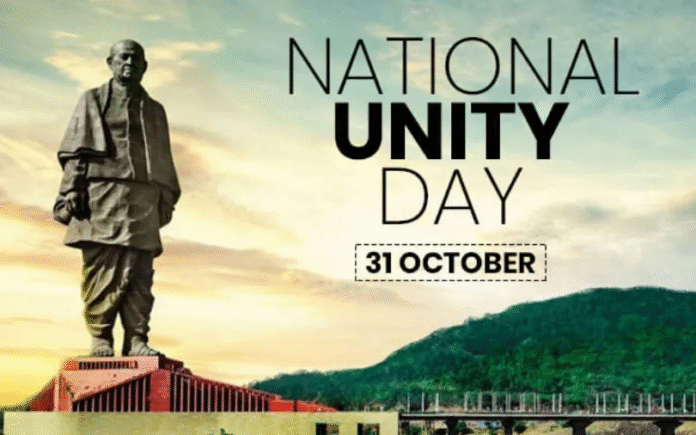
India will celebrate National Unity Day (Rashtriya Ekta Diwas) on October 31, 2025, marking the 150th birth anniversary of Sardar Vallabhbhai Patel, the Iron Man of India. This year’s theme — “Ek Bharat, Aatmanirbhar Bharat” — links the spirit of national integration with the pursuit of self-reliance, echoing India’s broader goal of building a Viksit Bharat by 2047.

A Milestone Celebration

This year’s observance is unique, coinciding with a historic milestone — Patel’s 150th birth anniversary. As India reflects on its unity in diversity, the day reinforces the need for collective strength and shared national purpose in times of rapid change.

The “Ek Bharat, Aatmanirbhar Bharat” theme captures the idea that unity goes beyond territorial integrity — it represents an inner strength that fuels innovation, confidence, and resilience. The government’s message is clear: India achieves its greatest successes when its many languages, regions, and cultures work toward a single national vision.

Sardar Patel and the Idea of Integration

Sardar Vallabhbhai Patel’s unmatched legacy as the architect of national integration remains at the heart of the celebration. His diplomacy and foresight transformed India’s diversity into its greatest strength. Patel’s inclusiveness laid the foundation for a pluralistic democracy — one that celebrates differences while upholding unity and justice.

National Unity Day, therefore, is not just a commemoration of Patel’s life but a renewal of his ideals — of courage, cooperation, and commitment to the nation’s collective identity.

Relevance in 2025: Unity for Progress and Resilience

In the backdrop of global challenges and domestic aspirations, the 2025 observance urges citizens to translate Patel’s vision into action. The theme calls for active participation in building a self-reliant India — economically, technologically, and socially.

The celebration emphasizes:

  • The synthesis of India’s linguistic, regional, and cultural diversity as a foundation for innovation and peace.
  • The importance of selfsufficiency in economy, technology, and culture through collective national will.
  • Alignment with the Viksit Bharat 2047 vision — a roadmap for a developed, harmonious, and resilient India.

How National Unity Day 2025 Is Being Celebrated

The main celebrations are centered at the Statue of Unity in Gujarat, the world’s tallest statue and a symbol of India’s enduring unity. Across the nation, people are participating in activities that honor Patel’s legacy and the spirit of togetherness:

  • Run for Unity: Marathons and unity runs in cities and towns, symbolizing collective strength.
  • Unity Pledge Ceremonies: Mass pledges in schools, colleges, and government offices to uphold India’s integrity and peace.
  • Cultural Programs: Folk dances, regional music, art exhibitions, and performances celebrating India’s rich diversity.
  • Educational Initiatives: Poster-making, essay writing, and quiz competitions to instill the values of unity among students.

A Vision for India’s Future

As India moves toward its centenary as a modern republic, “Ek Bharat, Aatmanirbhar Bharat” serves both as a celebration and a call to action. It reminds citizens that unity is not automatic — it must be continuously nurtured through participation, understanding, and shared progress.

In 2025, National Unity Day stands not only as a tribute to Sardar Patel but as a reaffirmation of India’s resolve to move forward — united in spirit, self-reliant in strength, and confident in its destiny.

Global Firepower Index 2025: World’s Strongest Militaries Revealed

0

The Global Firepower (GFP) Index 2025 provides a comprehensive analysis of the world’s most powerful armed forces. Evaluating more than 60 parameters — including manpower, defence budgets, logistics, technology, and geography — the index measures each nation’s ability to project and sustain military strength. A lower Power Index (PwrIndx) score indicates greater overall capability, reflecting modernization trends and strategic realignments shaping global military power.

United States Retains Global Military Dominance

The United States continues to hold the top position in the GFP 2025 rankings, maintaining its status as the world’s most powerful military. With a defence budget exceeding $860 billion and a vast global network of bases, the U.S. dominates across land, sea, air, and cyber domains. Advanced technologies such as F-35 fighter jets, nuclear submarines, stealth bombers, and space-based systems enhance its power projection and deterrence capabilities. Its unmatched global influence is sustained by innovation, strategic partnerships, and readiness across all fronts.

Russia Holds Strong Despite Sanctions and Strains

Despite facing severe economic sanctions and logistical challenges, Russia remains the second-strongest military power. It retains one of the world’s largest arsenals of tanks, artillery systems, and nuclear warheads. The deployment of advanced air defence systems like the S-500 and progress in hypersonic missile technology have bolstered its operational capabilities. Moscow’s military resilience continues to underpin its influence across Eurasia and the global strategic landscape.

China’s Military Modernisation Drives Global Ambition

China ranks close behind, reflecting its rapid and sustained military modernisation. The People’s Liberation Army (PLA) has transformed into a technology-centric force emphasizing cyber warfare, AI-driven systems, and naval expansion. Boasting the world’s largest standing army and a growing blue-water navy, China continues to strengthen its dominance in the Indo-Pacific region. Investments in unmanned systems and space capabilities further position it as a formidable global contender.

India and South Korea Strengthen Regional Influence

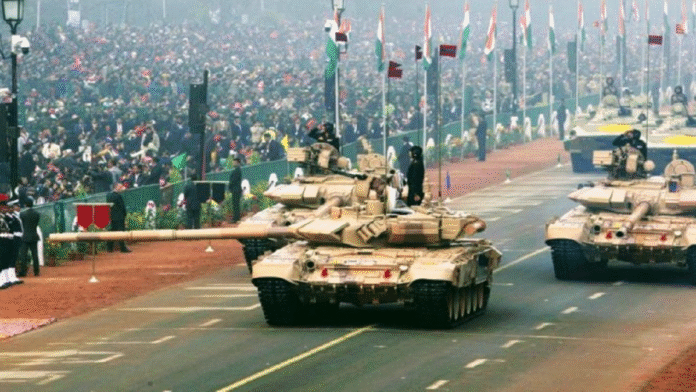
India maintains its position as the fourth-strongest military power, advancing its capabilities through the Atmanirbhar Bharat (self-reliance) initiative. Indigenous projects like the Tejas Mk1A fighter jet, Arihant-class submarines, and BrahMos missile upgrades highlight India’s push for technological autonomy and regional deterrence.
South Korea, ranked fifth, continues its upward trajectory through a robust domestic defence industry, advanced ballistic missile systems, and close strategic cooperation with the United States, making it a pivotal security player in East Asia.

Exam-Oriented Key Facts

  • The Global Firepower Index assesses over 60 parameters to rank military strength.
  • A lower Power Index (PwrIndx) score indicates a stronger overall capability.
  • The Top Five Militaries (2025): United States, Russia, China, India, and South Korea.
  • India’s defence strategy focuses on indigenisation and technological innovation under the Atmanirbhar Bharat initiative.

The GFP 2025 rankings reaffirm shifting global dynamics — where technology, innovation, and self-reliance now define the future of military power.