Home Blog Page 147

Thewa Jewellery: The Art of Gold on Glass

0

In the world of high jewelry, where pieces often rely on sheer carat weight or celebrity endorsements, one Indian art form stands apart. It is a masterpiece of light, color, and painstaking precision: Thewa jewelry.

Born in a small corner of Rajasthan and kept secret for over 250 years, Thewa has transcended its royal origins to become an international sensation, celebrated not for its size, but for its mesmerizing technique.

1. Thewa: Origin and Legacy of a Secret Art

Thewa’s story begins and remains centered in one city: Pratapgarh, Rajasthan.

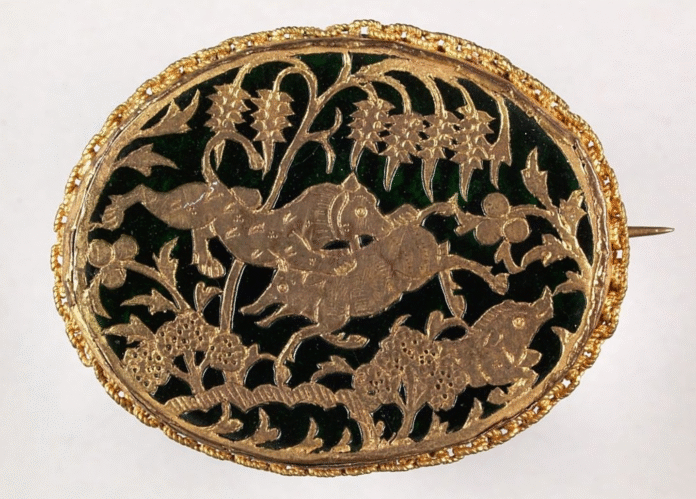
This unique craft originated in the late 18th century (around 1765 AD) under the patronage of the local royal family. Thewa translates literally to ‘setting’ or ‘a pattern on a thick piece of glass’. Historically, the process was so closely guarded that the techniques were passed down only to the family’s sons, and the secrets of the craft were not even shared with the family’s daughters for fear of the technique leaving the household through marriage.

2. The Meticulous Process: Gold as Thin as a Thread

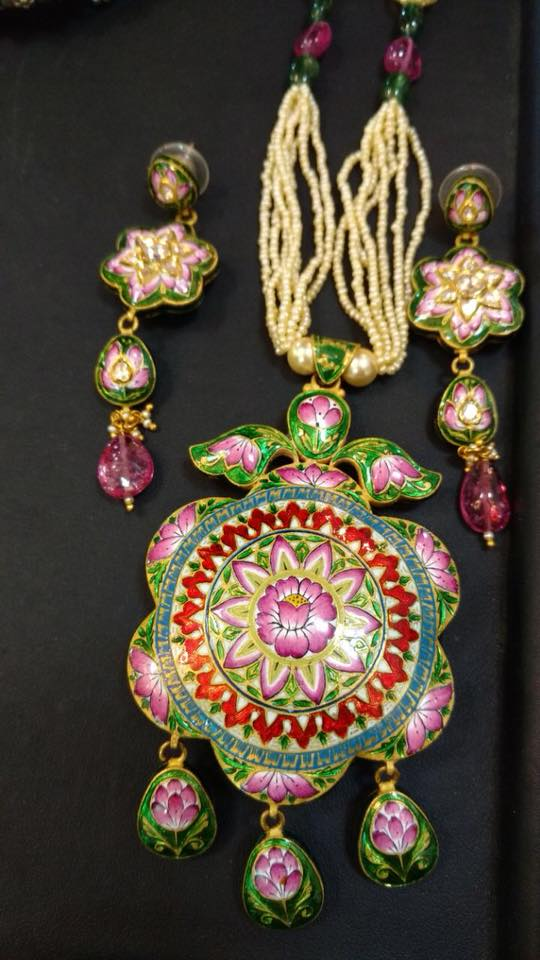
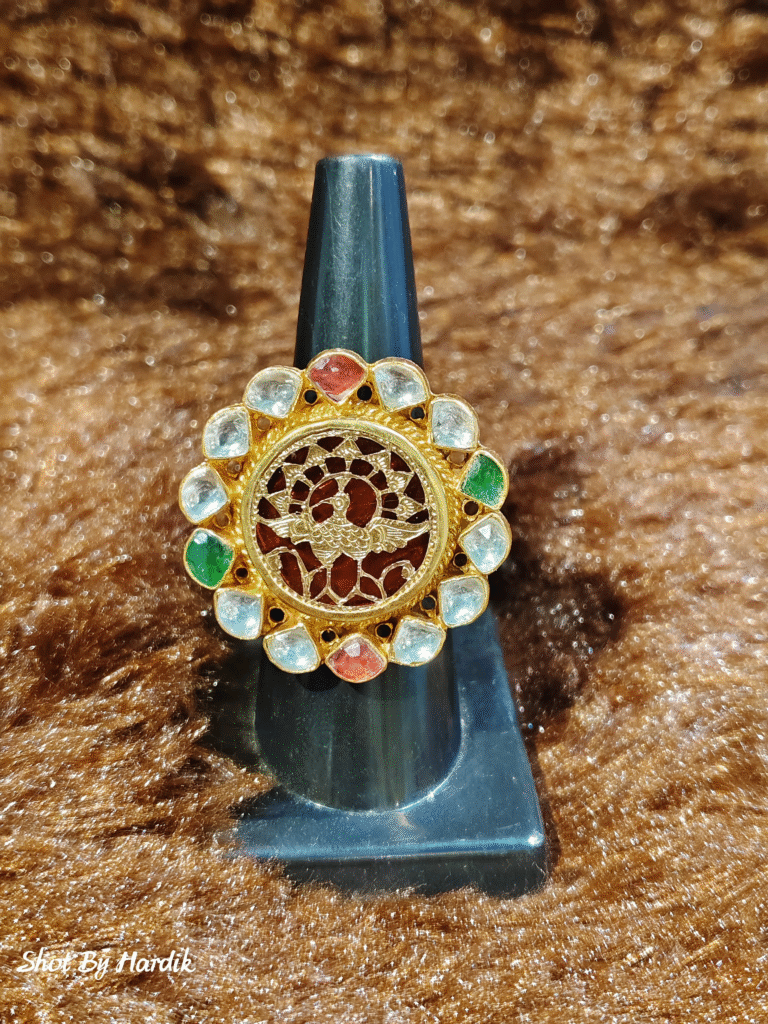
Thewa is the art of fusing intricately worked 23-carat gold sheets onto colorful, usually red, green, or blue, Belgian glass. The beauty lies in the impossible thinness and detailing of the gold foil.

The process is incredibly labor-intensive, requiring a high degree of skill and absolute concentration:

1. Preparation of the Glass: The Belgian glass is cut into the required shape (oval, round, or rectangular) and treated. The color of the glass acts as the backdrop, highlighting the gold work.

2. The Gold Foil: A 23K gold sheet, often no thicker than a single strand of thread (about 40 microns), is taken. The motifs—often depicting scenes from Hindu mythology (like Radha-Krishna or the Ramayana), hunting scenes, or intricate Mughal florals—are etched onto the gold sheet.

3. The Filing (Chitai): The most complex part. The artisan uses extremely fine tools to cut, shape, and file the delicate gold foil, creating a detailed lattice-like pattern.

4. Fusion (Jadaai): The fragile gold sheet is then meticulously pressed and fused onto the hot glass. Because the gold is so thin, it adheres perfectly to the surface, creating a stunning three-dimensional relief where the gold pattern stands out against the colored glass background. The glass provides the strength, while the gold provides the artistry.

This painstaking method means a single, complex pendant can take up to a month to complete.
Thewa Jewellery: The Art of Gold on Glass

3. From Royal Court to Red Carpet: The Global Glory

Thewa’s path to global recognition was cemented by two key factors: royal patronage and international exhibitions.

While initially confined to the royal court, Thewa soon caught the eye of Western connoisseurs. In the late 19th and early 20th centuries, Thewa pieces were exhibited at various world fairs, earning medals and high praise for their originality.

Today, its global appeal is due to its unique duality:

• Antique Appeal: The rich colors, mythological themes, and fine gold filigree give it an immediate antique and cultural depth that mass-produced jewelry lacks.

• Versatility: Modern Thewa artists have adapted the technique to create lighter, more contemporary pieces, such as cuff links, watch dials, and minimalistic pendants, making it accessible for daily wear while retaining its artistic value.

The Indian government recognized the art form’s national importance by issuing a commemorative stamp and honoring Thewa artists with prestigious awards, including multiple National Awards and a Padma Shri, ensuring that this ancestral secret continues to dazzle the world.

The Jeweler’s Perspective

“I have been practicing this art for over thirty years, inheriting the secrets of my father and his father before him. Thewa, this meticulous fusion of 23-carat gold and colored Belgian glass, is not mere jewelry; it is a painstaking dance between fire and foil. Even a single, minimal pendant, cut from a gold sheet thinner than a strand of hair, demands at least ten days of focused effort. We capture a whole story in a speck of glass, ensuring the 250-year legacy continues to shine,” says Hardik Soni, a jeweller.
Thewa Jewellery: The Art of Gold on Glass

“It’s not just jewelry. It’s a dance between fire and foil.”

That’s how master artisan Hardik Soni describes Thewa, the rare and radiant art form born in the royal courts of Pratapgarh, Rajasthan.

We caught up with Hardik in his sunlit workshop, where a single pendant can take up to a month to complete — and where every speck of glass tells a story.

What makes Thewa so unique?

Hardik Soni: “Thewa is unlike anything else. We take 23-carat gold, thinner than a strand of hair, and fuse it onto colored Belgian glass — red, green, blue. The motifs? Scenes from the Ramayana, Radha-Krishna, Mughal gardens. It’s storytelling in gold.”

How long have you been practicing this art?

“Over 30 years. I learned it from my father, who learned it from his. The technique was always passed from father to son — never written down, never shared outside the family. Even daughters weren’t taught, for fear the secret would leave through marriage.”

What’s the most challenging part?

“The chitai — the filing. We use tools finer than needles to carve the gold into lace-like patterns. One wrong move, and the whole piece is ruined. It’s ten days of meditation for a single pendant.”

And yet, Thewa is going global now.
“Yes! From royal courts to red carpets. We’ve shown at world fairs, won national awards, even got a commemorative stamp. Today, we’re making cufflinks, watch dials, minimal pendants — keeping the soul of Thewa, but adapting it for the world.”


In a world chasing carats and celebrity endorsements, Thewa stands apart — not for its size, but for its soul. It’s heritage you can wear. A 250-year-old secret that still shines.

(The writer of this story is Anjali Solanki)

Snake Boat Race of Kerala: Tradition Meets Thrill at the Champions Boat League in God’s Own Country

0


Snake Boat Race! Doesn’t this term sound interesting? For those who are listening to it for the first time should know that the serene backwaters of Kerala transform into an arena of excitement and energy during the Champions Boat League (CBL)—a grand celebration of tradition, teamwork, and tenacity. It’s here that the legendary Snake Boats (Chundan Vallam) glide through shimmering waters with rhythmic precision, their synchronized oars carving waves of passion and pride.

More than just a race, this vibrant festival captures the soul of Kerala’s cultural heritage, drawing spectators from across the world to witness a spectacle of color, music, and community spirit. Whether you’re cheering from the banks or drifting alongside in awe, the CBL offers an unforgettable glimpse into the heart of “God’s Own Country.”

Vallam Kali: A Snake Boat Race

Every year, as Kerala celebrates the harvest festival of Onam, its serene backwaters come alive with the thunderous rhythm of Vallam Kali — the legendary snake boat race that transforms the tranquil waterways into pulsating arenas of energy and excitement. Long, serpent-shaped boats glide swiftly across the shimmering waters, propelled by hundreds of oarsmen rowing in perfect unison to the beats of drums and the roar of cheering crowds. In August and September 2025, three of the biggest Vallam Kali events will once again turn God’s Own Country into a vibrant stage for one of India’s most spectacular cultural celebrations.

What Makes Vallam Kali Special?

The term Vallam Kali literally translates to “boat play,” but this centuries-old tradition is far more than a race. Held during Onam, Kerala’s grand harvest festival, it symbolizes the spirit of unity, devotion, and celebration. The races take place on rivers and lakes brimming with monsoon waters, where the magnificent Chundan Valloms (snake boats) — sleek, 100-foot-long wooden vessels with high, curving sterns — cut through the waves like arrows. Each boat carries more than 100 rowers, their synchronized strokes creating a mesmerizing display of teamwork and rhythm.

Vallam Kali: A Showcase of Communal Harmony

But Vallam Kali is not just a competition; it is a reflection of Kerala’s maritime heritage and communal harmony. Each village takes immense pride in its boat, and months of preparation go into training, rituals, and maintenance. The oarsmen row not merely for victory, but as an act of devotion, often invoking the blessings of deities before setting out.

Blending sport, spirituality, and cultural identity, Vallam Kali captures the very soul of Kerala — a timeless tradition where strength meets spirit, and where the waters themselves seem to dance in celebration.

France’s Bold Food Waste Law: A Lesson the World Still Needs to Learn

0

Nearly a decade ago, France made history by becoming the first country in the world to ban supermarkets from throwing away unsold or near-expiry food. Instead, stores were required to donate edible items to charities and food banks, ensuring that perfectly good food reached those in need rather than ending up in landfills.

This groundbreaking law, passed unanimously by the French Senate, was a response to shocking levels of food waste over 7 million tonnes annually, even as many people struggled with hunger.

Under the law, supermarkets that fail to comply face fines of up to €75,000 (₹68 lakh) or even two years in prison. It was a powerful message: wasting food is no longer just careless, it’s unethical and illegal.

The impact was immediate, food banks across France reported millions of additional meals being distributed every year. Campaigners like Arash Derambarsh, who initiated the petition, hailed it as a victory for both social justice and sustainability.

Fast forward to today, and the world’s food waste problem remains staggering. Globally, over 1.3 billion tonnes of food are wasted every year, while nearly 828 million people go hungry. This contrast makes France’s model more relevant than ever.
Countries like the UK and the US have voluntary programs to reduce waste, but few have taken such firm legislative action.

As climate change worsens and food insecurity rises, it’s time for others to follow France’s lead, making food redistribution mandatory, not optional.

France proved that one law can change habits, protect the planet, and feed millions. The question is how long will other nations wait to catch up?

The Dark Origin of the Pinky Promise: A Sweet Gesture with a Scary Past

0

We’ve all done it, linked our little fingers with a friend’s and sealed a secret, whispering, “Pinky promise!” It’s one of the cutest gestures of trust, right? But what if we told you this innocent act has a terrifying origin story?

The pinky promise, known in Japan as “Yubikiri” (which literally translates to “finger cut-off”), comes with a gruesome backstory.
Centuries ago in Japan, breaking this promise wasn’t just considered rude, it was punishable by the loss of your pinky finger! The belief was that if someone broke their word, they had to cut off their smallest finger as a sign of repentance.
Some historians even link this practice to the Japanese mafia, the Yakuza, who used it as a ritual of loyalty and discipline. Creepy, isn’t it?
Thankfully, time softened the meaning. What began as a blood oath of honor slowly evolved into a simple yet powerful gesture of friendship and honesty.

Today, the pinky promise is a global symbol of trust, especially between children and best friends. From swearing to keep secrets to promising not to tell your crush, it has turned into something sweet and sentimental rather than scary.

Interestingly, the pinky promise isn’t the only strange oath tradition in history.
In ancient Hebrew culture, people would touch someone’s thigh while making a solemn vow, while others wrote their promises with actual blood. Compared to that, the pinky promise doesn’t seem so extreme after all!

So, the next time you lock pinkies with someone, remember behind that adorable gesture lies a piece of ancient history soaked in loyalty, fear, and deep respect for one’s word.

Because once upon a time, breaking a pinky promise could literally cost you a finger.

Samrat Rana: The New Star in India’s Shooting Sky

0

Samrat Rana (born 8 January 2005) hails from Karnal district in Haryana. At just 20 years old, he has already etched his name in history by clinching the gold medal in the men’s 10 m air pistol at the 2025 ISSF World Championships in Cairo, becoming the first Indian ever to win a world title in an Olympic-pistol discipline.

From Karnal, With Grit


Growing up in Haryana’s wheat belt, Samrat was introduced to shooting by his father, Ashok Kumar Rana, who despite having no formal training, became his coach in 2018 and guided his daily practice from a modest home range. The young shooter studied at DAV College, Karnal, and balanced academics with early mornings at the range. His journey from Karnal’s lanes to the world stage reflects the quiet determination of a young athlete who knew that talent must meet opportunity.

The Struggle and Climb


Before the gold glitz, Samrat faced the grind. His senior international exposure began only in 2025, and in the same year he finished 10th at the World Cup in Ningbo, China, a performance that showed promise but not yet the elite result.

Away from big support systems, he and his father created a training environment with limited resources, often making do with what they had. Yet each shot, each practice, built the resilience that carried him off the domestic circuit and into global contention.

The Historic Achievement


At the World Championships in Cairo, Samrat scored a cool 243.7 in the final, edging out China’s Hu Kai by 0.4 points to clinch gold. In the qualification, he topped the charts and then held his nerve in a fiercely contested final against Olympic and World champions.

Along with teammates Varun Tomar and Shravan Kumar, he also spearheaded India’s team gold with a combined tally of 1754 points.

Why It Matters


This win marks a major shift for Indian pistol shooting. Until now, world titles in Olympic-pistol events had eluded the country; Samrat’s triumph signals both a personal breakthrough and the emergence of a new generation.

His story of a father-and-son duo, modest beginnings, provincial roots and a global podium resonates far beyond the range. As he himself said: “I still can’t believe it… I just tried to focus on my technique with every shot.”

In one swift stroke, Samrat Rana moved from “promising youngster” to “national treasure”. The journey ahead is long, but his footprint is already historic.

Prepare Your Immune System for Winter: Tips to Stay Strong and Healthy

0

Boost your immune system this winter with expert tips on nutrition, sleep, hydration, and vaccines. Stay healthy all season long. As the cold weather sets in, it often brings along sneezes, coughs, and bouts of fatigue. Winter can challenge your immune system, making it essential to strengthen your body’s natural defenses. Immunity isn’t built overnight — it’s about consistent, preventive habits that keep you healthy from the inside out.

Prepare Your Immune System for Winter: Tips to Stay Strong and Healthy

Health experts share essential ways to boost your immunity and stay well this winter.

  1. Eat Seasonal, Immune-Boosting Foods

Start with small yet meaningful changes to your diet. Seasonal fruits like oranges, amla, guava, and pomegranate are rich in vitamin C — a powerful antioxidant that helps your body fight infections.
Include foods packed with zinc such as nuts, seeds, and lentils, as zinc plays a vital role in activating immune responses.

  1. Stay Hydrated

Hydration isn’t just for summer. Drink plenty of warm fluids like decaffeinated tea, hot water with lemon and honey, or herbal infusions. Proper hydration keeps mucous membranes moist, reducing the chance of viruses entering the body.

  1. Keep Moving

Regular exercise, even a brisk walk or yoga session, boosts circulation and supports immune cell activity. Aim for at least 30 minutes of moderate activity daily to stay energized and resilient.

  1. Prioritize Quality Sleep

Good-quality sleep — around 7–8 hours per night — allows your immune system to repair and function effectively. Inadequate sleep can make you more susceptible to infections.

  1. Get Vaccinated

Vaccines provide an added layer of protection, especially against influenza and pneumonia. Individuals with chronic conditions such as diabetes, hypertension, or respiratory illnesses should also schedule regular preventive health check-ups.

  1. Practice Preventive Care

Avoid crowded indoor spaces with poor ventilation and maintain proper hand hygiene. These small steps go a long way in reducing your risk of seasonal infections.

A strong immune system is your best ally through the winter months. Eat mindfully, stay active, rest well, and take preventive measures to enjoy the season’s comforts without compromising your health.

India on Track to Become World’s Third-Largest Economy by 2028: UBS

0

India is on course to overtake Japan and Germany to become the world’s third-largest economy by 2028, according to a new report by UBS Global Research. The report attributes this milestone to steady GDP growth averaging 6.5% per year, alongside policy-driven expansion and robust domestic consumption.

UBS also projects that India will emerge as the third-largest consumer market by 2026, reflecting strong demand and a sustained reform momentum.

Growth Outlook and Economic Drivers

UBS Chief India Economist Tanvee Gupta Jain forecasts that India’s real GDP growth will stabilise at 6.4% in FY27 and 6.5% in FY28, supported by:

  • Continued economic reforms and industrial deregulation
  • A major infrastructure and logistics expansion
  • Strengthening manufacturing and technology sectors

The report notes that India’s macroeconomic fundamentals remain stable despite global challenges, aided by sound fiscal management and external balance.

UBS expects the current account deficit to stay around 1.2% of GDP in FY27, within manageable limits, and sees room for one additional 25 bps rate cut before a pause in FY27.

Inflation, Fiscal Trends, and Risks

UBS estimates headline CPI inflation to rise modestly to 4.3% in FY27, mainly due to base effects, remaining below the RBI’s 4.5% projection. Fiscal consolidation is likely to progress gradually, driven by strong tax collections and disciplined spending.

However, the report flags potential headwinds:

  • Sustained high trade tariffs (~50%) could lower GDP growth by 50 bps.
  • U.S. tax measures on offshore payments might reduce growth by 90 bps.
    On the upside, faster AI adoption and deeper structural reforms could lift India’s growth potential to 6.5–7%.

Key Facts

  • India to become 3rd-largest economy by 2028 (after the U.S. & China)
  • Expected GDP growth: 6.5% (FY28–30E)
  • Current account deficit: ~1.2% of GDP (FY27E)
  • Inflation forecast: 4.3% (FY27)
  • Growth enablers: Infrastructure, deregulation, R&D, AI adoption
  • Key Economist: Tanvee Gupta Jain, UBS Chief India Economist

Structural Reform Priorities

UBS underscores the importance of continued reforms in land acquisition, capital markets, and research investment to unlock India’s “new economy” potential. Enhancing productivity, innovation, and labour participation will be vital for sustaining long-term momentum.

Outlook

UBS concludes that India’s path toward becoming the third-largest global economy is anchored in macroeconomic stability, policy reforms, and an expanding middle class. While external risks persist, India’s transformation in energy, infrastructure, and digital sectors positions it as a key global growth driver for the coming decade.

Kaal Bhairav Jayanti 2025: Date, Puja Timings, Significance, and Aarti

0

Kaal Bhairav Jayanti 2025: Kaal Bhairav Jayanti, also known as Bhairav Ashtami or Kaal Bhairav Ashtami, is an important Hindu festival dedicated to Lord Kaal Bhairav, the fierce manifestation of Lord Shiva. As per scriptures, worshipping Kaal Bhairav helps remove negativity, planetary defects (Graha Dosh), and all forms of fear, including the fear of untimely death.

When is Kaal Bhairav Jayanti 2025?

According to the Vedic calendar, the Ashtami Tithi of Krishna Paksha in the Kartik month begins at 11:08 PM on November 11 and ends at 10:58 PM on November 12.
Based on Udaya Tithi (sunrise-based calculation), Kaal Bhairav Jayanti will be observed on Wednesday, November 12, 2025.

Auspicious Puja Timings

Devotees can perform Kaal Bhairav Puja at any time during the day, but performing it during the Bhairav Kaal Muhurat is considered most auspicious.

  • Morning Muhurat: 6:41 AM to 9:23 AM
  • Midday Muhurat: 10:44 AM to 12:05 PM

Lighting a mustard oil lamp (Deepak) before Lord Bhairav and offering black sesame, mustard oil, and dog food (roti or prasad) is considered highly auspicious.

Significance of Kaal Bhairav Jayanti

Lord Kaal Bhairav is regarded as the Kotwal (guardian deity) of Kashi (Varanasi). It is believed that any devotee who worships Him with devotion attains protection from evil influences, enemies, and fears.

Worshipping Kaal Bhairav is also believed to pacify Rahu, Ketu, and Shani Dosh, bringing relief from planetary troubles and obstacles in life. The day holds deep spiritual importance for devotees seeking courage, protection, and liberation from negativity.

ISRO Validates Gaganyaan Parachutes in Critical Airdrop Test

0

The Indian Space Research Organisation (ISRO) achieved another milestone in its Gaganyaan human spaceflight programme by successfully completing the Integrated Main Parachute Airdrop Test at the Babina Field Firing Range in Jhansi, Uttar Pradesh. The test simulated extreme re-entry conditions for the Gaganyaan crew module, validating the robustness and redundancy of its parachute system.

The critical test demonstrated that even with asymmetric deployment—a delay in the full opening of one of the main parachutes—the system ensured a stable descent and soft landing. This confirmed that two parachutes are sufficient for safe crew module recovery, reinforcing the design’s safety and reliability.

The experiment involved dropping a simulated crew module mass from an altitude of 2.5 km using an Indian Air Force IL-76 aircraft. The parachute deployment sequence unfolded exactly as planned, with flawless execution through all stages, culminating in a smooth touchdown.

ISRO explained that the Gaganyaan main parachutes deploy through a process known as reefed inflation, where the canopy first opens partially (reefing) and then fully after a controlled delay (disreefing), using pyro devices. This method ensures a gradual reduction of descent speed, minimizing mechanical stress on the spacecraft.

The test specifically evaluated asymmetric disreefing, one of the most demanding conditions expected during actual mission descent. It assessed the system’s structural integrity, load distribution, and dynamic performance, ensuring that the parachute assembly can handle real-world challenges during crew re-entry.

The success of this test represents a major step forward in qualifying the parachute system for human spaceflight. It was conducted through a coordinated effort involving the Vikram Sarabhai Space Centre (VSSC), Aerial Delivery Research and Development Establishment (ADRDE) of DRDO, the Indian Air Force, and the Indian Army.

With this validation, ISRO is now closer to its next milestones — an uncrewed Gaganyaan mission in 2026, followed by India’s first crewed spaceflight in 2027, marking a historic leap in the nation’s space exploration journey.

Dharmendra Deol: Meet The He-Man Who Won Millions With a Heart of Gold

0

Dharmendra Deol Spotlight: The lights of Bollywood seem to dimming today, but the glow of Dharmendra’s charm can still be felt. The man who defined love, laughter, and loyalty on screen has taken his final bow leaving behind not just a career, but an emotion that generations grew up with.

He is not merely a movie star. Dharmendra is the feeling of comfort when cinema felt too loud. His smile looks magnetic, his voice sincere, and his presence larger than life yet deeply human.
He embodies the perfect blend of strength and sensitivity, earning the title of Bollywood’s He-Man while carrying the gentlest heart.

His journey began with Phool Aur Patthar, where he redefined masculinity – brave, yet tender. Then came the unforgettable Veeru from Sholay, the man who made friendship eternal and romance playful. His teasing line, *“Basanti, in kutton ke samne mat nachna!” *still echoes with laughter across generations.

Just when the audience crowned him the action king, Hrishikesh Mukherjee’s Chupke Chupke revealed a different Dharmendra – the comic genius, the professor with wit sharper than words.
Whether it was Ajit in Mera Gaon Mera Desh, Jugnu the patriot, or Professor Parimal the prankster, every role carried that unmistakable sparkle only Dharmendra could bring.

And as decades passed, he didn’t fade, he has evolved. From Yamla Pagla Deewana with his sons Sunny and Bobby, to his heartwarming presence in Karan Johar’s Rocky Aur Rani Ki Prem Kahani, Dharmendra proved that legends don’t age, they simply adapt to new stories with the same old magic.

A Legacy Written in Love and Laughter

  • Over 300 films across six decades of cinematic brilliance
  • Recipient of Padma Bhushan (2012) and Filmfare Lifetime Achievement Award (1997)
  • Iconic partnerships with Hema Malini, Amitabh Bachchan, Sharmila Tagore, and many more

Beyond films, he is a producer, poet, and people’s representative. Through Vijayta Films, he gifted Bollywood timeless stories like Betaab. In Parliament, he spoke with the same honesty that defined his performances. And in his private world, he penned poetry – gentle, soulful verses that revealed the man behind the myth.

Dharmendra belonged to an era when heroes didn’t need VFX, just heart. His laughter, his humility, and his old-school grace remains unmatched till date.

“Dharmendra in His Own Words”
“Main filmon mein hero bana, par zindagi mein insaan banne ki koshish ki.”
(I became a hero in films, but I always tried to remain human in life.)

Dharmendra didn’t just act. He made us feel — deeply, beautifully, truly.
And though the reel seems slowly spinning, his warmth stays forever in every cinema lover’s heart.

(The article has been written by Rishita Sogani)