Home Blog Page 140

India Storms into Women’s World Cup Final: Jemimah Rodrigues Shines with Unbeaten 127 in Win Over Australia

0

Team India created history on Thursday by defeating seven-time champions Australia to book their place in the final of the Women’s ODI World Cup. In a thrilling semi-final at the DY Patil Stadium, India chased down a mammoth target of 339 runs, winning by 5 wickets with 9 balls to spare.

Jemimah Rodrigues emerged as the star of the match, playing a magnificent unbeaten innings of 127 runs, steering India to victory alongside Amanjot Kaur, who remained not out on 15.

Earlier, Harmanpreet Kaur led from the front with a brilliant 89, while Richa Ghosh contributed 26. Openers Smriti Mandhana (24) and Shafali Verma (10) gave India a steady start before both were dismissed by Kim Garth, who also took the key wicket of Harmanpreet. Deepti Sharma (24) was run out in a mix-up.

Batting first, Australia posted a challenging 338 for 9 in their 50 overs, powered by Phoebe Litchfield’s 119, Ellyse Perry’s 77, and Ashleigh Gardner’s 63. However, India’s bowlers kept the pressure on in the death overs. Spinners Shree Charani and Deepti Sharma took two wickets each, while Kranti Gaur, Amanjot Kaur, and Radha Yadav picked up one apiece. Three Australian batters were run out due to sharp fielding.

With this memorable win, India has stormed into the final and will now aim for their first-ever Women’s ODI World Cup title, carrying the hopes of millions of fans across the nation.

laying XI of Both Teams

India: Harmanpreet Kaur (captain), Smriti Mandhana, Shafali Verma, Amanjot Kaur, Jemimah Rodrigues, Richa Ghosh (wicketkeeper), Deepti Sharma, Radha Yadav, Kranti Goud, Shree Charani, Renuka Singh Thakur.

Australia: Alyssa Healy (captain and wicketkeeper), Phoebe Litchfield, Ellyse Perry, Beth Mooney, Annabel Sutherland, Ashleigh Gardner, Tahlia McGrath, Kim Garth, Sophie Molineux, Alana King, Megan Schutt

Richa Ghosh departs for 26; Sutherland strikes again
Richa Ghosh was dismissed by Annabel Sutherland on the final ball of the 46th over. Attempting a cut shot off a slower delivery, Richa found Kim Garth at short third man, who completed a comfortable catch.

Richa’s fireworks take India past 300
India crossed the 300-run mark in the 45th over. Richa Ghosh smashed consecutive boundaries off Ashleigh Gardner — including a massive 83-metre six followed by a four — to bring India closer to the target.

Jemimah gets another reprieve
Jemimah Rodrigues survived again in the 44th over. Her lofted shot off Annabel Sutherland went towards long-off, but Tahlia McGrath couldn’t hold on as the ball deflected off her hand. Jemimah was batting on 106 at the time.
National Unity Day 2025: Theme, History, and Significance

0

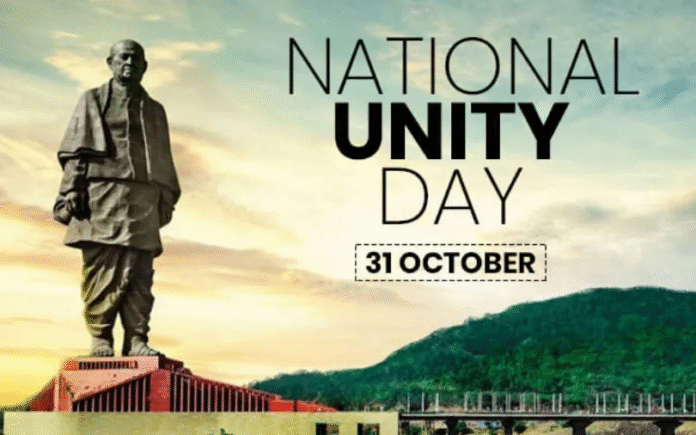
India will celebrate National Unity Day (Rashtriya Ekta Diwas) on October 31, 2025, marking the 150th birth anniversary of Sardar Vallabhbhai Patel, the Iron Man of India. This year’s theme — “Ek Bharat, Aatmanirbhar Bharat” — links the spirit of national integration with the pursuit of self-reliance, echoing India’s broader goal of building a Viksit Bharat by 2047.

A Milestone Celebration

This year’s observance is unique, coinciding with a historic milestone — Patel’s 150th birth anniversary. As India reflects on its unity in diversity, the day reinforces the need for collective strength and shared national purpose in times of rapid change.

The “Ek Bharat, Aatmanirbhar Bharat” theme captures the idea that unity goes beyond territorial integrity — it represents an inner strength that fuels innovation, confidence, and resilience. The government’s message is clear: India achieves its greatest successes when its many languages, regions, and cultures work toward a single national vision.

Sardar Patel and the Idea of Integration

Sardar Vallabhbhai Patel’s unmatched legacy as the architect of national integration remains at the heart of the celebration. His diplomacy and foresight transformed India’s diversity into its greatest strength. Patel’s inclusiveness laid the foundation for a pluralistic democracy — one that celebrates differences while upholding unity and justice.

National Unity Day, therefore, is not just a commemoration of Patel’s life but a renewal of his ideals — of courage, cooperation, and commitment to the nation’s collective identity.

Relevance in 2025: Unity for Progress and Resilience

In the backdrop of global challenges and domestic aspirations, the 2025 observance urges citizens to translate Patel’s vision into action. The theme calls for active participation in building a self-reliant India — economically, technologically, and socially.

The celebration emphasizes:

  • The synthesis of India’s linguistic, regional, and cultural diversity as a foundation for innovation and peace.
  • The importance of selfsufficiency in economy, technology, and culture through collective national will.
  • Alignment with the Viksit Bharat 2047 vision — a roadmap for a developed, harmonious, and resilient India.

How National Unity Day 2025 Is Being Celebrated

The main celebrations are centered at the Statue of Unity in Gujarat, the world’s tallest statue and a symbol of India’s enduring unity. Across the nation, people are participating in activities that honor Patel’s legacy and the spirit of togetherness:

  • Run for Unity: Marathons and unity runs in cities and towns, symbolizing collective strength.
  • Unity Pledge Ceremonies: Mass pledges in schools, colleges, and government offices to uphold India’s integrity and peace.
  • Cultural Programs: Folk dances, regional music, art exhibitions, and performances celebrating India’s rich diversity.
  • Educational Initiatives: Poster-making, essay writing, and quiz competitions to instill the values of unity among students.

A Vision for India’s Future

As India moves toward its centenary as a modern republic, “Ek Bharat, Aatmanirbhar Bharat” serves both as a celebration and a call to action. It reminds citizens that unity is not automatic — it must be continuously nurtured through participation, understanding, and shared progress.

In 2025, National Unity Day stands not only as a tribute to Sardar Patel but as a reaffirmation of India’s resolve to move forward — united in spirit, self-reliant in strength, and confident in its destiny.

Global Firepower Index 2025: World’s Strongest Militaries Revealed

0

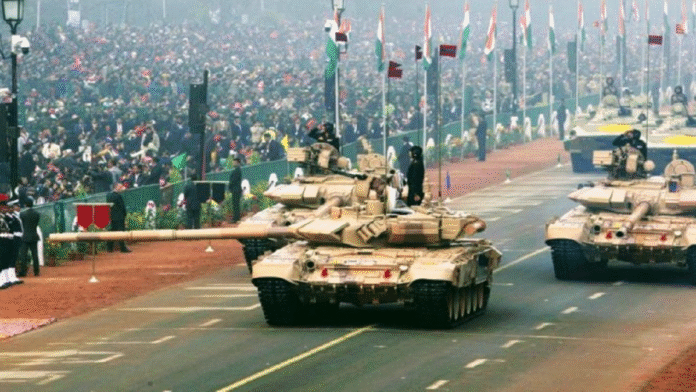
The Global Firepower (GFP) Index 2025 provides a comprehensive analysis of the world’s most powerful armed forces. Evaluating more than 60 parameters — including manpower, defence budgets, logistics, technology, and geography — the index measures each nation’s ability to project and sustain military strength. A lower Power Index (PwrIndx) score indicates greater overall capability, reflecting modernization trends and strategic realignments shaping global military power.

United States Retains Global Military Dominance

The United States continues to hold the top position in the GFP 2025 rankings, maintaining its status as the world’s most powerful military. With a defence budget exceeding $860 billion and a vast global network of bases, the U.S. dominates across land, sea, air, and cyber domains. Advanced technologies such as F-35 fighter jets, nuclear submarines, stealth bombers, and space-based systems enhance its power projection and deterrence capabilities. Its unmatched global influence is sustained by innovation, strategic partnerships, and readiness across all fronts.

Russia Holds Strong Despite Sanctions and Strains

Despite facing severe economic sanctions and logistical challenges, Russia remains the second-strongest military power. It retains one of the world’s largest arsenals of tanks, artillery systems, and nuclear warheads. The deployment of advanced air defence systems like the S-500 and progress in hypersonic missile technology have bolstered its operational capabilities. Moscow’s military resilience continues to underpin its influence across Eurasia and the global strategic landscape.

China’s Military Modernisation Drives Global Ambition

China ranks close behind, reflecting its rapid and sustained military modernisation. The People’s Liberation Army (PLA) has transformed into a technology-centric force emphasizing cyber warfare, AI-driven systems, and naval expansion. Boasting the world’s largest standing army and a growing blue-water navy, China continues to strengthen its dominance in the Indo-Pacific region. Investments in unmanned systems and space capabilities further position it as a formidable global contender.

India and South Korea Strengthen Regional Influence

India maintains its position as the fourth-strongest military power, advancing its capabilities through the Atmanirbhar Bharat (self-reliance) initiative. Indigenous projects like the Tejas Mk1A fighter jet, Arihant-class submarines, and BrahMos missile upgrades highlight India’s push for technological autonomy and regional deterrence.
South Korea, ranked fifth, continues its upward trajectory through a robust domestic defence industry, advanced ballistic missile systems, and close strategic cooperation with the United States, making it a pivotal security player in East Asia.

Exam-Oriented Key Facts

  • The Global Firepower Index assesses over 60 parameters to rank military strength.
  • A lower Power Index (PwrIndx) score indicates a stronger overall capability.
  • The Top Five Militaries (2025): United States, Russia, China, India, and South Korea.
  • India’s defence strategy focuses on indigenisation and technological innovation under the Atmanirbhar Bharat initiative.

The GFP 2025 rankings reaffirm shifting global dynamics — where technology, innovation, and self-reliance now define the future of military power.

Halloween: When the World Dresses Its Fears in Fun

0

October’s final night carries a kind of mystery that has slowly begun to enchant even India. Pumpkins glow on café counters, children wear witch hats in school carnivals, and laughter echoes at themed parties. Though Halloween is not a traditional Indian festival, it has quietly found its way into our cities, campuses, and celebrations adding a playful twist to the autumn air.

A Festival of Frights and Feelings


At its heart, Halloween is far more than scary costumes or trick-or-treats. Its roots go back over two thousand years to the Celtic festival of Samhain, a night that marked the end of harvest and the beginning of winter when people believed that the boundary between the living and the dead blurred. Bonfires were lit, costumes were worn, and prayers were offered for protection.

Today, Halloween has transformed into a celebration of creativity, imagination, and even community spirit. Across the world, people come together to laugh at what once terrified them. It’s about embracing the idea that fear can be fun, that darkness can glow if you light it right.

How India Sees the Spooky Season


In India, festivals already hold deep connections with light and darkness think of Diwali, which celebrates the triumph of light over shadow, or Pitru Paksha, when we remember and honor our ancestors. Halloween, in its own way, carries echoes of both. It may not have been born here, but its spirit of remembrance, reflection, and joy feels surprisingly familiar.
Over the past decade, urban India has embraced Halloween not just as a Western trend, but as a reason to gather, dress up, and let imagination run wild.
Schools host themed days, malls turn into haunted houses, and cafes decorate with cobwebs and pumpkins. It’s playful, youthful, and refreshingly different.

Beyond Costumes and Candles


What makes Halloween special is the way it invites everyone young or old to see fear differently. It’s not about ghosts; it’s about courage.
In a world that often takes itself too seriously, Halloween reminds us to loosen up, to tell stories, to be silly and to remember that sometimes, the best way to face the dark is to dance in it.

The Iron Man Who Molded a Nation: Remembering Sardar Vallabhbhai Patel on National Unity Day

0

By Rishita Sogani

When Freedom Felt Fragile: In 1947, India stood at the dawn of independence free yet fractured. The British had left behind not one nation, but a patchwork of more than 560 princely states. Fear, uncertainty, and ambition lingered in the air. It could have all fallen apart if not for one man whose courage was carved in iron and whose vision stretched beyond borders: Sardar Vallabhbhai Patel.

A Farmer’s Son with a Fire Within


Born in the quiet lands of Gujarat, Patel wasn’t born into power; he built it through grit and grace. A lawyer by profession, he found his true calling in the fight for justice and equality. His leadership during the Bardoli Satyagraha where he stood shoulder to shoulder with struggling farmers earned him the title “Sardar”, the leader. It wasn’t a name given out of respect alone, but out of faith, faith that he could move mountains if India needed him to.

Forging Unity from Uncertainty


When independence arrived, it brought a challenge few could have faced integrating hundreds of princely states into one nation. Patel, as the first Deputy Prime Minister and Home Minister, took on the impossible. With calm persuasion for some, firm resolve for others, and unwavering nationalism for all, he brought them together under one flag.
He didn’t just unite territories; he united hearts. His diplomacy wasn’t coated in softness but rooted in steel earning him the title “The Iron Man of India.”

Strength Woven with Compassion


Patel’s iron was not cold or cruel. It was the strength that protects, guides, and uplifts. Behind his steely gaze was a man who deeply loved his country who believed unity was not just about maps but about minds. His vision of a united India wasn’t political; it was emotional, cultural, and deeply human.

A Statue That Stands for a Spirit


Decades later, his towering legacy took physical form in the Statue of Unity the tallest statue in the world, rising 182 meters above Gujarat’s soil. But more than its height, it is the idea it represents that stands tallest the belief that courage and unity can shape destiny.

As we celebrate Rashtriya Ekta Diwas, we remember Sardar Patel the man who turned fragments into a nation and dreams into India.

Uber Partners with Nvidia to Deploy 100,000 Robotaxis Worldwide by 2027

0

In a landmark move toward the future of autonomous transport, Uber Technologies has partnered with Nvidia to develop and deploy a global fleet of 100,000 driverless robotaxis by 2027. The announcement, made at Nvidia’s GTC Conference in Washington, DC, signals a major leap in the commercial rollout of large-scale autonomous mobility.

Uber Partners with Nvidia to Deploy 100,000 Robotaxis Worldwide by 2027

Strategic Collaboration for Autonomous Mobility

The partnership builds upon an earlier agreement signed in January, under which Uber shared extensive driving data to enhance Nvidia’s AI systems and self-driving chip technology. The project will be powered by Nvidia’s Drive AGX Hyperion 10 platform, which integrates advanced sensors, processors, and software to enable full-scale autonomous operations.
The collaboration aims to create a global AI-driven mobility network, positioning Uber as a frontrunner in autonomous ride-hailing.

Stellantis and Foxconn to Supply the First Fleet

Automaker Stellantis will manufacture the first 5,000 robotaxis equipped with Nvidia’s advanced hardware, with Foxconn supporting production and system integration. Pilot programs are set to begin in the United States, followed by a global rollout by 2028. Uber will oversee the entire fleet operation — including maintenance, charging, remote monitoring, and customer support — while continuing to collaborate with other self-driving partners like Waymo, WeRide, and Nuro.

Building the Robotaxi Data Factory

To accelerate innovation, Uber and Nvidia will jointly establish a “Robotaxi Data Factory”, designed to process more than three million hours of driving data collected from Uber’s global operations. Nvidia will supply the necessary processors, simulation tools, and analytics systems to train AI models for safer and more efficient driverless performance.

Exam-Oriented Key Facts

  • Uber to deploy 100,000 Nvidia-powered robotaxis globally by 2027.
  • Stellantis and Foxconn to build the first 5,000 vehicles for the fleet.
  • Powered by Nvidia Drive AGX Hyperion 10 for integrated autonomous technology.
  • Uber–Nvidia’s Robotaxi Data Factory to utilize 3 million+ hours of driving data.

Implications for the Future of Ride-Hailing

The collaboration marks a pivotal step in transforming Uber’s business model. By reducing dependence on human drivers, Uber expects to cut operational costs, expand coverage, and improve profitability. For Nvidia, the partnership reinforces its dominance in AI and automotive computing, advancing the global transition toward safe, scalable, and sustainable autonomous transport.

If executed as planned, this initiative could redefine the future of ride-hailing, making driverless mobility a mainstream reality within the next decade.

“Tourism Vision 2029” — 50 World-Class Destinations to Showcase India’s Heritage

0
The valleys of Himachal Pradesh

The Government of India has unveiled “Tourism Vision 2029”, an ambitious national initiative aimed at transforming 50 domestic destinations into world-class tourist hubs by 2029. The project, part of the Modi government’s broader Tourism Boost Vision 2029, seeks to redefine India’s global tourism identity by blending cultural heritage, natural beauty, and modern infrastructure.

A Nationwide Push for Global-Standard Tourism

Under the new plan, each state and union territory has been directed to propose potential destinations within a month. The shortlisted sites will undergo major redevelopment over the next three to four years, guided by a central framework emphasizing sustainability, accessibility, safety, and visitor engagement.
From Kashmir’s snow-capped valleys and Kerala’s serene backwaters to Gujarat’s coastal heritage and Assam’s lush green hills, the initiative seeks to celebrate India’s incredible diversity through a unified vision of excellence in tourism.

Cultural and Economic Empowerment

Officials have described the program as a strategic step toward converting India’s vast cultural and natural wealth into global tourism assets. The framework ensures equitable representation, with at least one flagship destination in every state and union territory.
Aligned with the government’s call for self-reliance and national pride, the plan integrates heritage preservation, skill development, and local entrepreneurship to ensure that the economic benefits of tourism reach grassroots communities.

Boosting Local Economies and Employment

The upgraded destinations are expected to create thousands of jobs, empower local artisans, and strengthen small and medium tourism businesses. Local guides, homestay operators, and handicraft sellers are set to benefit directly from the surge in tourism activity.
The initiative also aims to attract foreign investment in hospitality and infrastructure while ensuring that all projects meet global standards for environmental sustainability and cultural preservation.

Exam-Oriented Highlights

  • The government will develop 50 world-class tourist destinations under Tourism Vision 2029.
  • Each state and UT will have at least one flagship site under the scheme.
  • The focus areas include sustainability, infrastructure, accessibility, and cultural preservation.
  • The initiative will be implemented over three to four years, targeting completion by 2029.
  • It aims to position India as a premier global tourism destination while boosting employment and local economies.

Reimagining India’s Global Tourism Identity

Described as a modern-day Swadeshi movement in tourism, Tourism Vision 2029 blends India’s timeless traditions with contemporary innovation. By 2029, the government envisions that travelers from around the world will find “50 new reasons to explore India”—destinations that are traditional in spirit, sustainable in design, and global in experience.

OpenAI to Offer 1-Year Free ChatGPT Go Access in India Starting November 4

0

In a move set to shake up the AI landscape in India, OpenAI has announced free, one-year access to ChatGPT Go for all Indian users beginning November 4, the same day the company hosts its first-ever DevDay Exchange in Bengaluru.

The announcement underscores India’s growing influence in the global AI ecosystem, as the country has rapidly become one of ChatGPT’s largest and fastest-growing markets.

ChatGPT Go, introduced earlier this year, sits between the free and Plus tiers offering advanced tools like GPT-5 access, higher message limits, image creation, file uploads, and longer conversation memory for a more personalized experience.

Originally launched in India in August at Rs 399 per month, the plan quickly gained traction among users seeking premium features at an affordable rate. Now, with OpenAI waiving the fee entirely for one year, millions of Indian users will gain premium-level access for free.

The move is seen as part of OpenAI’s strategy to strengthen its presence in India while countering competition from rivals like Google and Perplexity.

Google recently made its AI Pro membership free for students, while Perplexity partnered with Airtel to offer free premium access fueling what’s becoming a heated AI adoption race in the country.

Nick Turley, Vice President and Head of ChatGPT, said the company’s decision reflects the creativity and enthusiasm of Indian users. “Since launching ChatGPT Go in India, the adoption and innovation we’ve witnessed have been incredible. Ahead of our first DevDay Exchange, we’re making ChatGPT Go freely available for a year to help more people across India experience the benefits of advanced AI,” he said.

With this bold move, OpenAI seems ready to make India the heart of its next big AI chapter.

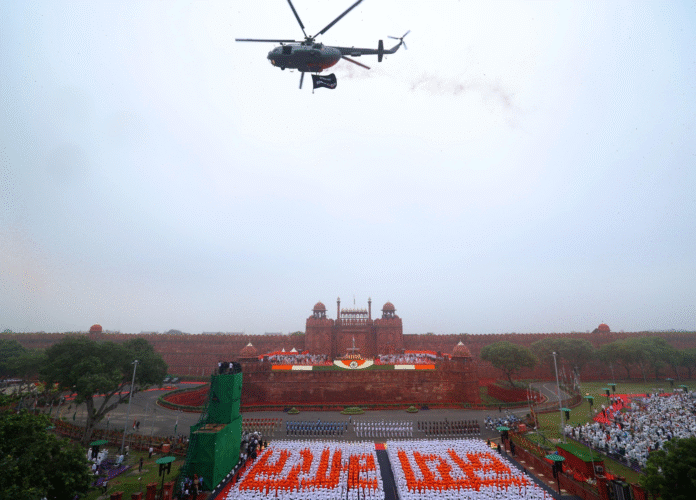
Delhi to Witness Red Fort Turning into a Divine Stage: 3-Day ‘Kirtan Darbar’ to Honour Guru Tegh Bahadur

0

The Red Fort, a symbol of India’s power and history, is set to transform into a soulful arena of devotion and light. From November 23 to 25, the Delhi government will host a three-day “Kirtan Darbar” to commemorate the 350th martyrdom anniversary of Guru Tegh Bahadur, the ninth Sikh Guru, remembered for his courage, sacrifice, and message of faith and freedom.

The celebration promises to be unlike anything seen before. Imagine devotional music echoing through the grand walls of the fort, a tech-powered light and sound show bringing to life Guru Tegh Bahadur’s extraordinary journey, his teachings, his philosophy, and his ultimate sacrifice.

With narrative storytelling and visual effects curated by the Union Ministry of Culture, the event aims to connect generations with the Guru’s timeless message of peace, tolerance, and unity.

Adding to the experience, a temporary museum will be set up inside the Red Fort, showcasing rare glimpses from his life. Visitors can also look forward to the release of a beautifully curated coffee table book chronicling his contributions to humanity.

The Delhi government has gone beyond celebrations announcing an academic chair in Guru Tegh Bahadur’s name at Guru Gobind Singh Indraprastha University to promote research on his teachings, and fast-tracking the renovation of Guru Tegh Bahadur Hospital with modern upgrades.

As Delhi Tourism Minister Kapil Mishra said, this is not just a religious event, it’s a tribute to India’s spiritual unity, cultural richness, and the timeless courage of a man who stood for freedom of faith.

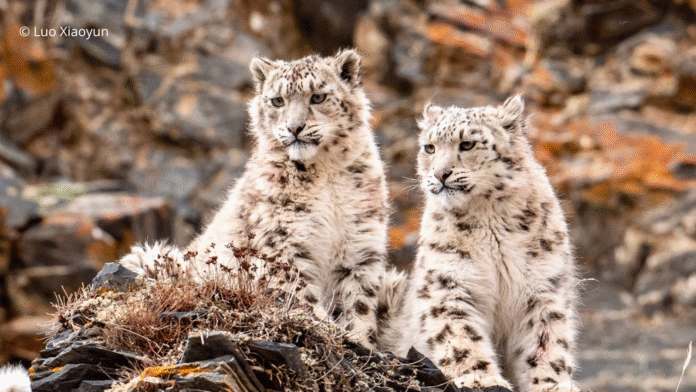
Himachal’s Lahaul-Spiti Emerges as India’s Fast-Growing Snow Leopard Tourism Hub

0

The Ghost of the Mountains, it seems, has become the Star of Himachal Pradesh’s frozen valleys as it us witnessing a new kind of winter rush one driven by the mystique of the snow leopard. Once known as the “ghost of the mountains,” this rare and majestic creature is now drawing thousands of visitors to Lahaul-Spiti, turning the region into one of Himachal’s most fascinating winter destinations.

From Remote Villages to Global Map


Villages like Kibber and Chicham, once cut off during harsh winters, are now buzzing with adventure seekers, wildlife photographers, and nature lovers. What began as a niche experience for trekkers has evolved into a booming local economy, powered by eco-tourism.
Homestays, local guides, and winter expeditions have flourished as over five lakh tourists now explore the region each year a number that has surged steadily over the past four years.
Where Ice Meets the Sky
At over 14,000 feet above sea level, the landscape is nothing short of breathtaking. Frozen rivers, ancient monasteries wrapped in snow, and rugged mountains form the perfect backdrop for those hoping to catch a glimpse of the elusive predator. The combination of adventure, solitude, and spirituality makes Lahaul-Spiti a one-of-a-kind travel experience.

Balancing Beauty with Sustainability


With rising tourist footfall, authorities and locals are working hand-in-hand to promote sustainable tourism. From eco-friendly stays to regulated snow leopard trails, the goal is to protect both the region’s fragile ecosystem and its wildlife while ensuring the community benefits from the boom.

A Journey of Awe and Respect


Spotting a snow leopard is more than just a thrill, it’s a moment of awe, a reminder of nature’s quiet resilience in one of the toughest terrains on Earth. As winter draws near, Lahaul-Spiti is all set to welcome another wave of dreamers, adventurers, and wildlife lovers all chasing that one unforgettable glimpse of the mountain’s silent ruler.