

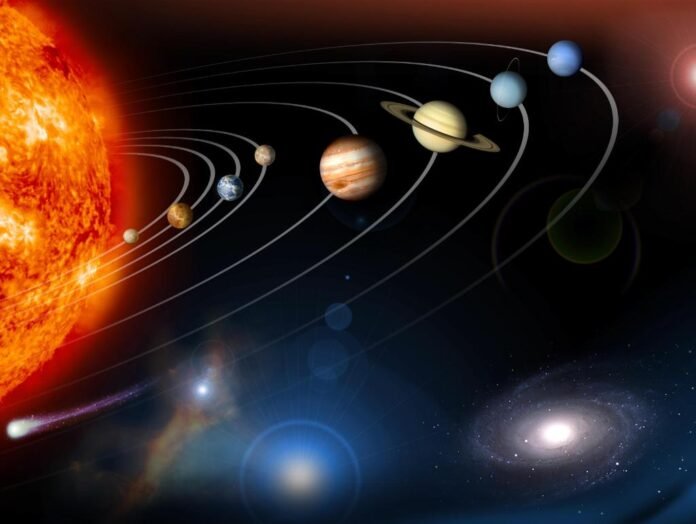
Look up at the night sky, and you’ll notice a quiet pattern in the universe—planets, no matter their size or composition, are almost always round. From rocky worlds like Earth to giant gas planets like Jupiter, this shared shape is not a coincidence but the result of one of nature’s most powerful forces: gravity.
The Sculptor of the Universe: Gravity
At the heart of every planet’s shape lies gravity. As a planet forms from dust, gas, and rock clumping together in space, its growing mass creates a gravitational pull. This force acts equally in all directions, drawing material inward toward the center.
Imagine gravity like spokes of a bicycle wheel, all pointing toward the hub. Every bit of matter is pulled toward the center from every direction. Over time, this even inward pull smooths out irregularities—flattening bumps, filling depressions, and gradually shaping the object into a sphere.
A sphere is the most stable and energy-efficient shape for a large object under its own gravity. It allows all mass to be as close as possible to the center, minimizing energy and creating balance.
Size Matters: Why Not Everything Is Round
Not every object in space is spherical. Asteroids and comets often look like jagged rocks or “lumpy potatoes.” The reason is simple: they are too small.
For smaller bodies, gravity is weak and cannot overcome the strength of the material holding them together. As a result, they retain irregular shapes. But once an object grows large enough—typically a few hundred kilometers across—gravity becomes dominant and forces it into a rounded form.
In fact, being nearly round is so fundamental that it is part of the scientific definition of a planet.
Are Planets Perfectly Round? Not Quite
Although we often imagine planets as perfect spheres, reality is a bit more nuanced. Many planets are slightly flattened at the poles and bulged at the equator—a shape known as an “oblate spheroid.”
This happens because planets spin. As they rotate, the outer regions—especially around the equator—experience an outward force. This causes the planet to bulge slightly in the middle.
For example:
●Giant planets like Saturn and Jupiter, which spin very fast, have noticeable equatorial bulges.
●Smaller, slower-spinning planets like Earth are much closer to perfect spheres, with only slight flattening.
A Universe Shaped by Balance
Ultimately, the roundness of planets is a story of balance—between gravity pulling inward and motion pushing outward. Over millions of years, this balance sculpts planets into their familiar forms.
What makes this even more fascinating is that the same principle applies across the universe. Stars, moons, and even large dwarf planets follow this rule: when gravity becomes strong enough, nature prefers a sphere.
So the next time you look at a picture of Earth from space, remember—you’re not just seeing a beautiful blue marble. You’re seeing physics at work, quietly shaping the cosmos into harmony.